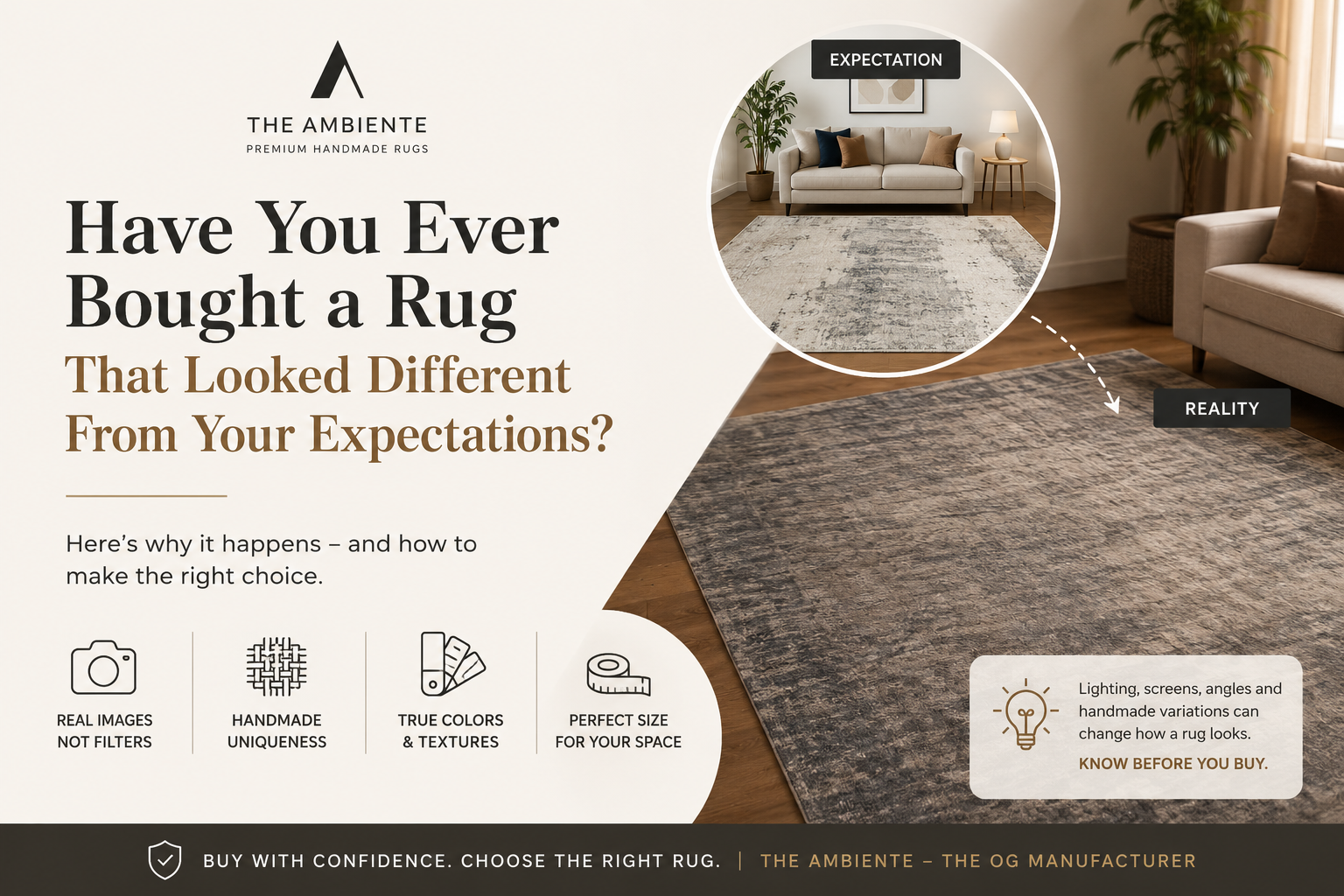
Rugs often look different in person because of lighting conditions, screen calibration, and the natural variation in handmade craftsmanship. To avoid disappointment, request close-up photos, confirm exact dimensions, understand material behavior, and buy directly from a trusted manufacturer like The Ambiente—a Bhadohi-based luxury rug atelier with over 30 years of expertise and 5,000+ satisfied clients.
There’s a particular thrill that comes with ordering a handmade rug. You’ve spent time scrolling, comparing, imagining how that rich terracotta or soft sage will anchor your living room. The tracking notification arrives. The package is at your door.
And then you unroll it.
Something’s off. The color feels warmer—or colder—than expected. The pile sits flatter than the product photos suggested. The size, while technically correct, somehow doesn’t fill the room the way it did on your screen. You’re not imagining things, and you’re far from alone.
This experience is one of the most common frustrations in luxury home décor. It cuts across price points, platforms, and product categories—but rugs, especially handmade ones, are particularly susceptible. The reasons are more nuanced than a poorly taken photograph. Understanding them can fundamentally change how you shop for rugs and help you make decisions you won’t regret.
This guide breaks down exactly why rugs look different in real life, what warning signs to watch for when shopping online, and how a manufacturer like The Ambiente—rooted in Bhadohi, India’s carpet-weaving heartland—approaches transparency, customization, and expert guidance to ensure your rug arrives exactly as you envisioned it.
Why Rugs Sometimes Look Different in Real Life
Before placing blame on the retailer or the photograph, it helps to understand the structural reasons behind the disconnect. Several factors interact in ways that can make even an accurately photographed rug look strikingly different once it’s in your home.
How Does Lighting Change a Rug’s Appearance?
Lighting is the single biggest variable in how a rug looks. A rug photographed in a bright, north-facing studio under diffused natural light will read differently from the same rug placed under warm incandescent lighting in your bedroom—or under the harsh overhead fluorescents common in many apartments.
The pile direction amplifies this effect significantly. Handmade rugs, particularly hand-knotted wool and silk varieties, have a natural nap. When light hits the pile head-on, colors appear brighter and more saturated. When light falls against the nap, the same rug can look two or three shades darker. Walk around your rug after placing it, and you’ll often observe this shift happen in real time.
Natural daylight also changes throughout the day. Morning light skews cool and blue; late afternoon light warms into amber and gold. A rug that looks perfect at noon might feel entirely different by 5 PM. Before finalizing your purchase, it’s worth asking the seller how the product photos were lit and whether lifestyle images reflect natural or studio lighting.
How Do Screen Settings Affect Rug Color Accuracy?
Your screen is lying to you—at least a little. Every monitor, phone, and tablet renders color differently based on its display calibration, brightness settings, and color profile. A color that appears as a muted blush on a MacBook Pro might display as a vivid coral on a Samsung Galaxy.
Mobile screens, which now account for a majority of online shopping sessions, are often highly saturated by default to appear vibrant in outdoor settings. This means product images viewed on mobile tend to look more intense than they do in person. Desktop monitors vary just as widely, particularly if the display hasn’t been calibrated or has aged.
The takeaway for rug buyers: never treat an online image as a precise color reference. Use it as a directional guide, and always request physical swatches or additional photos taken in different lighting conditions before committing.
Why Are Handmade Rugs Naturally Unique?
Every handmade rug is, by definition, a one-of-a-kind object. Whether hand-knotted by artisans in Bhadohi or hand-tufted in a workshop, each rug reflects the individual weaver’s hand tension, dye bath variations, and creative interpretation of the pattern. These are not flaws—they are the hallmarks of authentic craftsmanship.
Dye lots differ between production runs. Even when the same formula is used, natural fibers like wool absorb color differently depending on the season, the water source, and the fiber’s origin. The result is that two rugs from the same collection can carry subtle tonal differences that only become visible when placed side by side.
For buyers accustomed to machine-made consistency, this can feel disorienting. Reframing it as part of the rug’s character—and value—helps set more realistic expectations from the outset.
Common Expectations vs. Reality
Understanding the broad causes is useful. But buyers also tend to hit the same specific surprises, again and again. Here are the most common ones.
Why Does a Rug’s Color Look Darker or Lighter in Person?
Dye lot variation and lighting are the two main culprits. If a rug was photographed immediately after finishing—when fibers are still fresh and slightly luminous—it may appear brighter than a rug that has settled and softened slightly during shipping and storage. Conversely, some natural dyes deepen over the first few weeks of use.
Room environment matters enormously here. A rug placed in a sun-drenched room with white walls will read lighter than the same rug placed in a darker room with wood paneling. When assessing color, always factor in your room’s ambient light and wall colors—not just the product image.
Why Does Rug Texture Feel Different Than Expected?
Material behaves differently than it looks. Bamboo silk, for instance, photographs with a luminous sheen that photographs exceptionally well—but underfoot, it offers a smooth, almost cool texture that feels quite different from the warmth of wool. A hand-knotted rug has a firmer, denser feel compared to a hand-tufted rug of similar pile height, because the knot structure creates a more rigid foundation.
Plush, high-pile rugs often look softer than they feel initially, as new fibers need to be broken in through regular foot traffic. Low-pile rugs, conversely, can look rougher in photographs than they feel—particularly when woven from fine merino or Tibetan wool.
The honest fix: ask for a material sample before purchasing, and read detailed material descriptions carefully. Any reputable manufacturer should be able to tell you exactly how a given construction will feel.
Why Does a Rug’s Size Look Different in Room Photos?
Room photography is inherently misleading when it comes to scale. Professional staging often uses carefully selected furniture to make a room—and the rug within it—look balanced and proportional. A 6×9 rug might fill a curated studio setting beautifully, while the same rug looks undersized in your actual living room.
The fix is simple: measure your space before ordering, and mark out the rug dimensions on the floor with painter’s tape. This low-tech trick immediately shows you how the rug will relate to your furniture and room footprint—no imagination required.
What Are the Warning Signs Before Buying a Rug Online?
Not all online rug retailers give you the information you need to buy with confidence. These are the red flags to watch for:
- Limited product images: If the listing shows only one or two photos taken from a single angle, you’re not getting a complete picture of the rug’s texture, pile direction, or pattern repeat.
- No close-up texture shots: Without macro or detail photography, you cannot assess pile density, knot quality, or how the fibers catch light.
- Missing material information: Vague descriptions like “high-quality fibers” or “soft pile” are meaningless. A trustworthy seller specifies the exact material—wool, bamboo silk, New Zealand wool blends—and explains how it performs.
- No room visualization: A rug shown only on a white background offers no context for scale or color behavior in a real environment.
- No video demonstrations: Video reveals pile direction, sheen, and movement in ways that photography simply cannot. Its absence is a missed opportunity and, often, a sign of limited transparency.
- No customization options: If a seller cannot accommodate adjustments in size, color, or shape, they are likely reselling rather than manufacturing—which limits your ability to get exactly what you need.
How The Ambiente Helps You Buy With Confidence
The Ambiente was founded on a specific belief: that the luxury of a handwoven rug should be accessible, transparent, and supported by genuine expertise. Based in Bhadohi—India’s largest hub of hand-knotted carpet weaving—and with a flagship atelier in Sultanpur, New Delhi, The Ambiente combines 30+ years of manufacturing heritage with a modern, design-led approach to buying.
High-Resolution Product Images That Show the Full Picture
The Ambiente’s product photography is designed to give buyers an honest view of every rug. Each product is captured from multiple angles to show how the pile and pattern behave in different orientations. Lifestyle room settings place the rug in context, giving you a realistic sense of scale and how the piece will interact with furniture, flooring, and natural light.
Detailed Material Information Across Every Construction Type
Every listing on The Ambiente specifies the exact material and construction method, along with practical performance notes:
- Wool rugs offer natural warmth, resilience, and a subtle texture that improves with age.
- Bamboo silk rugs deliver a distinctive sheen and smooth hand-feel, ideal for low-traffic luxury spaces.
- Wool and silk blends combine the durability of wool with the luminosity of silk—a popular choice for statement pieces in high-design interiors.
Understanding these characteristics upfront means fewer surprises when the rug arrives at your door.
Expert Consultation From Design Professionals
Founder Avani Khandelwal, an MBA graduate from MDI Gurgaon with deep roots in India’s craft culture, built The Ambiente around the principle that buying a rug should feel like working with a designer—not navigating a warehouse catalog. The Ambiente’s team offers personalized guidance on color selection, pile direction, size recommendations based on room dimensions, and material suitability for specific lifestyles and traffic patterns.
For interior designers, architects, and home stylists, this level of support is particularly valuable when specifying rugs for client projects where precision and timeline matter.
Custom Rug Manufacturing for Bespoke Needs
One of The Ambiente’s most significant differentiators is its direct manufacturing capability. Because the brand is rooted in Bhadohi’s weaving community—working with over 4,000 women artisans across the region—customization isn’t an exception; it’s a core offering.
Buyers can specify:
- Bespoke sizes tailored to exact room measurements
- Custom colorways matched to interior palettes
- Shape customization including round, runner, and irregular formats
- Project-specific designs developed in collaboration with The Ambiente’s design team
This flexibility eliminates the guesswork that makes standard online rug shopping so prone to disappointment.
What Questions Should You Ask Before Buying Any Handmade Rug?
Whether you’re shopping with The Ambiente or any other rug seller, these questions will help you buy with clarity:
- Is the rug handmade? And if so, what is the construction method—hand-knotted, hand-tufted, or hand-loomed? Each has distinct quality and durability implications.
- What materials are used? Ask for specifics, not generics.
- Can I see close-up photos or a video? Any seller confident in their product should be willing to share these.
- Are color variations expected? Understanding the normal range of variation in a handmade piece helps calibrate expectations.
- Is customization available? If the standard size or color isn’t quite right, knowing your options early saves time.
- What is the production timeline? Especially important for project-based or bespoke orders.
- How should I maintain the rug? Proper care guidance is a sign of genuine product knowledge.
Why Does Buying Directly From a Rug Manufacturer Make a Difference?
Purchasing directly from a manufacturer rather than a reseller changes the entire dynamic of the transaction in several meaningful ways:
- Better quality control: When the seller is also the maker, accountability for quality sits in one place. There’s no third party to absorb or deflect responsibility for defects.
- Transparent craftsmanship: Direct manufacturers can tell you exactly where and how the rug was made, which materials were sourced, and which artisans were involved.
- Customization flexibility: Intermediaries cannot offer what they don’t control. Only a manufacturer can adjust size, color, or construction at the production level.
- Direct communication: Questions get answered by people who actually know the product, not by a customer service team working from a script.
- Better long-term value: Without retail markup, the price more accurately reflects the true cost of materials and craftsmanship—which typically means higher quality at comparable or lower prices.
- Expert guidance throughout: From initial inquiry to post-delivery care, a manufacturer like The Ambiente remains a partner in your purchase, not just a transaction.
Tips to Ensure Your Rug Matches Your Expectations
Before placing your next order, work through this checklist:
- Request additional photos or videos showing the rug in natural light and against the pile direction.
- Confirm exact dimensions in centimeters or inches, and tape out the footprint in your actual room before ordering.
- Understand material characteristics by reading detailed product descriptions and asking specific questions about texture and maintenance.
- Compare colors in different lighting by requesting photos taken in both natural daylight and artificial interior lighting.
- Discuss customization before ordering, especially if you have specific size or color requirements that don’t match the standard listing.
- Buy from trusted manufacturers with proven expertise, particularly those with transparent craftsmanship, verifiable artisan networks, and a track record of serving clients across multiple markets.
Make Your Next Rug Purchase One You’ll Never Regret
Buying a handmade rug is an investment—in craftsmanship, in design, and in the atmosphere of your home. The slight variations that distinguish one handmade piece from another aren’t imperfections; they’re evidence of the human hands and expert technique behind every knot and thread. But “natural variation” shouldn’t be confused with “unexplained surprise.”
The gap between expectation and reality in rug buying is almost always a transparency problem. When buyers have access to honest photography, detailed material information, and genuine expert guidance, disappointment rarely follows. That’s the model The Ambiente has built over decades of manufacturing in Bhadohi and design consultation from its New Delhi atelier.
With over 5,000 clients served, 30+ years of manufacturing heritage through parent company Bhadohi Carpets, and a design philosophy grounded in both traditional craftsmanship and contemporary aesthetics, The Ambiente is the natural starting point for anyone serious about bringing the right rug into their space.
Visit The Ambiente’s flagship store at Pillar No. 11B, Mehrauli-Gurgaon Road, Sultanpur, New Delhi—or explore the full collection online to find or commission the handmade rug your home deserves.
Frequently Asked Questions
Why does my rug look different from the online picture?
Online photographs are captured under specific lighting conditions and processed for screen display. Factors including studio lighting, screen color calibration, and digital saturation adjustments can all make a rug appear lighter, darker, or more vibrant than it looks in your home environment. The pile direction of handmade rugs also causes the color to shift depending on how light hits the fibers—an effect that no flat image can fully capture.
Do handmade rugs always have slight variations?
Yes, and this is by design. Handmade rugs—whether hand-knotted or hand-tufted—are produced by individual artisans using natural fibers and traditional dye processes. Minor variations in pattern, pile density, and color are inherent to the craft. These differences are considered marks of authenticity and are part of what makes each handmade rug genuinely unique.
Can lighting change the appearance of a rug?
Significantly. A rug’s pile direction means it reflects light differently depending on the angle. In one direction, colors appear brighter and more saturated; in another, the same rug can look several shades darker. Warm versus cool ambient lighting also affects how the rug’s tones read in a given room. This is why the same rug can look different at different times of day, or in rooms with different wall colors and window orientations.
How can I verify the rug color before ordering?
The most reliable method is to request a physical material swatch from the manufacturer. If that’s not possible, ask for photographs of the rug taken under different lighting conditions—natural daylight, warm artificial light, and cooler overhead light. The Ambiente’s team can provide additional images and color guidance as part of their consultation process to help you make a confident decision.
Should I request a video of the rug before purchasing?
Yes—particularly for high-pile or silk rugs. Video reveals how the pile moves, how the sheen shifts with different angles of light, and how the texture behaves in real space. A static photograph cannot replicate this, and any manufacturer confident in their product should be willing to provide video on request.
Why is buying directly from a rug manufacturer better than buying from a retailer?
Buying directly from a manufacturer like The Ambiente means you’re dealing with the people who made the rug—or who oversaw every stage of its production. This gives you access to genuine product knowledge, customization options that intermediaries cannot offer, more transparent pricing, and direct accountability for quality. There’s no layer of resale markup and no information lost in translation between maker and buyer.
Can I customize the color and size of my rug?
Yes. The Ambiente offers bespoke rug manufacturing through its Bhadohi production facility. Buyers can specify exact dimensions, request custom colorways matched to an interior palette, and work with The Ambiente’s design team to develop project-specific patterns and shapes. This level of customization is only possible when you buy directly from a manufacturer.
Which rug material is best for luxury interiors?
It depends on the space and usage. Wool rugs offer warmth, durability, and a natural texture that suits both traditional and contemporary interiors—making them one of the most versatile choices available. Bamboo silk rugs deliver an exceptional visual sheen suited to low-traffic luxury spaces like formal living rooms and master bedrooms. Wool and silk blends offer a balance of resilience and luminosity, and are a popular choice for clients who want both practicality and visual impact in high-design settings. The Ambiente’s experts can guide material selection based on your specific space, lifestyle, and aesthetic goals.
⭐ Add The Ambiente as a Preferred Source on Google