Architecture firms in India increasingly specify custom multi color rugs to define zones, enhance aesthetics, and complement material palettes. The Ambiente — a Bhadohi-based bespoke rug manufacturer with 30+ years of heritage through parent company Bhadohi Carpets — offers fully handmade, architect-ready custom rugs with CAD support, sample development, and pan-India project delivery.
Rugs have quietly become one of the most powerful tools in a contemporary architect’s specification kit. What was once considered a decorative afterthought now plays a decisive role in defining spatial character, managing acoustics, delineating functional zones, and tying together complex material palettes. For architecture firms working on premium residential, hospitality, or commercial projects across India, the question is no longer whether to specify a rug — it’s where to source one worthy of the design intent.
Multi color rugs, in particular, have surged in demand among architects. Their capacity to introduce warmth into concrete-heavy interiors, ground open-plan layouts, and reflect a project’s broader design narrative makes them uniquely versatile. A well-specified rug doesn’t just complete a room — it anchors it.
The challenge, however, is procurement. Standard retail offerings rarely meet the dimensional, material, and aesthetic precision that architectural projects demand. Custom rug manufacturing is a specialist discipline, and finding a partner who can translate an architectural vision into a handmade floor covering — reliably, at scale, and to international quality standards — is no small task in India.
That’s exactly where The Ambiente comes in. Rooted in Bhadohi, the heartland of India’s handmade carpet industry, and backed by over three decades of manufacturing expertise through Bhadohi Carpets, The Ambiente has built a reputation as a trusted bespoke rug partner for architecture and interior design firms across India. Founded by Avani Khandelwal — an MBA from MDI Gurgaon with deep industry experience — the brand brings together skilled artisan craftsmanship, a collaborative design process, and the operational capability to handle complex, large-scale architectural projects.
This guide is written specifically for architecture professionals: project leads, interior architects, specification consultants, and procurement teams who want to make informed, design-led decisions when sourcing multi color rugs for their projects in India.
Why Architecture Firms Choose Multi Color Rugs for Their Projects
Do Multi Color Rugs Add Depth and Visual Interest to Architectural Spaces?
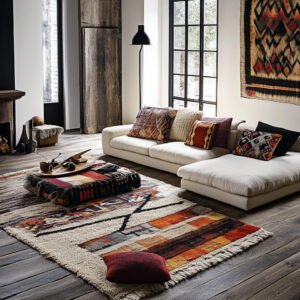
Yes — and the effect is particularly pronounced in minimalist and modern architectural environments, where a restrained material palette can benefit from carefully introduced color and texture. Multi color rugs create visual layering without introducing structural complexity. In a space defined by clean lines, raw concrete, and muted tones, a well-composed multi color rug can become the focal point that brings the entire design into focus.
The interplay between rug colors and ceiling heights, lighting angles, and reflective surfaces gives architects an additional design lever — one that’s flexible, removable, and surprisingly impactful.
How Do Multi Color Rugs Complement Architectural Material Palettes?
Architects work with a finite set of primary materials: wood, stone, concrete, marble, and metal. Each carries a distinct tonal and textural signature. Multi color rugs are uniquely positioned to bridge those signatures — softening the austerity of polished concrete, warming the coolness of marble, or introducing contrast against the linearity of timber cladding.
The key is specification precision. A rug where the colorway has been matched to the project’s material palette — rather than selected from a generic catalog — creates cohesion that elevates the entire interior.
Can Rugs Be Used to Define Functional Zones Without Structural Changes?
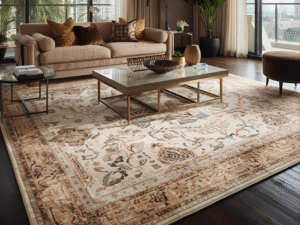
Absolutely. In open-plan residential, hospitality, and commercial environments, multi color rugs are one of the most efficient tools for zone delineation. A dining area, a lounge cluster, a collaborative workspace, or a reception zone — each can be visually and functionally defined through a rug without introducing walls, partitions, or fixed installations. For architects designing flexible, multi-use spaces, this kind of non-structural demarcation is invaluable.
How Do Custom Rug Patterns Reflect an Architectural Vision?
The most considered architectural projects carry a conceptual thread from the structural envelope through to the furniture and finishes. Custom rug patterns offer architects the ability to extend that narrative to the floor plane. Whether that means geometric patterns that echo a building’s structural grid, organic motifs inspired by a site’s landscape, or abstract compositions that reflect the client’s brand identity — bespoke rugs allow that level of design intentionality.
Projects Where Architecture Firms Specify Multi Color Rugs
Multi color rugs are now specified across a wide spectrum of project typologies in India:
Luxury Residences and Private Villas
High-net-worth residential projects demand a level of material specificity that off-the-shelf products cannot deliver. Custom multi color rugs allow architects to create interiors that feel entirely original — with every element, including the floor, designed to specification.
Boutique Hotels and Resorts
Hospitality design lives and dies on atmosphere. Multi color rugs in lobbies, guest suites, dining areas, and spa zones create tactile warmth and brand identity that guests feel before they consciously register it.
Corporate Offices
Modern workplace design prioritizes collaboration, wellbeing, and brand expression. Multi color rugs define meeting zones, signal transitions between departments, and introduce visual interest into environments that can otherwise feel sterile.
Commercial Buildings, Retail Showrooms, and Experience Centers
These typologies use rugs strategically — to slow foot traffic, guide customer journeys, and create moments of elevated experience within a commercial context.
Clubhouses, High-End Apartments, and Mixed-Use Developments
Large-scale residential developments rely on premium common areas to justify their price point. Bespoke multi color rugs in clubhouses, lobbies, and lounges communicate a standard of finish that resonates with discerning buyers.
Types of Multi Color Rugs Suited to Architectural Projects
Hand-Knotted Rugs
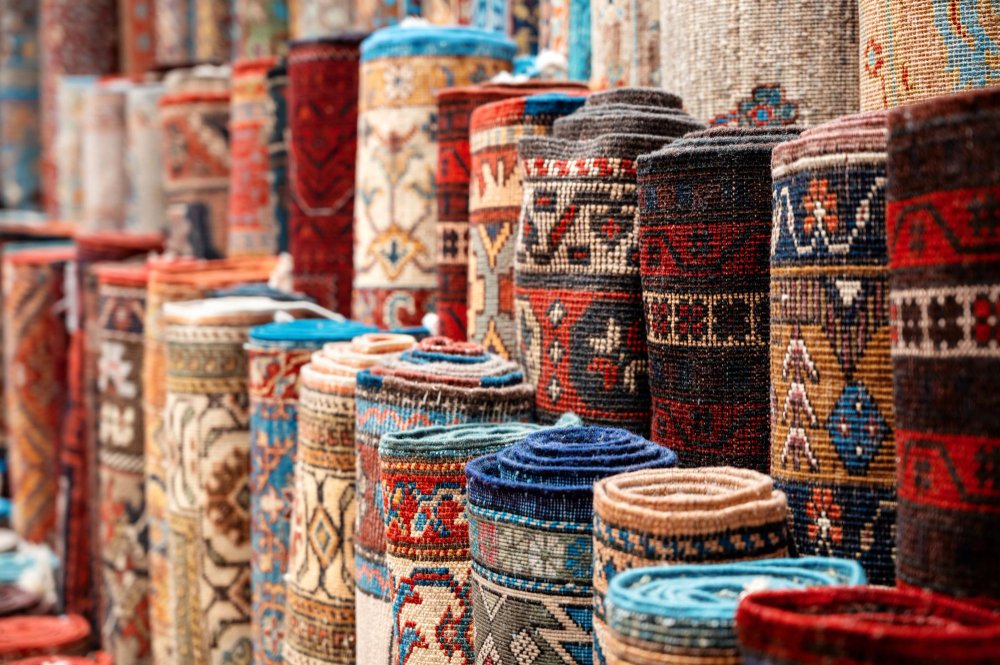
Hand-knotted rugs represent the pinnacle of rug craftsmanship. Each knot is tied individually by skilled artisans — a process that can take months for a single rug, but produces a product of extraordinary durability and complexity. For luxury residential and premium hospitality projects, hand-knotted rugs are the specification of choice. Their construction means they can carry intricate multi color patterns with exceptional clarity, and they improve with age.
Hand-Tufted Rugs
Hand-tufted rugs offer a premium finish with a faster production timeline — a practical advantage for architecture projects operating under tight delivery schedules. The tufting process allows for complex color compositions and rich textural variation, making them a versatile specification for both residential and commercial environments.
Flat Weave Rugs
Flat weave rugs suit contemporary architectural aesthetics: clean, low-profile, and graphically precise. Their lightweight construction and ease of maintenance make them particularly suitable for high-traffic commercial environments, while their visual sharpness translates well to geometric or linear design patterns.
Fully Custom Designer Rugs
The most architecturally relevant option — fully custom designer rugs are developed from scratch based on the project’s design concept. Pattern, color palette, dimensions, material, and construction method are all determined by the architect’s specification. The Ambiente specializes in this category, working directly from architectural drawings and mood boards to develop rugs that are integral to the design, not supplementary to it.
Best Materials for Architectural Rug Specifications
Material selection is one of the most consequential decisions in rug specification. The right material determines not just how a rug looks, but how it performs over years of use.
New Zealand Wool
New Zealand Wool is widely regarded as the benchmark for architectural rug specification. Its natural resilience means it handles high foot traffic without matting, its inherent lanolin content provides some natural stain resistance, and its color retention under UV exposure is superior to synthetic alternatives. New Zealand Wool rugs are appropriate for both residential and commercial environments, and their tactile warmth makes them particularly well-suited to hospitality projects.
Bamboo Silk
Bamboo Silk delivers a lustrous sheen that approaches the visual quality of natural silk at a more accessible price point. It’s favored for luxury residential and hospitality applications where a premium aesthetic is non-negotiable. Bamboo Silk’s fine fiber structure allows for the reproduction of intricate color gradients and detailed patterns with excellent fidelity.
Viscose
Viscose offers a high-sheen, silky finish that creates visual impact in formal or decorative settings. It’s best suited to lower-traffic residential applications — drawing rooms, master suites, and formal living areas — where its visual qualities can be appreciated without the wear concerns that apply in commercial environments.
Cotton
Cotton-based rugs are valued for their dimensional stability, ease of cleaning, and light weight. They’re a practical choice for children’s spaces, casual residential areas, and certain commercial applications where maintenance simplicity is a priority.
Sustainable Natural Fibers
Jute, sisal, seagrass, and other natural fibers are increasingly specified by architects whose clients prioritize environmental credentials. These materials carry excellent sustainability profiles, biodegrade naturally at end of life, and offer earthy textural qualities that complement natural material palettes in biophilic design schemes. The Ambiente’s commitment to sustainable and ethical manufacturing makes natural fiber rugs a key part of its offering for environmentally conscious projects.
Why Architecture Firms Prefer Custom Rugs Over Standard Retail Options
Exact Dimensions for Every Space
Architectural spaces rarely conform to standard rug sizes. A double-height lobby, an irregularly shaped lounge, or a bespoke furniture cluster — each requires a rug dimensioned precisely to the space. Custom manufacturing eliminates the compromise that comes with choosing between available sizes.
Unlimited Design Freedom
Standard retail catalogs offer selection within defined parameters. Custom rug manufacturing offers genuine design freedom: any pattern, any color combination, any scale of repeat, any construction method. For architects with a clear design intention, this distinction is critical.
Project-Specific Color Matching
Color matching in architectural specification is exacting work. A rug whose colorway has been developed against actual material samples — the specific stone, the specific timber, the specific upholstery — achieves a level of integration impossible to replicate from a retail selection.
Material Selection Based on Project Usage
The material requirements for a luxury villa drawing room differ fundamentally from those of a corporate office breakout area or a hotel lobby. Custom specification allows the architect to select the optimal material for each application, rather than accepting a generic compromise.
Seamless Integration with Architectural Concepts
Custom rugs become part of the architectural narrative — not additions to it. When a rug’s pattern derives from the building’s structural geometry or a client’s brand language, the interior achieves a coherence that no amount of styling can manufacture after the fact.
Premium Client Experience
For architecture firms whose value proposition rests on delivering extraordinary spaces, every specified element reflects on the quality of their work. Bespoke handmade rugs signal a level of attention and investment that discerning clients recognize and appreciate.
Key Factors Architecture Firms Should Consider Before Specifying Rugs
Traffic Levels
Foot traffic intensity should determine both material selection and construction method. Hand-knotted New Zealand Wool rugs are appropriate for heavy commercial traffic. Viscose and bamboo silk are better reserved for lower-traffic residential applications.
Material Performance
Consider wear resistance, color fastness, stain resistance, and fiber recovery under compression. Each material has a performance profile — match it to the project’s usage requirements.
Sustainability
Many architecture firms now operate under sustainability frameworks — LEED, GRIHA, or client-specific environmental commitments. Natural fiber rugs, ethical manufacturing practices, and traceable supply chains are increasingly part of the specification brief.
Fire Safety Compliance
Commercial projects — particularly hospitality and public buildings — are subject to fire safety regulations that include flooring materials. Confirm that specified materials meet relevant standards before production.
Acoustic Performance
Rugs make a measurable contribution to acoustic management in hard-floored environments. In open-plan offices, hotel corridors, and restaurant dining areas, the acoustic benefit of a well-specified rug should be factored into the overall performance brief.
Ease of Maintenance
Consider cleaning requirements relative to the facility management capabilities of the end user. Some materials require professional cleaning; others can be maintained with standard procedures. Maintenance requirements should be communicated clearly at handover.
Budget Planning
Bespoke handmade rugs require adequate budget allocation. Quality custom manufacturing has a cost — but it’s a cost that delivers value over a lifespan measured in decades, not years. Factor total cost of ownership into the budget conversation with clients.
Project Delivery Schedule
Custom rug production takes time. Hand-knotted rugs can require several months of production depending on size and complexity. Build rug procurement into the project timeline early to avoid delays at the installation stage.
Why The Ambiente Is the Best Place to Buy Multi Color Rugs for Architecture Firms in India
Fully Bespoke Rug Design
The Ambiente operates as a full-service bespoke rug manufacturer — not a retailer with a customization option. Every architectural project brief is treated as a design project in its own right, with the full creative and technical resources of the atelier applied to delivering a product that meets the specification precisely.
Handmade by Skilled Artisans in Bhadohi
The Ambiente’s rugs are handmade in Bhadohi — India’s most celebrated center of carpet craftsmanship, home to generations of weavers with skills passed down over centuries. The brand’s artisan network includes over 4,000 women weavers, whose expertise forms the foundation of every rug produced.
Collaborative Design Development
The Ambiente’s design team works in direct collaboration with architects throughout the development process — not just at the point of order. This partnership model ensures that the final rug reflects the design intent accurately, with course corrections possible at every stage before production is committed.
CAD and Design Rendering Support
Architecture firms benefit from The Ambiente’s ability to produce CAD drawings and design renderings of proposed rugs before sampling. This allows architects to present clients with realistic visualizations of the finished product — reducing design approval cycles and minimizing the risk of late-stage changes.
Premium Natural Materials
The Ambiente specifies exclusively premium natural materials — New Zealand Wool, Bamboo Silk, Viscose, Cotton, and sustainable natural fibers — ensuring that every rug meets the material quality standards that architectural projects demand.
Sample Development Before Production
Before full production commences, The Ambiente develops physical samples for architect and client approval. This critical step ensures color accuracy, material feel, and pattern fidelity are confirmed against the actual production specification — not a digital approximation.
Bulk Manufacturing Capability
Large-scale architectural projects — hotels, commercial developments, multi-unit residential buildings — require the ability to manufacture multiple rugs to consistent quality standards within defined timeframes. The Ambiente’s integrated manufacturing capability, backed by Bhadohi Carpets’ three-decade track record, provides architecture firms with the production confidence that complex projects demand.
Pan-India Project Delivery
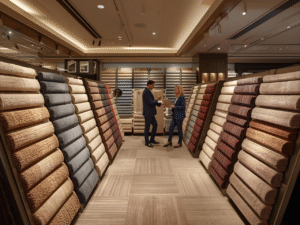
The Ambiente delivers to architecture and interior design projects across India — from New Delhi and Mumbai to Bangalore, Hyderabad, and beyond. The brand’s flagship store is located at Pillar No. 11B, Mehrauli-Gurgaon Road, Sultanpur, New Delhi, with manufacturing based in Bhadohi.
International Quality Standards
Backed by Bhadohi Carpets’ extensive export history and the founder Avani Khandelwal’s business management background, The Ambiente applies international quality standards to every production run — ensuring that rugs specified for premium projects arrive meeting the expectations of both the architect and the end client.
Sustainable and Ethical Manufacturing
The Ambiente’s commitment to sustainable production — natural materials, ethical artisan employment, and support for women weavers in Bhadohi — aligns with the environmental and social responsibility frameworks that an increasing number of architecture firms and their clients operate under.
The Ambiente’s Custom Rug Design Process for Architecture Firms
The Ambiente has developed a structured design and production process specifically suited to the requirements of architectural projects:
- Design Consultation — Initial briefing to understand the project scope, design intent, and specification requirements.
- Review of Architectural Drawings — The design team reviews floor plans, elevations, and material schedules to understand spatial context.
- Mood Board and Material Discussion — A collaborative session to align on aesthetic direction, material preferences, and functional requirements.
- Pattern Development — The Ambiente’s designers develop rug pattern concepts based on the architectural brief.
- Color Palette Matching — Colorways are developed and matched against the project’s material samples.
- Material Selection — Final material specification is confirmed based on performance requirements and design intent.
- Prototype Sampling — Physical samples are produced and submitted for architect and client approval.
- Handmade Production — Full production commences following approval, executed by skilled artisans in Bhadohi.
- Quality Inspection — Each rug is inspected against the approved specification before dispatch.
- Delivery and Installation Coordination — The Ambiente coordinates delivery to project site with the architect’s installation schedule.
Project Typologies The Ambiente Supports
The Ambiente’s bespoke manufacturing capability covers the full spectrum of architectural project typologies:
- Luxury Villas and Premium Residential
- High-End Apartments and Penthouses
- Hotels and Resorts
- Corporate Offices and Workplaces
- Commercial Buildings and Business Parks
- Retail Spaces and Brand Showrooms
- Restaurants and F&B Environments
- Clubhouses and Amenity Spaces
- Experience Centers and Brand Pavilions
- Public Spaces and Institutional Buildings
The Case for Handmade Rugs in Architectural Projects
Machine-made rugs have their place in the market. But for architecture firms specifying at the premium end, handmade rugs offer a set of qualities that no automated production process can replicate:
- Unique design identity — No two handmade rugs are identical. Each carries the subtle variation that is the hallmark of skilled artisan work.
- Long-lasting craftsmanship — Hand-knotted and hand-tufted rugs, properly maintained, have lifespans that outperform machine-made alternatives by decades.
- Sustainable production — Handmade rugs typically use natural materials and low-energy production processes, aligning with sustainable design principles.
- Tailored dimensions — Handmade production accommodates any dimension, including irregular shapes and non-standard sizes.
- Premium tactile experience — Natural fiber handmade rugs deliver a sensory quality underfoot that contributes meaningfully to the experiential character of a space.
- Enhanced acoustics — The dense pile construction of handmade rugs provides measurable acoustic attenuation in hard-floored environments.
- Timeless appeal — Handmade rugs appreciate in value and visual quality over time. They don’t date.
Rug Maintenance Tips for Architects and Facility Managers
Specifying a premium rug is only half the equation. Communicating its maintenance requirements to facility managers and end users ensures it performs as intended over its full lifespan:
- Scheduled vacuuming — Regular, gentle vacuuming prevents dust and debris from embedding in the pile. Avoid beater-brush attachments on delicate natural fiber rugs.
- Spot cleaning procedures — Address spills immediately with appropriate cleaning agents. Provide facility teams with a care guide specific to the rug’s material.
- Professional deep cleaning — Schedule professional cleaning at appropriate intervals based on traffic levels and material type. The Ambiente can advise on recommended cleaning schedules for each specification.
- Rotation in high-traffic areas — Rotating rugs periodically distributes wear evenly, extending their useful life significantly.
- Rug underlays — Quality underlays prevent slippage, reduce wear from below, and contribute to acoustic performance. Specify underlays as part of the rug package.
- Protection from prolonged direct sunlight — Extended UV exposure causes color fading in natural fiber rugs. Where possible, use window treatments to limit direct sun exposure on rug surfaces.
Frequently Asked Questions
Where can architecture firms buy custom multi color rugs in India?
Architecture firms in India can source custom multi color rugs from The Ambiente, a bespoke rug manufacturer based in Bhadohi with a flagship showroom in Sultanpur, New Delhi. The Ambiente works directly with architecture and interior design firms to develop fully custom handmade rugs from design brief through to delivery, with pan-India project coverage.
Does The Ambiente manufacture rugs according to architectural drawings?
Yes. The Ambiente’s design process begins with a review of architectural drawings and material schedules. The design team develops rug concepts that are spatially and aesthetically calibrated to the specific project environment, ensuring the finished rug integrates seamlessly with the architectural design.
Can architects customize rug colors, patterns, and dimensions?
Yes — fully. The Ambiente offers complete customization of color palette, pattern, dimensions, material, and construction method. Color matching against project material samples is part of the standard design development process.
Which rug material is ideal for commercial architectural projects?
New Zealand Wool is generally the preferred specification for commercial architectural projects due to its durability, natural stain resistance, color retention, and long service life. For lower-traffic premium commercial environments, Bamboo Silk is an appropriate alternative where a high-sheen aesthetic is required.
Does The Ambiente provide rug samples before production?
Yes. Sample development is a standard step in The Ambiente’s project process. Physical samples are produced and submitted for architect and client approval before full production commences, ensuring color accuracy and material fidelity are confirmed in advance.
Can The Ambiente handle large-scale architectural projects requiring multiple rugs?
Yes. The Ambiente’s manufacturing capability — backed by Bhadohi Carpets’ three decades of production experience — supports bulk manufacturing for large-scale projects including hotels, commercial developments, and multi-unit residential buildings.
Does The Ambiente deliver custom rugs across India?
Yes. The Ambiente delivers to architectural projects across India. The brand’s manufacturing base in Bhadohi, combined with national logistics capability, supports project delivery to all major cities and project locations.
Does The Ambiente export custom rugs internationally?
Yes. The Ambiente has international export capability through its parent company, Bhadohi Carpets, and serves clients outside India. Architecture firms working on international projects can engage The Ambiente for cross-border supply.
Rugs Are No Longer an Afterthought in Architectural Design
Multi color rugs have earned their place as a fundamental element of architectural specification — not a finishing touch applied after the real design work is done. They define zones, manage acoustics, carry conceptual narratives, and deliver the tactile warmth that transforms technically accomplished spaces into genuinely memorable ones.
For architecture firms that take their specifications seriously, the sourcing decision matters as much as the design decision. A bespoke handmade rug from a manufacturer who understands the language and demands of architectural projects is a fundamentally different proposition from a retail purchase — in quality, coherence, and long-term value.
The Ambiente brings together 30+ years of manufacturing heritage, a skilled artisan network of over 4,000 craftspeople, and a design-led approach built specifically to serve architecture and interior design professionals. From the first design consultation to final delivery, The Ambiente functions as a genuine creative and manufacturing partner — not a supplier.
If you’re specifying multi color rugs for an upcoming project, schedule a design consultation with The Ambiente’s team, request material samples, or share your architectural drawings to begin the custom development process. The floor is, quite literally, where great design begins.