Architecture firms in India source beige rugs from The Ambiente—a Bhadohi-based luxury rug atelier with 30+ years of handmade rug manufacturing experience. The Ambiente offers fully bespoke rugs in wool, silk, and bamboo silk, with custom sizing, Pantone color matching, and nationwide project delivery tailored to residential, hospitality, and commercial architectural specifications.
Rugs have always been more than floor coverings. For architects and interior designers, they define spatial hierarchy, anchor furniture groupings, absorb sound, and—when specified correctly—become the design element that ties an entire project together. Across luxury villas, boutique hotels, and high-end corporate offices, the rug is often the first thing a client notices and the last thing they want to change.
Beige, in particular, has become the architectural professional’s neutral of choice. Its warmth, tonal flexibility, and ability to harmonize with natural stone, timber, concrete, and metal make it indispensable across virtually every design language—from Japandi minimalism to classical Indian grandeur.
Yet sourcing the right beige rug for a professional project is far more demanding than buying off-the-shelf. Architecture firms need a manufacturing partner who understands design intent, delivers precise custom dimensions, matches colors to exact specifications, and produces at scale without compromising on quality.
The Ambiente, backed by over three decades of handmade carpet expertise through its parent company Bhadohi Carpets, has become the preferred rug partner for architects, interior designers, and luxury developers across India. Founded by Avani Khandelwal (MBA, MDI Gurgaon) and rooted in Bhadohi—India’s capital of handwoven carpets—The Ambiente combines traditional artisan craftsmanship with modern design collaboration. With a flagship store in Sultanpur, New Delhi, and a network of over 4,000 women weavers, the brand is positioned to serve India’s most demanding architectural projects at every scale.
This guide covers everything architecture firms need to know: why beige rugs remain a timeless specification, what to look for in a rug supplier, which materials and constructions suit which project types, and why The Ambiente is the best place to buy beige rugs and carpets for architecture firms in India.
Why Beige Rugs Are a Preferred Choice for Architecture Firms
Do Beige Rugs Work Across Every Design Style?
Yes—and that versatility is precisely why architects specify them. Beige sits at the intersection of warmth and neutrality, making it compatible with contemporary, transitional, maximalist, and heritage-inspired interiors. Unlike stark white or deep charcoal, beige introduces a softness that feels intentional rather than safe. It reads as refined, not generic.
How Do Beige Rugs Enhance Spatial Balance and Visual Harmony?
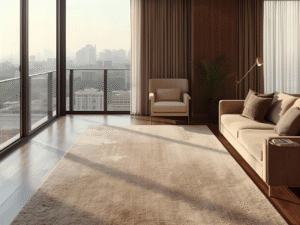
Spatially, beige grounds a room without competing with architectural elements. When walls are clad in natural stone, when joinery is in bleached oak, or when a space relies on layered textural contrast, a beige rug provides visual breathing room. It separates zones without creating harsh transitions—a quality that architects working on open-plan layouts find especially valuable.
Do Beige Rugs Maximize Natural Light in Interior Spaces?
Lighter floor tones reflect natural light back into a space rather than absorbing it. In projects where daylighting is a key design objective—large glazed residences, wellness centers, or south-facing living areas—a beige rug amplifies the luminosity already built into the architecture. It is a passive design tool that contributes to the quality of light without any additional specification effort.
Why Are Beige Rugs Associated with Luxury Interiors?
Beige, when executed in premium handwoven wool or silk, carries an inherent sense of luxury that bolder colors cannot replicate. The texture of a hand-knotted beige rug in fine New Zealand wool or bamboo silk communicates quality before a client even touches it. For high-end developers and hospitality brands, this subliminal perception of craftsmanship directly contributes to project positioning.
Why Architects Specify Premium Rugs Instead of Standard Carpets
Superior Craftsmanship
Handmade rugs are produced knot by knot or tuft by tuft by skilled artisans. Each piece carries a density, texture, and finish that machine-made carpeting simply cannot replicate. For architects presenting work to discerning clients, this visible quality makes a measurable difference to how a space is perceived.
Greater Design Flexibility
Premium rug manufacturers offer unlimited design customization—bespoke patterns, non-standard shapes, custom pile heights, and surface treatments. Standard carpets come in fixed widths, limited colors, and rigid patterns. For a project with a specific design vision, that rigidity is a constraint.
Long-Term Durability
A well-crafted handmade wool rug can last 20 to 50 years with proper maintenance. Machine-made carpets typically require replacement within 5 to 10 years. For commercial installations where replacement involves significant disruption and cost, durability is a functional specification requirement, not merely an aesthetic preference.
Sustainable Material Options
Natural fiber rugs—wool, silk, bamboo silk—are biodegradable, renewable, and free from the petrochemical compounds present in most synthetic carpets. For architecture firms pursuing green building ratings or working with sustainability-conscious clients, specifying natural fiber rugs is a straightforward choice.
Improved Acoustic Comfort
Dense handmade rugs absorb sound significantly better than hard flooring and even better than thin machine-made carpets. In open-plan offices, hotel corridors, and high-ceiling residential spaces, acoustic comfort is a serious design consideration. A well-specified rug addresses it elegantly.
Higher Perceived Project Value
Projects specified with premium handmade rugs are photographed differently, reviewed differently, and valued differently in the real estate market. For luxury developers, a bespoke rug in a model apartment or show villa is a direct investment in the project’s brand positioning.
Architectural Projects Where Beige Rugs Work Best
Luxury Villas
In private villas, beige rugs define living zones, soften master bedrooms, and add warmth to double-height entrance lobbies. Custom dimensions and patterns can be developed to mirror architectural motifs already present in the space.
Premium Residential Apartments
High-rise luxury apartments benefit from beige rugs that complement natural stone flooring, modular joinery, and neutral paint palettes. Custom rug sizes ensure precise fit within open-plan configurations.
Boutique Hotels
Hotel lobbies, suites, and corridor runners require rugs that balance aesthetic impact with durability. Beige tones photograph well, maintain their appearance over time, and can be specified with tighter weave constructions for high-traffic areas.
Corporate Offices
Premium corporate interiors use beige rugs in executive boardrooms, reception areas, and client-facing meeting rooms. The material communicates brand quality while providing acoustic benefits in hard-surfaced office environments.
Experience Centres
Property developers, automotive showrooms, and luxury brands use experience centres to sell a vision. A bespoke beige rug with a custom pattern or logo integration reinforces brand identity at the point of experience.
Clubhouses
Residential clubhouses require rugs that perform across social, lounge, and activity zones. Beige rugs in durable wool constructions balance lifestyle use with aesthetic continuity.
Luxury Retail Stores
Retail environments use rugs to slow foot traffic, define product zones, and create premium in-store atmospheres. Beige rugs encourage longer dwell time and signal quality at the threshold.
Model Homes
In model apartments and show villas, the rug is one of the most photographed elements. A custom beige rug specified by the architect communicates the project’s luxury positioning immediately.
High-End Restaurants
Fine dining interiors use rugs to manage acoustics, define seating areas, and communicate brand character. Beige tones work across candlelit, day-lit, and mixed-light environments without visual dominance.
Wellness and Spa Spaces
Spa reception areas, yoga studios, and meditation rooms benefit from the calm, grounding quality of natural beige tones. Wool and bamboo silk rugs add tactile warmth that reinforces the wellness experience.
Best Types of Beige Rugs for Architectural Projects
Hand-Knotted Rugs
The pinnacle of rug craftsmanship. Each knot is tied individually onto a loom, resulting in a rug of exceptional density, detail, and durability. Hand-knotted rugs are ideal for landmark spaces—entrance lobbies, executive offices, and prestige residential projects—where longevity and design precision matter most.
Hand-Tufted Rugs
Produced by pushing yarn through a canvas backing using a tufting tool, hand-tufted rugs offer a faster production timeline and strong design flexibility. They are well-suited to mid-to-large-scale architectural projects where consistent quality and bespoke design are required without the extended lead times of hand-knotted production.
Wool Rugs
New Zealand and Indian wool are the preferred materials for architectural specifications. Wool is naturally stain-resistant, dimensionally stable, and soft underfoot. In beige tones, wool takes dye beautifully, resulting in rich, complex surface depth that reads as genuinely luxurious.
Bamboo Silk Rugs
Bamboo silk (also known as banana silk or art silk) offers a lustrous sheen that mimics natural silk at a more accessible price point. Beige bamboo silk rugs have a luminous quality that transforms under different lighting conditions—a property that architects and photographers value highly.
Wool and Silk Blend Rugs
Combining the durability of wool with the sheen of silk, wool-silk blend rugs offer a premium specification option for spaces that require both performance and visual sophistication. The two fibers respond differently to light, creating a dynamic surface texture that photographs beautifully.
Flat Weave Rugs
Low-profile and reversible, flat weave rugs are suited to contemporary interiors, high-traffic areas, and layered rug applications. In beige, they provide clean, structured surface definition without adding visual weight.
Fully Custom Bespoke Rugs
For projects with a specific design vision that standard collections cannot fulfill, a fully bespoke rug—custom pattern, custom color, custom size, custom construction—is the correct specification. The Ambiente’s design team works directly with architects from concept to finished sample, developing rugs that are exclusive to each project.
What Architecture Firms Should Look for in a Rug Supplier
Not every rug manufacturer is equipped to serve the needs of professional architecture firms. When evaluating suppliers, architects should assess the following:
- Bespoke design capabilities: Can the manufacturer execute a pattern developed by your design team, rather than selecting from a fixed catalog?
- Material expertise: Does the supplier work with premium natural fibers and understand their performance characteristics across different applications?
- Custom sizing: Can rugs be produced in non-standard dimensions to fit precise architectural layouts?
- Pantone and color matching: Can the manufacturer match yarn colors to your specified interior palette with accuracy?
- Texture and weave options: Is there flexibility in pile height, weave construction, and surface finish?
- Prototype and sampling services: Can the manufacturer produce physical samples before committing to full production?
- Bulk project execution: Can the supplier manage multi-unit or multi-site projects with consistent quality across every piece?
- Sustainable manufacturing: Are natural fibers used? Are production practices ethical and environmentally responsible?
- Quality assurance: What quality control processes are in place during and after production?
- Reliable project timelines: Can the manufacturer commit to delivery schedules that align with construction and handover timelines?
Benefits of Choosing Handmade Rugs for Architectural Designs
One-of-a-Kind Craftsmanship
Every handmade rug is unique. Even two rugs woven from the same specification carry subtle variations that make each piece distinctly original—a quality that resonates strongly in bespoke architectural projects where uniqueness is part of the value proposition.
Unlimited Design Possibilities
Handmade production places no limit on pattern complexity, color combinations, or spatial configuration. Architects can develop patterns that echo structural details, reference cultural motifs, or carry brand identity—none of which is achievable with machine production.
Exceptional Durability
Natural fiber handmade rugs outlast their machine-made counterparts by decades. This is not simply a quality claim—it is a structural reality of how the materials are sourced, processed, and constructed.
Eco-Friendly Manufacturing
Handmade rugs produced with natural fibers generate significantly lower environmental impact than machine-made synthetic carpets. The production process requires no industrial chemicals, and the finished product is fully biodegradable.
Supports Artisan Heritage
Specifying handmade rugs from Bhadohi—India’s centuries-old carpet weaving region—directly supports a living craft tradition and provides sustainable livelihoods for skilled weavers, many of whom are women. The Ambiente works with over 4,000 women weavers, embedding social value directly into every architectural specification.
Why The Ambiente Is the Best Place to Buy Beige Rugs and Carpets for Architecture Firms in India
30+ Years of Handmade Rug Manufacturing Experience
The Ambiente’s parent company, Bhadohi Carpets, has been manufacturing handmade rugs for over three decades. This depth of experience translates into technical mastery at every stage—from loom setup and yarn selection to finishing, quality inspection, and dispatch. Architecture firms benefit from a supplier that has solved every manufacturing challenge before their project even begins.
Expert Design Collaboration with Architects
The Ambiente’s design team is equipped to work within the architectural design process—not alongside it. This means reviewing technical drawings, understanding scale and proportion, interpreting material boards, and developing rug designs that are genuinely integrated with the interior concept rather than added as an afterthought.
Fully Customized Rug Solutions
From pattern development to pile height, from shape to fringe treatment, every aspect of a rug produced by The Ambiente can be customized to the project’s exact requirements. No design is too complex, and no dimension falls outside of production capability.
Premium Wool, Silk, and Bamboo Silk Materials
The Ambiente sources its fibers from premium suppliers, including New Zealand wool, Indian wool, natural silk, and bamboo silk. Each material is selected for its performance, aesthetic quality, and suitability for the specific construction it will be used in.
In-House Sampling and Prototype Development
Before any bulk production begins, The Ambiente develops physical samples that allow architects to verify color, texture, and construction against the project’s material palette. This sample-first process eliminates costly errors and ensures that the final product matches the design intent precisely.
Large-Scale Production for Multi-Project Requirements
For developers managing multiple units, phases, or sites, The Ambiente’s production infrastructure can handle large-volume orders while maintaining consistency across every piece. This makes The Ambiente a reliable partner for residential developments, hotel groups, and commercial roll-outs.
Export-Quality Craftsmanship
The Ambiente produces rugs to international export standards—a benchmark of quality that ensures every piece meets the expectations of the most demanding clients, whether the project is in Delhi, Mumbai, Hyderabad, or abroad.
Nationwide Delivery and Project Support
The Ambiente delivers across India, with logistics support tailored to the timelines and coordination requirements of professional architectural projects. Site-specific delivery scheduling ensures that rugs arrive when the project is ready to receive them—not before, and never late.
Sustainable and Ethical Manufacturing Practices
The Ambiente’s commitment to natural fiber materials, fair weaver compensation, and low-impact production makes it a natural fit for architecture firms working on sustainable or LEED-aligned projects. Sustainability here is not a marketing claim—it is embedded in the production model.
Trusted by Architects, Interior Designers, and Luxury Developers
With over 5,000 clients served across India and internationally, The Ambiente has built a track record that speaks for itself. Architecture firms, interior design studios, luxury developers, and hospitality brands have repeatedly chosen The Ambiente as their rug manufacturing partner.
Custom Rug Solutions for Architecture Firms
Concept-to-Completion Design Support
The Ambiente’s team engages at the earliest design stage, reviewing mood boards, material references, and spatial drawings to develop rug concepts that are fully aligned with the architectural vision from the outset.
Custom Shapes and Dimensions
Circular, hexagonal, runner, irregular—any shape and any dimension can be produced. This is particularly valuable in architecturally complex spaces where standard rectangular rugs would interrupt the design intent.
Color Matching with Interior Schemes
Using Pantone references and physical yarn samples, The Ambiente ensures that the rug’s beige tones align precisely with the wall finishes, upholstery, and material palette already specified for the space.
Architectural Pattern Development
Geometric grids, abstract textures, tonal gradients, and culturally inspired motifs can all be translated into woven form. The Ambiente’s design team works directly from architect-provided artwork or develops original patterns to brief.
Logo and Brand Integration
For experience centres, luxury retail, and corporate interiors, The Ambiente can weave client logos, brand symbols, or custom motifs directly into the rug—creating a bespoke branded flooring element that reinforces identity at the spatial level.
Project-Based Sampling
Each architectural project receives a dedicated sampling process. Samples are produced to the specified scale, construction, and color before any production commitment is made, giving architects full confidence before sign-off.
Handmade Rugs vs. Machine-Made Carpets
| Feature | Handmade Rugs | Machine-Made Carpets |
|---|---|---|
| Design Flexibility | Fully Custom | Limited Options |
| Craftsmanship | Artisan Made | Factory Produced |
| Durability | 20–50+ Years | 5–10 Years |
| Sustainability | Natural Fibres | Mostly Synthetic |
| Luxury Appeal | High | Moderate |
| Long-Term Value | Excellent | Average |
The data above reflects a consistent pattern that architectural professionals encounter repeatedly: the upfront cost difference between handmade and machine-made narrows significantly when measured against the total lifecycle value of the installation. For luxury projects, where perceived quality directly impacts property value and brand positioning, the case for handmade rugs is straightforward.
How Architects Can Select the Perfect Beige Rug
Define the Project’s Design Language
Before selecting a material or construction, clarify the design language of the space. A Japandi interior calls for a flat weave or low-pile wool rug with clean geometry. A classical villa may call for a hand-knotted wool and silk piece with a traditional border. The design language determines everything that follows.
Choose the Right Material
Wool offers durability and warmth. Silk offers sheen and refinement. Bamboo silk offers luminosity at a more accessible price point. Wool-silk blends balance all three qualities. Choose based on the specific demands of the space—foot traffic, lighting conditions, and client expectations.
Consider Space Functionality
A rug in a hotel lobby must perform differently than one in a private study. High-traffic applications call for tighter weave constructions and stain-resistant fibers. Low-traffic prestige applications can accommodate more delicate constructions with finer pile heights.
Select Appropriate Texture and Pile Height
High-pile rugs add plushness and warmth but require more maintenance. Low-pile and flat weave options are easier to maintain and more suited to high-traffic environments. In spaces with furniture, a medium pile height often provides the best balance of comfort and practicality.
Ensure Color Consistency Across Spaces
For projects with multiple rooms or units, color consistency across all rugs is essential. Request yarn samples and physical prototypes for every distinct space to verify that the beige reads consistently under different lighting conditions and alongside different materials.
Maintenance Tips for Architectural Projects
Specifying a premium rug is only part of the architect’s responsibility. Maintenance guidance should be included in the project handover documentation to ensure the rug performs as intended throughout its lifespan.
- Specify maintenance requirements clearly during project handover, including recommended cleaning methods and frequency
- Use rug pads in high-traffic areas to prevent slippage and reduce underside wear
- Vacuum regularly using a low-suction setting to preserve pile texture and remove surface debris
- Address stains immediately using the appropriate cleaning method for the specific fiber—blot rather than rub
- Schedule professional deep cleaning annually for commercial installations, or bi-annually for residential spaces
- Rotate rugs periodically in areas with uneven foot traffic to ensure even wear across the surface
Frequently Asked Questions (FAQs)
Why do architects prefer beige rugs?
Beige rugs are preferred by architects because they work seamlessly across every design style, complement natural materials such as stone and timber, enhance natural light reflection, and communicate a sense of luxury without visual dominance. Their tonal flexibility makes them the most versatile neutral in architectural specification.
Can rugs be custom-designed to match architectural concepts?
Yes. The Ambiente offers fully bespoke rug design services, including custom patterns, architectural motifs, Pantone color matching, and logo or brand integration. The design team works directly with architects from concept to final sample, ensuring the finished rug aligns precisely with the interior vision.
Which material is best for luxury architectural projects?
For the highest-tier luxury projects, hand-knotted wool and silk or wool-silk blend rugs offer the finest craftsmanship and visual refinement. Bamboo silk is an excellent alternative for projects seeking high sheen and luminosity at a broader price range. The right material ultimately depends on the specific space, foot traffic, and client expectations.
Does The Ambiente offer custom sizes and shapes?
Yes. The Ambiente produces rugs in any size and shape, including circular, runner, hexagonal, and fully irregular forms. Custom dimensions are a standard part of The Ambiente’s architectural project service.
Can architecture firms place bulk orders?
Yes. The Ambiente’s production infrastructure supports large-scale projects, including multi-unit residential developments, hotel rollouts, and commercial fit-outs. Consistent quality is maintained across every piece in a bulk order.
How long does it take to manufacture bespoke rugs?
Lead times depend on the construction type, size, and complexity of the design. Hand-tufted rugs typically require 4–8 weeks, while hand-knotted rugs may require 8–16 weeks or longer for complex pieces. The Ambiente works with each project’s timeline during the briefing stage to ensure delivery aligns with construction schedules.
Are handmade rugs suitable for commercial spaces?
Yes, when specified in the appropriate construction and fiber. High-traffic commercial applications are best served by tight-weave constructions in durable wool or wool-blend materials. The Ambiente’s team advises on the correct specification for each commercial application based on the space’s traffic levels and maintenance requirements.
Does The Ambiente deliver across India?
Yes. The Ambiente delivers to all major cities and project sites across India, with logistics support tailored to architectural project schedules. International delivery is also available for export projects.
The Timeless Case for Beige Rugs in Architectural Design
Beige rugs have earned their place as a permanent specification in architectural practice—not through trend, but through genuine design utility. They bridge the gap between warmth and neutrality, anchor spatial compositions without competing with other design elements, and age gracefully in both residential and commercial environments. When crafted by hand in premium natural fibers, they add a layer of authenticity and longevity that no machine-made carpet can replicate.
For architecture firms in India seeking a manufacturing partner with the depth, flexibility, and craftsmanship to match the ambition of their projects, The Ambiente stands in a category of its own. With 30+ years of handmade rug manufacturing experience through Bhadohi Carpets, a design team that speaks the language of architecture, and production capabilities that scale from single bespoke pieces to multi-site commercial rollouts, The Ambiente is the natural first choice.
The flagship showroom at Sultanpur, New Delhi, is open for consultation. Whether the project is a luxury villa in Lutyens’ Delhi, a boutique hotel in Goa, or a premium residential development in Hyderabad, The Ambiente’s team is ready to develop the right rug—exactly to specification, exactly on time.