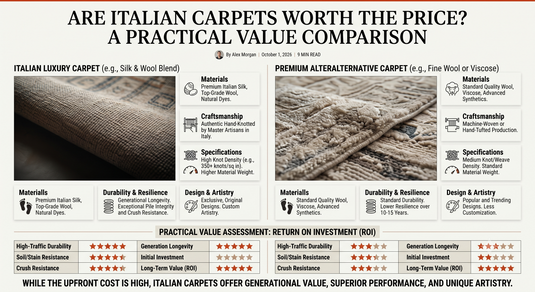
Some rugs sold by Italian design brands are more expensive than many mass-market carpets, but Italian does not define one price category or one level of quality. A fair comparison needs the selected product's dimensions, material, construction, design work and delivered cost. The brand's location alone cannot tell you whether the rug is worth its price.
An Italian design rug may be worthwhile when you value a particular design, custom service or documented specification that you cannot find in another suitable product. It may be unnecessary when a less costly alternative meets the room's requirements equally well. The decision is about the actual rug and the services included.
Clarify what Italian means
A brand can be based in Italy while producing rugs in other countries. Italian design identity, country of manufacture and material origin are separate facts. Ask for the information relevant to your purchase rather than treating them as interchangeable.
For example, cc-tapis describes its international production network, including production outside Italy. This does not make the design identity meaningless, but it does show why a company address is not enough to establish manufacturing origin.
If made in Italy is a requirement, request product-specific documentation before ordering. If your priority is the aesthetic of an Italian design brand, say that instead. A clear brief prevents you from paying for an origin assumption that the supplier never actually made.
Compare rugs with rugs, and carpets with carpets
An area rug is a bounded textile with a defined shape and edge. Fitted carpet is installed over a larger floor area, while carpet tile is another category. Their pricing and installation requirements can differ.
Do not compare the price of a designer area rug with a per-square-metre carpet rate without accounting for the complete scope. A fitted carpet quote may include or exclude installation, underlay and preparation. A rug quote may include or exclude shipping and a pad.
Start by identifying the product that solves your room's problem. If you need a focal textile beneath a seating group, compare suitable rugs. If you need continuous floor coverage, compare carpet systems with equivalent installation requirements.
What can contribute to a higher price
Material, labour, construction and design development can all affect cost. A complex handmade rug may require more time than a simpler product. A distinctive designer collaboration or custom commission can also carry costs beyond the raw fibre.
Retail distribution, importation, shipping and service may contribute to the delivered price. Ask what is included rather than assuming every price difference reflects superior material. Two similar-looking products can have different costs for several reasons.
No single factor establishes value on its own. A higher knot count, a famous name or a silk-rich surface may matter to a particular buyer, but none automatically makes the rug suitable for a busy family room. The specification needs to be connected to use.
Examine the fibre before judging luxury
Wool, silk, cotton and regenerated fibres provide different appearances and care requirements. A luxury description does not replace a precise composition. Ask for percentages in a blend where they are relevant.
Lustrous materials can create a refined visual effect, especially under directional light. That effect may be exactly what you want in a quiet decorative room. It may be less useful where frequent spills and easy home cleaning are priorities.
Compare the selected product with an alternative using similar material and construction. The Ambiente's wool rugs and wool-silk rugs offer separate directions to investigate. Check each product's actual details rather than treating the whole collection as one specification.
Construction matters, but labels are not enough
Hand-knotted, hand-tufted, handwoven and machine-made products involve different processes. Their suitability depends on the finished rug, not only the construction name. Examine density, finishing, backing where applicable and maintenance.
A hand-knotted rug can be valuable for its particular craftsmanship and design. A well-specified tufted rug may serve another brief effectively. Do not assume that the most time-intensive method is the only sensible choice for every home.
Our hand-knotted versus hand-tufted guide explains the differences to discuss with a supplier. Use that understanding to compare products, not to create an automatic ranking that ignores the room.
Pay for a design you actually need
A distinctive rug can become the focal point of a room. If you are buying for that role, assess the whole composition and how it will appear around furniture. A design largely hidden beneath a sofa may not deliver the effect you expected.
Check whether the design can be adjusted to your dimensions without losing its balance. A border or central motif may need redrawing. A custom service can be valuable when it solves this problem, but you should know which approvals are included.
If the main appeal is a general colour or texture, compare alternatives. You may find the desired relationship without paying for a specific signature design. Modern rugs and minimal rugs provide different visual starting points without implying that they duplicate another brand's work.
Compare the complete delivered cost in India
Ask for a quote that states the delivery address and all included charges. Clarify taxes, freight, customs handling where relevant, insurance and any installation service. A catalogue amount in another currency may not represent what you will pay in India.
Confirm who is responsible for the shipment and how transit damage will be handled. If a dealer supplies the rug, identify the dealer's role in after-sales service. Clear responsibility can be part of the value of a purchase.
Do not use a rough currency conversion as a final price. Exchange rates and charge structures can change. Ask when the quoted amount is fixed and which items remain provisional before paying a deposit.
Understand the cost of custom work
Custom dimensions, colours or shapes can add design and production requirements. A standard catalogue price may not apply. Give suppliers the same brief if you want a meaningful comparison.
Illulian's published FAQ describes pricing in relation to quality, size and composition, with shipping separate. This illustrates why a single brand-wide price comparison is inadequate. The specific order needs a quote.
Our custom-size rug supplier comparison explains how to record price, sampling, approvals and delivery. A custom rug's value includes whether it resolves the actual dimensional or design problem, not merely whether it carries a prestigious label.
Include care in the value calculation
Request the care sheet before buying. Check vacuuming, spot-treatment restrictions and professional cleaning requirements. A rug is easier to evaluate when you know what ownership involves after the initial installation.
Ask whether a suitable cleaning service is available locally. A delicate imported rug may need specialist attention, and the cost and convenience can vary by location. Do not assume any carpet cleaner can safely treat every fibre and construction.
Keep the technical information and invoice. They can help with maintenance and repair discussions. A high price does not make a rug immune to spills, sunlight or unsuitable cleaning methods, so practical care remains part of protecting the purchase.
Think about longevity without assuming a guarantee
How long a rug remains useful depends on material, construction, care and the room's stresses. A costly rug placed in an unsuitable location can disappoint. A more modest rug chosen carefully can serve its purpose well.
Ask about repairability and after-sales support where these matter. A supplier's willingness to explain maintenance can be useful, but it should be supported by clear terms. Do not interpret broad statements about lasting generations as a guarantee for every product.
Avoid assuming that a new designer rug will gain resale value. Collectibility depends on many factors and is not established by nationality or retail price alone. Buy for the room and your enjoyment unless you have a separate, well-informed collecting brief.
Compare Italian design brands with Indian choices
India has a substantial range of rug constructions and design traditions. An Indian-made alternative should be assessed on its own specifications rather than treated as a lower tier simply because its price is different.
The Ambiente's hand-knotted rugs and luxury rugs provide options to explore alongside international products. Confirm each design's composition, dimensions and supply terms. These collections are not presented as Italian-made.
An international product may offer a specific aesthetic you strongly prefer. A local option may suit your budget or communication needs better. Neither outcome should be assumed before the products and services are compared fairly.
Use samples to reduce uncertainty
An expensive rug deserves more than a decision made from one photograph. Ask for close-up images, the reverse side and a material sample where available. Confirm whether the sample represents the actual fibre and construction.
View colours in the intended room. Upholstery, floor colour and lighting can change their appearance. A lustrous pile may look different from opposite directions. These effects should be understood before a custom colour is approved.
If sampling is not available, ask what visual information the supplier can provide and how variation is handled. Do not fill the gap with assumptions. A clear description of uncertainty helps you decide whether to proceed.
Consider the room's real use
A formal lounge, a family television room and a dining room require different priorities. Write down the expected traffic, spills and furniture movement. Then ask whether the selected rug is appropriate for those conditions.
For heavy daily use, our tufted material guide gives questions about fibre, density and backing. If you are choosing a cream design, the cream rug care guide helps assess visible marks and maintenance.
The most expensive option is not necessarily the most practical. It may still be worth buying for a quieter area where its design and surface can be appreciated. Matching the rug to its location protects both the room and the investment.
A simple decision framework
First, confirm that the rug fits the dimensions and daily use. Next, check the actual material, construction and care. Then compare the delivered cost, services and terms with a suitable alternative.
Ask what you would lose by choosing the alternative. It might be a particular design, custom colour, texture or service. If that difference matters enough to you and the product is suitable, the premium may be justified.
If the difference is mainly a vague impression of prestige, pause and gather more information. You should be able to explain the purchase in terms of the room and your preferences. A clear reason is more useful than a broad belief that a country label guarantees quality.
Keep the purchase tied to a clear brief
Write down the features that would make the premium worthwhile for you. They might include an original design, a specific colour, unusual dimensions or a documented service. Then ask whether the selected rug actually provides those features. This prevents the decision from drifting toward general prestige.
If you are comparing a dealer quote with a direct purchase, include the support each route provides. A lower amount may come with different delivery, inspection or return arrangements. A higher amount may include useful services, or it may not. Confirm the details instead of assuming that either route is better. The final choice should be based on the complete offer and the needs of the room.
Related rug planning guides
If you are comparing other specialist materials or design routes, read our leather rug buying guide, custom-size supplier comparison and 2026 carpet inspiration guide. Keep the room’s needs consistent across the shortlist.
Frequently asked questions
Are Italian carpets always more expensive?
No. Prices vary by brand, product, construction and supply route. Some designer rugs are costly, but nationality alone does not establish the amount. Compare products of similar size and specification using delivered quotes.
Does a higher price mean better durability?
Not automatically. Durability depends on the selected rug and its use. A delicate luxury surface may require more careful placement than a practical everyday rug. Ask for the specification and intended-use guidance rather than relying on price.
When is the premium worth paying?
When a particular design, custom service or documented quality meets a need you value and the ownership costs are acceptable. The rug should fit the room and routine. A premium is harder to justify when a suitable alternative delivers everything you need.
How should I begin the comparison?
Explore documented brands such as cc-tapis, Amini and Illulian, then select actual products to compare. Our Italian rug brand guide introduces the questions to ask. Use samples and written quotes to move from general interest to a concrete decision.