Put a hand-knotted rug and a hand-tufted rug next to each other, and the difference may not be obvious at first.
Both can be made with wool. Both can feature intricate patterns and rich colors. Both involve skilled manual work. From the front, a well-made hand-tufted rug can even resemble a hand-knotted one closely enough that someone unfamiliar with rug construction might assume they were made the same way.
They are not.
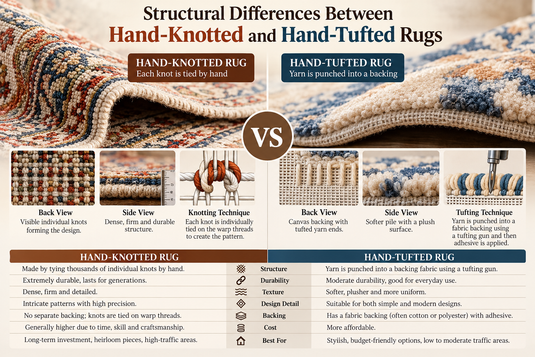
The major difference is structural. In a hand-knotted rug, individual knots are tied onto a woven foundation, and those knots become an integral part of the rug's construction. In a hand-tufted rug, yarn is pushed through a pre-existing backing with a tufting tool, then typically secured with adhesive and covered with a secondary backing.
That difference affects almost everything that follows, including production time, appearance, weight, durability, repairability, aging, price, and the way you should care for the rug.
At The Ambiente, we believe understanding construction is more useful than relying on labels such as "luxury" or "premium." Once you understand how a rug is actually made, its price and maintenance requirements make considerably more sense.
Let's look closely at what separates hand-knotted and hand-tufted rugs.
What Does "Handmade" Actually Tell You?
Before comparing the two methods, it helps to clear up a common source of confusion.
"Handmade" is a broad term.
A hand-knotted rug is handmade. A hand-tufted rug is also handmade. A handwoven flatweave can be handmade too.
Those rugs are not structurally interchangeable.
This matters when shopping because a product description that simply says "handmade wool rug" does not tell you enough about how that rug was constructed.
The type of handwork matters.
Hand-knotting involves manually tying yarn around foundation threads, knot by knot. Hand-tufting involves manually directing yarn through a backing using a tufting tool.
Both require human skill, but the physical structure and amount of labor are very different.
When evaluating a rug, always look for a specific construction description rather than stopping at "handmade."
How Is a Hand-Knotted Rug Constructed?
A hand-knotted rug begins with a loom and a foundation.
Vertical foundation threads are known as warps. Horizontal threads, known as wefts, pass across the warps as the rug is built.
The weaver ties individual pieces or loops of pile yarn around the warp threads according to the rug's design.
After a row of knots is completed, weft threads are typically passed across the rug and packed into place. The process continues row after row.
The pile, pattern, and foundation are therefore created as parts of one integrated textile structure.
This point is fundamental.
The wool, silk, or other pile material is not simply attached to the surface of a finished cloth. The knots are physically tied into the foundation.
Depending on the rug's size, fineness, knot density, design complexity, and number of people working on it, the process can take months or considerably longer.
That labor is one reason hand-knotted rugs tend to cost more.
The Foundation of a Hand-Knotted Rug
When discussing rug structure, the foundation deserves attention because it is effectively the rug's skeleton.
Many hand-knotted rugs use cotton warps and wefts, although wool and silk foundations are also found depending on the region, style, and type of rug.
The pile material is tied onto that structural framework.
The foundation needs to remain stable enough to support hundreds of thousands, or sometimes millions, of individual knots.
This integrated construction is one reason a well-made hand-knotted rug can remain useful for decades and, in favorable circumstances, generations.
It is also why damage to the foundation is serious.
Surface wear in the pile may sometimes be repaired. If the underlying warps or wefts deteriorate significantly, the rug's structural integrity can be compromised.
A skilled rug repair specialist may be able to reconstruct damaged areas, but such work can be painstaking and expensive.
How Is a Hand-Tufted Rug Constructed?
A hand-tufted rug begins differently.
Instead of building the pile and foundation together on a traditional knotting loom, the maker generally starts with a primary backing stretched on a frame.
The rug design may be drawn or transferred onto that backing.
A craftsperson then uses a hand-operated tufting gun or similar tool to push yarn through the backing along the design.
This process is dramatically faster than tying individual knots.
Once tufting is complete, an adhesive is typically applied to the back to help secure the tufts. A secondary backing, often fabric, is then attached to cover and protect the adhesive and provide a more finished appearance.
The front may be trimmed, carved, washed, or otherwise finished depending on the intended look.
The result can be thick, soft, colorful, and highly detailed.
But structurally, it is not a knotted rug.
The Adhesive Is a Major Structural Difference
If you remember only one distinction between these two rug types, make it this one.
Traditional hand-knotted rugs do not depend on a layer of latex or similar adhesive to hold the pile in place.
Hand-tufted rugs generally do.
This adhesive performs an important structural job. Because the yarn has been inserted through the backing rather than individually tied into a woven foundation, something needs to help lock those tufts in position.
A secondary backing is commonly placed over the adhesive.
This affects both durability and aging.
Over time, some rug adhesives can dry out, become brittle, deteriorate, or produce powdery residue. In some cases, an older tufted rug may develop an odor associated with backing materials or adhesive deterioration.
Quality varies considerably, so this does not mean every hand-tufted rug will experience early backing failure.
It does mean, however, that the adhesive is part of the rug's expected lifespan in a way that does not apply to traditional hand-knotted construction.
What Does the Back of a Hand-Knotted Rug Look Like?
Turn over a hand-knotted rug and you can usually see the design.
The back reflects the rug's structure because the knots and foundation create the pattern itself.
Depending on knot density and construction, the design may appear relatively crisp from the reverse side. You can often inspect the knots closely and get a sense of how fine or coarse the weaving is.
There is typically no fabric sheet hiding the back of the rug.
This makes the reverse side useful when identifying construction.
On many hand-knotted rugs, you will also notice that the fringe is structurally connected to the foundation. The visible fringe at the ends may be an extension of the warp threads rather than decorative trim simply sewn onto the rug.
The exact treatment varies, but structural fringe is an important clue.
What Does the Back of a Hand-Tufted Rug Look Like?
A hand-tufted rug usually looks very different when flipped over.
Rather than seeing the complete design constructed through visible knots, you will commonly see a secondary fabric backing.
This fabric covers the adhesive layer and the backs of the tufts.
The backing might be cotton or another textile, depending on how the rug was made.
Fringe, if present, may be added decoratively rather than forming part of the structural foundation.
This makes the reverse side one of the quickest ways to distinguish many hand-tufted rugs from hand-knotted ones.
It is not an infallible test. Rugs can have unusual construction methods, repairs, linings, or other features.
But as a general shopping tool, checking the back is extremely useful.
Individual Knots vs. Inserted Tufts
The difference between a knot and a tuft sounds technical, but it explains much of the performance difference.
In a hand-knotted rug, the pile yarn is mechanically tied to the foundation.
In a hand-tufted rug, the pile yarn is inserted through the backing and then secured as part of an adhesive-backed system.
Think about what happens when the surface experiences years of foot traffic.
A knot physically integrated into a woven foundation has a different relationship to the rug than a tuft held within a backed construction.
This is one reason high-quality hand-knotted rugs can tolerate many years of use and can often be repaired by skilled specialists.
It is also one reason tufted rugs should not be evaluated as less expensive versions of the exact same product.
They are different textile structures.
Production Time Can Be Dramatically Different
Hand-knotting is slow.
Imagine creating a large rug one knot at a time, following a detailed pattern row by row. Even skilled weavers require substantial time to complete a fine hand-knotted rug.
Knot density makes a big difference.
A rug with a relatively coarse weave will progress faster than a rug containing an exceptionally high number of knots per unit of area.
Complex curving designs may also demand more precision than simple geometric patterns.
Hand-tufting is much faster.
A tufting gun can place yarn into the backing far more quickly than a person can tie individual knots. This makes it possible to produce a handmade rug in substantially less time.
That difference in labor is a major reason hand-tufted rugs are generally much less expensive than hand-knotted rugs of similar dimensions and materials.
You are not necessarily paying less because the wool is worse. You may be paying less because the construction method requires dramatically fewer hours of labor.
Does Hand-Knotted Always Mean Better Quality?
No.
This is where simple comparisons can become misleading.
Hand-knotting is generally the more labor-intensive construction, but a poorly made hand-knotted rug can still be a poor rug.
Quality depends on materials, craftsmanship, foundation stability, finishing, design execution, and many other factors.
Likewise, a carefully manufactured hand-tufted rug can be attractive, comfortable, and perfectly appropriate for many homes.
The better question is not "Which label is superior?"
Ask what you need the rug to do.
If you want an heirloom-quality textile with substantial repair potential and a construction associated with very long life, a well-made hand-knotted rug has clear advantages.
If you want a thick wool rug with an intricate contemporary design at a more accessible price, a high-quality hand-tufted rug might make much more sense.
Construction should match expectations.
Knot Density: What Does It Actually Mean?
Hand-knotted rugs are often discussed in terms of knot density.
Depending on the rug's origin and the seller, this may be expressed as knots per square inch, knots per square centimeter, or another traditional measurement.
A higher knot density can allow for finer detail.
Imagine drawing a picture with large square pixels versus tiny ones. Smaller structural units allow smoother curves and more intricate details.
But more knots do not automatically make a rug artistically superior or more appropriate for your home.
Some traditional tribal rugs intentionally use coarser knotting. Their appeal comes from bold geometry, distinctive wool, color, irregularities, and cultural design traditions rather than extreme fineness.
A beautifully executed rug with a moderate knot density may be more desirable than a technically fine rug with poor materials or uninteresting design.
Use knot density as descriptive information, not as a universal quality score.
Hand-Tufted Rugs Don't Have a Comparable Knot Count
Because hand-tufted rugs are not constructed from individually tied knots, quoting a traditional knot density does not make sense.
Their quality needs to be evaluated differently.
Consider factors such as:
- The quality and amount of pile fiber
- Density of the tufting
- Primary backing quality
- Adhesive quality
- Secondary backing
- How securely the pile is held
- Surface finishing
- Edge construction
- Design execution
Pile weight may also be discussed, but no single specification tells the whole story.
A heavy rug is not necessarily a well-made rug. Weight can come from a thick pile, heavy adhesive, dense backing, or a combination of those factors.
Why Hand-Tufted Rugs Often Feel Thick and Plush
Shoppers are sometimes surprised when a less expensive hand-tufted rug feels thicker than a hand-knotted rug costing several times as much.
Thickness is not a reliable measure of craftsmanship.
Hand-tufting makes it relatively practical to create a deep, dense pile. The process can produce a plush surface without the immense labor that would be required to build the same visual depth one knot at a time.
Hand-knotted rugs vary enormously in thickness.
Some are finely knotted with a relatively low pile. Others are thick and substantial. Vintage examples may have worn down considerably over decades while remaining structurally valuable.
Do not interpret more pile as more quality.
Think about whether you actually want the thickness.
A deep rug may feel luxurious in a bedroom but can be more difficult to place beneath doors or dining chairs.
How the Two Rug Types Age
Hand-knotted and hand-tufted rugs tend to age differently because of their structures.
A quality hand-knotted wool rug may gradually show wear in high-traffic areas. The pile can become lower over decades, colors may mellow, and the surface can develop the characteristics associated with age and use.
If the foundation remains sound, that wear does not necessarily mean the rug has reached the end of its life.
Many old rugs remain functional even with substantial pile wear.
Hand-tufted rugs have another aging factor: the adhesive and backing system.
Even if the surface wool remains attractive, deterioration in the adhesive can eventually become a structural issue. Depending on construction and conditions, the backing may loosen or powder may begin appearing underneath the rug.
This generally gives hand-tufted rugs a shorter expected lifespan than high-quality hand-knotted rugs.
Actual life varies widely, however. Traffic, pets, cleaning, sunlight, humidity, product quality, and maintenance all matter.
Repairability Is a Major Difference
One of the strongest structural advantages of a hand-knotted rug is repairability.
Because the rug was built through a woven foundation and individually tied knots, a skilled restorer can sometimes reconstruct damaged sections using similar techniques.
Fringes can potentially be repaired. Damaged edges can be stabilized. Missing pile can sometimes be re-knotted. Holes may be rebuilt if the work is economically and technically justified.
This requires specialist skill.
Good restoration can be expensive, which means not every damaged rug is financially sensible to repair. But the structure allows for the possibility.
Hand-tufted rugs are more difficult to restore in the same way.
The pile depends partly on backing and adhesive. Once those materials deteriorate significantly, traditional knot-by-knot restoration methods do not apply in the same manner.
Localized repairs may be possible, but large-scale structural deterioration often makes replacement more practical.
For someone buying a rug with the intention of keeping it for decades, this difference matters.
Cleaning Requirements Differ Too
Construction affects cleaning.
Many hand-knotted wool rugs can be professionally washed using methods appropriate to their dyes, fibers, and condition. A knowledgeable cleaner will inspect and test the rug first.
The lack of adhesive can provide greater flexibility in certain professional washing processes, although delicate dyes, silk, damaged foundations, antique condition, or other characteristics may still require specialized treatment.
Hand-tufted rugs need more caution with moisture.
Excessive water can affect backing materials and adhesives. An older tufted rug with deteriorating latex may be especially problematic.
This does not mean hand-tufted rugs cannot be cleaned.
It means the cleaner needs to understand what they are working with.
At home, avoid soaking either rug type unless its manufacturer specifically allows it. For valuable handmade rugs, professional cleaning is often the safer choice when a deep clean is needed.
What About Shedding?
Both rug types can shed, but hand-tufted rugs are often associated with noticeable initial shedding, particularly when made from wool.
During production, tufting and surface finishing can leave loose fibers that work their way out as the rug is used and vacuumed.
Some shedding when a wool rug is new can be normal.
Excessive or persistent shedding deserves attention, especially if fibers appear to be pulling from the structure rather than simply releasing as loose surface material.
Hand-knotted wool rugs can shed too, depending on wool quality, pile, finishing, age, and vacuuming method.
Do not try to fix shedding by using the most aggressive vacuum setting available.
Strong rotating brushes can place unnecessary stress on some handmade rugs.
Follow care guidance appropriate to the specific construction.
Weight Is Another Clue
Hand-tufted rugs can be surprisingly heavy.
The pile itself may be substantial, and the adhesive and secondary backing add additional weight.
A hand-knotted rug's weight comes primarily from its foundation and pile fibers rather than a thick adhesive layer and fabric backing.
Weight alone cannot reliably identify rug type.
A thick hand-knotted rug may be very heavy, while a small tufted rug may be relatively light.
Still, if a rug feels unusually heavy and the back is covered with fabric, hand-tufted construction is a strong possibility.
Edge and Fringe Construction
Look closely at the ends of a rug.
On many traditional hand-knotted rugs, fringe is an extension of the structural warp threads. Those threads run the length of the rug and help form its foundation.
That means the fringe is not merely decoration.
Damage to structural fringe can eventually affect the ends of the rug if it progresses far enough.
On a hand-tufted rug, fringe is often decorative and may be attached after the body of the rug has been made.
This does not make decorative fringe bad. It simply performs a different role.
The side edges differ too.
Hand-knotted rugs frequently have wrapped or finished selvages that are integral to the textile. Hand-tufted rugs may use binding or other edge finishing appropriate to their backed construction.
Examining these details can tell you quite a lot about how a rug was built.
Design Precision Works Differently
Both methods can produce detailed patterns, but they achieve that detail differently.
A hand-knotted design is built knot by knot. The fineness of curves, outlines, flowers, figures, or other motifs depends partly on knot density and weaving skill.
At very high knot densities, a weaver can create remarkably fine detail.
In hand-tufting, the craftsperson follows a design drawn or transferred onto the backing. The tufting tool makes it possible to build shapes and color fields relatively quickly.
This makes hand-tufted construction well suited to bold contemporary designs and custom patterns.
Carving can also be used to emphasize boundaries between colors or create dimensional effects.
Neither method has exclusive ownership of complex design. They simply translate a design into textile form using different structures.
Are Hand-Knotted Rugs Always More Expensive?
Generally, yes, particularly when comparing rugs of similar size and material.
The labor explains a large part of the difference.
A hand-knotted rug can require months of skilled work. A hand-tufted rug can be produced much more quickly.
Materials still matter.
A very large, densely tufted rug made from high-quality wool may cost more than a small or relatively simple hand-knotted rug. Brand, design, origin, shipping, retail costs, and rarity also affect pricing.
Vintage and antique hand-knotted rugs introduce another layer because value can depend on age, provenance, condition, collectibility, design, and scarcity.
Do not use price alone to identify construction.
A rug is not automatically hand-knotted because it is expensive.
Is One More Sustainable Than the Other?
This requires more nuance than a simple answer.
A hand-knotted rug's potential longevity can be a significant advantage. A well-made example may remain useful for decades, and repair can extend its life further.
It also avoids the large adhesive layer typically found in hand-tufted construction.
Hand-tufted rugs, however, can make handmade design accessible at a lower price and may use natural pile materials such as wool.
The full environmental picture depends on raw materials, dyes, adhesive chemistry, backing, manufacturing practices, worker conditions, transportation, maintenance, expected lifespan, and what happens at the end of the product's life.
Neither "handmade" nor "natural wool" answers all those questions.
If environmental impact matters to you, ask for specific information rather than relying on a construction label alone.
Labor and Ethical Sourcing Matter in Both Categories
Both rug types involve people.
Hand-knotted rugs are especially labor-intensive, which makes questions about artisan compensation and working conditions important.
The extraordinarily low price of a supposedly fine, large hand-knotted rug should invite questions about how it was produced.
Hand-tufted rugs also involve skilled labor, even though production is faster.
Ask where the rug was made, whether suppliers are monitored, what policies exist around child and forced labor, and whether relevant third-party standards apply.
Construction method tells you how the rug was built. It does not tell you whether the supply chain was ethical.
Those are separate questions.
Which Type Is Better for a Busy Family Home?
It depends on what you expect from the rug.
A quality hand-knotted wool rug can perform exceptionally well in a busy room. Wool is resilient, and hand-knotted construction can tolerate long-term use when appropriately maintained.
Some people hesitate to use an expensive rug in an active household, but a well-chosen hand-knotted rug does not necessarily need to be treated as fragile.
Hand-tufted rugs can also work well for family life.
Their lower purchase price may make everyday spills and pet wear feel less stressful. If you want a large rug beneath a sofa without making a major long-term investment, tufted construction can be attractive.
The trade-off is usually expected lifespan and repairability.
If you expect to redecorate in several years, a hand-tufted rug may provide exactly what you need.
If you hope to own the same rug for several decades, hand-knotted deserves serious consideration.
Which Type Works Better Under a Dining Table?
Both can work, but construction and pile height should guide the choice.
For dining rooms, we generally prefer a relatively low, dense surface that allows chairs to move comfortably.
A low-pile hand-knotted wool rug is an excellent candidate. Its durable structure and relatively flat profile can suit regular dining use.
A hand-tufted rug can work too, particularly if the pile is not overly deep.
Keep in mind that dining rooms are prone to spills. Professional cleaning options and the rug's response to moisture should therefore be considered before purchase.
No matter which construction you choose, make sure the rug is large enough for chairs to remain on it when pulled out.
Which Type Is Better for a Bedroom?
Bedrooms give you more freedom.
Because foot traffic is usually lower, the plush feel of a hand-tufted rug can be very appealing.
A thick tufted wool rug beside or underneath a bed can provide softness without the price of a large hand-knotted piece.
A hand-knotted rug makes sense if you want something you expect to keep for many years, especially if the design has lasting appeal rather than being tied to a short-lived decorating preference.
There is no structural reason a bedroom needs one type over the other.
This decision comes down to budget, feel, design, and how long you want to own the rug.
How to Tell Hand-Knotted From Hand-Tufted When Shopping
If the product description is unclear, inspect the rug.
You can usually gather useful clues quickly:
- Turn the rug over. A visible version of the pattern on the back suggests hand-knotted construction, while a fabric-covered backing commonly indicates hand-tufting.
- Look at the fringe. Structural fringe extending from the foundation often points toward hand-knotting. Sewn-on fringe may indicate another construction.
- Examine the pile closely. Hand-knotted rugs may reveal individual knots and slight handmade variations.
- Feel the back. A stiff, fabric-covered back can indicate adhesive-backed tufted construction.
- Ask specifically how the rug was made. "Handmade" is not a sufficient answer.
- Ask whether latex or another adhesive is used in the backing.
- Check the care instructions. Cleaning recommendations can reveal information about the construction.
- Ask about expected lifespan and repair options.
A knowledgeable rug seller should be able to answer these questions clearly.
Hand-Knotted vs. Hand-Tufted: The Structural Comparison
The essential differences can be summarized simply.
A hand-knotted rug is constructed by tying individual pile knots into a woven foundation. The pile, pattern, and foundation are structurally interconnected. Adhesive is not normally required to hold the pile in place.
A hand-tufted rug is constructed by pushing yarn through a primary backing using a tufting tool. Adhesive is generally added to secure the tufts, and a secondary fabric backing covers the reverse side.
From that structural difference come several practical consequences.
Hand-knotted rugs take longer to make, generally cost more, are often more repairable, and can have exceptionally long useful lives.
Hand-tufted rugs can be produced faster, generally cost less, can create thick and detailed surfaces efficiently, and often have a shorter expected lifespan because the backing and adhesive become part of the aging process.
Neither description tells you whether a particular rug is attractive or right for your home.
That requires a separate judgment.
Which Should You Choose?
Choose a hand-knotted rug when construction longevity, traditional craftsmanship, repairability, and long-term ownership are central to what you want.
It can be particularly worthwhile when you have found a design you expect to appreciate for many years and are comfortable making a larger initial investment.
Choose a hand-tufted rug when you want the look and tactile quality of a handmade rug at a more approachable price.
It can be an excellent option for bedrooms, living rooms, contemporary interiors, or spaces where you expect the decor to change over time.
At The Ambiente, we do not think the useful question is whether hand-knotted rugs are "good" and hand-tufted rugs are "bad."
That misses what is actually interesting about them.
They solve different problems.
Understanding the Structure Helps You Understand the Price
The biggest mistake when comparing these rugs is judging them only from the front.
A hand-tufted rug can have excellent wool, beautiful colors, and an impressive pattern. A hand-knotted rug can appear surprisingly simple. If you look only at surface appearance, the large price difference can seem arbitrary.
Turn them over and the explanation becomes much clearer.
With a hand-knotted rug, you are looking at a textile built knot by knot into its own foundation.
With a hand-tufted rug, you are looking at yarn inserted through a backing and stabilized as a layered structure.
Both involve handwork. Both can bring real character to a room. Both can be made well or poorly.
But they are not the same product under different marketing names.
At The Ambiente, we encourage buyers to ask about construction before making assumptions based on softness, thickness, or price. Find out whether the pile is knotted or tufted. Look at the backing. Understand whether adhesive is part of the structure. Ask about care, expected lifespan, and repair.
Once you know those things, you can make a much more useful comparison.
A hand-knotted rug may be the right choice if you are thinking in decades. A hand-tufted rug may be exactly right if you want substantial texture, skilled handwork, and a lower initial investment.
The important thing is knowing what you are buying and choosing the construction because it fits the way you intend to live with the rug.