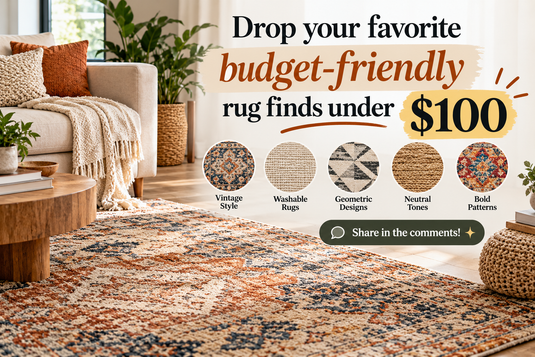
Finding a good rug for under $100 is absolutely possible. Finding a large, beautifully made, natural-fiber, heirloom-quality rug for under $100 is a different proposition.
That distinction matters.
Budget rug shopping gets frustrating when every recommendation pretends you can have size, premium materials, handmade construction, exceptional durability, and a tiny price tag all at once. Usually, something has to give.
The good news is that it does not have to be the part you care about most.
For less than $100, you can find practical runners, washable accent rugs, small wool rugs on sale, flatweaves, indoor-outdoor rugs, vintage pieces from secondhand sellers, and surprisingly good machine-made rugs for bedrooms, kitchens, entryways, offices, and small seating areas. You may even find larger sizes during clearance events or through resale marketplaces.
At The Ambiente, our favorite budget rug finds are not necessarily specific products that happen to be discounted this week. Prices, inventory, and sales change too quickly for that to be genuinely useful.
Instead, we would shop by category.
If we had $100 and needed a rug right now, these are the places we would put our money, what we would look for, and where we would refuse to compromise.
First, What Can You Realistically Get for $100?
Size is the biggest factor.
A $100 budget stretches much further when you need a 2-by-3-foot accent rug than when you need something large enough for an entire living room.
At the smaller end, you have plenty of options.
Runners can also fall within budget, especially when they are machine-made from synthetic fibers.
Once you move into 5-by-7-foot and larger sizes, the choices narrow. You will find plenty of inexpensive synthetic rugs, but quality varies considerably.
At 8 by 10 feet, staying under $100 usually means looking at very lightweight machine-made rugs, clearance items, washable covers, indoor-outdoor constructions, or secondhand finds.
That does not make them bad.
It simply means you should adjust expectations.
If you want a substantial handmade wool rug for a large living room, saving a little longer or shopping secondhand is likely to produce a better result than buying the cheapest new option available.
Find #1: A Low-Pile Vintage-Inspired Runner
If we had to choose one category that consistently works on a small budget, it would be a low-pile patterned runner.
Runners give you a lot of visual impact without requiring much material.
A vintage-inspired design in muted red, blue, rust, olive, brown, or beige can add character to a hallway, kitchen, bedside, or narrow entry.
Machine-made polyester and polypropylene versions are widely available below $100 in common runner sizes.
Why We Like Them
Pattern is your friend when shopping inexpensively.
A solid low-cost rug can sometimes reveal every inconsistency in texture or pile. A detailed pattern tends to be more forgiving.
Traditional-inspired motifs also disguise minor stains and everyday dirt between cleanings.
Look for a relatively low pile that allows doors to open comfortably and makes vacuuming easy.
If the runner is going into a kitchen, check cleaning instructions before buying.
What We'd Avoid
Very thin runners without any form of grip can move constantly on smooth flooring.
Use an appropriate rug pad.
We would also be wary of printed designs that look excellent from several feet away but noticeably pixelated or blurry up close. Customer photographs can be useful here.
Find #2: A Washable Kitchen Runner
If your $100 rug budget needs to cover a high-mess area, washability can be more valuable than premium materials.
Kitchen runners are a perfect example.
Food drops. Water splashes. Coffee spills. Pets wander through after coming inside.
A machine-washable runner can make daily life easier.
You can find plenty of synthetic washable runners below $100, particularly in narrower standard dimensions.
Check Your Washing Machine First
"Machine washable" sounds straightforward until you discover that your rug is technically washable but too large or heavy for your machine.
Read the manufacturer's care information.
Check the washing-machine capacity required. Find out whether the rug can go in a dryer or needs to air-dry.
For a small runner, this is usually manageable.
For larger rugs, washability can become less practical.
Don't Forget the Backing
Some washable rugs include a non-slip backing. Others require a separate pad.
Make sure whatever sits underneath is compatible with your flooring.
Certain rubberized or synthetic backings can interact with particular flooring finishes over time, so follow both the rug and floor manufacturer's guidance.
Find #3: A Small Flatweave for an Entryway
Flatweaves offer excellent value.
Because there is no deep pile, the construction can use less material while still providing an attractive textile surface.
Cotton flatweaves are often available at accessible prices. Synthetic flatwoven rugs are another practical option.
A small striped or geometric flatweave can look far more considered than its price suggests.
Why Flatweaves Work Well on a Budget
There is less pile to disguise with artificial softness.
You are buying a simple construction and allowing the pattern, texture, and color to do the work.
They are often easy to move and shake out too.
For renters, this can be particularly appealing. A flatweave is easy to take with you and can be repurposed in another room.
The Trade-Off
Thin rugs move.
Put an appropriate rug pad underneath.
That pad may cost $15 to $40 depending on the rug size and material, so include it in your $100 budget.
A $75 rug plus a $25 pad is a better buy than a $100 rug that slides across the floor every time you step on it.
Find #4: An Indoor-Outdoor Rug for a Pet-Heavy Room
Outdoor rugs are not only for patios.
A low-pile indoor-outdoor rug can be useful in mudrooms, playrooms, casual dining areas, covered porches, or spaces where pets create significant wear.
Polypropylene is common in this category because it absorbs relatively little moisture and resists many everyday stains.
These rugs are often machine-made and produced at scale, which keeps prices accessible.
Small and medium sizes can frequently be found below $100.
Why We'd Consider One
They're practical.
If your dog tracks dirt through the back door every afternoon, you may value cleanability more than plushness.
An indoor-outdoor rug also makes sense when you want to try a bold pattern without spending heavily.
Stripes, checks, borders, and geometric motifs are widely available.
Where We Wouldn't Use One
If barefoot softness is your main priority, there are better options.
An outdoor-style rug may feel firmer or rougher than a bedroom rug.
Also, "outdoor" does not mean indestructible or immune to mold. If you use it outside, proper drying and drainage still matter.
Find #5: A Small Wool Rug on Clearance
Wool and under $100 can coexist, but you'll usually need to compromise on size or shop patiently.
Clearance sections are worth watching.
Retailers periodically discontinue colors, patterns, or sizes, and the smallest dimensions can receive substantial discounts.
A 2-by-3-foot or similarly compact wool rug can work beside a bed, in front of a reading chair, or in a small entry.
Why We Would Rather Buy Small and Good
If your budget is fixed, buying a smaller well-made rug can sometimes make more sense than stretching the money across the largest possible area.
Wool is resilient and comfortable, and a quality small rug can move around the home over time.
Today's bedside rug can become tomorrow's entry rug.
Read the Construction Details
"Wool rug" does not tell you how it was made.
It might be hand-knotted, handwoven, hand-tufted, or machine-made.
For hand-tufted rugs, adhesive and secondary backing are generally part of the structure. For hand-knotted rugs, the pile is tied into the foundation.
These constructions have different expected lifespans and care requirements.
At under $100, a new handmade wool rug is likely to be small, heavily discounted, or made using a faster construction such as hand-tufting.
That is fine as long as you know what you are buying.
Find #6: A Secondhand Wool Runner
If you're willing to shop used, $100 suddenly gets much more interesting.
Facebook Marketplace, local estate sales, thrift stores, consignment shops, antique markets, online resale platforms, and neighborhood selling apps can all turn up genuine wool rugs at prices well below comparable new pieces.
Runners are especially worth watching.
People sell them after moving because the dimensions no longer fit the new house.
What We'd Search For
Instead of searching only "vintage rug," try variations such as:
"wool runner," "Persian runner," "Turkish rug," "hand-knotted rug," "hallway rug," and even misspellings.
Not every seller knows what they have.
Inspect Before You Buy
Secondhand prices can be excellent, but condition matters.
Look for holes, moth damage, weakened edges, stains, odors, pet urine, significant fading, foundation damage, and previous repairs.
Turn the rug over.
For older handmade rugs, the back can reveal construction and damage that is harder to see from the face.
Budget for professional cleaning if needed.
A $70 vintage rug that requires $150 worth of cleaning is still potentially a worthwhile purchase, but it is no longer a sub-$100 project.
Find #7: A Cotton Rag Rug
Cotton rag rugs are among the simplest budget-friendly rugs around.
They often feature stripes, multicolored woven patterns, or solid and tonal constructions.
They're casual, lightweight, and particularly good for areas where you do not need a luxurious pile.
Where They Work
Think kitchens, laundry rooms, dorms, casual bedrooms, craft rooms, and small home offices.
They can also be useful in children's rooms because many are easy to move and some are washable.
What to Know
Cotton absorbs moisture readily.
That makes it less suitable for persistently damp locations.
It can also shrink or distort depending on construction and washing method, so follow the care label rather than assuming every cotton rug can be thrown into a hot washing cycle.
Use a pad underneath to keep lighter rugs stable.
Find #8: A Bold Checkerboard Accent Rug
If you want to try a strong rug trend without spending heavily, do it in a small size.
Checkerboard rugs are a good example.
Instead of buying a huge living-room rug in a pattern you may tire of, use a 3-by-5-foot or smaller checkered rug in an office, bedroom, or reading corner.
At this size, sub-$100 options are plentiful.
We Prefer Softer Color Combinations
Black and white makes a statement, but brown and cream, green and beige, rust and tan, burgundy and pink, or blue and cream can be easier to live with.
An irregular checkerboard pattern can also feel less rigid than a perfect grid.
The benefit of choosing a small trend-focused rug is that it can move to another room later.
Find #9: A Bordered Neutral Rug
If bold patterns are not your thing, look for a simple rug with a contrasting border.
A cream center with brown, green, black, navy, or burgundy trim can look clean and intentional without requiring complicated manufacturing.
Flatwoven synthetic and cotton-blend options are often affordable.
Why Borders Work
Furniture hides a large percentage of many rugs.
The edge remains visible.
A contrasting border gives that visible section a clear design element.
This makes bordered rugs particularly effective beneath a small dining table, desk, or seating arrangement.
For dining rooms, make sure the rug extends far enough for chairs to remain on it when pulled back.
A beautiful $89 rug that is too small is not a bargain.
Find #10: A Small Round Rug
Round rugs can solve spaces where another rectangle feels unnecessary.
A small round rug works well beneath a pedestal table, in a reading nook, next to a bed, or in the middle of a small entry.
Because you are buying less total material than many room-size rectangular rugs, interesting round options can fall within a $100 budget.
Measure Diameter Carefully
Round rugs often look larger in product photographs than they feel in the room.
Use painter's tape or string to mark the diameter on the floor.
If it is going beneath a dining table, account for chairs.
The rug needs to extend far enough beyond the table for chairs to remain supported during normal use.
That requirement can quickly push you beyond the $100 price category, so small round rugs work better as accents on this budget.
Find #11: A Low-Pile Rug for Under a Desk
A home office does not necessarily need a huge decorative rug.
A low-pile rug beneath a desk can add warmth and protect hard flooring.
Look for something dense and relatively flat.
A thick shag rug can make rolling an office chair difficult.
Flatweaves and low-profile synthetic rugs are generally more practical.
If you use a wheeled chair, remember that repeated rolling is hard on many rugs. Depending on the chair and rug, you may need a suitable chair mat or a carpet specifically intended to tolerate rolling traffic.
Do not buy based on appearance alone.
Your chair needs to function.
Find #12: An Open-Box or Returned Rug
This is one of the easiest ways to buy above your budget without actually going above your budget.
Many retailers sell returned, open-box, or slightly imperfect rugs at meaningful discounts.
Often the problem is simply damaged packaging.
Sometimes a customer ordered the wrong size, opened the rug, and returned it.
Other products may have minor cosmetic flaws.
Ask What "Open Box" Actually Means
Find out whether the rug has been used.
Check the return policy.
If it is being sold as imperfect, ask for photographs of the defect.
A small mark that will sit under your sofa may not matter at all.
A backing defect or structural damage is a different story.
With discounted products, the reason for the discount matters more than the percentage shown in red.
Find #13: Last Season's Color
Color trends create opportunities for budget shoppers.
When retailers move toward a new palette, older colorways often get discounted even though there is nothing structurally wrong with them.
Yesterday's trendy gray may be today's clearance item.
If you actually like gray, congratulations. The internet's changing preferences may have just saved you money.
The same applies to colors such as blue, blush, mustard, or specific greens.
Do not avoid a rug because a trend report says another color is more current.
Your house is not an algorithm.
Buy the color that works with the room.
Find #14: Kids' Rugs Without Cartoon Licensing
Children's rugs can become expensive surprisingly quickly, particularly when they feature licensed characters.
Look beyond the character-branded section.
Simple geometric patterns, roads, stars, dots, rainbows, stripes, or colorful abstract designs often cost less and have a longer useful life as the child grows.
Low pile makes cleaning easier.
A washable construction may also be valuable.
And again, use a non-slip pad.
Children running across a lightweight rug on hard flooring can turn it into a sliding mat very quickly.
Find #15: A Bedside Rug Instead of a Huge Bedroom Rug
One of our favorite ways to work with a limited budget is to question the assumption that you need one large rug.
For a bedroom, maybe what you actually want is softness when you get out of bed.
Two runners or small rugs beside the bed can provide that feeling without the cost of a large 8-by-10 or 9-by-12 rug.
This approach also leaves attractive hard flooring visible.
It makes cleaning underneath the bed easier too.
The two rugs do not even have to be identical if you enjoy a more collected look, though using related colors helps keep the room coherent.
Where We Would Shop With a $100 Budget
The exact stores available to you will depend on location, so we prefer thinking in shopping channels rather than giving you a list of products whose prices may change tomorrow.
For new rugs, check large home retailers, discount home stores, outlet sections, online marketplaces, seasonal sales, and clearance categories.
For better materials at the same budget, check resale platforms, estate sales, antique stores, thrift shops, warehouse sales, and local classifieds.
Do not forget rug specialists.
Independent rug and flooring stores sometimes have remnants, discontinued samples, small-size inventory, or clearance pieces that do not make it onto the main website.
Ask.
A good deal is often sitting in the back because there is only one left.
What Materials Are Realistic Under $100?
Synthetic fibers will dominate this price range.
Polypropylene and polyester are common because they can be manufactured efficiently, dyed in many colors, and used in a wide variety of machine-made constructions.
You may also find nylon, although it is less common in inexpensive decorative area rugs than in carpeting.
Cotton is widely available in flatweaves and rag rugs.
Jute appears in small sizes, although quality can vary.
Wool is possible primarily in smaller dimensions, blends, clearance pieces, or secondhand rugs.
Silk is not realistic as a new quality floor rug under $100. Products marketed with a silky appearance may use viscose, rayon, polyester, or another fiber instead.
Read the fiber label rather than relying on appearance.
What We'd Avoid, Even at $59.99
Cheap and good value are not the same thing.
There are several reasons we would leave a low-cost rug behind.
A strong chemical odor that does not appear to be normal new-product smell deserves caution.
A backing that is already cracking, flaking, or separating is another warning sign.
Edges should be reasonably secure.
Printed patterns should look intentional rather than badly misaligned.
Look at customer reviews for repeated reports of curling, severe shedding, color transfer, or impossible cleaning.
Be cautious with a rug that arrives folded tightly if buyers consistently report that creases never relax.
We would also avoid buying a rug solely because it has been discounted from an implausibly high "original" price.
The final product is what matters, not the claimed percentage off.
Don't Spend Your Whole Budget on the Rug
If $100 is the total budget, reserve some money for a rug pad.
A rug pad can improve comfort, reduce sliding, protect the floor, and help reduce unnecessary wear.
The correct pad depends on the rug and flooring underneath.
Do not assume every rubber or PVC-backed pad is safe for every hard floor.
Check your flooring manufacturer's recommendations, especially for luxury vinyl, hardwood, and floors with specialized finishes.
For a $100 total budget, we might rather buy an $80 rug and a $20 pad than spend all $100 on the rug itself.
How to Make an Inexpensive Rug Look Better
Correct size and placement do more for an inexpensive rug than people realize.
A $70 rug positioned well can look more considered than a $700 rug that is obviously too small.
In a living area, try to connect the rug visually with the seating rather than leaving it isolated under the coffee table.
In a hallway, choose a runner with enough floor showing at the edges to look intentional.
In a bedroom, align the rug with the bed rather than the entire room if that produces better proportions.
In a dining room, make sure chairs fit on the rug when pulled out.
Flatten curled corners before putting the rug into full use.
Add an appropriate pad.
Then give the rug some space. You do not need to cover it with excessive furniture or accessories to prove it belongs there.
Is It Worth Buying a $100 Living-Room Rug?
It can be.
Just understand the trade-offs.
If you need an 8-by-10 rug for under $100, expect a lighter machine-made construction and primarily synthetic materials.
For a rental apartment, first home, temporary setup, student space, or household with messy young pets, that may be completely reasonable.
If you are furnishing a long-term home and want a substantial rug that can handle many years of use, increasing the budget may provide better value.
You can also use the $100 as a starting point for secondhand shopping.
A used wool rug may offer much more material and craftsmanship for the money than a new ultra-budget large rug.
How to Shop Online Without Getting Fooled by Photography
Rug photography can be deceptive.
A rug shown under a sofa may have been digitally staged or photographed in a room with proportions that make it seem larger.
Always read the dimensions.
Then mark them on your floor.
Look at close-up images of the pile and backing.
Read the material composition.
Check pile height.
Look for customer photographs taken in ordinary homes.
Pay attention to comments about actual color. Beige can lean yellow, pink, gray, or green depending on lighting and photography.
Make sure you understand the return cost too.
Returning a $90 rug can become surprisingly expensive if you have to pay oversized shipping.
Our Favorite Sub-$100 Strategy: Buy Less Rug, Not Worse Rug
There is a strong temptation to maximize square footage.
If $100 buys either a decent 3-by-5 rug or a questionable 8-by-10 rug, many people automatically choose the bigger one.
Sometimes that makes sense.
But not always.
Ask what you really need from the rug.
Maybe the room does not need full coverage.
A runner beside the bed, small rug beneath an armchair, vintage accent rug near the entry, or washable mat in the kitchen may solve the actual problem more effectively.
Small rugs can also be easier to clean, store, and move to another room.
Budget decorating becomes much easier once every purchase does not have to pretend to be the permanent final version of the room.
The Ambiente's Under-$100 Shortlist
If someone handed us $100 today, we would look first at these categories:
- A low-pile vintage-inspired runner for a hallway or kitchen
- A washable runner for a pet-heavy or spill-prone area
- A cotton or synthetic flatweave with a proper rug pad
- A small clearance wool rug for a bedroom or reading corner
- A genuine secondhand wool rug if condition is good
- An indoor-outdoor polypropylene rug for a casual high-mess space
- A small round rug for an entry or pedestal table
- A checkerboard or graphic accent rug for a trend-focused room
- A bordered neutral rug when we want something simple
- An open-box, discontinued, or returned rug from a reputable seller
Which one we chose would depend entirely on the room.
The Best Budget Rug Is One You Don't Have to Apologize For
There is a strange tendency in interiors to treat affordable furnishings as placeholders until the "real" version arrives.
We do not think that is particularly useful.
A rug under $100 can do its job perfectly well.
It can protect the floor beside your bed, make a hallway warmer, give your rental some color, survive muddy paws, soften a home office, or make a bland kitchen feel much more personal.
It does not need to pretend to be a hand-knotted wool rug that took someone six months to make.
Those are different products with different prices and purposes.
At The Ambiente, we would rather see someone buy a modest rug with clear expectations than overspend simply because they have been told every object in a home needs to be an investment piece.
Pay attention to fiber content and construction. Read care instructions. Get the dimensions right. Budget for a rug pad. Shop clearance and secondhand when you want better materials for less.
Most importantly, decide where your $100 matters.
If you need easy cleaning, spend it on washability.
If you care about natural materials, accept a smaller size or buy secondhand.
If visual impact matters most, use pattern and color.
If you need maximum coverage, look at machine-made polypropylene or polyester and be realistic about expected lifespan.
There are plenty of good rugs under $100.
The trick is not finding the rug that somehow gives you everything.
It is finding the one that gives you the things your room actually needs, without asking your budget to perform magic.