Your cat has a scratching post. A perfectly good scratching post. Possibly several.
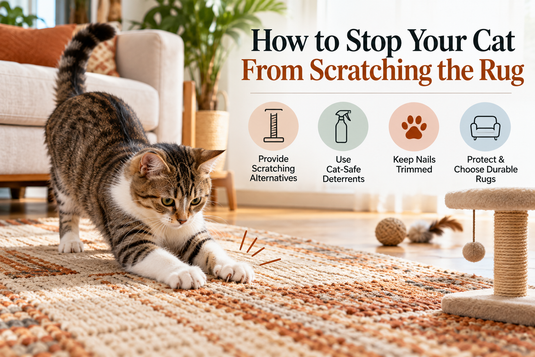
And yet, every morning, there they are, enthusiastically working on the corner of your rug as though they have been hired to dismantle it.
If this sounds familiar, the first thing to understand is that your cat is not confusing the rug with a scratching post. From the cat's point of view, the rug may simply be a better scratching post.
It is stable. It does not wobble. It offers resistance. It may have a satisfying texture. It is always available. And if your cat prefers scratching horizontally rather than vertically, the rug is positioned exactly the way they want it.
That last point is important.
Stopping a cat from scratching a rug usually works better when you focus on providing a more appealing alternative rather than trying to convince the cat that scratching itself is unacceptable. Scratching is normal feline behavior. Cats do it to maintain their claws, stretch, leave visual and scent marks, and sometimes respond to excitement or environmental changes.
At The Ambiente, we care quite a lot about rugs. We also accept a basic fact of life: the cat did not read the care instructions.
So if you are currently watching the edge of a beautiful wool rug turn into a fringe design you definitely did not order, here is what you can realistically do.
Why Is Your Cat Scratching the Rug in the First Place?
Before trying to stop the behavior, work out what the cat is getting from it.
Scratching serves several functions.
It helps remove the outer layers of a cat's claws. It allows the animal to stretch its legs, shoulders, back, and paws. Cats also have scent glands in their paws, so scratching contributes to territorial communication.
There is a visual component too. Scratch marks themselves can communicate that a cat regularly occupies a particular area.
Sometimes cats scratch during moments of excitement.
You may notice your cat going directly to the rug when you come home, before feeding time, after waking up, or during energetic play.
In other cases, the location matters more than the material.
A rug positioned at the entrance to a room or next to a favorite sleeping area may be an attractive place to mark.
Understanding the motivation helps because you can give the cat an alternative that satisfies the same need.
Your Cat May Simply Prefer Horizontal Scratching
One of the most common mistakes cat owners make is buying a vertical scratching post and assuming the scratching problem is solved.
Some cats love vertical posts.
Others prefer scratching horizontally.
Your rug is, unfortunately, an enormous horizontal scratching surface.
If your cat repeatedly ignores a standing scratching post but attacks carpets and rugs, try offering a horizontal scratcher.
Cardboard scratching pads are widely available. Flat sisal scratchers are another option. Some scratchers sit nearly level with the floor, while others provide a gentle incline.
Experiment.
The objective is to make the approved scratching surface at least as satisfying as the rug.
A cat that wants to scratch horizontally may never be particularly impressed by your elegant six-foot scratching tower, no matter how much you paid for it.
Placement Is Often More Important Than the Scratcher
You bought a scratching pad and put it in the spare room.
Your cat continues scratching the living-room rug.
That is not particularly surprising.
Cats often scratch in specific locations for a reason. An approved scratcher placed somewhere completely different may not serve the same behavioral purpose.
If your cat always scratches the front-left corner of the rug, put the scratcher directly beside or temporarily over that area.
Yes, this may not be the interior design decision you wanted to make.
Think of it as temporary negotiation.
Once your cat uses the new scratcher consistently, you may be able to move it gradually to a more convenient nearby location.
Moving it immediately across the house is likely to send the cat straight back to the rug.
Pay Attention to the Rug Area Your Cat Targets
Cats are often surprisingly specific.
One may scratch only the corners.
Another chooses the rug edge beside the sofa.
Another scratches directly in the middle of the rug after waking up.
These patterns give you useful information.
A cat targeting edges may enjoy getting its claws under or around a slightly raised section. If the corner moves during scratching, the movement itself may be rewarding.
A cat scratching a central flat area may be choosing the texture.
A cat repeatedly scratching near a doorway may be marking an important passage.
Do not just ask, "Why does my cat scratch rugs?"
Ask, "Why this part of this rug at this particular time?"
The more specific you can be, the easier the environment is to modify.
Match the Alternative to the Rug's Texture
Imagine your cat loves scratching a coarse woven wool rug.
You replace it with a tiny smooth plastic scratcher.
From your perspective, you supplied an alternative.
From the cat's perspective, you supplied an entirely unrelated object.
Texture matters.
Try to identify what the cat seems to enjoy about the rug.
Does it have a rough surface? Prominent loops? A flatwoven construction? Thick pile?
Then look for a scratching surface that provides a similar level of resistance.
Sisal is popular partly because many cats like its rough texture. Corrugated cardboard appeals to others. Some cats prefer carpet-covered scratchers, though these can create a slightly complicated message if your goal is teaching them that carpet itself is off limits.
There is no universal best scratching material.
Your cat will have opinions. Possibly strong ones.
Make Sure the Scratcher Is Large Enough
Size is another overlooked factor.
Cats often like to stretch fully while scratching.
A small scratching board that slides around the floor or allows only the front paws to engage may not compete successfully with a large stable rug.
For a vertical post, your cat should generally have enough height to extend upward comfortably.
For horizontal scratching, provide enough length and width for the cat to place its body naturally and scratch repeatedly without the surface moving away.
Stability matters just as much.
If the scratching post wobbles the first time your cat puts their weight against it, the rug suddenly looks like the premium option.
A rug has a major competitive advantage here. Furniture often anchors it, making it virtually impossible to move.
Your scratcher needs to feel secure too.
Reward the Scratcher Instead of Punishing the Rug Scratching
Cats tend to learn better when desired behavior leads to something good.
If your cat uses the approved scratcher, reward that choice promptly.
Depending on the cat, the reward could be a treat, affection, praise, or play.
Timing matters.
A reward delivered immediately after scratching the correct surface makes the connection clearer than a treat offered several minutes later.
You can also use toys to encourage interaction with the new scratcher.
Move a wand toy over or around the scratching area. Some owners use catnip or silver vine where appropriate and safe for the individual cat.
The goal is to make the scratcher a familiar, rewarding part of the environment.
Avoid physically placing a cat's paws on the scratcher and forcing scratching movements. Many cats dislike being manipulated that way, and it can make them avoid the object.
Give them reasons to investigate it voluntarily.
What Not to Do: Don't Yell at the Cat
You may stop the scratching temporarily by making a loud noise.
You may also teach the cat that scratching the rug is something best done when you are not in the room.
Punishment does not address the underlying need to scratch.
Spraying a cat with water, shouting, or frightening them can create stress without providing an appropriate outlet for the behavior.
Remember, scratching is normal.
Your job is not to make the cat stop being a cat. It is to redirect scratching toward surfaces you are willing to sacrifice to the cause.
A scratching post slowly being destroyed is a successful scratching post.
A rug slowly being destroyed is an expensive communication failure.
Temporarily Protect the Cat's Favorite Rug Area
While your cat is learning to use another surface, make the existing target less available or less appealing.
Depending on the rug and location, you might temporarily cover the targeted area with a cat-safe protective surface.
There are commercial products designed to deter scratching, including certain furniture and floor protectors. Always confirm that anything you use is safe for cats and compatible with the rug material and flooring underneath.
Be careful with adhesive products.
Tape can leave residue, discolor fibers, pull pile, or damage finishes. A product that is safe for synthetic upholstery may not be appropriate for a handmade wool or silk rug.
Test anything that contacts the rug in an inconspicuous area first.
You can also rearrange furniture temporarily if doing so blocks access to the preferred scratching corner without damaging the rug.
But protection alone is rarely enough.
Pair it with a desirable scratcher nearby.
Be Very Careful With DIY Scent Deterrents
Online advice frequently recommends essential oils, citrus sprays, vinegar mixtures, or other homemade deterrents.
This is an area where caution matters.
Some essential oils and concentrated fragrances can be harmful to cats. Products may also stain or damage rug fibers and dyes.
Do not apply essential oils to a rug in an attempt to stop scratching.
If you are considering a commercial pet deterrent, check that it is explicitly safe for cats and appropriate for your rug's fiber and dye system. Even then, spot-test it somewhere inconspicuous.
For valuable wool, silk, antique, vintage, or handmade rugs, applying unknown chemical sprays is a poor gamble.
There are usually better solutions involving placement, scratching alternatives, physical protection, and behavior reinforcement.
Keep Your Cat's Claws Appropriately Trimmed
Regular nail maintenance will not remove the urge to scratch.
It can, however, reduce the amount of damage sharp claws cause when scratching does happen.
If your cat tolerates nail trimming, keeping claws at an appropriate length can help protect textiles and furniture.
Use tools designed for cats and avoid cutting into the quick, which contains sensitive tissue and blood vessels.
If you are not comfortable trimming claws yourself, ask your veterinarian or a professional groomer to demonstrate the correct method or handle the trimming.
Some cats cooperate happily.
Some behave as though nail clipping violates international law.
Work within what is safe for you and the animal.
Never Declaw a Cat to Protect a Rug
Declawing is not simply nail trimming.
The procedure involves amputation of part of each toe and raises serious welfare concerns. It can be associated with pain and other health or behavioral problems.
It is also prohibited or restricted in some jurisdictions.
A rug is replaceable.
A cat's toes are not.
Use environmental management, suitable scratching surfaces, training, nail care, and veterinary or behavioral advice where needed.
Rug Construction Makes a Big Difference
If you live with a committed scratcher, some rugs are simply more practical than others.
Loose or prominent loops can be especially tempting and vulnerable.
A claw catches the loop, the cat pulls, and suddenly a small snag becomes a long pulled section.
This can happen with certain loop-pile carpets and textured rugs.
Tightly woven flatweaves may offer fewer large loops to catch, although determined cats can still scratch them.
Dense cut-pile rugs can also be more forgiving because there are no closed loops to pull in the same way.
No rug construction is cat-proof.
The aim is to reduce opportunities for catastrophic damage.
If you are buying a rug specifically for a home with cats, examine the surface closely.
Can you easily catch a fingernail under large loops? If so, claws probably can too.
What About Wool Rugs?
Wool can be an excellent material for pet-friendly homes in many respects.
It is resilient, durable, and can age beautifully.
But cats can still damage it.
A tightly constructed, low-pile wool rug will generally be less vulnerable to claw snagging than a loose, heavily looped wool construction.
Hand-knotted rugs deserve particular thought.
Their structure can be very durable, and some damage can be professionally repaired. That does not mean you want your cat scratching one daily.
If you own a valuable handmade rug and your cat has developed a habit of attacking it, early intervention is worth the effort.
A minor pulled area may be repairable.
Repeated scratching in the same location can eventually become a much more significant restoration problem.
Be Especially Careful With Tufted Rugs
Hand-tufted rugs can have a thick, appealing pile, but repeated aggressive scratching may pull fibers and damage the surface.
Their construction differs from hand-knotted rugs.
In a tufted rug, yarn is inserted through a backing and usually secured with adhesive, with a secondary backing covering the reverse.
If a cat repeatedly pulls tufts from one area, repairing the rug may be more difficult than simply correcting a loose knot or isolated damage in another type of construction.
Again, individual rugs vary.
If your cat is a dedicated floor scratcher, prevention is much easier than trying to reconstruct a badly damaged tufted area later.
Jute and Sisal Present an Interesting Problem
Natural-fiber rugs made from jute or sisal can be appealing to cats because their rough texture resembles scratching materials people intentionally buy.
That can be good or bad depending on your perspective.
If you do not mind the rug developing wear, a natural-textured floor covering may tolerate a certain amount of scratching aesthetically.
If you expect it to remain pristine, you may be disappointed.
Some cats will treat a sisal rug as the world's largest scratching board.
The difference between a sisal rug and a sisal scratching post may be obvious to you.
It is less obvious to the cat.
If your cat already loves sisal posts, think carefully before covering the entire living-room floor with something similar.
High-Pile Rugs Can Invite Kneading and Clawing
A soft shag rug may be irresistible to some cats.
Long pile can encourage kneading, digging, pouncing, or playing.
Sometimes the cat is not intentionally scratching in the conventional sense. They may be engaging with a texture that feels exciting under their paws.
Long fibers can also be pulled or damaged more easily.
If your cat regularly attacks plush textiles, a lower-pile rug is likely to be less stressful to own.
Low pile also makes pet hair and debris easier to remove.
You do not need to give up texture completely. Just be realistic about your cat's behavior.
Rug Fringe Is Basically a Cat Toy Until Proven Otherwise
From a design standpoint, fringe can add a beautiful traditional finish.
From a cat's standpoint, you have attached dozens of small moving strings to the floor.
Some cats ignore fringe completely.
Others chew it, pull it, chase it, or lie on their backs and attack it with all four paws.
If you have the second type of cat, fringed rugs may require management.
Do not casually cut structural fringe from a handmade rug. On many hand-knotted rugs, fringe is an extension of the warp foundation. Cutting it incorrectly can damage the rug.
If fringe is being destroyed, talk to a qualified rug repair professional about protective or repair options.
For future purchases, a rug without exposed fringe may simply be easier.
Look at What Happens Immediately Before the Scratching
Behavior often has a trigger.
Maybe your cat wakes from a nap, stretches, and scratches the rug.
That suggests placing an approved scratcher near the sleeping location.
Maybe the cat scratches when watching another cat through a window.
Territorial arousal may be part of the behavior.
Maybe scratching starts when dinner preparation begins.
Excitement or anticipation may be involved.
Maybe it happens during high-energy evening periods when your cat is running through the house.
Additional interactive play may help channel some of that energy.
Keep notes for a few days if the behavior seems persistent.
Patterns become easier to see once you stop treating every scratching episode as random.
Multiple Cats Usually Need Multiple Scratching Options
One scratching post may not be enough in a multi-cat home.
Cats do not necessarily want to share resources, especially when those resources are located in important areas.
Provide scratching options in several locations.
This also allows you to offer different orientations and materials.
One cat may prefer an upright sisal post.
Another may want flat cardboard.
Another may like an inclined scratcher.
The rug often wins because it is large and available throughout a social area.
You can compete with that advantage by distributing acceptable scratching surfaces where your cats naturally spend time.
Replace Worn-Out Scratchers
A thoroughly used scratching post is a sign of success.
But eventually it may become too unstable or degraded to work well.
Cardboard scratchers wear down.
Sisal rope becomes loose.
Fabric tears.
Posts start wobbling.
Cats may then look for another surface.
Inspect scratching furniture periodically and repair or replace it when necessary.
Do not be too quick to discard a scratcher simply because it looks rough. Cats often prefer one that smells familiar and has already been used.
Replace it when function or safety declines, not when it stops looking new.
Give Your Cat Enough Play and Environmental Enrichment
Scratching cannot always be solved by adding exercise because it is a natural behavior rather than simply excess energy.
Still, an under-stimulated cat may interact with household objects more destructively.
Regular interactive play can help.
Wand toys, chase games, climbing opportunities, puzzle feeders, window perches, and other forms of enrichment can make the home environment more engaging.
Cats differ in activity level.
A young indoor cat may need considerably more active play than an older animal.
Environmental enrichment is particularly worth considering if rug scratching appears alongside other destructive or restless behavior.
Could Stress Be Contributing?
Sometimes a sudden increase in scratching is associated with environmental change.
A new pet, new baby, house move, schedule change, outdoor cats appearing near windows, construction noise, or changes to familiar furniture may alter a cat's behavior.
Scratching can increase as part of territorial marking or stress-related activity.
If the behavior appears suddenly and is intense or accompanied by other changes, consider what else has changed in the household.
Changes in eating, litter-box use, grooming, hiding, aggression, or vocalization may warrant a discussion with your veterinarian.
Behavior does not exist separately from health.
When to Talk to a Veterinarian
Routine scratching is normal.
Sudden or dramatically increased scratching behavior may deserve closer attention, particularly if your cat is showing other unusual signs.
Contact your veterinarian if you notice changes such as excessive licking, biting at paws, limping, sensitivity in the feet, changes in activity, significant anxiety, inappropriate elimination, or other new behaviors.
A veterinarian can also advise you on nail care and whether there are medical factors affecting behavior.
For persistent destructive scratching that does not respond to environmental changes, a qualified feline behavior professional may be helpful.
The objective is to understand why the behavior continues rather than escalating punishment.
What to Do If the Rug Is Already Damaged
First, stop pulling at loose fibers.
It can be tempting to tug a loose thread to see where it goes.
Do not.
Depending on the rug's construction, pulling may make a small problem much larger.
Avoid cutting loose material until you know what it is.
In a hand-knotted rug, a loose fiber may be part of the pile or foundation. In a looped rug, one pulled loop can sometimes affect neighboring sections.
Photograph the damage and, for valuable rugs, contact a professional rug repair specialist.
Small damage is often easier to address early.
For inexpensive machine-made rugs, repair may not always be economically worthwhile, but stabilizing the area can still prevent further deterioration.
Can You Hide the Damaged Spot Under Furniture?
You can, but make sure the cat does not simply move to another edge.
If scratching was driven by the texture of the rug, placing a side table over one damaged corner may lead your cat to discover a new corner tomorrow.
Use furniture placement as temporary protection while also providing an acceptable scratching alternative.
If the damage occurred near a favorite sleeping or observation area, keep the replacement scratcher close by.
The behavioral solution still matters.
Should You Roll Up the Rug Temporarily?
Sometimes, yes.
If the rug is valuable and the cat is damaging it faster than you can redirect the behavior, temporarily removing it can be sensible.
This interrupts the habit and gives you time to establish appropriate scratching alternatives.
Store the rug correctly in a clean, dry environment and according to its material and construction.
Once your cat is regularly using appropriate scratching surfaces, you can reintroduce the rug and monitor behavior closely.
This is particularly useful when moving into a new home or introducing a new cat.
You do not have to offer the most expensive rug as the first behavioral experiment.
Choosing Your Next Rug With the Cat in Mind
If you are replacing a rug in a cat household, prioritize construction before color.
Look for a relatively low pile and tight weave or dense construction.
Avoid large loose loops if your cat likes to dig claws into textiles.
Consider skipping long fringe.
Choose a pattern or color that does not make every strand of fur obvious.
Make sure the rug can be vacuumed using a method appropriate for the construction.
Use a suitable rug pad so the rug does not slide during running, playing, or scratching attempts.
If accidents are also a concern, consider cleanability and whether liquids can easily penetrate into the rug pad.
A pet-friendly rug is not one magical material. It is a rug whose construction matches the particular pet you live with.
A Simple Plan for Saving Your Rug
If your cat is currently shredding the rug, approach the problem in this order:
- Identify exactly where, when, and how your cat scratches.
- Decide whether they prefer horizontal, vertical, or angled scratching.
- Put a large, stable, appealing scratcher directly beside the favorite rug area.
- Match the scratcher's texture as closely as practical to what the cat seems to enjoy.
- Reward use of the approved scratching surface immediately.
- Temporarily protect or block the rug area using cat-safe, rug-safe methods.
- Keep claws appropriately trimmed.
- Provide enough scratching options, especially in a multi-cat household.
- Increase play and enrichment if boredom or excess energy seems to contribute.
- Avoid punishment and unsafe scent deterrents.
- If behavior changes suddenly or appears unusual, speak with your veterinarian.
- Repair rug damage early rather than waiting for a pulled section to become larger.
Consistency matters more than finding one clever trick.
Your Cat Is Not Plotting Against the Rug
We understand why it feels personal.
You researched the rug. You measured the room. You finally found the right size. You waited for delivery, moved the sofa, unrolled it, adjusted it by half an inch several times, and stood back to admire the result.
The cat waited approximately four minutes before putting claws into it.
But scratching is not commentary on your interior design.
It is normal feline behavior meeting an extremely convenient surface.
At The Ambiente, our preferred solution is not trying to eliminate scratching. It is making sure the scratching happens somewhere designed to absorb it.
Figure out the orientation your cat likes. Offer the right material. Put it exactly where the scratching already occurs. Make the rug temporarily less appealing or accessible, and make the new scratching area rewarding.
Then give it time.
If you are buying a rug for a home with a known scratcher, choose with that reality in mind. Tight, low-pile constructions generally present fewer opportunities for claws to catch than large loose loops. Skip tempting fringe if your cat thinks tassels exist specifically for combat.
And if you already own a handmade or valuable rug, deal with scratching early. Small damage is much easier to manage than repeated clawing in the same spot.
The objective is not a home where your cat never behaves like a cat.
It is a home where your cat has better places to behave like a cat than the rug you spent three months choosing.
Your friend’s floor will appreciate it.