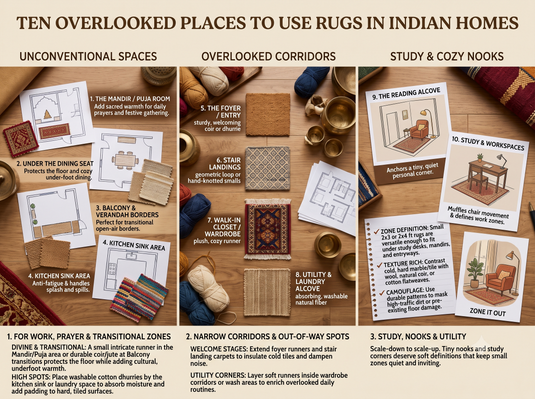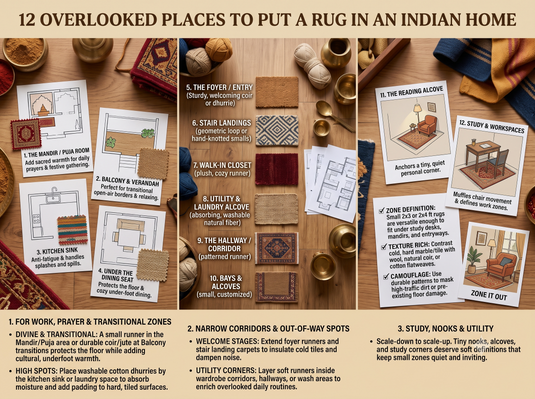
A well-placed rug can transform a spot you pass every day into a place worth using. From a bedside strip to an open-plan reading nook, these overlooked areas can gain comfort and definition without crowding the floor. This guide focuses on practical placement for Indian homes, where space, floor finishes and furniture clearances matter.
Why overlooked spaces need a different rug strategy
Most rug advice begins with a sofa or a bed, but a home also contains the small spaces between destinations. A reading chair, the landing beside a staircase, the space behind a sofa, or a work desk may benefit from a rug without requiring a room-sized purchase. The aim is not to place fabric on every exposed part of the floor. It is to solve a specific problem: visual definition, comfort underfoot or an inviting transition.
In Indian apartments, fixed cabinetry, inward-opening doors, corridors and marble or tiled floors make placement decisions especially important. Start with a tape measure and a simple floor sketch. Include the swing of every door, chair movement and the route people normally take through the space.
1. Beside a reading chair or bedroom armchair
A modest rug can turn a lonely chair and side table into a reading corner. It usually looks more intentional when the chair's front legs land on the rug rather than when the rug floats several inches in front of it. Test whether your feet rest comfortably on the surface while seated.
Choose a low or medium pile where a side table needs steady footing. If you prefer a textured or plush construction, test chair stability and cleaning requirements before deciding. Browse small rugs and compare exact centimetre measurements rather than relying on a size label.
2. Behind a sofa in an open-plan living room
The space behind a sofa may double as a slim console zone, a reading spot or an informal walkway. A rug can visually separate it from the main seating area, but only when there is enough space for safe movement. Do not push a second rug into a narrow passage merely to fill the gap.
For a wider console or gallery-style area, align the runner with the furniture rather than the wall by default. Maintain a visible and convenient pathway, and avoid creating an edge where people repeatedly turn. Compare runner rugs with the measured walkway.
3. Along the side of a bed, not always under it
A bedroom rug need not extend under the entire bed. When a large rug would disappear beneath built-in storage or exceed the budget, a slim bedside runner may give your feet a soft landing without taking over the room.
Think about which side of the bed is used daily and whether a wardrobe door or drawer needs to open over the rug. Use a grippy, floor-compatible underlay where necessary. For the complete under-bed approach, see king and queen bed rug sizing.
4. At the foot of a bed
The space beyond a bed can accommodate a bench, storage trunk or occasional chair. A rug here helps make the arrangement read as a distinct zone, especially in larger bedrooms. It should relate to the width of the furniture and not obstruct the path to the bathroom or balcony.
In a compact bedroom, first check whether enough floor remains exposed around the bed. If not, skip the extra rug rather than selecting one so small that it appears accidental.
5. Under a home-office desk
A rug under a desk can soften a work corner, particularly in a multipurpose living room. Unlike a decorative reading nook, however, desk areas involve frequent chair movement. Thick or loosely textured rugs can make wheeled chairs hard to roll and may wear more quickly.
Draw the full chair movement range, not only the desk footprint. For an office chair with wheels, test a suitable low-profile solution and consider an appropriate chair mat. Ensure furniture legs and edges do not become tripping points.
6. Between two armchairs
Two chairs facing each other can form a conversation nook outside the main sofa grouping. A rug that reaches at least the front legs of both chairs often connects them visually. A very small piece placed between the chairs can feel like a mat rather than an anchor.
The shape can respond to the furniture: a rectangular rug works well with linear side tables, while a round rug may soften an angular room. Test the complete setup with masking tape on the floor before buying.
7. In a generous entryway
A hallway or foyer creates the first impression of the house, but it also brings in dust, rain and outdoor grit. A decorative handmade rug can work in a protected entryway if the cleaning plan is realistic. It should not block the door or curl at the threshold.
At a busy entrance, prioritise an easy-to-maintain surface and a correctly specified pad. If footwear is wet or the space receives significant outdoor debris, a utilitarian entrance mat may be a better first layer than a delicate handmade rug.
8. In a hallway that has enough width
A runner can make a long corridor more welcoming and bring rhythm to otherwise blank walls. Centre it according to the usable walking zone, not automatically according to the distance between two walls. Check cupboard openings and corners.
Leave sufficient uncovered floor for foot placement and avoid abrupt thickness changes near stairs. A runner on a landing must not compromise stair safety. For narrow stairs themselves, seek professional installation rather than positioning a loose area rug.
9. Beneath a small breakfast table
A compact breakfast table or two-seater dining arrangement may benefit from a rug, provided chairs can move without catching on its edges. To test this, pull each chair back to the position it reaches when someone stands up. If the chair falls off the rug, the footprint may be too small.
For dining, consider spills, repeated chair friction and cleaning. A low-profile construction is usually more practical than a very deep pile. Read the round versus rectangular dining rug guide for shape decisions.
10. In front of a bookshelf
An independent bookshelf wall can become a small library corner with a rug, floor cushion or low chair. However, the rug should not interfere with doors, drawers or ladders, and the bookcase must be stable and properly secured independently of the rug.
Treat the rug as a finishing layer, not a substitute for suitable furniture positioning or anchoring. For colour, repeat one existing accent from book spines, upholstery or wall art rather than introducing several new dominant colours.
11. In a covered balcony or indoor-outdoor transition
A covered balcony may look like a natural location for a rug, but exposure to wind-driven rain, intense sunlight and moisture can damage materials that are intended for indoor use. Check the product's stated use and fibre requirements before placing it there.
Do not assume that every handmade wool, bamboo-silk or hand-knotted rug is outdoor-rated. If the balcony is not reliably dry and protected, select a rug expressly designed for outdoor conditions from an appropriate retailer instead.
12. In a nursery or children's reading zone
A defined play or reading area can be useful when children share a larger room with other activities. Measure the zone for comfortable sitting, ensure the rug lies flat, and choose materials and cleaning requirements suitable for the household.
Never use a rug as a substitute for supervision or age-appropriate flooring safety. Avoid loose corners and use only a compatible non-slip backing or pad. When in doubt, prioritise function over decorative texture.
Choosing shape, colour and pile for small spaces
Start with geometry. Long narrow layouts generally suggest a runner; square furniture groupings may suit a compact rectangular or round rug; irregular nooks may require a carefully measured custom shape. The visual scale of the pattern matters too: tiny repeated motifs can become busy beside ornate furniture, while a bold field of colour can simplify the floor.
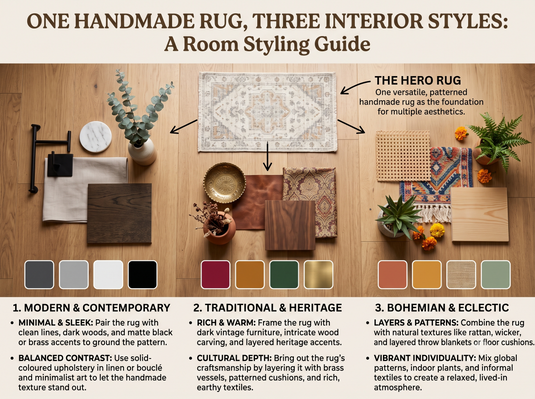
A handmade rug also has a tactile identity. Wool offers a different handle and maintenance profile from bamboo silk or blended materials. Check the fibre label, construction, pile height and care guidance on the actual product. Browse modern rugs and hand-knotted rugs to compare documented designs.
A practical five-minute placement test
First, measure the usable floor area. Second, mark the proposed rug outline with painter's tape. Third, open doors, pull out chairs and walk the usual routes. Fourth, check whether the rug anchors at least one piece of furniture or defines a purposeful activity. Fifth, evaluate direct sunlight, moisture, cleaning and the flooring material.
Photograph the taped area from your doorway and the main seating point. A useful rug often improves how the room reads from both views. If the layout works only from one angle, try a different size or rotate the rug before ordering.
Mistakes to avoid
Avoid stacking multiple small rugs in a busy passage, positioning a rug too close to a swinging door, placing an easily marked fibre by wet footwear, or ignoring chair travel. Do not choose a runner solely because its width matches a hallway. Leave breathing room on both sides and consider how people use the floor.
A pad is not universal: match it to the rug and the manufacturer's advice for marble, stone, tile or timber. Test for dye transfer and finish compatibility where appropriate, and keep safety and floor-care rules ahead of styling.
Frequently asked questions
Can I use a rug in a narrow corridor? Yes, if its width, thickness and edge placement leave a safe, unobstructed route. Should a rug go entirely under a desk? It should cover the necessary chair movement zone; test the chair before committing. Is a round rug always better for a small nook? No. It depends on furniture layout and available clearance.
Do I need a rug in every corner? No. A purposeful gap is often more elegant than adding a rug to every patch of floor. Can handmade rugs be used on balconies? Only if the specific product is suitable for those conditions. What if standard dimensions don't fit? Explore custom sizing after confirming the exact layout and intended use.
Two more flexible ideas: dressing areas and guest rooms
In front of a wardrobe or dressing table
A compact rug can soften a dressing area where you stand each morning. Measure not just the visible floor but the full swing of wardrobe doors and the distance needed to pull out drawers. Choose a low-profile construction if there is limited clearance, and ensure the rug stays stable on tile or marble. Where you have a long dressing wall, a well-sized runner may be more practical than a small accent rug. Explore bedroom rugs and compare exact dimensions before purchasing.
In a guest bedroom
A guest room that doubles as a study or storage space may not need a large rug under the bed. A modest bedside piece can welcome visitors and can be moved when the room's function changes. Keep the rug away from suitcase wheels, folding furniture and doors, and make sure edges do not curl. If the room is used infrequently, still check periodically for moisture and dust rather than leaving a rug unattended for months.
At the boundary between living and dining zones
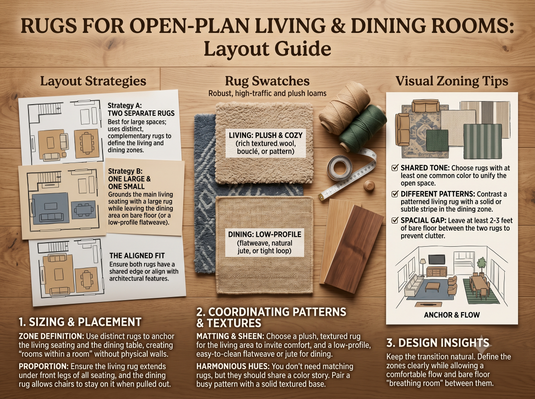
In some open-plan homes, the best placement is not the middle of either zone but the comfortable reading or occasional seating spot between them. Avoid putting a loose rug directly across a busy passage. If two distinct rugs would work better, read our open-plan living and dining rug layout guide before measuring. A living room rug should anchor furniture rather than merely cover empty floor.
Explore rugs with The Ambiente
If you have an unusual floor plan, share room dimensions, furniture photos and the intended placement. The Ambiente team can help you compare suitable designs and discuss custom possibilities, subject to product specifications.
Need help choosing the right rug?
Send your room measurements and placement photos to The Ambiente.
Chat with us on WhatsApp