Rugs for Open-Plan Living and Dining Rooms: Layout Guide. A practical guide for Indian homes.
Start with zones, not products
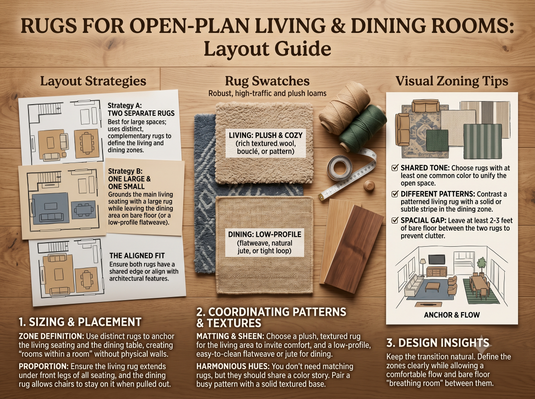
An open-plan room may contain seating, dining and passage without walls between them. Rugs can define these functions visually and add comfort. Begin with a drawing of where people sit, eat and move, then work out whether one rug or two are truly needed. A second rug is not mandatory beneath every table. The strongest arrangement feels connected and leaves usable flooring visible rather than covering every corner.
Measure your furniture footprint
Record sofa width, chair positions, dining table dimensions and how far dining chairs move when someone sits down. Mark doors and the route from the entrance to kitchen or balcony. Tape the intended rug outlines on the floor. This reveals whether a corner falls in a walking route or a chair catches its edge. Room dimensions alone are not enough; the rug needs to relate to furniture and ordinary movement.
Living room placement
For many seating groups, the front legs of sofas and chairs can rest on a rug, visually joining the furniture. In larger rooms, an all-legs-on arrangement may be suitable. A rug that reaches only beneath the coffee table often looks isolated. Match its shape to the way seating faces the television or conversation area. Browse living room rugs to assess choices, then verify dimensions on the product pages.
Dining rug placement
Dining chairs should remain supported as they pull away from the table, otherwise they may catch the rug edge repeatedly. Measure the dining table with the chairs in a normal seating position and allow appropriate clearance. Rectangular rugs often suit long tables; round rugs can suit round tables if dimensions work. Think about spills and cleaning requirements before choosing delicate fibres for a dining area. Explore dining room rugs and round rugs.
One rug or two?
A living rug alone may provide enough definition when the dining space is compact or exposed to frequent spills. Two rugs can work when both zones benefit from softness and the floor plan offers sufficient separation. The key is to retain sensible pathways between them and avoid edges colliding. A rug beneath a dining table is a lifestyle decision, not a decoration rule. Consider how frequently chairs move and how much cleaning each surface requires.
Coordinate colours
Rugs in adjoining zones should look related without needing to be identical. One may contain olive and ivory while the other is mainly ivory with a small amount of green. Alternatively, repeat a texture or undertone. If the living rug is rich in pattern, keep the dining rug quieter. Avoid buying two bold statement pieces simply because each looks attractive in isolation. View product photographs side by side and compare them to your floor and upholstery.
Different patterns and shapes
Mixing rug shapes can work when driven by furniture arrangements. A rectangular piece may frame the sofa and a round piece may complement a circular dining table. Pattern scale needs careful attention: large geometry next to a detailed floral rug can look crowded. Let one area take visual priority and use the other as a softer companion. An open-plan room should read as one interior with different functions, not two unrelated showroom sets.
Small apartment solutions
In a modest flat, a living room rug can be the main soft furnishing while the dining table remains on bare flooring. This reduces clutter and makes chair movement easier. Choose the rug by the actual seating group rather than the full room dimensions. Check medium-size rugs and draw the rug footprint with tape. Leave space near doors and passages to avoid tripping hazards. A correctly sized rug often does more than multiple undersized rugs.
Larger open-plan homes
A generous seating group may require a larger rug to prevent furniture from feeling scattered. Compare large rugs with oversized rugs according to the measured footprint. A dining rug can be chosen next, using the first rug's colours as a guide. Remember that large handmade rugs need practical delivery access and professional cleaning considerations.
Material, safety and maintenance
Living rooms and dining areas can have very different demands. Wool can offer natural texture for a seating space, while material, weave and pile height should be chosen carefully where chairs move and food spills occur. Never assume every rug is washable or stain-resistant. Inspect corners and consider a compatible non-slip underlay where necessary. Move heavy furniture by lifting rather than dragging it. FAQ: Must both rugs match? No. Is a dining rug essential? No. How big should it be? Large enough to support normal chair movement, judged from your specific table layout.
Worked example: sofa zone and four-seat dining table
Picture a rectangular open-plan apartment with a sofa at one end and a four-seat dining table near the kitchen. Start by measuring the sofa group, including any armchairs. Mark a candidate living rug that reaches beneath the main seating front legs. Next pull out the dining chairs as they would be during a meal and mark their movement. If the two outlines are too close, prioritise the living rug and leave the dining zone uncovered. That can be more functional than squeezing two rugs into insufficient floor space.
Worked example: large residence with two zones
For a spacious home, identify a dominant living rug first. Perhaps it has an ivory field and soft blue detail. The dining zone could then use a quieter neutral design with a compatible undertone rather than an identical print. Maintain enough uncovered flooring to establish visual separation. Before ordering an oversized living rug, verify the lift, staircase and doorway dimensions needed for delivery. A design that fits the room but cannot be carried to it is not a workable purchase.
Dining clearance measurement method
Place the table in its final position, pull each chair back to a comfortable sitting and standing distance, and measure the full footprint. The dining rug should support the chair legs during normal movement, without repeatedly catching them at the edge. Do not use a single standard dimension for every dining set: chair size, table shape and room layout vary. If the rug needed is larger than the clear dining zone allows, consider leaving the flooring exposed instead.
Visual continuity between two rugs
Two rugs can look related because they share warmth, texture or one secondary accent. An olive and cream living rug can coordinate with a plain warm ivory dining rug without matching exactly. A vivid patterned design next to another vivid design may pull attention in conflicting directions. Make a small mood board with both rugs, furniture and flooring. Judge them together at the scale at which they will be seen from the entrance, not as isolated website images.
Practical choices for everyday dining
Food spills and frequent chair movement make construction important. A delicate lustrous pile may not be a sensible choice under a heavily used dining table. A stable low-profile design may permit easier chair movement, although actual fibre care still matters. Check whether crumbs can be removed according to the manufacturer's cleaning guidance. Do not assume that a rug described as wool, washable or durable has the same treatment requirements as every other rug of that category.
Handling circulation and door swings
Leave a natural route between the living and dining zones, especially where people carry dishes or move chairs. A corner extending into a corridor can become a trip hazard and often looks awkward. Mark doors in their fully open positions on your plan. If a balcony door or wardrobe catches the proposed pile, adjust the size or location. A rug should support the room's daily use, not force people to walk around it unnaturally.
Making a purchase checklist
Collect room measurements, sofa and table dimensions, chair-clearance measurements, two photographs of the floor and a record of existing upholstery colours. Then shortlist rugs by real size and fibre composition. Check product photography from more than one angle, confirm delivery access and discuss maintenance. If standard dimensions are unsuitable, ask about custom possibilities rather than compromising placement. A well-sized single rug is usually preferable to two poorly placed rugs.
One rug or two? A useful decision rule
Use one large rug when the seating and dining furniture operate as a single compact arrangement and a second rug would interrupt circulation. Use two rugs when the room has clearly separate conversation and dining zones and there is enough clear floor between them. Neither arrangement is automatically more luxurious. The floor plan determines what works.
Dining chair clearance comes first
Before buying a dining rug, pull each chair back to its normal standing position and measure the resulting footprint. The rug should not end exactly where chair legs repeatedly move, because catching an edge can be uncomfortable and unsafe. A low-profile material is often more manageable in eating areas than a deep pile. See round versus rectangular dining rugs for shape considerations.
Coordinate zones without matching everything
Carry one shared colour or material character between the seating and dining areas. The rugs need not have identical patterns. Map entry doors, kitchen traffic and table pull-back space before selecting sizes. For seating layouts, refer to the living-room size guide; for less obvious corners, explore alternative rug placements.
Need help choosing your rug?
Share your room photo, approximate measurements and preferred colours with The Ambiente.
WhatsApp: +91 63885 19911