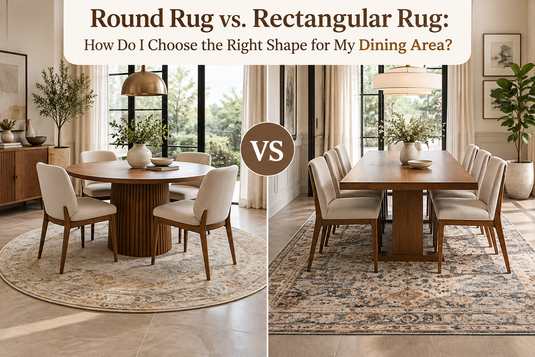
Choosing a rug for a dining area involves more than finding a pattern you like.
The rug has a practical job. It needs to sit comfortably under the dining table and chairs, stay relatively flat as chairs move back and forth, and protect the floor beneath. At the same time, it has a visual job. It should make the table feel grounded in the room rather than looking as though a rug was simply placed underneath it because there happened to be an empty patch of floor.
One of the first decisions is shape.
Should you use a round rug or a rectangular rug?
The most useful starting point is usually the dining table itself. Round tables often pair naturally with round rugs, while rectangular tables usually work well with rectangular rugs. But that is a guideline, not a rule. Room proportions, table size, chair clearance, nearby furniture, traffic paths, and the overall feeling you want can all point you in a different direction.
At The Ambiente, we tend to think of dining rugs in terms of relationships. The rug needs to relate to the table, but it also has to relate to the room around it.
Here is how to choose between a round and rectangular rug without getting trapped by rigid design rules.
Start With the Dining Table Shape
Your table is the most obvious reference point.
If you have a round dining table, a round rug repeats that shape. The result usually feels cohesive because the rug follows the geometry of the furniture above it.
A rectangular table on a rectangular rug works for the same reason. The lines of the table and rug reinforce one another.
That makes matching the rug shape to the table a reliable approach.
But reliable is not the same as mandatory.
A round table can look excellent on a rectangular rug, particularly in a rectangular room. A square table can work with a round rug. An oval table might sit comfortably on either an oval or rectangular rug, depending on the dimensions.
The question is not simply, "Do the shapes match?"
A better question is, "Do the proportions make sense when the table, chairs, rug, and room are viewed together?"
Why a Round Rug Works So Well With a Round Table
There is something naturally satisfying about a round dining table centered on a round rug.
The repeated shape creates a clear focal point. It also emphasizes one of the main qualities people like about a round table in the first place: there is no obvious head of the table.
This combination can work particularly well in breakfast nooks, compact dining rooms, open-plan dining zones, and square rooms.
Imagine a 48-inch round table with four dining chairs. Place it on a sufficiently large round rug, and the whole arrangement becomes one defined visual unit.
A round rug can also soften a space with a lot of straight architectural lines. Most rooms are made up of rectangles. Walls, doors, windows, cabinets, islands, and many pieces of furniture all tend to be linear.
Introducing a large circle can break up that repetition.
That does not mean round is automatically more interesting. It simply creates a different visual rhythm.
When a Rectangular Rug Works Better Under a Round Table
This is where matching rules become less useful.
Suppose you have a round dining table, but your dining room is long and narrow. A round rug large enough to accommodate the chairs may leave awkward amounts of floor exposed at either end while coming relatively close to the side walls.
A rectangular rug might relate better to the dimensions of the room.
It can create a larger visual zone around the table while reinforcing the room's length.
A rectangular rug is also useful when the dining area includes more than just the dining table. If a sideboard, bar cabinet, or console visually belongs to the dining zone, a rectangular rug may help make the whole area feel more substantial.
Another factor is availability.
Round rugs are widely available, but rectangular rugs come in a much broader range of standard sizes. If your table requires a very large rug, finding the exact round size you need can sometimes be more difficult or expensive.
Never choose a round rug that is too small simply because it matches the table shape.
Correct size matters more than matching geometry.
Rectangular Tables Usually Favor Rectangular Rugs
If you have a six- or eight-seat rectangular dining table, a rectangular rug is generally the most straightforward choice.
It follows the table's proportions and provides space for chairs along both the long and short sides.
This is particularly important when the end chairs are used regularly. You want all diners to have enough rug behind them to pull out their chairs without immediately catching the rear chair legs on the rug edge.
A rectangular rug also helps reinforce the dining zone in an open-plan room.
For example, if the dining table sits between a kitchen and living room, a large rectangular rug can visually mark where dining begins and ends without requiring a physical divider.
For most standard rectangular dining tables, starting your rug search with rectangular options will make the sizing process easier.
Can You Put a Rectangular Table on a Round Rug?
Yes, but it takes more care.
This combination tends to work best when the table is relatively compact and the round rug is generously sized.
A small rectangular or square table centered on a large circle can create an interesting contrast. The effect can feel deliberate and less predictable than simply repeating the same shape.
The difficulty is chair clearance.
The corners and ends of a rectangular table spread seating into areas where the round rug narrows. A rug that looks large enough from directly above may not actually provide enough surface when an end chair is pulled backward.
This is why measurements matter.
Use the chairs, not just the tabletop, to determine rug size.
If the round rug needs to become enormous to accommodate a long rectangular table comfortably, a rectangular rug will usually be the more practical and visually balanced choice.
Rug Size Matters More Than Rug Shape
If there is one dining-room rug rule worth taking seriously, it is this:
Your dining rug needs to be large enough for the chairs.
A beautiful rug in the perfect shape will still feel wrong if diners are constantly catching chair legs on its edge.
When someone sits down at a dining table, they pull the chair away from the table first. Ideally, all four chair legs should remain on the rug during normal use.
A common guideline is to extend the rug roughly 24 inches beyond the edge of the table on all sides, with many rooms benefiting from closer to 30 inches depending on the chairs and seating arrangement.
Treat those numbers as a starting point rather than a universal rule.
Dining chairs vary in depth. People pull them out different distances. Armchairs may require more room than compact side chairs.
The better method is to test your actual furniture.
Pull a chair back as you normally would to sit down. Measure from the table edge to the rear chair legs. Repeat at both the sides and ends of the table.
Now you know how much functional rug space you really need.
Don't Measure Only the Tabletop
This is one of the most common mistakes when buying a dining rug.
Someone has a 60-inch round table, so they shop for a rug that looks proportionally larger than 60 inches.
But the table itself does not move across the rug. The chairs do.
The same issue occurs with rectangular tables. A table might be 72 by 40 inches, but once six chairs are pulled out for seating, the functional footprint is dramatically larger.
Think of the dining set at its maximum normal use rather than its most compact appearance.
If the table has extension leaves, there is another question to consider.
Do you size the rug for everyday use or for the fully extended table?
If you regularly host large dinners with the table extended, it makes sense to size the rug for that arrangement. If you use the extension once every two years, you may decide that the everyday setup matters more.
There is no right answer, but make the decision before purchasing the rug.
Consider the Shape of the Room
The table is not the only shape in the room.
Look at the architecture.
Is your dining room square, rectangular, open-plan, or tucked into a curved bay? Is it a small breakfast nook? Does one side open into another room?
A round rug can look particularly natural in a square room because it creates a centered focal point without emphasizing one axis more than another.
In a long rectangular dining room, a rectangular rug often sits more comfortably within the architecture.
You should also look at the amount of visible floor around the rug.
Ideally, the gap between the rug and nearby walls or fixed elements should feel intentional rather than cramped.
If an oversized round rug nearly touches two walls but leaves large empty areas in other directions, its relationship to the room may feel awkward.
Likewise, an extremely long rectangular rug can dominate a compact dining room unnecessarily.
Shape and scale need to be considered together.
Open-Plan Dining Areas Have Different Needs
In an open-plan home, a dining rug does something especially useful: it creates a visual boundary.
There may be no wall separating the dining table from the living room or kitchen. The rug can provide that distinction.
A rectangular rug is often effective here because it creates a clearly defined zone around a rectangular dining table.
But a round rug can be even more useful when you want visual contrast.
Suppose the living room next to the dining area already contains a large rectangular rug. Adding another rectangle a few feet away can sometimes make the floor look like a collection of adjacent boxes.
A round rug beneath a round dining table can create separation between the two zones.
Rather than trying to make the rugs match exactly, look for a relationship between them. They might share a color, material, level of formality, or general visual weight.
They do not need to be identical.
Think About How People Walk Through the Room
Traffic flow is easy to ignore when looking at a floor plan.
In daily life, it matters enormously.
Where do people walk when moving from the kitchen to the dining table? Is there a door directly behind one chair? Does someone need to walk between the rug and sideboard to reach another room?
The dining rug should not create awkward little strips of walking space.
For example, placing a very large round rug in a narrow rectangular room may leave curved gaps along the walls. If those gaps happen to be main traffic paths, the layout might feel less comfortable than a rectangular rug that follows the room more closely.
Likewise, rug edges should not land in inconvenient places where people are repeatedly stepping on and off them while carrying dishes.
Map out the way the room is actually used.
A technically beautiful arrangement can still be irritating if it interferes with everyday movement.
A Round Rug Can Make a Small Dining Area Feel Intentional
Small dining areas present an interesting challenge.
Sometimes there is no formal dining room at all. You may have a table tucked into the corner of a kitchen, a small apartment dining area, or a breakfast nook beside a window.
A round table is often a smart choice in these locations because it eliminates corners and makes it easier to move around.
Pairing it with a round rug reinforces the sense that the table has its own defined space.
This can prevent the dining setup from feeling like leftover furniture squeezed into an available corner.
But resist the temptation to use a tiny rug.
A rug barely wider than the table can make a small space feel more cramped, not less.
Even in a compact dining area, the chairs need room to function.
If you cannot fit an appropriately sized rug without blocking doors or hitting walls, it may be better to use no dining rug at all.
Yes, Going Without a Dining Rug Is an Option
Not every dining area needs a rug.
If the room is too small, chairs constantly catch rug edges, or your household experiences frequent food spills, leaving the hard flooring exposed may be the practical choice.
This can be particularly sensible beneath a table used by young children.
A rug adds warmth, sound absorption, color, and visual definition, but it also adds another surface to clean.
At The Ambiente, we would rather see a dining room with no rug than one with a rug that is obviously too small for the furniture.
A rug should improve the room's function, not create a daily obstacle.
What About Square Dining Tables?
Square tables can go either way.
A square rug is the most literal match, but square rugs are not always readily available in the size or design you want.
A round rug can work beautifully beneath a square table, particularly in a square dining room.
The geometry creates a layered effect: square room, round rug, square table.
This arrangement tends to work best when the rug is clearly large enough. If the circle barely reaches beyond the table corners, the rug will look undersized.
A rectangular rug is also possible, especially if the room itself is rectangular or the table expands into a rectangular configuration.
Again, think about the expanded chair footprint.
What About Oval Dining Tables?
Oval tables sit somewhere between round and rectangular geometry.
A rectangular rug is usually the easiest option because it provides generous chair clearance at the sides and rounded ends of the table.
An oval rug can look elegant too, particularly if you want to echo the tabletop shape. Availability can be more limited, however.
A large round rug can occasionally work with a compact oval table, but the dimensions have to be right.
If the oval table is long, a round rug usually needs to become disproportionately large before the end chairs fit comfortably.
When in doubt, rectangular is the practical choice for a long oval dining table.
Pattern Can Affect How the Shape Feels
Rug shape and rug pattern work together.
A round rug with a strong central medallion naturally pulls attention toward the center of the dining table. This can create a formal, composed look.
A round rug with an all-over pattern feels less centered and can work well in casual spaces.
Rectangular rugs provide more room for borders, repeating motifs, stripes, and directional patterns.
Pay attention to what will actually remain visible once the table is placed on top.
Dining tables conceal a substantial part of a rug. If the rug has an elaborate central motif, the most interesting portion may disappear entirely beneath the table.
A border-based design may remain much more visible around the chairs.
The same applies to round rugs. If the design relies heavily on one central feature, decide whether you are comfortable covering it.
There is no problem with doing so. Just know what you are buying.
Material Matters in a Dining Area
Once you have decided on shape and size, think about construction.
Dining rooms experience food, drink, crumbs, chair movement, and regular foot traffic.
Very deep or shaggy rugs can make chair movement difficult. They also provide more space for crumbs to settle.
For most dining areas, a low-pile or flatwoven rug is easier to live with.
Wool can be an excellent choice because it is durable, resilient, and attractive, although spills need to be handled appropriately.
Certain synthetic rugs offer useful stain resistance and easy maintenance, which can be appealing in a household with children.
Natural-fiber rugs such as sisal can create a beautiful textural foundation but may be less forgiving of liquid spills, depending on the material.
There is no universal best fiber.
Choose based on how often the table is used and what kinds of messes are realistic in your household.
Round Rugs Can Soften Angular Furniture
Dining spaces often contain a surprising number of straight lines.
There is the sideboard, cabinet, doorway, flooring pattern, window frames, chairs, and sometimes the dining table itself.
A round rug introduces a strong curved shape at floor level.
That can be useful if the space feels overly rigid.
You do not need a round dining table to take advantage of that effect. A small square table on a generous round rug can create an appealing contrast.
The key word is generous.
When mixing shapes, the size needs to look deliberate. If the rug is too small, the effect looks accidental rather than interesting.
Rectangular Rugs Are Easier to Coordinate With Larger Dining Sets
For large dining tables, rectangular rugs generally become the practical winner.
Consider a table seating eight or ten people.
The table is already long, and the chairs extend the usable footprint even further. A rectangular rug can follow this shape efficiently.
A round rug large enough to hold every chair might require a very large diameter, taking up unnecessary floor space at the sides while still potentially creating clearance issues near the table ends.
Rectangular rugs are also available in larger standard dimensions, making them easier to source.
If you regularly seat six or more people around a long table, there needs to be a compelling reason to move away from a rectangular rug.
Make Sure the Rug Is Flat Enough for Chairs
A dining rug should stay put.
Because chairs move repeatedly, curled corners, wrinkles, or shifting can become particularly annoying.
This is one reason a suitable rug pad matters.
A rug pad can help reduce movement, protect the flooring underneath, add a small amount of cushioning, and support the rug.
Choose one specifically compatible with both your rug and your flooring material.
The pad should normally be slightly smaller than the rug itself so it does not show around the edge.
With round rugs, use a pad that can be trimmed or purchased in an appropriate circular shape. A rectangular pad extending beyond the curved edge defeats the purpose.
If your dining chairs are heavy or moved frequently, stability is especially important.
Test the Shape Before You Buy
One of the simplest ways to decide between round and rectangular is also one of the cheapest.
Mark the potential rug dimensions on the floor.
You can use painter's tape, paper, or another temporary method that is safe for your flooring.
For a rectangle, tape out the full perimeter.
For a circle, mark the rug's diameter and enough points around the circumference to visualize its footprint. You can also use string from the proposed center point to establish the radius.
Put the table and chairs in their normal positions.
Then pull every chair out.
Walk around the room. Open nearby doors. Sit down at the table. Imagine moving through the space while someone else is seated.
This exercise tells you far more than looking at a rug online against a white background.
It also prevents one of the most common expensive mistakes: discovering after delivery that the rug looked much larger in your imagination.
Common Dining Rug Mistakes to Avoid
The wrong rug shape is rarely the biggest problem. Size and placement usually cause more trouble.
Common mistakes include:
- Choosing a rug only a few inches wider than the table
- Forgetting to account for chairs when they are pulled out
- Buying a round rug solely because the table is round, even though it does not suit the room
- Centering the rug in the room instead of around the dining arrangement when those centers are different
- Ignoring an extension leaf when the table is frequently expanded
- Using a deep-pile rug that makes chairs difficult to move
- Choosing a delicate material in a household where frequent spills are inevitable
- Forgetting nearby doors, vents, cabinets, or traffic paths
- Buying a large rug without checking whether it can realistically be cleaned
- Skipping an appropriate rug pad
Most of these problems can be prevented with measurements and a little planning.
Should the Rug Be Centered in the Room?
Not necessarily.
Ideally, the rug should be centered under the dining table.
The dining table itself may or may not be perfectly centered in the room.
Suppose one wall contains a large sideboard. You may need to shift the dining table slightly away from it to maintain comfortable walking space. If you center the rug in the architecture rather than under the table, the whole arrangement can look off balance.
Treat the table, chairs, and rug as a single furniture grouping.
Then position that grouping within the room.
This is particularly important in open-plan layouts where there may not even be four traditional walls defining the dining area.
How to Decide Between Round and Rectangular
If you are still undecided, start with these basic relationships.
A round rug is particularly worth considering when you have a round table, a square or compact dining zone, or you want to introduce curves into a room dominated by straight lines. It can also help distinguish a dining zone from a nearby rectangular living-room rug.
A rectangular rug is usually the more practical choice for a rectangular table, long dining room, large dining set, or table that regularly seats six, eight, or more people. It is also generally easier to find in a wide range of standard sizes.
But shape comes after function.
Before deciding, make sure the proposed rug provides enough chair clearance and fits comfortably within the room.
If the "correct" matching shape forces you to buy a rug that is too small, choose the other shape.
A Simple Way to Think About the Decision
At The Ambiente, we recommend looking at the decision in this order:
- Measure the dining table in its normal configuration and, if relevant, fully extended.
- Pull the dining chairs back to a comfortable seating position.
- Measure the total footprint created by the table and extended chairs.
- Look at the shape and proportions of the room.
- Check walking routes, doors, sideboards, cabinets, and nearby furniture.
- Compare round and rectangular rug dimensions that fully accommodate the chairs.
- Mark both options on the floor before buying.
- Only then decide which shape looks better.
This order matters because it prevents appearance from overriding function.
A dining rug is different from a decorative rug in an entryway. Furniture moves across it every day. If that movement does not work, you will notice the problem constantly.
Round or Rectangular: Which Would The Ambiente Recommend?
For a round dining table, we would typically look at round rugs first. The visual relationship is natural, particularly in a square dining room or breakfast nook.
For a rectangular dining table, we would usually start with a rectangular rug. It offers the easiest way to provide adequate chair clearance and maintain balanced proportions.
But we would not force either combination.
A round table in a long rectangular room may look better on a rectangular rug. A small square table in a compact dining area may become much more interesting when centered on a large round rug.
The deciding factors should be scale, chair movement, room shape, and how the dining area connects with the rest of the home.
The Right Shape Is the One That Works When You're Actually Eating
Dining rooms are sometimes designed as if chairs never move.
In photographs, every chair is pushed neatly under the table. The rug is perfectly aligned. Nothing is spilled, nobody needs to squeeze behind another person, and apparently no one ever drops a breadcrumb.
Real dining rooms do not work like that.
People pull chairs back. Children move them at odd angles. Guests walk behind seated diners. Tables get extended for holidays. Drinks spill. Crumbs fall.
Your rug should accommodate that reality.
That is why size should come before shape, and function should come before a strict design formula.
A generously sized round rug under a round table can create one of the most balanced dining arrangements you can make. A rectangular rug beneath a long dining table can anchor a room and give every chair the space it needs. Crossing those shapes can also work beautifully when the architecture supports it.
At The Ambiente, we suggest treating design rules as useful starting points rather than instructions you cannot break.
Measure your table. Pull out the chairs. Look at the proportions of the room. Consider the nearby furniture and traffic paths. Mark the rug dimensions on your floor before making a decision.
If a round rug makes the table feel comfortably centered and gives every chair enough room, choose round.
If a rectangular rug relates better to the room and provides more practical space around the table, choose rectangular.
The best dining rug is not simply the one that matches the tabletop. It is the one that makes the entire dining area feel considered and works just as well when dinner is underway as it does when the room is empty.