When people shop for carpet, color and softness usually get most of the attention. That makes sense. Those are the things you notice immediately when you walk into a room or pick up a carpet sample.
But the fiber deserves just as much attention.
Carpet fiber affects how the floor feels, how well it handles foot traffic, how easily it stains, how much it costs, and how it needs to be cleaned. It can also influence how quickly a carpet shows wear in a hallway compared with a quiet bedroom.
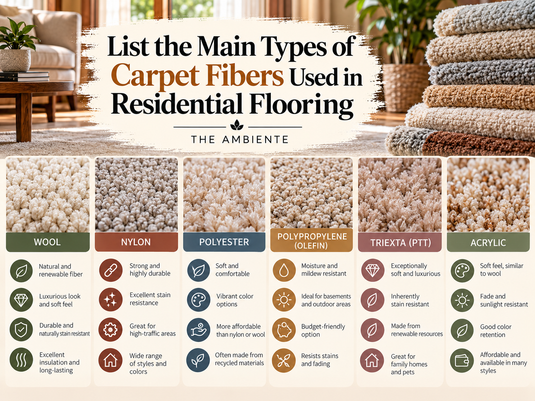
The main carpet fibers used in residential flooring are nylon, polyester, polypropylene, wool, and triexta. You may also encounter acrylic, natural plant fibers, and various blends, although these are less common in standard wall-to-wall residential carpeting.
There is no single best carpet fiber for every home. A family room with children and pets has different requirements from a formal bedroom. A basement has different environmental concerns from an upstairs hallway. Budget, cleaning habits, allergies, desired lifespan, and even direct sunlight can affect the decision.
At The Ambiente, we think understanding the material is one of the easiest ways to make a more confident flooring choice. Once you know what the main fibers actually do, comparing carpet samples becomes much more useful.
Here is a closer look at the major carpet fiber types, where they work well, and the trade-offs worth considering.
Why Does Carpet Fiber Matter So Much?
The visible surface of a carpet is made from thousands or millions of fibers. Those fibers are repeatedly stepped on, compressed by furniture, vacuumed, exposed to spills, and subjected to dust and everyday dirt.
The material determines how those fibers respond.
Some fibers are particularly resilient, meaning they tend to recover after being compressed. Others are valued for softness or stain resistance. Some absorb very little moisture. Natural fibers such as wool have characteristics that are quite different from petroleum-based synthetic fibers.
Fiber is not the only measure of carpet quality, however.
Construction matters just as much. Pile density, twist, pile height, backing, tufting or weaving method, padding, and installation can all affect performance.
A high-quality carpet made from one fiber may easily outperform a poorly constructed carpet made from another.
This is important because carpet shopping is often reduced to statements such as "nylon is best" or "wool is luxury." Those descriptions may point to general tendencies, but they leave out most of the actual buying decision.
Think of fiber as the starting point.
1. Nylon Carpet
Nylon is one of the most established synthetic fibers used in residential carpeting.
Its biggest strength is resilience.
A carpet is constantly being compressed when people walk across it. Furniture also puts sustained pressure on the pile. Nylon generally has a strong ability to handle this kind of use and maintain its appearance, particularly when the carpet is densely constructed.
That makes it a popular choice for high-traffic areas.
Hallways, stairs, living rooms, family rooms, and other frequently used parts of a home are all places where nylon deserves consideration.
What Are the Advantages of Nylon Carpet?
Durability is the main attraction.
Good-quality nylon carpet can perform very well in active households, and its resilience makes it useful where a softer fiber might flatten or mat more quickly.
Nylon is also available in an enormous range of styles. It can be used to create plush carpets, textured surfaces, loops, patterns, and low-pile commercial-inspired flooring.
Modern nylon carpets may also be treated or manufactured to improve stain resistance.
Solution-dyed nylon is worth knowing about. In solution dyeing, pigment is incorporated into the material as the fiber is produced. This can provide excellent colorfastness and resistance to certain stains and fading.
For families with children or pets, those qualities can be particularly valuable.
What Are the Drawbacks of Nylon?
Nylon can cost more than polyester or polypropylene carpet.
While it generally offers good long-term performance, you still need to decide whether the additional cost makes sense for the room.
A lightly used guest bedroom, for example, may not need the same level of resilience as a busy hallway.
Nylon can also absorb some moisture, although stain treatments and manufacturing methods affect its behavior.
As with any synthetic carpet, people concerned about environmental impact may want to look into recycled content, recyclability, product certifications, manufacturing processes, and expected lifespan rather than judging the fiber solely on its synthetic origin.
Where Does Nylon Work Best?
Nylon is particularly well suited to areas that receive significant foot traffic.
If your main priority is durability and you want conventional wall-to-wall carpeting, nylon should usually be somewhere on your shortlist.
2. Polyester Carpet
Polyester has become a major part of the residential carpet market, and it is easy to understand why.
It can feel very soft, comes in rich colors, offers good resistance to many common stains, and is often available at accessible price points.
Polyethylene terephthalate, commonly called PET, is widely used for polyester carpeting. Some polyester carpet incorporates recycled material, including material derived from plastic bottles.
What Are the Advantages of Polyester Carpet?
Softness is one of polyester's strongest selling points.
If you are choosing carpet for a bedroom where barefoot comfort matters more than extreme traffic resistance, polyester can be very appealing.
It also has naturally good resistance to many water-based stains because polyester is relatively hydrophobic.
Color is another strength. Polyester can produce bright, saturated shades as well as the neutral colors used in most residential interiors.
Price is often attractive too. Depending on the product, polyester can offer the look and feel you want for less than a comparable premium nylon carpet.
What Are the Drawbacks of Polyester?
Resilience is the main issue to consider.
Polyester generally does not recover from crushing as effectively as nylon, especially in lower-quality constructions. In heavily trafficked areas, it may show matting or wear sooner.
That does not mean all polyester carpet performs poorly. Dense, well-constructed polyester can be a perfectly sensible residential floor.
The important point is to match it to the room.
Polyester can also be attracted to oily soils, so regular cleaning and appropriate stain treatment matter.
Where Does Polyester Work Best?
Bedrooms, guest rooms, home offices, and moderate-traffic living spaces can all be good candidates.
If budget, softness, and stain resistance are high priorities, polyester is worth comparing directly with nylon rather than assuming the more expensive option is always necessary.
3. Polypropylene or Olefin Carpet
Polypropylene is another synthetic carpet fiber. In the flooring industry, you will also hear it called olefin.
Its most distinctive characteristic is very low moisture absorption.
This makes polypropylene useful in environments where moisture and staining are concerns, although it does not make the carpet or room waterproof.
You often find polypropylene in indoor-outdoor carpeting, looped carpets, carpet tiles, and certain budget-conscious residential products.
What Are the Advantages of Polypropylene?
Polypropylene is highly resistant to water-based staining because the fiber absorbs very little moisture.
It can also have good colorfastness, particularly when solution-dyed.
The fiber is often relatively affordable, making it attractive for large spaces or projects where budget is a major consideration.
Polypropylene's low moisture absorption can make it worth considering for a dry, properly prepared basement. That said, no carpet should be installed over an unresolved moisture problem simply because its face fiber is polypropylene.
What Are the Drawbacks of Polypropylene?
Resilience is a major limitation.
Polypropylene does not generally recover from compression as well as nylon. Heavy furniture and substantial foot traffic may cause crushing or matting, depending on the carpet's construction.
It can also attract oily substances, which can make some soil difficult to remove.
Heat is another consideration. Polypropylene has a relatively low melting point compared with some fibers, and friction or excessive heat can damage it.
Where Does Polypropylene Work Best?
It can be a practical choice for lower-traffic rooms, certain basement applications, casual living spaces, and indoor-outdoor transitions when the specific product is designed for that use.
It is also commonly used in area rugs because of its affordability and resistance to many everyday stains.
4. Wool Carpet
Wool is the major natural fiber in residential carpeting.
People have used wool for floor coverings for centuries, and its continued popularity is not simply about tradition.
Good wool is naturally resilient, feels pleasant underfoot, takes dye beautifully, and can perform exceptionally well when made into quality carpet.
It is also the fiber people often think of when they want a premium natural carpet.
What Are the Advantages of Wool Carpet?
Wool has a natural ability to recover from compression, which helps quality wool carpet maintain its appearance.
Its texture is another attraction. Wool can feel soft without having the artificial slickness sometimes associated with synthetic fibers.
Wool fibers also contain a natural protective outer structure that contributes to soil resistance. This does not make wool stain-proof, but it can help with everyday maintenance when the carpet is properly cared for.
As a renewable natural fiber, wool may appeal to homeowners who prefer natural materials. A quality wool carpet can also have a long useful life, which should be included when thinking about environmental impact.
Wool is a good acoustic and thermal material as well. Carpet in general helps absorb sound and feels warmer than hard flooring, and wool performs well in both respects.
What Are the Drawbacks of Wool?
Price is the most obvious one.
Quality wool carpet typically costs substantially more than many synthetic options.
It also requires knowledgeable care.
Wool is sensitive to certain cleaning chemicals, especially strongly alkaline products. It can absorb moisture and should not be installed in persistently damp environments without careful consideration.
Moths and other textile pests can also damage untreated or improperly stored wool under the right conditions.
Spills need to be addressed properly, and professional cleaning may be preferable for significant stains.
Where Does Wool Work Best?
Wool can work beautifully in bedrooms, living rooms, stairs, hallways, and other dry, climate-controlled areas when you want a natural, durable, high-quality flooring material.
The specific carpet's construction and rating for its intended location still matter.
5. Triexta Carpet
Triexta is one of the newer fiber categories consumers are likely to encounter when shopping for residential carpet.
Its technical name is polytrimethylene terephthalate, or PTT.
For many years, PTT fibers were often grouped with polyester. Triexta is now recognized as a distinct generic fiber classification in the United States.
You may encounter it through branded products, including carpets using fibers partly derived from bio-based feedstocks.
What Are the Advantages of Triexta?
Triexta is known for softness and stain resistance.
The fiber's stain resistance is inherent to its structure rather than necessarily being dependent on topical stain treatments. That characteristic can make it attractive to families dealing with spills, children, or pets.
It can also have good resilience, though performance should always be evaluated at the individual product level.
Many triexta carpets feel particularly soft, making them popular in bedrooms and family rooms.
What Are the Drawbacks of Triexta?
Triexta does not have the same decades-long residential track record as nylon, although it has now been used for many years and is well established.
Product choice may also be more limited depending on where you shop.
And as with polyester, softness should not distract from construction quality. A very soft carpet is not necessarily the most durable carpet.
Compare density, pile height, warranty terms, and the manufacturer's recommended applications.
Where Does Triexta Work Best?
Triexta can be a strong choice for family rooms, bedrooms, playrooms, and other spaces where softness and resistance to common household stains are priorities.
It is particularly worth considering if you have pets or children.
6. Acrylic Carpet
Acrylic is much less common in wall-to-wall residential carpeting than nylon, polyester, polypropylene, or wool, but you may still encounter it.
Acrylic was developed partly to provide some wool-like qualities in a synthetic material. It can have a soft feel and good color.
It also tends to resist moisture and mildew reasonably well as a fiber.
However, acrylic is generally less durable than nylon and may pill or fuzz with use.
For that reason, it is more common in certain rugs and specialty products than in heavily trafficked residential carpet installations.
If you come across acrylic carpeting, evaluate the specific construction rather than assuming its wool-like appearance means it will perform like wool.
7. Natural Plant Fibers
Although these materials are often found in rugs rather than conventional tufted wall-to-wall carpet, natural plant fibers are increasingly relevant when people discuss textile flooring.
Examples include sisal, jute, seagrass, and coir.
Each behaves very differently.
Sisal
Sisal is derived from the agave plant. It creates a strong, textured flooring surface that can work in residential interiors when its characteristics suit the room.
It is firmer underfoot than conventional carpet and can be sensitive to liquid staining.
Jute
Jute tends to be softer than sisal but is generally less durable under demanding traffic.
It is popular for area rugs because of its warm natural color and tactile appearance.
Moisture can be problematic, so jute is not usually the first material we would choose for an entryway, bathroom, or damp basement.
Seagrass
Seagrass has a relatively smooth, firm texture and is naturally resistant to many stains because of its less absorbent surface.
Its natural color range is more limited because it does not accept dyes as readily as fibers such as wool.
Coir
Coir is made from coconut husks. Its coarse, durable texture makes it more familiar in doormats and utility applications than soft residential carpeting.
Are Plant Fibers a Substitute for Conventional Carpet?
Sometimes, but not always.
A sisal floor feels very different from a plush nylon carpet. If your main goal is soft flooring for a child's bedroom, plant fiber may not deliver what you expect.
If you want natural texture and a firm, tailored surface, these materials can be interesting options.
Carpet Fiber Blends
Not every carpet is made from a single fiber.
Blends combine two or more fibers in an attempt to bring together particular characteristics.
Wool and nylon is one of the better-known combinations. The wool provides natural texture and resilience, while nylon can add strength and potentially help manage cost.
Other fiber blends are available depending on the manufacturer and construction method.
Do not assume a blend automatically provides "the best of both worlds." Ask what percentage of each material is present and why the blend was chosen.
A product containing a small percentage of wool, for example, should not be evaluated as if it performs like an all-wool carpet.
The exact composition matters.
Natural vs. Synthetic Carpet: Which Is Better?
This question comes up frequently, and there is no universal answer.
Natural fibers have obvious appeal. Wool is renewable, can be long-lasting, and offers a tactile character that is difficult to duplicate exactly.
Synthetic fibers have their own practical advantages. Nylon can be highly durable. Polyester can provide softness and stain resistance at an accessible price. Polypropylene handles moisture differently from absorbent fibers. Triexta combines softness with strong stain resistance.
Environmental impact is complicated too.
It would be overly simplistic to say natural is always environmentally friendly while synthetic is always harmful.
You need to consider fiber production, farming practices, manufacturing energy, chemical inputs, transportation, recycled content, recyclability, durability, cleaning requirements, and how long the carpet remains in use.
A carpet that lasts 15 years may have a different overall impact from one replaced every few years, regardless of what the fiber is made from.
What Is the Best Carpet Fiber for High-Traffic Areas?
For busy areas such as hallways and family rooms, nylon is often one of the first fibers worth considering.
Its resilience makes it well suited to repeated foot traffic.
Wool can also perform very well in high-traffic residential settings when the carpet is appropriately constructed and cared for, though the initial cost is typically higher.
Fiber alone is not enough.
For heavy use, look for a dense carpet with an appropriate pile height and construction. A loose, tall carpet made from a strong fiber may still show wear differently from a dense low-pile product.
Stairs deserve particular care because they concentrate traffic into a very small area.
Always confirm that the carpet is rated for stair use if that is where you plan to install it.
What Is the Best Carpet Fiber for Bedrooms?
Bedrooms generally experience less traffic, giving you more flexibility.
Polyester can make sense because it provides softness and color at a relatively accessible cost. Triexta is another good candidate when you value softness and stain resistance.
Wool is an excellent choice when you prefer natural fiber and are comfortable with the cost and maintenance requirements.
Nylon works perfectly well too, particularly if you want to use one carpet throughout multiple rooms and hallways.
In a bedroom, comfort and appearance can often take slightly more priority because extreme durability may not be necessary.
What Is the Best Carpet Fiber for Pets?
There is no completely pet-proof carpet.
Still, some fibers and constructions make living with pets easier.
Nylon is popular because of its durability. Triexta is worth considering for its stain resistance. Solution-dyed synthetic carpets can be practical where colorfastness and stain performance are important.
Construction may matter as much as fiber.
Cats and dogs can potentially catch claws in looped carpets, so a dense cut pile may be preferable for some households.
If pet accidents are likely, consider how easily the carpet, backing, and pad can be cleaned.
A stain-resistant face fiber does not stop liquid from penetrating into the padding.
For areas where pet accidents occur regularly, carpet tiles may provide a useful alternative because individual sections may be replaceable, depending on the installation.
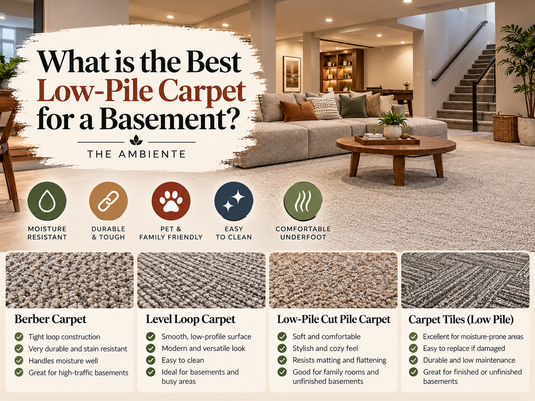
What Is the Best Carpet Fiber for a Basement?
Basements require moisture assessment first.
If the basement has an unresolved leak, groundwater problem, or persistent dampness, do not try to solve it by choosing a particular carpet fiber.
Once the space is dry and suitable for carpeting, synthetic options are often practical.
Low-pile nylon can provide excellent durability. Polyester may be useful in less heavily trafficked areas, and polypropylene's very low moisture absorption can make it attractive for certain below-grade applications.
Carpet tiles are also worth considering in basements because of their modular design.
Always follow the carpet and installation-system manufacturer's requirements for below-grade concrete.
What Is the Best Fiber for Stain Resistance?
This depends on the type of stain and the way the fiber is manufactured.
Polyester has strong resistance to many water-based stains but can be more vulnerable to oily soils.
Polypropylene has very low moisture absorption and good resistance to many common spills, but oils can be more challenging.
Triexta is known for inherent stain resistance.
Nylon can perform extremely well when manufactured or treated for stain resistance, particularly solution-dyed varieties.
Wool has natural soil-resistance characteristics but requires appropriate treatment when spills occur.
When comparing products, ask for specific performance information rather than relying on a generic "stain-resistant" label.
What About Carpet and Allergies?
People sometimes assume one particular carpet fiber is automatically hypoallergenic.
It is more complicated than that.
Carpet can collect dust, pollen, pet dander, and other particles regardless of fiber type. Construction and cleaning practices can therefore be extremely important.
Low-pile, dense carpeting is generally easier to vacuum thoroughly than deep, shaggy carpet.
If allergies are a concern, consider effective vacuum filtration, regular cleaning, indoor humidity, pet exposure, and other textiles throughout the room.
For medically significant allergies or asthma, follow the recommendations of your healthcare professional.
No carpet fiber can guarantee that allergic symptoms will not occur.
Solution-Dyed vs. Traditionally Dyed Fibers
When comparing carpet, you may see the phrase "solution-dyed" repeatedly.
It is worth understanding.
In solution-dyed synthetic fibers, pigment is incorporated into the material during fiber production. You can think of the color as being part of the fiber rather than something added only to its exterior afterward.
This can provide strong resistance to fading and certain stains.
Solution dyeing is commonly associated with fibers such as nylon, polyester, and polypropylene.
Other dyeing methods are not necessarily inferior. They may allow manufacturers to create particular colors, patterns, or effects that solution dyeing cannot produce as easily.
The method should be evaluated based on what you need from the carpet.
For active households, solution-dyed synthetics are often worth investigating.
Fiber Is Only Half the Carpet Story
Two carpets made from the same fiber can perform very differently.
This is why buying carpet based entirely on a label that says "100% nylon" or "100% wool" can be misleading.
Pay attention to:
- Pile density
- Fiber twist
- Pile height
- Cut versus loop construction
- Backing
- Carpet weight and overall construction
- Stain treatments or dyeing method
- Padding requirements
- Installation method
- Manufacturer warranty
- Recommended room and traffic level
A dense, appropriately constructed carpet tends to hold up better than a loose product of similar fiber.
Ask to see specifications alongside samples.
How a carpet feels when you press your hand into a display sample can tell you something about softness, but very little about how it will look after years of foot traffic.
How Should You Compare Carpet Samples?
Bring samples into your home whenever possible.
Showroom lighting can dramatically change color, and carpet can look different when installed across a large room.
Place samples in the space where the carpet will actually be used.
Look at them in natural daylight, evening light, and under your regular lamps. Walk on them if the sample format allows it. Compare how easily fibers separate when you bend the sample slightly and look at the density.
If you have pets, put a little loose pet hair on the sample. You may discover that one beautiful dark carpet makes every light-colored hair immediately visible.
Consider how the carpet feels with bare feet if it is going into a bedroom.
Then look at the technical specifications.
The goal is to choose with both your eyes and the practical realities of your household.
Which Carpet Fiber Should You Choose?
If you want the short version, the major residential carpet fibers generally break down like this:
- Nylon: Excellent resilience and durability, making it a strong choice for high-traffic homes.
- Polyester: Soft, colorful, and often affordable, with good resistance to many common stains.
- Polypropylene or olefin: Low moisture absorption and affordable, but generally less resilient under heavy traffic.
- Wool: A premium natural fiber known for resilience, comfort, appearance, and longevity with proper care.
- Triexta: Soft and naturally stain resistant, with characteristics that make it particularly appealing for family homes.
- Acrylic: Less common for wall-to-wall residential carpet, offering a wool-like feel but generally lower durability.
- Plant fibers: Sisal, jute, seagrass, and related materials provide distinctive natural textures but behave very differently from conventional soft carpeting.
- Blends: Combine fibers to achieve particular characteristics, with performance depending on the exact percentages and construction.
Those descriptions are useful starting points, not final verdicts.
Choosing a Carpet for the Way You Actually Live
The best carpet is not necessarily the most expensive one, the softest sample in the showroom, or the fiber with the longest list of claimed features.
It is the carpet that suits the room.
If you have a hallway filled with daily family traffic, resilience may be your first priority. Nylon deserves serious consideration.
If you are carpeting a quiet bedroom and want softness without stretching the budget unnecessarily, polyester might make more sense.
If stains from children and pets are the main concern, triexta or a solution-dyed synthetic carpet may be worth investigating.
If you value natural fibers and long-term quality and are comfortable with appropriate care, wool has a lot to offer.
And if you are dealing with a basement, utility-oriented room, or unusual moisture considerations, polypropylene or modular carpet systems may enter the conversation.
At The Ambiente, we think the important thing is to look beyond the surface. Carpet is something you will walk on thousands of times. You will vacuum it, put furniture on it, spill things on it, and live with the way it changes over the years.
The fiber plays a major part in all of that.
Learn the basic differences, compare actual product specifications, and make sure the construction suits the amount of traffic the room receives. Factor in children, pets, cleaning habits, moisture, allergies, and how long you expect to keep the carpet.
Once those practical questions are answered, choosing the color is the easy part.