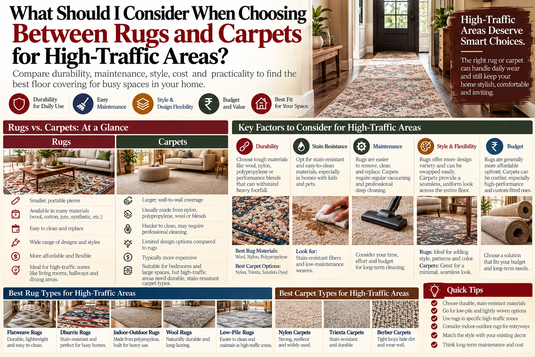
High-traffic areas expose every weakness in a floor covering. Hallways, family rooms, entrances, stairs and frequently used living spaces deal with repeated footfall, dust, shoes, pets, furniture movement and occasional spills. That means the choice between a rug and wall-to-wall carpet should be based on performance, not only appearance.
At The Ambiente, we think the first question is not “Which one is better?” It is “What does this area need to handle every day?” A removable rug can be easier to replace, rotate and professionally clean. Wall-to-wall carpet provides continuous softness and sound absorption but becomes a more permanent part of the room.
This guide explains what to consider when choosing between rugs and carpets for high-traffic areas, including fibre, pile, construction, cleaning, safety, cost and long-term maintenance.
What Counts as a High-Traffic Area?
High traffic is relative to the household, but common examples include:
- Main entrances
- Hallways and corridors
- Living rooms used daily
- Family rooms
- Staircases
- Dining spaces
- Passage areas between rooms
- Homes with children or multiple pets
A guest bedroom may see only a few footsteps a day. A hallway between bedrooms and the kitchen may see hundreds.
The more concentrated the traffic, the more important material, density and pile height become.
Rug vs Carpet: The Basic Difference
An area rug is movable. It covers part of the floor and can be rotated, lifted, cleaned elsewhere or replaced independently.
Wall-to-wall carpet is installed across most or all of the room and usually fixed to the floor with tack strips, adhesive or another installation system.
That basic difference changes how each performs in a busy area.
If you want a broader overview, read our article on how rugs and carpets differ.
Why Rugs Can Be Strong in High-Traffic Areas
Rugs give you flexibility.
If one area receives more wear, you can rotate the rug. If it becomes heavily soiled, it can often be taken away for professional cleaning. If your needs change, you can replace the rug without changing the entire floor.
A well-chosen wool rug can handle substantial residential traffic when the pile is dense and the construction suits the room.
Rugs also protect the hard flooring underneath, which can be useful in busy living rooms and hallways.
Why Carpet Can Be Strong in High-Traffic Areas
Wall-to-wall carpet provides continuous coverage, so there are no rug edges to move or curl.
It also absorbs sound across the entire room and provides a softer surface underfoot.
On stairs, carpet can add traction and cushioning when correctly installed.
The trade-off is that wear in one path may eventually require repair or replacement of a larger installed area.
Material Matters More Than the Rug-or-Carpet Label
A durable rug can outperform a poorly constructed carpet, and a dense commercial-grade carpet can outperform a delicate rug.
Do not compare categories in the abstract. Compare the actual fibre, pile, density and construction.
Best Rug Fibres for High Traffic
Wool
Wool is one of the strongest premium natural choices because it has good resilience and can recover from compression better than many soft decorative fibres.
Dense wool works well in living rooms, hallways and other dry residential spaces.
It still needs regular vacuuming and correct stain care, but it offers a strong balance of comfort and durability.
Polypropylene
Polypropylene is commonly used in practical rugs and carpets because it absorbs little moisture and can resist many water-based stains.
It is often used in indoor-outdoor rugs and budget-friendly high-traffic options.
The limitation is resilience. It can flatten under heavy repeated compression depending on construction.
Nylon
Nylon is especially common in wall-to-wall carpet because of its resilience.
For heavily used installed carpet, quality nylon is often worth considering.
Our guide to residential carpet fibres explains nylon, polyester, polypropylene, wool and triexta in more detail.
Polyester
Polyester can provide softness and stain resistance at an accessible price, but it generally does not recover from crushing as well as nylon.
It may suit moderate traffic better than the most demanding hallway or staircase.
Fibres to Use More Carefully
Silk, bamboo silk and other high-sheen fibres can be beautiful but are not usually the first choice for intense foot traffic.
They may show crushing, moisture marks and surface changes more easily.
If you want a premium look in a busy room, consider wool or a wool-dominant blend instead of a fully lustrous surface.
See our wool vs bamboo silk vs silk comparison for more detail.
Pile Height: Lower Is Usually Easier
Low to medium pile tends to work better in busy areas because it is easier to vacuum, less likely to trap debris deeply and generally handles furniture movement better.
Very deep shag can feel luxurious, but it is harder to maintain in a hallway or family room.
For wall-to-wall carpet, dense low pile is often preferable in high-traffic areas.
Density Matters
A dense surface gives the pile more support.
Two rugs made from the same fibre can perform very differently if one has tightly packed yarn and the other has a loose, tall pile.
Do not judge quality only by softness or total weight.
Construction Matters
Hand-knotted rugs can be very durable when made with quality material and appropriate density.
Handloom rugs can also work well in high traffic when woven firmly.
Hand-tufted rugs may perform well, but the backing system and adhesive quality become important.
For a full comparison, see our hand-knotted, hand-tufted and handloom guide.
What About Flat-Weave Rugs?
Flat-weave rugs can be excellent in busy areas because they have no deep pile to crush.
They are easy to place under furniture and often easier to vacuum.
The trade-off is that they provide less cushioning than a pile rug.
Which Is Better for an Entryway?
A removable rug is often more practical because entrances collect dirt and moisture.
Choose a low-pile surface and use an appropriate pad to reduce slipping.
A dark or patterned rug can hide everyday soil better than a pale solid rug.
Avoid delicate high-sheen fibres near the main door.
Which Is Better for a Hallway?
Runner rugs are a practical choice because they protect the central walking path while leaving flooring visible along the sides.
They can be rotated or replaced if wear becomes concentrated.
Wall-to-wall carpet can provide more sound reduction, especially in long upstairs corridors.
Which Is Better for Stairs?
Carpet can be very effective on stairs because it provides continuous traction and cushioning.
A stair runner offers a middle ground by covering the main walking path while leaving wood visible at the edges.
If using a runner, professional installation is important. Loose edges on stairs create a safety risk.
Which Is Better for a Busy Living Room?
For many homes, hard flooring plus a large area rug gives the best balance.
The hard floor handles the room perimeter and spills, while the rug adds softness and defines the seating area.
A large living room rug also protects the floor where furniture and foot traffic are concentrated.
Which Is Better for Dining Rooms?
A rug can work well if it is low pile and large enough for chairs to remain on the surface when pulled out.
Wall-to-wall carpet provides softness but may be less convenient when food spills are frequent.
For many households, a removable rug over hard flooring is easier to manage.
Pets Change the Decision
Pets add hair, claws, accidents and repeated traffic.
Low-pile rugs are generally easier to vacuum and less likely to catch claws than loose looped constructions.
Rugs also allow local replacement if one piece is damaged.
Carpet offers full-room traction for pets that slip on hard floors, but accidents can be harder to isolate.
Children Change the Decision Too
Carpet provides softness across the entire room, which can be useful for play areas.
A large rug provides a softer zone while still leaving hard flooring exposed for easier cleanup.
For a busy family room, washable or easy-care materials may matter more than whether the floor covering is technically a rug or carpet.
Cleaning and Maintenance
High-traffic areas need regular dry-soil removal.
Vacuum frequently enough that grit does not settle deep into the pile.
Deal with spills promptly. Rotate area rugs to distribute wear.
For wall-to-wall carpet, professional extraction may be needed periodically depending on fibre and traffic.
For handmade rugs, use cleaners who understand the specific fibre and construction.
How Often Should You Rotate a High-Traffic Rug?
There is no fixed schedule, but every few months can be useful in rooms where one pathway receives noticeably more use.
Rotation helps distribute wear and sunlight exposure.
If the rug is partly under heavy furniture, rotation may be less convenient, so plan the furniture layout before choosing the rug.
What About Rug Pads?
A good pad is important in high-traffic areas.
It reduces movement, adds support and can help protect both the rug and floor.
Choose a pad compatible with the flooring material. The wrong rubber or adhesive layer can mark some finishes.
What About Wrinkles and Buckling?
Wall-to-wall carpet can develop wrinkles if it is poorly installed, loses tension or experiences environmental changes.
Area rugs can also ripple if the backing is unstable or the rug is placed on an unsuitable surface.
If installed carpet develops waves, our guide on diagnosing and fixing carpet wrinkles explains common causes.
Which Is Cheaper Over Time?
It depends on quality and lifespan.
Wall-to-wall carpet may have a lower initial cost for covering a large room, but replacement affects the whole installed area.
A rug can be more expensive per square foot, especially if handmade, but only the rug itself needs to be replaced.
Hard flooring plus a quality rug can also preserve flexibility because the room can be restyled without changing the base floor.
Which Is Better for Rentals?
Rugs are usually the better option because they are removable and move with you.
They can hide unattractive flooring without making permanent changes.
Use a suitable rug pad and check that the backing will not damage the landlord’s floor finish.
Which Is Better for Long-Term Homes?
Either can work.
If acoustics and warmth matter most, wall-to-wall carpet may be ideal in bedrooms and upstairs areas.
If flexibility and easier replacement matter, hard floors plus rugs are attractive.
Many homes use both rather than forcing one solution into every room.
How Colour Affects High-Traffic Performance
Very pale rugs show soil sooner. Very dark solid rugs can show lint and dust.
Mid-tone colours, heathered yarns and patterns often hide everyday traffic better.
This does not replace cleaning, but it can make the room look more consistent between maintenance cycles.
Pattern Can Be Practical
Geometric, vintage-inspired and lightly distressed patterns can camouflage small marks better than a perfectly plain surface.
Browse geometric rugs or vintage rugs if you want practical visual texture.
How to Choose for a High-Traffic Indian Home
Start with the actual household.
Are shoes worn indoors? Are there pets? Children? Frequent guests? Is the room connected to a balcony or garden? How often do you vacuum?
These details matter more than generic advice.
A premium delicate rug can be the wrong choice in a demanding room. A practical wool or flat-weave rug may give much better long-term satisfaction.
When a Rug Makes More Sense
- You want flexibility.
- You may move homes.
- You want to protect existing hard flooring.
- You need easier local replacement.
- You like changing decor.
- You want to define only part of a room.
When Carpet Makes More Sense
- You want softness across the entire floor.
- Acoustic control is a major priority.
- You want continuous traction.
- The room is dedicated to one long-term use.
- You prefer a fully installed finish.
What Would The Ambiente Choose?
For a high-traffic living room, we would usually start with hard flooring plus a dense wool or flat-weave rug.
For stairs, a properly installed carpet or stair runner can make sense.
For a busy hallway, a low-pile runner is flexible and practical.
For bedrooms, full carpet can work beautifully if softness and quiet matter more than flexibility.
The decision should be room by room.
Questions to Ask Before Buying
- How much traffic does the area receive?
- What fibre is the floor covering made from?
- Is the pile low, medium or high?
- How dense is the construction?
- Can the rug be rotated?
- How will spills be cleaned?
- Are pets or children using the area?
- Does the floor covering need to reduce sound?
- What is the expected replacement cycle?
- Will the rug or carpet interfere with doors?
The Bottom Line
For high-traffic areas, the choice between a rug and carpet is less important than choosing the right material and construction for the job.
Rugs offer flexibility, easier replacement and the ability to protect hard flooring while keeping part of the floor exposed. Wall-to-wall carpet offers continuous softness, quieter acoustics and no loose edges.
For durability, look at dense wool, quality nylon carpet, low-pile constructions and practical flatweaves. Use delicate silk and bamboo silk more carefully in busy spaces.
If you prefer the flexibility of rugs, explore The Ambiente’s wool rugs, flat-weave rugs and living room rugs. Choose the size and construction around the traffic pattern rather than simply choosing the design you like most.