Carpet wrinkles rarely improve on their own.
A small ripple across the middle of a room may start as a visual annoyance, but it can eventually become a practical problem. Raised carpet is easier to trip over, vacuum cleaners may catch on it, furniture can sit unevenly, and continued movement can put unnecessary stress on the carpet's backing.
The tricky part is that not every wrinkle has the same cause.
One carpet may have been installed without enough tension. Another may have been stretched correctly but later affected by humidity, heavy furniture, rolling traffic, or damage to the tack strip. A carpet that suddenly ripples after professional cleaning requires a different assessment from one that has slowly developed wrinkles over several years.
That is why simply trying to flatten the carpet is not a good repair strategy.
At The Ambiente, we believe the sensible approach is to diagnose first and repair second. Start by identifying where the wrinkle appears, when it developed, what the carpet is installed over, and whether the problem involves the carpet itself or something beneath it.
In many cases, professional power stretching can correct carpet wrinkles. In others, the problem is related to delamination, moisture, damaged tack strips, poor seams, or an unsuitable installation. Those situations may require a different repair or even replacement.
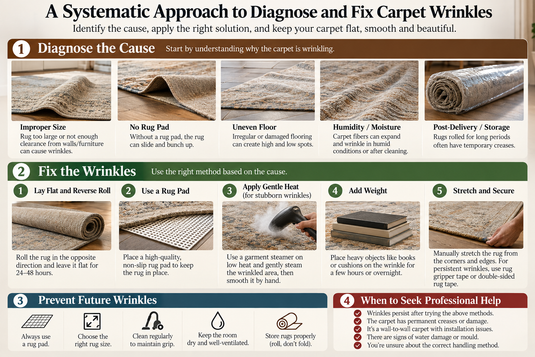
Here is a systematic way to work out what is happening and decide what to do next.
First, What Exactly Is a Carpet Wrinkle?
People use several terms for essentially similar symptoms: wrinkles, ripples, waves, buckles, humps, and loose carpet.
They all describe a carpet surface that no longer lies flat.
The size and shape can vary significantly.
You might see one long ridge crossing the room, several parallel waves, a loose area near a doorway, a hump near a seam, or broad rippling throughout almost the entire floor.
The shape of the problem provides clues.
A large open area with multiple waves may suggest inadequate tension. A localized raised section near a wall may point toward a tack-strip problem. A hump that follows a seam deserves a closer look at the seam itself.
Before deciding how to repair anything, determine whether you are looking at genuine carpet buckling or another flooring issue.
Why Carpet Wrinkles Matter
Wrinkles are not purely cosmetic.
The most immediate concern is tripping. Even a low ridge can catch someone's foot, particularly in a hallway, bedroom, or other route people use in low light.
Loose carpet can also make vacuuming difficult. A powerful vacuum head may pull at the ripple rather than moving smoothly over it.
Long-term movement can potentially contribute to wear because the carpet is flexing in ways it was not intended to.
Wrinkles may also indicate an underlying installation or moisture problem.
In other words, the raised carpet is sometimes a symptom rather than the actual problem.
That is why it is worth investigating rather than simply placing furniture over the wrinkle and forgetting about it.
Step 1: Identify When the Wrinkles Appeared
Timing is one of the best diagnostic tools you have.
Ask yourself when you first noticed the problem.
Did wrinkles appear shortly after installation?
Did they develop gradually over several years?
Did they appear after a professional carpet cleaning?
Did the problem begin during a humid season?
Did you recently move heavy furniture across the floor?
Was there a leak, flood, plumbing problem, or other source of moisture?
Did the carpet begin rippling after new heating or air-conditioning conditions changed the indoor environment?
Each answer points toward different possibilities.
A carpet that has been loose since shortly after installation may have an installation-related tension problem.
A carpet that had been perfectly flat for ten years and suddenly buckles after a water leak needs to be evaluated for moisture and material damage rather than simply stretched immediately.
Write down the timeline if necessary. It can be valuable information when speaking with an installer or carpet repair professional.
Step 2: Map the Location of the Wrinkles
Next, look at where the ripples occur.
Do they appear across the entire room or only in one section?
Are they concentrated in the middle of the floor?
Do they run parallel to a particular wall?
Are they near a doorway?
Do they follow a seam?
Are they close to stairs?
Do they occur where heavy furniture was dragged or repeatedly moved?
Is the carpet still tight around the perimeter?
The pattern matters.
If a carpet has lost tension over a large open area, broad ripples may appear away from the walls.
If the tack strip has failed along one edge, the carpet may feel loose near that particular wall.
If the problem runs directly along a seam, stretching alone may not be the only repair required.
Take photos from several angles. Low side lighting can make subtle wrinkles easier to see than overhead lighting.
Step 3: Determine How the Carpet Was Installed
Not all carpeting is installed the same way.
Many residential carpets use a stretch-in installation. Tack strips are fixed around the room perimeter, padding sits underneath, and the carpet is stretched across the room and attached to the strips.
Other carpet may be glued directly to the subfloor.
There are also double-glue installations, carpet tiles, and other systems.
This article focuses primarily on wrinkles in stretch-in residential carpet because loss of tension is a common source of rippling.
If your carpet is glued down and begins bubbling or lifting, the diagnosis may involve adhesive failure, moisture, substrate conditions, or other issues. Trying to treat it as a conventional stretch-in carpet problem would be inappropriate.
If you do not know how the carpet was installed, gently inspecting an inconspicuous perimeter may provide clues, but do not start pulling up the carpet casually.
An installer can identify the method quickly.
Step 4: Check the Age and Condition of the Carpet
How old is the carpet?
A relatively new carpet with wrinkles is different from a 20-year-old carpet showing widespread backing deterioration.
Carpet has multiple structural components. The visible pile is only the top layer. The backing provides dimensional stability and helps hold the carpet together.
As a carpet ages, backing materials can deteriorate.
If the carpet has delaminated, meaning primary and secondary backing components are separating, simply stretching it may not provide a durable repair.
Look for other signs of age or damage.
Is the carpet heavily worn? Does it feel unusually soft or unstable in certain areas? Are edges fraying? Is backing visible where the carpet has pulled away? Are there unusual cracking or crunching sounds when the material bends?
If a carpet is near the end of its useful life, paying for a substantial repair may not make financial sense.
Step 5: Inspect for Moisture Before Stretching Anything
This is one of the most important steps.
Moisture can contribute to carpet buckling, and stretching carpet while an unresolved moisture problem exists can treat the symptom while ignoring the cause.
Think about recent events.
Has the room experienced a plumbing leak?
Is it in a basement?
Did an appliance overflow?
Has water entered around a door or window?
Is the subfloor damp?
Has indoor humidity been unusually high?
Was the carpet recently cleaned with a wet extraction method?
If you suspect moisture, investigate before proceeding with a mechanical repair.
Basements deserve particular caution. A carpet installed over concrete may be affected by moisture moving through the slab or by high indoor humidity.
A musty odor, discoloration, damp padding, or unexplained moisture should not be ignored.
If there is significant water damage or potential mold growth, the situation may require water-damage or indoor-environment professionals rather than an ordinary carpet stretching service.
Fix the moisture source first.
Step 6: Consider Humidity
Carpet and its backing can respond to changing environmental conditions.
High humidity can contribute to dimensional changes in some carpeting and may be associated with temporary or persistent rippling.
If wrinkles appear mainly during humid weather and become less noticeable when conditions change, indoor humidity deserves attention.
Use a hygrometer to see what the room is actually experiencing.
Do not assume every humidity-related ripple will disappear permanently once the air dries. A carpet that has loosened may still require re-stretching.
Also do not assume a dehumidifier is the complete answer.
If excessive basement humidity comes from water intrusion, for example, address the underlying building issue.
Environmental control and carpet repair sometimes need to happen together.
Step 7: Think About Recent Carpet Cleaning
People occasionally notice wrinkles immediately after professional carpet cleaning.
This can happen for several reasons.
Moisture can temporarily affect the carpet or backing. An already marginal installation may become more visibly loose after cleaning. Excessive moisture or inadequate extraction can also create complications.
The first step is usually to allow the carpet to dry completely under appropriate conditions.
Good ventilation and normal climate control can help. Follow any instructions supplied by the cleaning professional.
Do not immediately begin stretching a damp carpet.
Once it is thoroughly dry, reassess.
If ripples remain, contact the cleaner and, where appropriate, the original installer or a carpet repair specialist.
A properly trained professional can determine whether re-stretching is needed or whether something else happened during cleaning.
Step 8: Consider How Furniture Was Moved
Heavy furniture can contribute to carpet problems when it is dragged rather than lifted or moved using suitable equipment.
Imagine pushing a very heavy cabinet across a stretch-in carpet.
The force can pull the carpet in the direction of movement, potentially releasing it from tack strips or changing the tension.
Rolling loads can sometimes create similar issues, particularly when they are unusually heavy.
If a wrinkle appeared immediately after moving a piano, large sectional, pool table, or heavy cabinet, tell the repair technician.
That history can help identify where tension was lost.
When moving heavy furniture in the future, use appropriate moving methods and equipment rather than dragging objects directly across the carpet.
Step 9: Check the Room Perimeter
With stretch-in carpet, the perimeter is critical.
The carpet is held under tension by tack strips installed near the walls.
If it has disengaged from the strip or the strip itself is loose, damaged, corroded, or improperly installed, wrinkles can develop.
Problems are especially possible around doorways, transitions, unusual architectural details, and areas where installation conditions made secure fastening difficult.
Do not run your bare fingers along exposed tack strips. The pins are sharp.
If you have experience with flooring, you may be able to visually identify obvious issues at an already exposed edge. Otherwise, leave perimeter inspection to a professional.
Replacing or properly securing damaged tack strip may be necessary before the carpet is re-stretched.
Stretching the carpet back onto a failing perimeter will not solve much.
Step 10: Examine the Padding
Carpet padding is hidden, so it tends to be forgotten.
But it forms part of the flooring system.
Padding that is too thick for the carpet, improperly installed, damaged, compressed, wet, or deteriorating can affect overall carpet performance.
Carpet manufacturers often specify the acceptable density and thickness of cushion to use with particular products.
Using padding that is excessively thick or soft can allow too much movement and may affect warranty coverage or carpet performance.
If an area of carpet is already lifted during professional inspection, the pad should be examined too.
Replacing damaged pad may be necessary before the carpet can be put back into service.
After a significant water event, the condition of the padding becomes particularly important because moisture and contamination can remain underneath even when the carpet surface appears dry.
Step 11: Inspect Seams
Many rooms are too large or shaped in a way that prevents installation from a single piece of broadloom carpet.
That means seams are necessary.
A properly made seam should remain relatively stable and unobtrusive, though visibility varies with carpet style and lighting.
If the apparent "wrinkle" follows a seam, inspect it carefully.
Is the seam raised?
Has it separated?
Does it appear peaked?
Is the carpet loose on one side but not the other?
Seam peaking can sometimes be influenced by tension and installation technique. Seam separation is a different problem and may require repair to the seam itself.
Do not keep pulling on a failing seam.
A carpet repair professional may need to rebuild or reinforce it before or during re-stretching.
Step 12: Check Whether Improper Initial Stretching Is Likely
One of the common causes of carpet wrinkles is inadequate stretching during installation.
Professional stretch-in carpet installation typically involves a power stretcher. A knee kicker has an important role in fitting and positioning, particularly around edges and difficult locations, but it generally should not be treated as the sole tool for tensioning large expanses of carpet where power stretching is required.
A power stretcher braces across the room to apply controlled tension over a larger area.
When carpet is installed without appropriate tension, it may initially look flat. Over time, normal traffic, humidity changes, and use can reveal looseness.
If relatively new carpet has developed broad ripples without any water event or obvious damage, inadequate initial stretching is a possibility.
Check your installation paperwork and warranty information.
If the work is still covered, contact the original retailer or installer before paying someone else to alter the installation.
Step 13: Don't Assume a Knee Kicker Will Fix the Problem
A knee kicker is one of the most recognizable carpet tools.
Because it is relatively compact and available for rental or purchase, homeowners sometimes assume they can remove wrinkles by kicking the carpet tighter at one wall.
That may not solve a room-wide tension problem.
A knee kicker is primarily useful for positioning and engaging carpet in local areas. A power stretcher is typically the appropriate tool when a broad area needs to be properly tensioned.
Trying to remove significant ripples with a knee kicker alone can produce uneven tension and may not provide a lasting repair.
This is one reason carpet re-stretching is often better left to a flooring professional.
The equipment and technique both matter.
Step 14: Decide Whether Re-Stretching Is Appropriate
Once moisture, severe backing damage, and other structural issues have been ruled out, re-stretching may be the correct repair.
A professional re-stretch generally involves releasing parts of the carpet from the perimeter, applying controlled tension using appropriate stretching equipment, reattaching the carpet, and trimming excess material where necessary.
Furniture usually has to be moved.
Depending on the room, seams, transitions, doorways, built-ins, and unusual layouts may complicate the work.
If the carpet was significantly loose, there may be more excess material at the edges than you would expect.
A competent technician should stretch the carpet according to the manufacturer's requirements rather than merely making the wrinkles disappear visually.
The goal is correct tension, not just a flat photograph at the end of the job.
Step 15: Understand What Professional Power Stretching Involves
A power stretcher has a head that engages the carpet and an adjustable series of tubes extending across the room. The tool braces against an opposing surface, often using appropriate protection to avoid damaging walls or trim.
The installer uses the tool to apply controlled force.
The exact process depends on the room and carpet. Professionals may work in multiple directions and reposition the equipment to create consistent tension.
This is different from simply grabbing an edge and pulling until the ridge disappears.
Carpet needs to remain properly aligned with seams, doorways, stairs, transitions, and patterned designs.
Too little tension can leave the problem unresolved. Poorly controlled stretching can create other issues.
Experience matters.
Step 16: Know When DIY Re-Stretching Makes Sense
Can you re-stretch carpet yourself?
Technically, yes. Whether you should is a different question.
A small, simple room with conventional stretch-in carpet may be manageable for someone who has solid home-improvement experience and access to the correct equipment.
But the job becomes more difficult when there are:
- Multiple seams
- Patterned carpet
- Large room dimensions
- Stairs
- Complex doorways
- Built-in furniture
- Damaged tack strips
- Delaminated backing
- Moisture concerns
- Unusual subfloors
- Transitions to other flooring
- High-value carpeting
There is also a practical problem: furniture.
To stretch carpet properly, technicians often need broad access to the floor and perimeter. Trying to work around a room full of heavy furniture can make correct tensioning difficult or impossible.
DIY repair is most appropriate when you understand the installation system, can identify the cause of the wrinkle, and know how to use the equipment safely.
If you are guessing, professional help is usually less expensive than replacing damaged carpet.
Step 17: Know When Stretching Will Not Fix It
Not every wrinkled carpet can be rescued by adding tension.
Re-stretching may be inappropriate or insufficient when the carpet has significant delamination, severe water damage, extensive backing deterioration, major seam failure, or damage associated with contamination.
Age matters too.
If the pile is badly worn and the backing is failing, spending money on repair may only postpone replacement briefly.
Repeated re-stretching is another warning sign.
If carpet has already been professionally stretched and quickly develops the same problem again, the cause needs to be investigated rather than repeating the identical repair indefinitely.
There may be a problem with the tack strip, backing, subfloor, environmental conditions, installation layout, or the carpet itself.
Step 18: Contact the Installer Before Altering New Carpet
If your carpet is relatively new, check your paperwork first.
You may have an installation warranty, manufacturer warranty, or retailer service agreement.
Photograph the problem before moving furniture or attempting repairs.
Record when you first noticed it and any relevant events, such as cleaning or changes in humidity.
Then contact the retailer or installer.
Avoid making DIY alterations until you understand whether they could affect warranty coverage.
The installer may want to inspect the carpet before anyone else works on it.
This can save you both money and frustration if the cause is determined to be installation-related.
Step 19: Fix the Cause, Not Just the Visible Ripple
This is the principle that ties the entire diagnosis together.
Imagine you have a ripple caused by a loose tack strip.
You stretch the carpet.
It looks flat.
But the tack strip still does not hold correctly.
The ripple returns.
Or imagine high moisture is affecting the installation.
You keep mechanically stretching the carpet but never address the damp conditions.
Again, you have treated the symptom.
A lasting repair needs to address both cause and effect.
That might mean correcting humidity, repairing a water leak, replacing tack strips, replacing damaged padding, repairing a seam, addressing backing failure, or properly re-stretching an installation that was insufficiently tensioned the first time.
How to Prevent Carpet Wrinkles After Repair
Once your carpet is flat again, a few habits can help reduce the likelihood of new problems.
First, maintain reasonable indoor conditions. Extreme or prolonged humidity can affect many building and furnishing materials, not just carpet.
Second, deal with water quickly. Plumbing leaks, wet basements, and excessive carpet-cleaning moisture should never be ignored.
Third, move heavy furniture properly. Lift items when possible or use equipment designed to distribute weight rather than dragging heavy pieces across stretched carpet.
Fourth, follow professional cleaning recommendations for your particular carpet.
Finally, make sure any future carpet is installed correctly from the beginning.
Good installation is not an optional extra. It is part of the flooring product.
Should You Put Furniture Over a Carpet Wrinkle?
Avoid using furniture as a permanent solution.
A sofa may hide a small ripple, but it does not restore the carpet's tension.
Placing a very heavy object over a loose area may also make future repair more complicated.
If the ripple is in an area where people walk, address it promptly because of the trip risk.
If you cannot have it repaired immediately, reduce exposure to the hazard rather than assuming furniture will flatten it permanently.
Weights, books, boxes, and other improvised methods do not correct a tension problem.
Can You Iron Carpet Wrinkles?
Using a household iron on installed carpet is not a good general solution.
carpet fibers react differently to heat.
Synthetic fibers can be damaged or even melt under excessive temperature. Backings can also be affected.
Even if heat makes a small surface distortion look better temporarily, it does not correct a stretch-in carpet that has lost tension.
Do not confuse carpet wrinkles with flattening in an area rug that was folded during shipping. They are different problems with different causes.
For installed carpet, diagnose the installation rather than applying heat to the pile.
Do Wrinkles Mean the Carpet Needs to Be Replaced?
Usually not by themselves.
Many wrinkled carpets can be successfully re-stretched when the carpet and backing remain in good condition.
Replacement becomes more likely when wrinkles are accompanied by broader failure.
Examples include extensive delamination, severe wear, water damage, contamination, widespread seam failure, or a badly deteriorated backing.
Age alone is not a perfect guide. A high-quality older carpet may still be a good repair candidate, while a newer carpet damaged by flooding may not be.
A qualified flooring professional can inspect the backing and installation and help determine whether repair makes sense.
A Quick Diagnostic Sequence
When a customer at The Ambiente describes a wrinkled carpet, the useful questions follow a particular order.
Start with safety. Is the wrinkle creating a trip hazard?
Then establish timing. When did it appear, and did anything happen immediately beforehand?
Next, identify the installation type and map where the wrinkles occur.
After that, check for moisture, humidity, recent cleaning, water events, and heavy furniture movement.
Then evaluate the carpet's age, backing, padding, perimeter attachment, seams, and tack strips.
Only when those issues are understood should you decide whether power stretching is the appropriate repair.
That sequence prevents you from automatically treating every ripple as a tension problem.
When to Call a Professional
Professional carpet repair is the sensible choice when you have large or multiple wrinkles, do not know the cause, lack access to power-stretching equipment, or suspect problems with the backing, seams, padding, or tack strips.
You should also seek professional help when moisture is involved.
For significant leaks, flooding, or suspected mold, you may need a water-damage specialist in addition to a flooring professional.
When contacting a carpet repair company, ask how they intend to re-stretch the carpet.
Specifically, ask whether they use a power stretcher for room-wide stretching where appropriate.
You should also mention seams, stairs, recent cleaning, water exposure, and the approximate age of the carpet before they arrive.
The more useful information you provide, the easier it is to plan the repair.
The Ambiente's Approach: Diagnose Before You Stretch
A carpet wrinkle looks simple because the symptom is easy to see.
The carpet is raised. You want it flat.
But the reason it became raised is what determines whether the repair lasts.
Sometimes the answer is straightforward. The carpet was insufficiently stretched during installation, and a proper professional power stretch restores the necessary tension.
Sometimes a tack strip has come loose.
Sometimes humidity or moisture contributed to the problem.
Sometimes heavy furniture pulled the carpet out of position.
And sometimes the backing has deteriorated enough that stretching is no longer a sensible solution.
At The Ambiente, we recommend treating carpet wrinkles as a small diagnostic problem rather than immediately reaching for a tool.
Start with the timeline. Map the location. Check for water. Consider recent cleaning and furniture movement. Identify the installation method. Evaluate the perimeter, seams, pad, and backing.
If the carpet is structurally sound and moisture is not an issue, professional re-stretching is often the appropriate answer.
If something underneath the carpet has failed, repair that first.
Most importantly, do not ignore a significant ripple simply because you can live with how it looks. Loose carpet can become a tripping hazard and may deteriorate further as it moves.
Carpet should lie flat because the installation is correctly tensioned and supported, not because a sofa is hiding the wrinkle.
Find the cause, make the appropriate repair, and you have a much better chance of keeping the floor flat rather than solving the same problem again six months later.