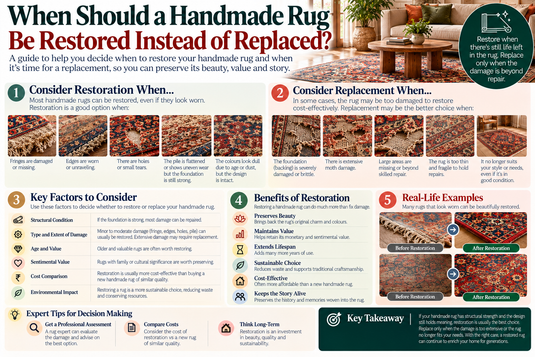
When a handmade rug is damaged, faded or heavily worn, owners often face the same question: should it be restored or replaced?
The answer depends on more than repair cost. Age, construction, material, sentimental value, rarity, damage level and how the rug fits the room all matter.
At The Ambiente, we believe a well-made handmade rug deserves evaluation before it is discarded. Some rugs can be restored beautifully. Others have reached a point where replacement is more practical.
This guide explains how to decide between restoration and replacement, what restoration can fix, when costs become difficult to justify and how to assess the long-term value of the rug.
What Does Rug Restoration Mean?
Restoration is broader than a simple repair.
It may include cleaning, fringe reconstruction, edge repair, hole reweaving, re-knotting, pile restoration, stain treatment and structural stabilisation.
The goal is to return the rug to stable usable condition while preserving as much original material as possible.
Repair vs Restoration
A repair usually addresses one local problem.
Restoration may involve several parts of the rug and can require a staged process.
For local damage, see our handmade rug repair guide.
When Restoration Makes Sense
Restoration is worth considering when:
- The rug is genuinely hand-knotted.
- The material quality is high.
- The design is difficult to replace.
- The rug has sentimental value.
- The foundation remains largely sound.
- The damaged area is limited relative to the whole rug.
- The replacement cost would be substantial.
When Replacement May Be More Practical
Replacement can make more sense when:
- The structure is deteriorating across a large area.
- Backing adhesive has failed extensively in a tufted rug.
- Water or mould damage is widespread.
- The rug no longer suits the room.
- Restoration cost approaches the value of a comparable replacement.
- The rug is mass-produced and easily replaceable.
Start With Construction
Hand-knotted rugs usually have the greatest restoration potential because damaged foundation and pile can often be rebuilt.
Hand-tufted rugs can also be repaired, but extensive backing failure may make full restoration less economical.
Handloom and flat-weave rugs can be rewoven in some cases depending on the damage.
Our construction guide explains the structural differences.
Material Matters
A high-quality wool or silk rug may justify more restoration effort than a low-cost synthetic piece.
Natural fibres can also develop patina and character with age.
See our material comparison guide for how premium fibres differ.
Assess the Foundation
The foundation is the structural skeleton of a hand-knotted rug.
If warp and weft threads are still strong across most of the rug, local damage can often be repaired.
If the foundation is brittle or broken throughout, restoration becomes far more extensive.
Assess the Fringe
Worn fringe can often be restored or secured.
Because fringe is connected to the foundation in many hand-knotted rugs, early intervention can prevent damage from moving into the body.
Assess the Edges
Open side bindings are usually repairable.
If the edge has unravelled deeply into the rug, more reconstruction is needed.
Assess the Pile
Local pile loss can often be re-knotted.
Widespread thinning is more difficult because the repair may involve a large percentage of the rug.
Assess Colour and Fading
Fading does not always need “fixing”.
Older rugs can develop attractive colour softening that becomes part of their character.
Trying to make an aged rug look completely new can reduce its visual authenticity.
When Stains Can Be Restored
Some stains can be reduced through professional cleaning and local treatment.
Others permanently change the fibre or dye.
Stain treatment should be evaluated before structural restoration.
Water Damage
Water damage ranges from a temporary wet area to severe dye bleeding and foundation weakening.
If the rug was soaked, professional cleaning and drying should happen quickly.
Mould or prolonged dampness can make restoration much more difficult.
Moth Damage
Moth larvae can remove wool pile while leaving cotton foundation visible.
If the foundation remains strong, the missing pile may be re-knotted.
The pest problem must be eliminated before restoration begins.
Pet Damage
Pet chewing, scratching and accidents can often be repaired locally.
Repeated damage in the same area may make restoration less practical unless the behaviour is also addressed.
Burn Damage
Small burns can sometimes be cut out and rewoven.
Large burn damage affecting both pile and foundation requires more extensive reconstruction.
Can a Very Old Rug Be Restored?
Yes, but age alone does not determine feasibility.
The important question is whether the fibres and foundation are stable enough to work with.
Antique rugs should be evaluated by experienced restorers because aggressive repair can reduce historical integrity.
Should Antique Rugs Look New?
No.
Good restoration usually aims for structural stability and visual harmony, not complete erasure of age.
Patina, gentle fading and historic wear can be part of the rug’s value.
Sentimental Value Changes the Decision
A rug inherited from family may be worth restoring even if the repair cost exceeds its market value.
Financial value is only one part of the decision.
Sentimental value can justify preservation.
Market Value Matters Too
For collector or high-end hand-knotted rugs, restoration can protect value if done well.
Poor DIY repairs can do the opposite.
If market value matters, use an experienced professional.
How to Estimate Whether Restoration Is Worth It
Compare:
- Restoration quote
- Current rug value
- Replacement cost
- Expected lifespan after restoration
- Sentimental value
- Whether an equivalent design is available
Replacement Cost Is Not Only Purchase Price
A comparable handmade rug may require custom size, material and design development.
If the existing rug fits the room perfectly, replacing it can involve more time and design work than expected.
When Custom Replacement Makes Sense
If the rug is too damaged to restore but the design is still loved, a new custom rug can reinterpret the original colour, scale or motif.
See our guide on how custom rugs are made.
Can a Rug Be Partially Restored?
Yes.
You can repair structurally vulnerable areas without fully rebuilding every worn section.
This can preserve character while making the rug safe to use.
Should You Clean Before Restoration?
Often, yes, but fragile rugs may need stabilisation first.
A professional can decide whether cleaning should come before or after structural work.
How Long Does Restoration Take?
Small repairs may be completed relatively quickly.
Large reweaving projects can take weeks or months because the work is done by hand.
Timeline depends on the size and complexity of the damaged area.
Why Colour Matching Is Difficult
Older rugs have often faded and aged naturally.
New yarn may look too bright if matched only to the original colour formula.
Skilled restorers choose yarns that visually integrate with the aged surface.
Can Re-Knotting Be Invisible?
Good re-knotting can be very discreet, but perfect invisibility is not always realistic.
Material, age, dye variation and pile wear all affect the final result.
When Restoration Costs Too Much
If large parts of the rug need foundation rebuilding, re-knotting and colour reconstruction, labour can exceed the cost of a new rug.
At that point, replacement may be the more practical choice unless the piece has exceptional value.
Hand-Tufted Rugs and Replacement Decisions
Hand-tufted rugs can be repaired locally, but widespread adhesive and backing failure is difficult to reverse economically.
If the backing is deteriorating across the whole rug, replacement often makes more sense.
Hand-Knotted Rugs and Restoration
Hand-knotted rugs are especially suited to restoration because the pile and foundation can be reconstructed locally.
This is one reason quality hand-knotted rugs can remain in use for generations.
Restoration and Sustainability
Extending the life of a rug can reduce the need for replacement and preserve the labour already invested in the piece.
Restoration is not always the lowest-cost choice, but it can be the more resource-conscious one when the rug has many years of useful life left.
How to Protect a Restored Rug
Use an appropriate rug pad, rotate the rug, vacuum gently and respond quickly to spills.
Keep it away from persistent dampness and strong direct sunlight.
Our rug pad guide and rug care guide can help.
Questions to Ask a Restorer
- What part of the damage is structural?
- What can be preserved?
- Will original yarn be retained?
- How will colour be matched?
- How long will the work take?
- What will the rug look like after restoration?
- What care will be required afterward?
When to Get a Second Opinion
For expensive, antique or sentimental rugs, a second opinion can be worthwhile before committing to major reconstruction.
Different restorers may suggest different levels of intervention.
How The Ambiente Thinks About Restoration
We believe the decision should start with the rug’s structure and value.
If the foundation is sound and the rug has craftsmanship, sentimental meaning or a difficult-to-replace design, restoration deserves serious consideration.
If the structure is failing across most of the rug, replacement may be more sensible.
How to Think About Restoration Value Over Time
Restoration is easier to justify when it meaningfully extends the rug’s useful life. A well-executed repair that gives a quality hand-knotted rug another decade or more of service can make sense even when the upfront cost feels substantial.
By contrast, spending heavily on a rug whose structure is failing everywhere may only postpone replacement for a short period.
Can Restoration Improve Resale Value?
Sometimes, but not automatically. Professional restoration can preserve the usability and appearance of a valuable rug, while poor or excessive restoration can reduce collector interest.
For older or collectible pieces, any major intervention should be documented and carried out conservatively.
What if the Rug Still Fits the Room Perfectly?
This matters more than people expect. A rug may have been chosen specifically for the room’s dimensions, furniture layout and colour palette. Replacing it with something equally suitable can take time and may require custom production.
If the existing rug still works beautifully in the space, that can strengthen the case for restoration.
What if the Rug No Longer Fits Your Lifestyle?
A delicate silk rug may have made sense before children or pets entered the home. A very pale rug may now sit in a high-traffic family room. Even if restoration is technically possible, replacement with a more suitable material may be the better long-term decision.
The goal is not to preserve every rug at all costs. It is to make a practical decision about the next phase of its life.
When to Store Instead of Restore
If a sentimental or antique rug is not suitable for current daily use, storage can be a reasonable alternative to immediate restoration.
Clean and fully dry the rug, roll it carefully, store it in a dry interior location and inspect it periodically. Restoration can then be considered later when the rug will actually be used.
How to Compare Restoration Cost With Replacement Cost
Ask for a written restoration estimate, then compare it with the cost of a truly comparable replacement. That means matching construction, material, size and quality rather than comparing an old hand-knotted rug with a low-cost machine-made alternative.
If a similar handmade replacement would cost substantially more, restoration may be financially sensible even before sentimental value is considered.
Restoration for Rugs With Custom Sizes
Unusual dimensions can make replacement harder. A rug designed specifically for a long room, curved layout or oversized seating arrangement may not be easy to replace with a stocked size.
In those cases, restoration can preserve a piece that already fits the architecture perfectly. If replacement is still necessary, custom production may be the closest alternative.
Document the Rug Before Major Restoration
Take full photographs of the front and back before work begins, along with close-ups of damaged areas. For older rugs, keep any available purchase records, family history or previous repair information.
This creates a useful record of the rug’s condition and helps track what material was preserved or replaced during restoration.
The Bottom Line
Restore a handmade rug when the structure is largely sound, the damage is local and the rug has enough material, design or sentimental value to justify the work.
Replace it when deterioration is widespread, the backing or foundation is failing extensively or repair cost becomes disproportionate to the rug’s value and expected life.
The decision is not only financial. Craftsmanship, memory and the difficulty of finding an equivalent rug all matter.
If replacement becomes the better option, explore The Ambiente’s hand-knotted rugs, wool rugs and luxury rugs for long-term alternatives.