A handmade carpet can look beautiful in a showroom and still vary greatly in quality. Good colour and attractive design are important, but they do not tell you whether the rug is structurally sound, whether the material is appropriate or whether it will age well.
The best way to judge quality is to look at the whole rug: construction, fibre, foundation, density, finishing, edges, back, shape and how the surface responds to handling.
At The Ambiente, we recommend evaluating handmade carpets through visible evidence rather than vague labels such as premium or luxury. This guide gives you a practical checklist for judging whether a handmade carpet is well made and durable.
First Confirm That It Is Actually Handmade
Ask how the rug was made.
Hand-knotted, hand-tufted, handloom and flat-weave rugs are all handmade, but they use different structures.
If a seller cannot clearly explain the construction, that is a reason to be cautious.
Check the Back of the Rug
The reverse tells you a lot.
On a genuine hand-knotted rug, you should usually see the design structure through the back.
A hand-tufted rug typically has a secondary backing covering the tufting structure.
Look for Structural Consistency
Handmade does not mean careless.
Small variations are normal, but the rug should still feel balanced and stable.
Large distortions, loose structure or unexplained gaps deserve closer inspection.
Check the Foundation
In hand-knotted rugs, the warp and weft form the structural base.
A strong foundation supports long-term use and allows local repairs if needed.
If the foundation looks brittle, broken or unusually weak, durability may be compromised.
Check Knot Density in Context
Higher knot density can support finer detail, but it is not a universal quality score.
A bold tribal rug may not need fine knotting.
A detailed floral rug may benefit from it.
Read our KPSI guide before using knot count as a buying metric.
Inspect the Wool or Other Fibre
Good wool should feel resilient rather than brittle.
Very short, weak fibre may shed more and wear faster.
For silk, bamboo silk and blended rugs, look for even surface quality and appropriate sheen.
Do Not Judge Quality by Softness Alone
A very soft rug is not automatically better.
Softness depends on fibre type, finishing and pile height.
A durable wool rug may feel firmer than a delicate viscose rug but perform much better in a busy room.
Check Pile Density
Press your fingers into the pile.
A dense pile should feel well supported rather than sparse.
However, density must still be considered with construction and material.
Check Pile Height
High pile is not the same as high quality.
Low-pile hand-knotted rugs can be extremely refined.
Choose pile height according to the room and traffic level.
Inspect the Edges
Edges should feel secure and evenly finished.
Loose binding, open side cords or fraying can allow damage to spread.
Early edge weakness is especially important in rugs intended for high traffic.
Inspect the Fringe
In many hand-knotted rugs, fringe is part of the foundation.
Look for secure ends and avoid rugs where fringe is already badly unravelled unless you are intentionally buying a restoration piece.
Check the Shape
Handmade rugs can have minor variation, but they should still lie flat and look balanced.
Severe skewing or large dimensional distortion can create placement problems.
Check Whether the Rug Lies Flat
Place it on a flat surface.
Edges should not curl excessively, and the centre should not buckle.
Some temporary rolling memory is normal after shipping, but structural rippling is different.
Check the Colour From Different Directions
Pile direction can make a rug look lighter from one side and darker from the other.
This is normal, especially with lustrous fibres.
Uneven colour caused by poor dyeing is different from normal directional shading.
Look for Abrash
Abrash is tonal variation within a colour area.
In handmade rugs, especially naturally dyed or handspun pieces, abrash can be intentional and desirable.
It should look coherent rather than random or damaged.
Ask About Dye Quality
Natural and synthetic dyes can both be excellent when used properly.
What matters is fixation, colourfastness and how the dye interacts with the fibre.
See our natural vs synthetic dye guide.
Check for Excessive Shedding
Some new wool rugs shed loose fibres at first.
That should gradually reduce.
If whole tufts pull out or the pile visibly thins, there may be a quality problem.
Our wool shedding guide explains the difference.
Check for Sprouting
One or two raised yarns can be normal in handmade pile.
They should be trimmed, not pulled.
Widespread repeated sprouting can point to a deeper issue.
Smell the Rug
A strong chemical or musty smell deserves attention.
Fresh wool has a natural scent, but persistent adhesive, mould or chemical odour can indicate backing or storage problems.
Check the Backing on Hand-Tufted Rugs
Hand-tufted rugs rely on adhesive and secondary backing.
The backing should feel secure and not crumble, crack or separate.
Strong powdering or latex deterioration can reduce lifespan.
Check the Weave on Handloom Rugs
Handloom rugs should show consistent weave tension and secure edges.
Loose loops, skipped areas or obvious weak sections deserve inspection.
Check Flat-Weave Structure
Flatweaves should feel balanced and firmly woven.
Look for strong edge finishing and avoid pulled continuous yarns.
Ask What Material Percentage Is Used
Do not rely on terms such as silk touch or wool feel.
Ask for actual fibre composition.
This helps you compare price and expected durability more fairly.
Ask Where the Rug Was Made
Origin alone does not guarantee quality, but a transparent manufacturer should be able to explain where and how the rug was produced.
The Ambiente’s roots in Bhadohi are relevant because the region has a long carpet-weaving tradition.
Read our Bhadohi carpet-making guide for background.
Ask About Finishing
Washing, clipping, stretching and edge finishing affect how the final rug looks and lies.
Good finishing can improve surface clarity and remove loose production residue.
Ask About Recommended Room Use
A good seller should not tell you every rug is suitable everywhere.
A delicate silk rug may be high quality but inappropriate for a busy entrance.
Durability always depends on matching the rug to the room.
Ask About Cleaning
If the seller cannot explain how the rug should be vacuumed and professionally cleaned, that is a warning sign.
Quality products should come with clear care guidance.
Ask About Repairability
One advantage of quality handmade rugs is that local repair may be possible.
Hand-knotted rugs can often be re-knotted, and edges or fringe can be rebuilt.
See our rug repair guide.
Durability Test: Consider the Room
A durable rug in a bedroom may not be durable enough for a hotel lobby.
Always judge expected life in relation to actual use.
High-Traffic Quality Checklist
- Dense pile
- Resilient fibre
- Strong foundation or backing
- Secure edges
- Low to medium pile
- Appropriate colour and pattern
Pet-Friendly Quality Checklist
- Cut pile rather than loose loops
- Strong edge finish
- Dense construction
- Easy-to-clean material
- Stable rug pad
How Price Relates to Quality
Higher price can reflect better fibre, more labour, finer knotting and better finishing, but price alone is not proof.
Compare the specification.
A well-made handloom wool rug may offer better value than a poorly made high-priced rug with vague material information.
How Brand Reputation Helps
A specialist brand with transparent product information and clear customer support reduces uncertainty.
But you should still inspect the individual rug specification rather than relying only on the brand name.
How to Judge Quality When Buying Online
Look for close-up photos, back images, exact fibre composition, construction details and dimensions.
Ask for video if needed.
Our online handmade rug store guide explains what to check before ordering.
Common Quality Myths
- Higher KPSI always means better.
- Heavier always means better.
- Softer always means better.
- Handmade imperfections mean poor quality.
- Natural dyes are always superior.
- Expensive rugs are always more durable.
How The Ambiente Recommends Evaluating a Handmade Carpet
Look at structure first, then material, then finishing.
Make sure the rug suits the room where it will be used.
Quality is the relationship between craftsmanship and suitability, not one isolated number.
How to Test Rug Resilience by Hand
Press your palm firmly into the pile and release it. A resilient rug should recover reasonably well rather than staying permanently crushed after light pressure.
This is only a quick showroom test, not a laboratory measurement, but it helps you compare two rugs made from similar materials.
How to Check for Weak Corners
Corners receive stress during handling and cleaning. Inspect them for loose binding, missing stitches or early fraying.
A strong rug should have corners that feel secure and consistent with the rest of the edge finishing.
How to Check for Backing Problems in Tufted Rugs
Gently flex the rug and listen for cracking or feel for brittle areas. A healthy backing should remain stable and flexible enough for normal handling.
Powdering, strong adhesive odour or widespread cracking can indicate ageing or poor backing quality.
How to Compare Two Wool Rugs
If both rugs are wool, compare the yarn quality, pile density, construction and finishing instead of simply choosing the softer one.
A dense, well-finished rug with good edge work may provide better long-term value than a very soft rug with sparse pile.
How to Compare Two Hand-Knotted Rugs
Check knot density, material, pile height, foundation and pattern detail. Then consider whether the density suits the design.
A simpler pattern does not need extremely high KPSI to be high quality.
How to Compare Two Hand-Tufted Rugs
Compare pile weight, wool quality, backing stability, carving and edge finishing.
Because tufted rugs rely on adhesive and backing, those areas deserve as much attention as the visible surface.
How to Compare Two Handloom Rugs
Look at weave consistency, yarn quality, edge finishing and whether the rug lies flat. Handloom quality is often visible in even tension and a clean, stable surface.
How to Check Whether a Rug Has Been Overfinished
Heavy chemical washing, excessive sheen treatments or aggressive clipping can sometimes make a rug look impressive initially while changing the natural character of the fibre.
Ask what finishing process was used, especially for premium wool and silk rugs.
How to Judge Durability Before You Know the Brand
Use the same physical checklist regardless of label: construction, fibre, density, edge security, foundation, shape and suitability for the intended room.
This keeps the decision grounded in the actual rug rather than reputation alone.
How to Check a Rug in Natural Light
Whenever possible, view the rug in daylight as well as artificial light. Natural light makes it easier to see pile direction, colour variation, uneven finishing and any areas where the surface looks thinner.
Move around the rug and view it from several angles because handmade pile can change appearance depending on direction.
How to Check for Odour From Moisture or Storage
A musty smell can indicate that the rug has been stored in damp conditions. This matters because prolonged moisture can affect fibre, backing and foundation.
If the odour remains strong after airing, ask how the rug was stored and whether it has been professionally cleaned.
How to Check a Rug Before Accepting Delivery
Lay the rug flat, confirm the size, inspect the edges, look for visible damage and compare the colour with the approved product image or sample.
If the rug is handmade, allow for minor variation, but document any major issue immediately.
How to Judge Quality in a Custom Rug
For custom work, compare the finished rug with the approved strike-off or sample. Check colour, pile height, carving, edge finish and overall dimensions.
The final piece should reflect the approved specification even though handmade variation remains natural.
Why Durability Depends on Care After Purchase
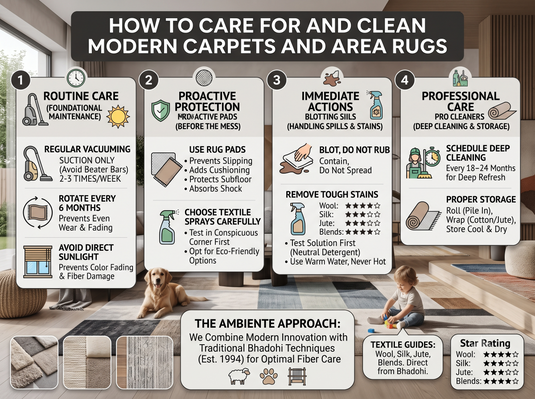
A good rug can still wear badly if it is vacuumed aggressively, left damp, exposed to intense sunlight or used in a room that does not suit the fibre.
Quality gets you a better starting point. Correct maintenance is what helps preserve that quality over time.
The Bottom Line
A good handmade carpet should have clear construction, appropriate fibre, stable structure, secure edges, balanced shape and finishing that suits the design.
Use knot density, weight and softness as supporting information rather than complete quality scores.
For handmade examples, explore The Ambiente’s hand-knotted rugs, handloom rugs and wool rugs.