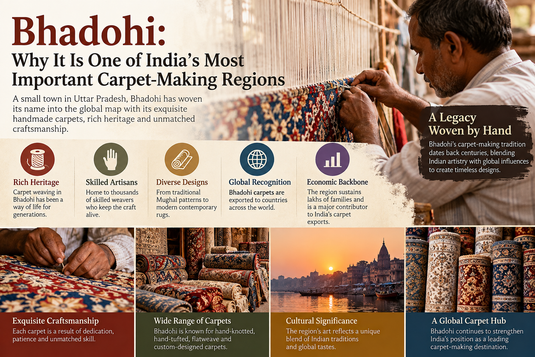
Bhadohi is one of those places whose name means much more inside the rug trade than it does to the average shopper. For generations, the region has been closely associated with handmade carpet production, skilled weaving communities and export-oriented manufacturing. If you have ever bought a hand-knotted rug made in India, there is a good chance that Bhadohi or the surrounding carpet belt has some connection to its story.
For The Ambiente, Bhadohi is not just a manufacturing reference. It is part of the brand’s roots. Understanding the region helps explain why handmade rugs from India carry such a strong reputation for craftsmanship, labour-intensive construction and design variety.
This guide looks at why Bhadohi became so important, how the local carpet ecosystem works, what makes the region distinctive and why buyers should care about origin when choosing a handmade rug.
Where Is Bhadohi?
Bhadohi is a district and city in Uttar Pradesh, in northern India. It lies within a wider carpet-producing belt that includes weaving communities spread across Bhadohi and nearby areas.
The region is often referred to as a major centre of India’s handmade carpet industry because weaving, washing, finishing, dyeing, design, trading and export activities are concentrated within a relatively connected ecosystem.
That ecosystem matters because a handmade rug is not produced by one person doing one job. It passes through multiple specialised stages before it reaches a customer.
Why Did Carpet Weaving Become So Important Here?
Carpet weaving in northern India developed over centuries through a mix of court traditions, Persian influence, local craftsmanship and changing trade networks. Over time, weaving knowledge spread into communities that specialised in knotting, dyeing and finishing.
Bhadohi became especially important because skills were passed across generations and the region developed the infrastructure needed to support large-scale handmade production without turning the work into purely machine manufacturing.
This combination of specialised labour and production networks allowed the area to serve both the Indian market and international buyers.
For a broader historical context, see our article on the origins and development of carpet weaving in India.
What Makes Bhadohi Different From a Single Factory Town?
The carpet industry is distributed. Weaving may happen in village workshops or smaller production units, while washing, clipping, stretching and finishing may happen elsewhere.
Design teams, yarn suppliers, exporters, quality controllers and logistics partners connect these stages.
This distributed model means the region functions more like a specialised craft ecosystem than a single industrial complex.
Hand-Knotted Rugs and Bhadohi
Bhadohi is particularly well known for handmade carpets, including hand-knotted rugs.
Hand-knotting requires patience and repetition. A weaver ties knots around foundation threads row by row, slowly building the pile and pattern.
The production time depends on size, knot density and design complexity. Large, fine rugs can take months to complete.
This labour intensity is one reason the region’s skill base matters so much. The knowledge is not limited to operating a machine. It includes reading designs, maintaining tension, managing colour changes and producing consistency over a large surface.
Hand-Tufted and Handloom Production
Bhadohi is not limited to one rug construction. The region also produces hand-tufted rugs, handloom rugs and other handmade floor coverings.
This allows manufacturers and designers to match construction to the project. A luxury residential project may favour fine hand-knotting, while a contemporary custom design with a shorter lead time may use hand-tufting.
Our guide to hand-knotted, hand-tufted and handloom rugs explains these differences from a buyer’s point of view.
The Role of Weaving Communities
The strength of Bhadohi’s carpet industry depends on skilled people.
Weaving knowledge is often practical and highly specialised. It may involve knotting technique, loom setup, pattern reading, yarn handling and finishing skills that are learned through experience.
This is why conversations about handmade carpets should include the people behind them. A rug is not simply a decorative object. It represents many hours of manual work and specialised knowledge.
Why Skill Continuity Matters
Traditional craft regions face a real challenge when younger generations see fewer reasons to remain in labour-intensive work.
If weaving knowledge disappears, it cannot be recreated simply by buying new equipment.
For brands working with handmade rugs, supporting skilled production means more than preserving a romantic image of craft. It means creating enough economic value for the work to remain viable.
Materials Used in Bhadohi Rugs
The region works with many rug fibres, including wool, cotton foundations, viscose-type fibres, bamboo silk, jute and blends.
Wool rugs remain important because wool is naturally suited to pile construction. It is resilient, warm and able to take dye well.
Bamboo silk and other lustrous fibres are popular in contemporary designs because they create sheen and contrast.
Material choice affects the final rug just as much as the place of production.
Why Bhadohi Rugs Can Look So Different From One Another
There is no single “Bhadohi look”.
The region produces traditional Persian-inspired patterns, modern abstracts, geometric rugs, minimal designs, textured rugs and custom project work.
This flexibility is one of its strengths. The craft base is broad enough to support both heritage techniques and contemporary design.
Browse The Ambiente’s modern rugs and traditional rugs to see how varied handmade design can be.
Design Development in the Region
Modern rug production often begins digitally. Designers develop artwork, colourways and scaled patterns before the rug reaches a loom.
But the design still has to be translated into a construction that can actually be woven or tufted.
A fine line may need to become wider. A gradient may be interpreted through colour mixing. A large motif may need to be adjusted for the final room size.
This bridge between design software and hand production is a major part of contemporary carpet making.
Custom Rugs and Bhadohi
The region is well suited to custom production because different skills and construction methods exist within the same broader ecosystem.
Architects and interior designers can specify size, colour, material, shape and texture.
Our article on how custom rugs are made for architects and interior designers explains the project process in detail.
Dyeing and Colour
Colour is one of the most demanding parts of rug production. Wool, bamboo silk and other fibres absorb and reflect colour differently.
Yarn colours also need to work together at full scale. A shade that looks subtle in a small sample may become dominant across a large rug.
Experienced production teams understand these changes and can help designers adjust palettes before weaving begins.
Washing and Finishing
A rug is not finished when it comes off the loom.
It may go through washing, stretching, drying, clipping, shearing, carving and final edge work.
These stages can influence softness, clarity of pattern, pile height and overall appearance.
Two rugs made with similar yarn and construction can look quite different if the finishing quality is not the same.
Why Quality Control Matters
Handmade production naturally includes variation. Quality control is about making sure that variation stays within acceptable limits.
Teams check dimensions, pattern alignment, pile, colour, edges and finishing before dispatch.
For export and high-end residential work, consistency with approved samples is especially important.
Bhadohi and India’s Carpet Exports
The Bhadohi carpet belt has long played an important role in India’s handmade carpet export sector. Export-oriented production pushed the region to work with international sizes, design preferences and quality requirements.
This helped local manufacturers build experience across markets while maintaining handmade techniques.
It also created relationships between Indian producers, global retailers, designers and interior projects.
Why Geographic Reputation Matters
When a region becomes associated with a craft, buyers begin to use the place name as a shortcut for quality.
That can be useful, but it should not replace product-level evaluation.
A rug being made in Bhadohi does not automatically guarantee perfect quality. Material, construction, finishing and the individual producer still matter.
Origin is one part of the story, not the entire quality test.
How to Evaluate a Handmade Rug From Bhadohi
Ask about the construction first. Is it hand-knotted, hand-tufted or handloom?
Then ask about material. Is it wool, bamboo silk, a blend or another fibre?
Look at the back of the rug. Check the edges, pile consistency and finishing.
Ask for care instructions and expected use. A good seller should be able to explain where the rug works best.
Our guide on how to identify a genuine handmade rug goes deeper into inspection.
Bhadohi and the Difference Between Handmade and Machine-Made
Machine-made carpets can be practical and well engineered, but they are produced through a different process.
Handmade carpets rely much more heavily on human skill and time. This affects visual character, production speed and pricing.
If you want to understand the contrast, our guide to the machine-made carpet manufacturing process shows how industrial production differs.
Why Handmade Rugs Cost More
A major part of the price is labour. Hand-knotting thousands of knots cannot be compressed into the same production time as machine manufacturing.
Material, dyeing, washing, design development and finishing add additional cost.
This is why a genuine handmade rug should not be judged only by comparing its square-foot price with a machine-made alternative.
What Bhadohi Means to The Ambiente
The Ambiente grew from a carpet-making background connected to Bhadohi. That matters because our understanding of rugs begins with how they are made, not only how they are styled.
We believe customers should know why one rug takes longer to produce, why materials behave differently and why handmade work deserves clear explanation.
That knowledge also helps customers choose more confidently instead of treating every rug as interchangeable.
Why the Region Still Matters in a Modern Interior Market
Interior design changes quickly. Colours, shapes and trends evolve every year.
But the underlying ability to turn yarn into a durable handmade surface remains relevant.
Bhadohi’s strength is that traditional skills can be used to create contemporary products. A modern abstract rug and a traditional medallion rug may come from the same broad craft ecosystem even though they look completely different.
Challenges Facing the Carpet-Making Region
Like any craft-based industry, Bhadohi faces pressure from changing labour patterns, machine-made competition, raw material costs and demand for faster production.
There is also growing pressure for greater transparency around working conditions, sustainability and supply chains.
These are important issues. Buyers increasingly want to know not only how a rug looks but also how it was produced.
What Responsible Buying Can Look Like
Ask brands about materials, construction and origin. Look for businesses that can explain their production rather than relying on vague “artisan” language.
Buy a rug that suits your actual needs so it stays in use for longer.
Care for it properly rather than treating it as disposable decor.
Long product life is one of the most practical ways to respect the labour and resources that went into making it.
Is Bhadohi Only About Traditional Carpets?
No. This is one of the biggest misconceptions.
Traditional rugs remain an important part of the region’s identity, but Bhadohi produces contemporary, minimal, geometric and custom rugs for modern interiors as well.
The skills are traditional. The design language does not have to be.
Why Buyers Should Learn About the Place Behind the Rug
Knowing where a handmade rug comes from helps a buyer ask better questions. Instead of seeing only a finished pattern, you begin to think about who made it, how long the process took, what material was used and why one construction costs more than another. That knowledge makes it easier to compare value fairly.
For Indian consumers, Bhadohi is also a reminder that world-class rug production exists within the country. Many buyers discover handmade carpets through international design references without realising how much production knowledge is concentrated in Indian weaving regions.
Understanding origin does not mean buying on geography alone. It means using origin as one more layer of information alongside fibre, construction, quality and design. The strongest purchase is still the rug that fits your room and performs well, but knowing the production context can make that choice more informed.
The Bottom Line
Bhadohi is important because it combines a long history of carpet making with a dense network of skilled weavers, finishers, designers, suppliers and manufacturers.
The region became one of India’s major handmade carpet centres not because of one factory or one style, but because generations of specialised knowledge accumulated there.
For buyers, that history is useful context. It explains why Indian handmade rugs can involve so many stages and why craftsmanship remains central to their value.
At The Ambiente, Bhadohi represents both heritage and possibility. The same weaving knowledge that created traditional carpets can also produce modern, custom and highly contemporary rugs for today’s homes.
If you want to explore that craftsmanship, start with The Ambiente’s hand-knotted rugs, handloom rugs and hand-tufted rugs.