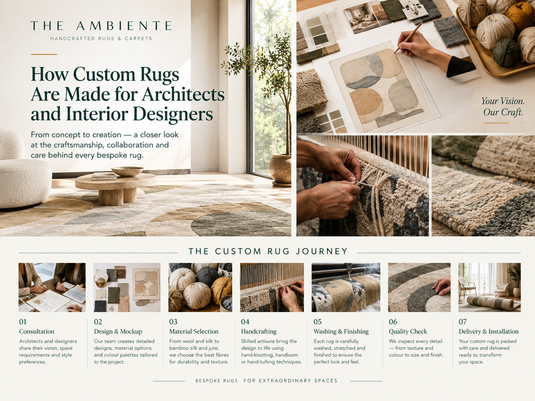
Custom rugs are often discussed as if they begin with a colour swatch and end with a finished piece arriving on site. In reality, a good custom rug project is closer to a small design and manufacturing process. Architects and interior designers have to balance scale, material, colour, construction, performance, budget and installation, often across several rounds of sampling.
At The Ambiente, we see custom rug work as a collaboration between design intent and weaving reality. A drawing may look perfect on screen, but yarn behaves differently from pixels. Colours shift with fibre and light. A fine curve may need a different construction from a bold geometric form. A rug that is visually beautiful but unsuitable for the traffic level can become a problem after installation.
This guide explains how custom rugs are typically developed for architects and interior designers, from the first brief to final delivery. It also shows where decisions about hand-knotted, hand-tufted and handloom construction enter the process.
What Makes a Rug “Custom”?
A rug can be customised in several ways. The simplest project may involve changing the size of an existing design. A more involved project may alter colour, material and shape. A fully bespoke rug can begin with a completely new design created for one room, residence, hotel, office or hospitality project.
Customisation can include:
- Exact dimensions
- Custom shape
- Colour matching
- Material selection
- Pile height
- Construction method
- Pattern scale
- Carving or high-low texture
- Border details
- Special edge finishing
The more variables that change, the more important sampling becomes.
Step 1: Start With the Room, Not the Rug
The strongest custom rug briefs begin with the space.
An architect or designer should provide the room dimensions, furniture plan, key finishes and intended circulation. The rug needs to relate to sofas, beds, dining tables, joinery and architectural lines.
A custom rug made without understanding furniture placement can end up technically accurate but visually wrong.
If the main problem is size, our complete rug size guide for Indian homes is a useful starting point before moving into bespoke dimensions.
Step 2: Define the Performance Requirement
Before choosing colours, decide what the rug must survive.
Is it for a quiet master bedroom, a formal living room, a busy family room, a hotel lobby, an office lounge or a dining space?
Traffic level changes material and construction decisions. A delicate high-sheen pile may be appropriate in one room and completely impractical in another.
For commercial or hospitality projects, designers may also need to consider fire performance, accessibility, maintenance schedules and local project specifications.
Step 3: Establish the Design Direction
The design can begin from many sources: an original sketch, artwork, architecture, fabric, stone, a historical motif, a colour story or an existing rug that needs reinterpretation.
The goal should not be to copy another brand’s design. A good custom project translates the designer’s own concept into textile language.
For architects, this may mean picking up a curve from the floor plan or a rhythm from the facade. For interior designers, it may mean connecting upholstery, wall finishes and artwork through colour and texture.
Step 4: Decide the Rug Shape
Rectangular rugs remain the most common because they align easily with furniture. But custom work makes irregular shapes possible.
Curved, oval, circular and freeform rugs can help soften angular interiors or define zones in open-plan rooms.
Shape affects production. A complicated outline may be easier in a tufted construction than in certain woven methods. The edge also needs to be finished cleanly so the final form holds its shape.
Step 5: Choose the Construction
Construction is one of the most important decisions in the entire project.
Hand-Knotted
Hand-knotting suits projects where longevity, fine detail and craftsmanship are central. It is slower and generally more expensive because the pile is built knot by knot.
It works beautifully for luxury residences, collector pieces and projects where the rug is intended to remain relevant for many years.
Hand-Tufted
Hand-tufting is highly flexible for custom work. It can produce bold graphics, curves, sculpted surfaces and complex colour areas faster than hand-knotting.
For many interior design projects, it offers a practical balance between visual freedom, lead time and budget.
Handloom
Handloom rugs work well when the design depends on texture, stripes, tonal surfaces or cleaner geometric language. They can be an excellent fit for contemporary interiors.
Our buyer’s guide to rug construction explains the differences in more detail.
Step 6: Select the Material
Material changes both performance and appearance.
Wool is a common foundation for custom projects because it is resilient, comfortable and versatile. Bamboo silk can add sheen and softness. Natural silk can create exceptional fineness in specialised high-end work.
Blends are useful when a designer wants matte and lustrous areas in the same rug. A wool base with bamboo silk highlights can create depth without making the entire surface highly delicate.
See our guide to wool, bamboo silk and silk rugs before locking the specification.
Step 7: Build the Colour Palette
Colour matching is more complex in yarn than on screen. A digital RGB colour, printed sample and dyed yarn can all look different.
Designers usually work from physical references such as Pantone systems, fabric swatches, paint chips, stone samples or approved yarn poms.
The fibre matters too. The same dye colour can look softer on wool and brighter on a lustrous yarn because the surface reflects light differently.
This is why physical colour approval is important for premium custom work.
Step 8: Translate the Artwork Into a Weavable Design
A rug design has to be adapted to the chosen construction.
Very thin lines may need to become thicker. Tiny details may disappear in a lower-density construction. Curves can require additional definition. Gradients may need to be interpreted through colour steps or mixed yarns.
This technical translation is not a compromise. It is part of textile design.
A designer who understands the construction can create artwork that looks stronger in yarn than a literal pixel-for-pixel reproduction would.
Step 9: Confirm Pattern Scale
A motif that looks balanced on a laptop screen may feel completely different across an 8' x 10' rug.
Pattern scale should be reviewed at full size or through a clearly dimensioned rendering.
Furniture also hides parts of the rug. A central motif may disappear beneath a dining table, while a border may become the most visible part of the design.
Good custom development considers what will actually be seen after installation.
Step 10: Create a Strike-Off or Sample
A strike-off is a small sample made using the proposed colours, materials and construction.
It allows the designer to check:
- Colour accuracy
- Texture
- Pile height
- Material contrast
- Carving
- Pattern definition
- Sheen
- Overall hand feel
This step can prevent expensive surprises in the full-size rug.
Step 11: Review the Sample in the Actual Material Context
Do not approve a sample under one office light if the rug will live in a room with warm residential lighting and strong daylight.
View the sample next to flooring, upholstery, stone and paint wherever possible.
Lustrous fibres can look dramatically different when turned 180 degrees because pile direction changes the reflection.
Step 12: Revise Before Production
Custom work often needs one or more revisions. A colour may be too cool. A line may need more contrast. A high-low texture may need adjustment.
It is cheaper and faster to make those decisions at the sample stage than after a full-size rug has been produced.
Step 13: Approve the Final Specification
Before production, the final document should clearly state the design, size, shape, colour references, material percentages, construction, pile height, finishing and approved sample.
This creates one shared reference for designer and manufacturer.
For larger projects, each rug should have a clear code so multiple rooms do not become confused during production and installation.
Step 14: Production Begins
Once the specification is approved, the rug moves into weaving or tufting.
Hand-knotted production may take considerably longer because the pile is built manually knot by knot. Hand-tufted and handloom projects can generally move faster, though complexity and size still affect timelines.
Custom work should never be scheduled as if it were an off-the-shelf accessory. Build enough time for sampling, approval, production, washing, finishing and logistics.
Step 15: Washing and Finishing
After weaving, many handmade rugs go through washing and finishing stages. These can affect softness, colour clarity and surface character.
The rug may be stretched, clipped, carved or sheared depending on the design.
Edges and fringes are finished, and the dimensions are checked.
Step 16: Quality Control
Before dispatch, inspect size, colour, pattern, surface, edges and overall finishing.
Handmade rugs can have minor natural variation. The goal is not machine-like sterility. The goal is consistency with the approved sample and specification.
For a custom project, photographs and measurements before dispatch can help reduce site surprises.
Step 17: Delivery and Site Installation
Large rugs need thoughtful handling. Door widths, lifts, staircases and site access should be checked before delivery.
The rug should be placed on a clean, dry floor. A suitable rug pad may be used depending on flooring and project requirements.
Furniture placement should follow the approved layout so the rug aligns with the design intent.
How Long Does a Custom Rug Take?
There is no universal timeline. Construction, size, complexity, material, sample revisions and workshop capacity all matter.
Hand-tufted projects may be completed relatively quickly compared with hand-knotted work, while a large fine hand-knotted rug can require months.
For project planning, always separate sample lead time from production lead time.
How Much Does a Custom Rug Cost?
Price is influenced by area, material, construction, complexity and finishing.
A small wool hand-tufted rug and a large silk hand-knotted rug are both “custom rugs”, but they belong to completely different cost categories.
Designers should share budget expectations early. That allows the maker to recommend construction and material options that preserve the visual idea without developing an unrealistic specification.
Why Architects Often Need Custom Sizes
Architecture does not always conform to standard rug dimensions. Long rooms, curved walls, built-in seating and unusual furniture layouts can make ready-made sizes feel compromised.
A custom rug can align with architectural axes, circulation lines and joinery in a way a standard rectangle cannot.
Why Interior Designers Use Custom Colour
Colour is often the reason a designer moves from ready-made to custom.
A standard rug may be close but not quite right. Custom dyeing allows the rug to connect with upholstery, art, curtains and finishes more precisely.
That does not mean every colour should match. Often, a slightly shifted tone creates a richer room than exact repetition.
Custom Rugs for Hospitality Projects
Hotels and restaurants may need stronger performance specifications than private residences. Traffic, cleaning frequency and replacement planning all matter.
Designers should discuss the intended use honestly. A beautiful residential construction may not be suitable for a busy lobby.
Custom Rugs for Luxury Residences
Residential projects allow more freedom to focus on tactile quality and craftsmanship. A hand-knotted rug can be developed as a long-term piece for a formal living room, while a hand-tufted design can bring stronger graphic expression to bedrooms or lounges.
The Ambiente’s luxury rugs can also provide a starting reference for material, palette and scale.
Common Mistakes in Custom Rug Projects
- Choosing construction after finalising artwork.
- Approving colours only on a screen.
- Ignoring furniture placement.
- Using delicate fibres in high-traffic locations.
- Skipping the strike-off.
- Not allowing enough lead time.
- Changing dimensions after production begins.
- Failing to check lift and doorway access for oversized rugs.
- Expecting handmade production to look mechanically identical everywhere.
How to Brief a Rug Manufacturer Clearly
A useful brief includes a dimensioned floor plan, final rug size, design artwork, colour references, material preference, traffic level, construction preference, target budget, project timeline and delivery city.
If you are still developing the concept, say so. A good maker can often suggest construction or material changes that make the design more practical.
You can also read our existing guide on sourcing rugs for interior projects for procurement considerations beyond design development.
The Bottom Line
A successful custom rug is not simply a standard rug in a different colour. It is a coordinated design, material and manufacturing process.
Architects and interior designers get the best results when they define the room, performance requirement and construction early, then approve physical colour and texture samples before full production.
Hand-knotted, hand-tufted and handloom methods each have a place. Wool, bamboo silk and other fibres each bring different visual and practical qualities. The right combination depends on what the space needs.
At The Ambiente, the most useful custom conversations begin with the project itself: the room, the furniture, the traffic, the mood and the budget. From there, the rug can be designed to belong to the architecture rather than simply sit on top of it.