When architects and interior designers specify a rug for a project, appearance is only one part of the decision. The rug also has to fit the furniture plan, traffic level, maintenance routine, flooring, acoustics, budget, delivery schedule and project standards.
That is why commercial rug specification should be treated more like a material specification than a styling choice.
At The Ambiente, we work with handmade rugs across residential, hospitality and design-led projects. The best results usually come when construction, material, size and performance are decided early rather than after the design has already been finalised.
This guide explains the most important commercial rug specifications architects and interior designers should consider, including construction, fibre, pile height, density, backing, size, edge finishing, colour, sample approval, maintenance and installation.
Start With the Use Case
Before choosing a design, define where the rug will be used.
A rug for a luxury bedroom has a very different performance requirement from a hotel lobby, executive lounge, restaurant, villa entrance or high-traffic living room.
The first questions should be simple:
- How much daily foot traffic will the rug receive?
- Will shoes be worn on it?
- Will food and drink be served nearby?
- Will furniture move across it regularly?
- Is the room exposed to direct sunlight?
- Will the rug sit near an entrance, balcony or wet zone?
- How often can the rug be professionally cleaned?
Those answers shape almost every technical decision that follows.
Choose the Right Construction
Construction determines how the rug is physically built and has a major effect on cost, lead time, design detail and long-term behaviour.
Hand-Knotted Rugs
Hand-knotted rugs are built knot by knot on a loom. They are suitable for premium residences, luxury hospitality areas, formal lounges and projects where craftsmanship and long-term value matter.
They can support detailed designs and natural materials such as wool and silk blends, but they also require longer production time.
Hand-Tufted Rugs
Hand-tufted rugs are useful when a project needs custom graphics, sculpted pile, curves, logos or quicker production than hand-knotting.
They are widely used in interior projects because they offer strong design flexibility and can be produced in many custom shapes and colour combinations.
Handloom Rugs
Handloom rugs work especially well for contemporary projects that rely on texture, stripes, tonal colour or lower pile.
They can offer a clean architectural look and are often practical under furniture.
For a detailed comparison, see our hand-knotted vs hand-tufted vs handloom guide.
Specify the Fibre Clearly
Never write only “premium yarn” or “luxury fibre” in a project specification.
The fibre should be named clearly, along with blend percentages where relevant.
Wool
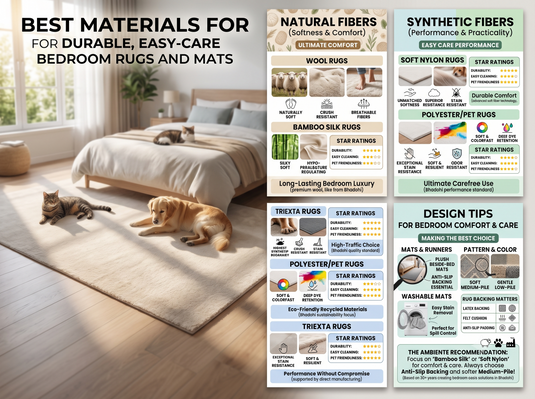
Wool is one of the strongest all-round fibres for premium rugs because it balances comfort, resilience and appearance.
It is suitable for many living rooms, lounges, bedrooms, dining areas and commercial spaces with moderate traffic.
Bamboo Silk and Lustrous Fibres
Bamboo silk can add sheen and visual depth but needs more careful maintenance.
It is usually better suited to formal or controlled-use spaces than highly demanding circulation zones.
Natural Silk
Silk supports very fine detail and luxurious surfaces but is generally reserved for carefully used premium areas.
Jute and Natural Textures
Jute works beautifully in dry interiors where natural texture matters, but it should not be specified in damp areas.
Our rug material comparison can help when selecting premium fibres.
Define the Rug Size From the Furniture Plan
Architects should not specify rug size only from the room dimensions.
The rug needs to relate to furniture placement and circulation.
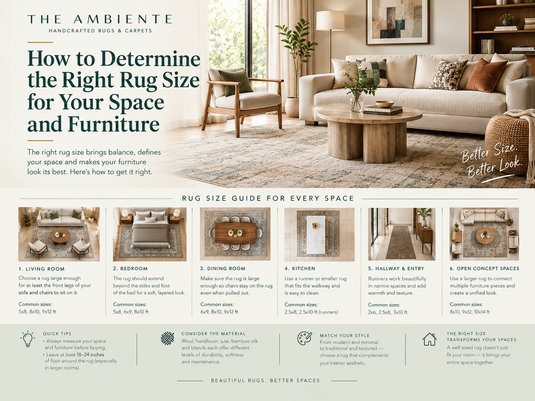
For living rooms, decide whether all furniture legs or only front legs will sit on the rug. For dining rooms, allow enough clearance for chairs to remain on the rug when pulled back. For bedrooms, decide how much rug should extend beyond the bed.
Our complete rug size guide provides practical starting dimensions.
Custom Dimensions Should Be Exact
For bespoke projects, provide final finished dimensions rather than approximate room size.
Do not assume a drawing scale alone is enough. Site conditions, skirting, built-in furniture and door swings can change the usable rug footprint.
A final site measurement before production is especially useful for unusually shaped or oversized rugs.
Specify Pile Height
Pile height changes comfort, cleaning and furniture movement.
Low pile is generally easier under dining chairs, office furniture and high-traffic areas.
Medium pile creates more softness and works well in lounges and residential spaces.
High pile can create a luxurious look but is harder to maintain and may not suit busy commercial zones.
Specify Pile Structure
A rug can use cut pile, loop pile, high-low texture, carving or combinations of these.
High-low designs can create visual interest without adding many colours.
For commercial projects, make sure texture does not interfere with rolling furniture, door clearance or cleaning equipment.
Specify Knot Density When Relevant
For hand-knotted rugs, knot density can influence design detail and production time.
Do not specify the highest possible KPSI automatically. Choose a density that matches the design.
Our KPSI and knot density guide explains how the measurement works.
Specify Rug Weight or GSM Carefully
Weight can be useful for comparing tufted constructions, but it should not be used as a universal quality measure.
A heavy rug may simply use thicker yarn. A fine hand-knotted rug can be lighter while requiring much more labour.
Use GSM or weight together with material, pile height and construction.
Backing Specification Matters
Hand-tufted rugs generally use a primary backing plus adhesive and a secondary backing. Hand-knotted rugs typically do not use the same glued backing structure.
If the project requires a particular backing material, slip resistance or floor compatibility, state it clearly.
Also specify the correct rug pad or underlay for marble, wood or tile.
Consider the Flooring Below
The rug specification should account for the floor underneath.
Polished marble and vitrified tile may need strong grip. Wood flooring requires pad compatibility. Uneven stone may need more cushioning.
Floor finish and rug backing should be reviewed together.
Specify the Edge Finish
Edges are easy to overlook in design drawings but important in the finished rug.
Options may include binding, serging, hand finishing, turned edges or shaped finishing depending on construction.
Irregular rugs require especially careful edge detailing because the outline is part of the design.
Fringe or No Fringe?
Fringe can support a traditional look but may not be practical in every commercial space.
It can catch in cleaning equipment and show wear in high-traffic areas.
If a clean architectural edge is preferred, specify no visible fringe from the beginning.
Colour Specification Needs Physical Approval
Do not rely only on a screen or PDF.
Colours look different in wool, bamboo silk and other fibres because each material reflects light differently.
Use physical yarn poms, Pantone references, fabric swatches or approved project samples.
Final colour should ideally be checked under the actual project lighting.
Understand Pile Direction
Lustrous fibres can look dramatically lighter from one direction and darker from another.
This should be considered before installation, especially in long corridors and large formal rooms.
Specify the preferred pile direction if the visual effect matters.
Ask for a Strike-Off
A strike-off is a small sample produced using the intended material, colours, pile and construction.
It helps the design team evaluate colour, texture, carving and detail before committing to the full rug.
For custom work, this is one of the most important approval stages.
Our guide on how custom rugs are made for architects and interior designers explains the full workflow.
Approve the Sample Against Real Finishes
Place the sample next to stone, wood, upholstery, curtains and paint finishes.
A neutral that looks perfect in isolation may feel too warm or too cool next to the final flooring.
This is why physical project context matters.
Specify Tolerances
Handmade rugs can have minor dimensional variation.
If the project needs extremely tight tolerances because the rug fits between fixed joinery, communicate that early.
Do not wait until installation to discover that the allowable gap is only a few millimetres.
Specify Shape Clearly
Custom rugs can be rectangular, round, oval or irregular.
Provide dimensioned drawings for shaped rugs rather than relying only on artwork.
Complex shapes should include radii, curves and reference points so production can be checked accurately.
Think About Cleaning Before Choosing the Material
Maintenance should be part of specification, not an afterthought.
A rug in a restaurant, hotel or family lounge will need a different care strategy from one in a low-use formal bedroom.
Use low-pile, resilient materials in demanding zones and reserve delicate high-sheen fibres for controlled spaces.
Specify Vacuum Compatibility
Deep pile, loops and delicate handmade constructions may not tolerate aggressive beater-bar vacuums.
If the housekeeping team uses particular equipment, consider that before finalising the pile.
For premium rugs, moderate suction and fibre-appropriate cleaning are safer.
Plan for Stain Risk
Dining rooms, bars and hospitality areas have higher spill risk.
Choose colours, patterns and materials that fit the actual maintenance environment.
A pale silk rug may be visually beautiful but operationally difficult in a busy restaurant.
Fire, Safety and Project Standards
Commercial and hospitality projects may have project-specific fire, accessibility and safety requirements.
These requirements vary by location and building type, so they should be confirmed with the project consultant and applicable local codes.
If formal test certificates are required, specify the exact test or documentation before production begins.
Acoustic Requirements
Rugs can help reduce reflected sound and footfall noise, especially in large hard-surface interiors.
Thicker pile and underlay generally increase softness, but acoustics should be coordinated with the wider interior specification rather than assumed from the rug alone.
Consider Replacement Strategy
In hospitality and commercial projects, ask whether the rug is expected to remain for many years or be replaced as part of a refurbishment cycle.
This can affect construction choice and budget.
A long-term hand-knotted statement piece may make sense in a formal lobby, while a hand-tufted rug may be more practical in spaces that change design more frequently.
Plan Lead Time Early
Handmade rugs should not be treated like stocked accessories.
Sampling, colour approval, yarn preparation, weaving, washing, finishing and shipping all require time.
Hand-knotted projects usually need more production time than hand-tufted or handloom projects.
Build the rug schedule into the interior programme early.
Specify Packaging and Site Access
Large rugs can be difficult to move through lifts, staircases and narrow doors.
Check rolled dimensions and site access before dispatch.
For oversized rugs, installation planning should be coordinated before delivery day.
Installation Matters
The floor must be clean and completely dry.
Use the correct pad where needed.
Position the rug according to the approved furniture plan and confirm pile direction before placing heavy furniture.
Document the Final Specification
A complete rug schedule should include:
- Project and room code
- Finished size
- Shape
- Construction
- Material composition
- Pile height
- Knot density where relevant
- Colour references
- Edge finish
- Fringe requirement
- Backing
- Approved sample reference
- Quantity
- Delivery location
- Care instructions
How The Ambiente Works With Design Projects
For architects and interior designers, we prefer to begin with the room and performance requirement.
From there, construction, material and design can be selected intelligently rather than forcing one rug type into every application.
Custom colour, shape, size and construction can then be developed around the project brief.
Include Maintenance Responsibility in the Specification
For commercial projects, the rug specification should also make clear who is responsible for ongoing maintenance. A beautifully specified rug can still fail operationally if housekeeping teams are not told how to vacuum it, which products to avoid, or when professional cleaning is required.
Where possible, include a simple maintenance note with the handover documents. That note should identify fibre, construction, vacuuming method, spill response and the recommended professional cleaning approach. This helps protect both the rug and the project investment.
The Bottom Line
A commercial rug specification should answer more than what the rug looks like.
It should define how the rug is made, what it is made from, how large it is, how it will perform, how it will be cleaned and how it will be installed.
When these decisions are made early, architects and interior designers reduce revisions, avoid unsuitable materials and get a finished rug that actually works in the space.
For project references, explore The Ambiente’s hand-knotted rugs, hand-tufted rugs, handloom rugs and luxury rugs.