“How much does a custom rug cost in India?” sounds like a simple question, but a useful answer needs more than one number.
A custom rug is priced from its specification. Size, construction, material, knot density, design complexity, pile height, shape, colour development and finishing all affect the quote. Two rugs with identical dimensions can therefore have very different prices.
At The Ambiente, we think custom rug pricing should be transparent in structure even when the final amount needs a project-specific quote. The goal is to understand what is moving the price and whether that extra cost is buying something you actually need.
This guide explains how custom rug pricing works in India, why hand-knotted and hand-tufted rugs differ, how to estimate area, what designers should include in a request for quotation and where clients can save without compromising the design.
Why Custom Rugs Do Not Have One Fixed Price
Ready-made rugs are priced after the manufacturer has already decided the size, material, construction and design.
A custom rug works in the opposite direction. The client or designer defines those choices first, and the manufacturer prices the combination.
That means the question is not simply “What is your custom rug price?” It is “What does this specification cost?”
The Main Factors That Change Custom Rug Cost
- Finished rug size
- Construction method
- Material
- Knot density
- Pile height
- Number of colours
- Design complexity
- Custom shape
- Carving or high-low texture
- Sampling requirements
- Quantity
- Finishing
- Packaging and delivery
Size Is the First Cost Driver
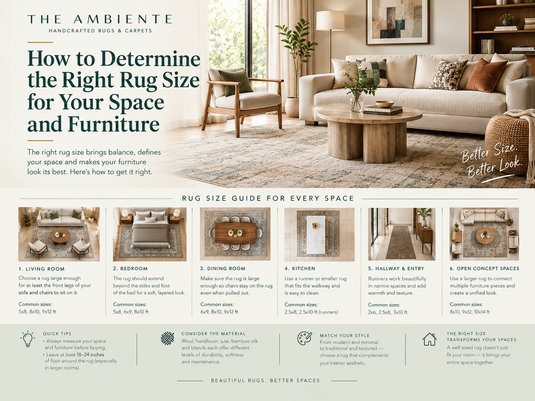
Most handmade custom rugs are strongly influenced by area because larger rugs require more yarn and more production time.
Calculate the area before requesting a quote.
For a rectangular rug, multiply length by width. An 8' x 10' rug covers 80 square feet. A 9' x 12' rug covers 108 square feet.
For irregular shapes, the manufacturer may calculate from the actual design area or from the loom and cutting requirement depending on construction.
Construction Changes the Price Dramatically
Hand-Tufted Custom Rugs
Hand-tufting is one of the most practical methods for custom interior projects.
It allows custom shape, colour, pile height and sculpting without the production time of hand-knotting.
Because the yarn is inserted through a backing using a tufting tool rather than tied knot by knot, labour time is lower.
This often makes hand-tufted rugs a useful option when design flexibility and budget both matter.
Hand-Knotted Custom Rugs
Hand-knotted rugs require substantially more labour because the pile is tied knot by knot.
Price increases as knot density rises because more knots are required within the same area.
Fine materials and intricate designs can increase the cost further.
Handloom and Flat-Weave Custom Rugs
Handloom and flat-weave rugs can offer a more accessible custom route for contemporary interiors.
They work well for stripes, tonal textures, simple geometry and lower-pile designs.
Material Is the Next Major Cost Driver
Wool
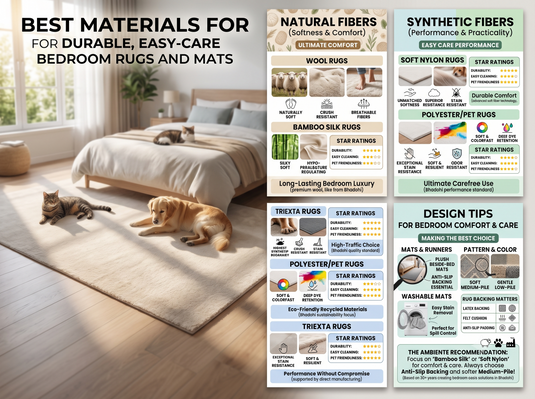
Wool offers one of the strongest balances of comfort, resilience and premium appearance.
It is commonly used for both hand-knotted and hand-tufted custom rugs.
Bamboo Silk
Bamboo silk adds sheen and softness. It can be used alone or in selected areas of a wool rug.
Using it only in highlights can create a premium effect without making the entire rug delicate.
Natural Silk
Natural silk sits at the premium end of custom rug materials and is usually paired with fine hand-knotting.
It is chosen for detail and lustre rather than heavy everyday use.
Jute, Cotton and Blends
These can be appropriate for flatweaves, casual rugs and certain handloom designs.
Material should be chosen according to the room, not only price.
Why Knot Density Affects Hand-Knotted Pricing
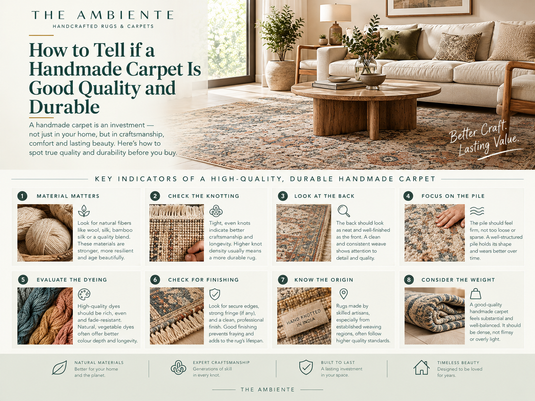
Higher knot density means more knots per square inch and usually more weaving time.
It can improve pattern resolution, but not every design needs a high KPSI.
Our KPSI guide explains when denser knotting adds real value.
One of the easiest ways to overspend on a custom rug is to specify a knot density far higher than the design requires.
Design Complexity Can Change the Quote
A simple two-colour geometric design is easier to produce than a detailed multi-colour floral composition.
Complex designs may require more colour changes, slower weaving and more detailed finishing.
In hand-tufted rugs, complex carving or multiple pile heights can also add labour.
Custom Shape Can Add Complexity
A standard rectangle is straightforward.
Round, oval, scalloped and freeform shapes need additional layout and edge finishing.
In tufted production, irregular shapes are relatively flexible. In other constructions, the production method may require more planning.
High-Low Texture and Carving Affect Cost
Carving is done after tufting or weaving to create channels and relief.
High-low pile designs may also use different yarn heights across the same rug.
These details add visual depth, but they also add finishing time.
If the room does not need sculptural texture, a simpler surface can reduce cost.
More Colours Can Mean More Development
Using many colours does not always increase cost dramatically, but it can increase dyeing, sampling and production complexity.
For projects that need precise colour matching, every shade may require yarn approval.
A sophisticated tonal design with four well-chosen colours can sometimes look more premium than a complicated 12-colour rug.
Sampling Has a Cost but Can Save Money
A strike-off or sample lets the client approve material, colour, pile height and texture before full production.
Skipping the sample may seem cheaper, but it creates the risk of approving a full-size rug that does not match the project.
For custom work, sampling is usually worth including in the budget.
Does Custom Size Always Cost More?
Not necessarily on a per-square-foot basis.
Handmade rugs are already built on a loom for a specific size, so a non-standard dimension does not always create the same “custom surcharge” you might see in mass-produced products.
The larger area itself costs more because it requires more yarn and labour, but the fact that a rug is 7' x 11' instead of 8' x 10' does not automatically make it inefficient.
When Customisation Becomes Expensive
Cost rises most clearly when customisation changes the underlying production method.
Examples include very high knot density, natural silk, complex freeform shape, many pile heights, special carving, extremely tight tolerances or very large dimensions.
How Current Indian Market Pricing Varies
Published custom-rug pricing in India varies widely because manufacturers are often quoting very different specifications.
Public 2026 market examples show hand-tufted and handloom work commonly quoted in the hundreds of rupees per square foot, while premium hand-knotted work can move into the low thousands of rupees per square foot and substantially higher for fine silk, dense knotting or luxury specifications.
These are market reference bands, not The Ambiente quotations. A real quote should be based on the exact rug specification, material and size.
Why Two Hand-Knotted Quotes Can Be Very Different
Ask whether both quotes use the same wool quality, knot density, pile height, foundation, dyeing and finishing.
A low quote may be based on coarser knotting or a different material.
A high quote may include finer knotting or silk highlights that are not obvious in a small rendering.
Compare specification with specification, not only total price.
Why Two Hand-Tufted Quotes Can Differ
Hand-tufted pricing is affected by wool quality, pile weight, backing, carving, number of colours and shape.
A thick sculpted wool rug with several pile heights will cost more than a flat single-level tufted design.
How to Estimate a Budget Before Requesting a Quote
Begin with area.
Then decide whether the project belongs in one of three broad categories:
- Practical custom handloom or flatweave
- Design-led hand-tufted
- Premium hand-knotted
After that, choose the material.
This sequence gives the manufacturer enough information to provide a meaningful range before detailed artwork is developed.
What Information Should You Send for a Quote?
- Finished rug size
- Shape
- Reference design or artwork
- Preferred construction
- Material preference
- Number of colours
- Pile height
- Project location
- Quantity
- Required delivery date
For interior projects, also include the room use and expected traffic level.
Should You Specify a Budget First?
Yes, if the budget is real.
A manufacturer can often adapt construction or material to preserve the visual idea while meeting the target.
For example, a design planned in hand-knotting might be translated into hand-tufting if the project has a tighter budget and faster schedule.
Where Can You Save Without Making the Rug Look Cheap?
Reduce complexity before reducing quality.
You can often save by:
- Using fewer colours
- Choosing wool instead of full silk
- Using bamboo silk only as highlights
- Choosing hand-tufted instead of hand-knotted
- Reducing unnecessary carving
- Using a knot density appropriate to the design
- Simplifying an extremely complex shape
Where Should You Not Cut Cost?
Do not compromise basic yarn quality, foundation, backing or finishing.
A cheaper rug that sheds excessively, curls, delaminates or cannot handle the room will cost more in the long run.
Custom Rugs for Architects and Interior Designers
Design professionals should ask for a proper specification rather than a verbal price alone.
Our commercial rug specification guide lists the fields that should be documented for project work.
Custom Rugs for Hospitality
Hotels and restaurants often need stronger performance requirements and larger quantities.
Volume may improve production efficiency, but sampling, testing, installation and logistics become more important.
Budget should include those project-level requirements, not only manufacturing cost.
Custom Rugs for Luxury Residences
Residential clients often have more flexibility to prioritise material and craftsmanship.
Hand-knotted wool, wool-bamboo-silk blends and custom oversized rugs can be developed around furniture, artwork and architecture.
See The Ambiente’s luxury rugs for design references.
Does Buying Direct From a Manufacturer Change Cost?
Direct sourcing can reduce some retail layers, but the biggest advantage is usually specification control.
You can choose size, material, construction and colour rather than paying for a ready-made piece that is only close to what the project needs.
Why Lead Time and Price Are Connected
Handmade rugs require real production time.
Urgent changes can limit construction options or require production rescheduling.
Plan the rug early so you are not forced into a faster method simply because the site is nearly ready.
Can Rush Orders Cost More?
They can, depending on workshop capacity and the construction method.
However, true hand-knotting cannot be compressed indefinitely because each knot still needs to be tied.
The best way to control cost is to approve design and colour early rather than relying on a rush schedule.
Ask What Is Included in the Quote
A quote may or may not include:
- Sampling
- Design development
- Shipping
- Installation
- Rug pad
- Taxes
- Site measurement
- Special packaging
Make sure you are comparing the same scope.
How The Ambiente Approaches Custom Rug Pricing
We prefer to price from the actual requirement.
That means understanding the room, size, material, construction, design and expected use first.
A transparent custom quote should explain what you are paying for rather than presenting one unexplained number.
How to Compare Two Custom Rug Quotes Fairly
Before choosing the lower quote, put both specifications side by side. Check whether the construction, fibre percentages, pile height, knot density, backing, carving, sample development and shipping scope are actually the same.
A quote can look cheaper simply because it excludes sampling, uses a different wool quality, reduces pile weight or changes the construction. The fairest comparison is always like-for-like. If one supplier cannot explain the specification clearly, the price difference is not meaningful enough to base a decision on.
For larger projects, also ask whether future repeat orders will use the same approved yarn colours and construction. Keeping those references documented can make later additions or replacements more consistent and easier to price.
The Bottom Line
Custom rug cost in India depends mainly on size, construction, material and complexity.
Hand-tufted and handloom rugs usually offer more accessible customisation and faster production. Hand-knotted rugs cost more because of the labour involved, especially when knot density and material quality increase.
The smartest way to budget is to define the room, area and construction first, then refine material and design.
If you are considering a bespoke project, explore The Ambiente’s hand-knotted rugs, hand-tufted rugs, handloom rugs and our guide to how custom rugs are made.