Choosing the right rug size becomes much easier when you stop thinking about the room as an empty rectangle and start thinking about the furniture that actually sits inside it.
A rug should connect furniture, define a zone and leave a deliberate amount of visible floor around the edges. If it is too small, the furniture looks disconnected. If it is too large, the room can feel crowded.
At The Ambiente, we recommend a furniture-first method rather than choosing from a generic size chart alone. This guide shows how to measure your space, test rug dimensions on the floor and choose the right size for sofas, beds, dining tables and open-plan layouts.
Step 1: Measure the Room
Record the room length and width.
Also note doors, wardrobes, built-in cabinets, columns, floor transitions and other fixed elements.
This gives you the maximum practical rug area.
Step 2: Measure the Furniture Group
The rug should relate to the furniture, not the walls alone.
Measure the sofa width, chair positions, bed dimensions or dining table footprint depending on the room.
Step 3: Decide What the Rug Needs to Connect
In a living room, the rug usually connects the sofa and chairs.
In a bedroom, it connects the bed and walking zone.
In a dining room, it supports the table and pulled-out chairs.
In an open-plan room, it defines one functional area.
Step 4: Mark the Rug on the Floor
Use painter’s tape to mark the proposed dimensions.
This is one of the most effective ways to prevent sizing mistakes.
Walk around the room, move chairs and open doors while the tape is in place.
Step 5: Compare Two Sizes
If you are between sizes, mark both.
In many rooms, the larger option looks better because it connects more furniture and makes the space feel more intentional.
Common Rug Sizes
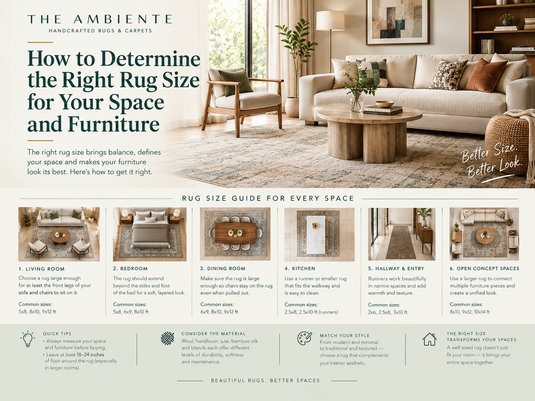
Typical rectangular rug sizes include 4' x 6', 5' x 8', 6' x 9', 8' x 10', 9' x 12' and larger custom dimensions.
Handmade rugs may vary slightly in finished size, so always check the actual measurements.
For a broader India-focused chart, see our complete rug size guide for Indian homes.
Living Room: Front Legs on the Rug
This is one of the most practical layouts.
The rug sits under the front legs of the sofa and chairs, connecting the seating group without covering the entire floor.
Make sure the rug extends beyond the sofa width so it does not look narrow.
Living Room: All Furniture Legs on the Rug
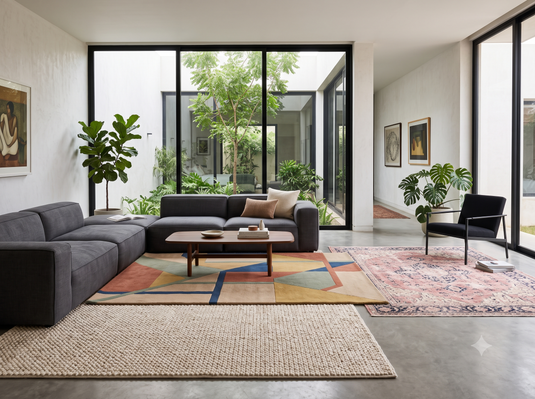
In larger rooms, placing all seating completely on the rug creates a more luxurious and unified look.
This usually requires 8' x 10', 9' x 12' or larger sizes depending on furniture.
Living Room: Coffee Table Only
A rug only under the coffee table can work in very small rooms, but it often looks undersized.
If possible, move up one size so the rug relates to the sofa as well.
How Wide Should a Living Room Rug Be?
As a starting point, the rug should be at least as wide as the sofa and ideally extend beyond it on both sides.
Measure the entire seating group if lounge chairs are part of the layout.
Sectional Sofa Rug Sizing
Sectionals usually need wider rugs than standard sofas.
Measure both sections and the central coffee-table area.
A rug that only fits the centre can make a large sectional look visually heavy.
Small Living Room Sizing
Do not automatically choose the smallest rug.
A larger rug that reaches under the sofa can make a compact room feel more coherent.
See our small living room rug guide.
Large Living Room Sizing
Large rooms need enough rug area to hold visual weight.
If standard sizes leave too much exposed floor inside the seating group, consider oversized rugs or custom sizing.
Dining Room: Measure the Chairs Pulled Out
The dining rug should extend beyond the table far enough for chair legs to remain on the rug when someone sits down or stands up.
A common starting point is roughly 24 to 30 inches beyond the table edge, but the actual chair depth should decide the final size.
Rectangular Dining Table Rug Size
Measure the table length and width, then add chair clearance on all sides.
This usually results in a rug that is much larger than the table itself.
Round Dining Table Rug Size
Measure the table diameter plus chair clearance.
A round rug often works beautifully, but it still needs enough diameter for the chairs.
See our round rug size guide.
Bedroom: Rug Under the Entire Bed
This creates the most complete look.
The rug should extend clearly beyond both sides and the foot of the bed.
Bedside tables can sit on the rug as well if the room is large enough.
Bedroom: Rug Under the Lower Two-Thirds
This is one of the most efficient layouts.
The rug begins below the bedside tables and extends beyond the bed sides and foot.
You get softness where you step without needing the full rug length under furniture.
Bedroom: Runners Beside the Bed
Runners work well in narrow rooms or when you want to keep more flooring visible.
Measure the clear floor beside the bed and check wardrobe clearance.
Our runner rug guide can help with width and length.
Queen Bed Rug Size
Depending on room size and placement, 6' x 9' or 8' x 10' rugs are common starting points.
Always measure the actual bed frame because upholstered beds can be wider than the mattress.
King Bed Rug Size
8' x 10' and 9' x 12' are common starting points for king beds.
Large rooms may need even bigger custom rugs.
See our king vs queen bedroom rug guide.
Hallway Runner Size
Leave visible floor on both sides of the runner and some space at each end.
Do not let the runner crowd walls or extend awkwardly into unrelated doorways.
Foyer Rug Size
A foyer rug should fit within the clear entry area and allow doors to open freely.
Round rugs work well in square foyers, while rectangular rugs suit longer entrances.
Open-Plan Living Room Rug Size
Use the rug to define one functional zone rather than trying to fill the entire open floor.
The living rug should connect the seating while leaving a clear circulation path to the dining or kitchen area.
Open-Plan Dining Rug Size
Keep the dining rug large enough for chair movement but distinct from the living rug.
The two rugs can relate through colour or material without matching exactly.
Home Office Rug Size
The rug should allow the chair to remain on the surface as it rolls backward.
Low-pile rugs are generally easier under office chairs.
Reading Nook Rug Size
Measure the chair, side table and lamp as one small furniture group.
A 4' x 6', 5' x 5' round or 5' x 7' rug may work depending on the space.
Kids’ Room Rug Size
Choose enough floor area for play.
A larger rug is more useful than a small decorative mat if children sit and play on the floor.
How Much Floor Should Remain Visible?
There is no fixed number for every room.
The visible floor should form a balanced border around the rug.
In many rooms, 12 to 24 inches of exposed floor around the perimeter creates a comfortable frame, but furniture layout matters more than the number alone.
Should the Rug Touch the Wall?
Usually, no.
Area rugs look more intentional when some flooring remains visible.
If you want wall-to-wall coverage, carpet may be a better solution.
Door Clearance
Measure the gap under nearby doors.
Remember that a rug pad adds height.
Low-clearance doors can catch on thick pile.
Wardrobe Clearance
In bedrooms, check hinged wardrobes and low drawers.
A thick rug placed too close to cabinetry can make doors difficult to open.
Custom Rug Sizing
Custom size is useful when standard dimensions leave awkward gaps.
For example, a 7' x 11' rug may suit a room much better than forcing an 8' x 10' into the layout.
Our custom rug measurement guide explains how to prepare final dimensions.
How Material Affects Size Choice
Heavy hand-knotted rugs are harder to move, so plan carefully before ordering an oversized piece.
Flatweaves are easier to handle and can be practical when the rug needs to be moved frequently.
How Pattern Scale Affects Perceived Size
Large-scale patterns make a rug feel more expansive and modern.
Small busy patterns can make the floor feel visually denser.
Choose pattern scale according to the room and furniture size.
Why Larger Rugs Often Look More Expensive
Scale creates visual confidence.
A properly sized rug makes the furniture look grounded and the room feel designed.
A smaller expensive rug can look less successful than a larger, simpler rug that fits correctly.
Common Rug Sizing Mistakes
- Buying before measuring furniture.
- Choosing the smallest rug to save money.
- Ignoring chair movement in dining rooms.
- Forgetting door and wardrobe clearance.
- Choosing standard size when the room needs custom dimensions.
- Measuring the room but not the furniture group.
- Assuming every king or queen bed needs the same rug.
A Simple 5-Minute Rug Size Test
- Measure the furniture group.
- Choose two likely rug sizes.
- Mark both with painter’s tape.
- Walk around the room and move chairs.
- Choose the size that connects the furniture without blocking circulation.
How The Ambiente Recommends Choosing Rug Size
Start with the furniture group, not the empty room.
Use the rug to connect the objects that belong together.
Then check circulation, visible floor and clearance.
Only after that should you decide whether a standard or custom size makes sense.
How to Size a Rug Around a Coffee Table
The coffee table should sit comfortably within the rug zone, but the rug should not be sized to the coffee table alone. The better reference is the full seating group.
If the rug extends only a few inches beyond the table, it usually looks too small unless the room is extremely compact.
How to Size a Rug Around a Bench
For entryways and bedrooms, benches need enough rug depth so the front legs do not sit half on and half off the rug. Measure the bench together with the surrounding walking zone.
How to Size a Rug for a Floating Sofa Layout
If the sofa sits away from the wall, use the rug to define the seating island. In most cases, all major seating legs should either sit fully on the rug or follow a consistent front-legs-on arrangement.
This is one of the layouts where a larger rug almost always looks more intentional.
How to Size Rugs in Rooms With Angled Furniture
When sofas or chairs are angled, measure the furniture group by its outermost points rather than the straight wall dimensions.
Mark the proposed rug on the floor and check whether angled chair legs remain supported.
How to Size a Rug in a Studio Apartment
Use one rug to define the main living zone rather than trying to cover every open area. A second smaller rug can define the bed or dining area if there is enough visual separation.
The goal is zoning, not filling every square foot of floor.
How to Size a Rug Around a Fireplace
Keep enough clearance so the rug does not sit too close to heat or sparks, and make sure the furniture grouping still feels centred on the rug rather than on the fireplace alone.
If the hearth projects into the room, measure from the usable furniture zone rather than from the wall behind it.
How to Size a Rug in a Room With Two Sofas
Measure the outer edges of both sofas and the space between them. The rug should visually connect the entire conversation area, not only the coffee table in the centre.
In many two-sofa layouts, an 8' x 10' or 9' x 12' rug works better than a smaller option, but the final decision should come from the actual furniture footprint.
The Bottom Line
The right rug size is determined by furniture placement and room function.
Measure the room, measure the furniture group and mark the proposed rug on the floor before ordering.
For living rooms, connect the seating. For dining rooms, allow chair clearance. For bedrooms, make sure enough rug extends beyond the bed.
Explore The Ambiente’s medium rugs, large rugs and oversized rugs once you know the dimensions your furniture actually needs.