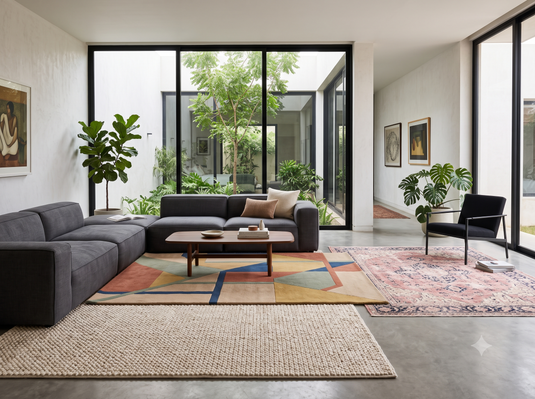
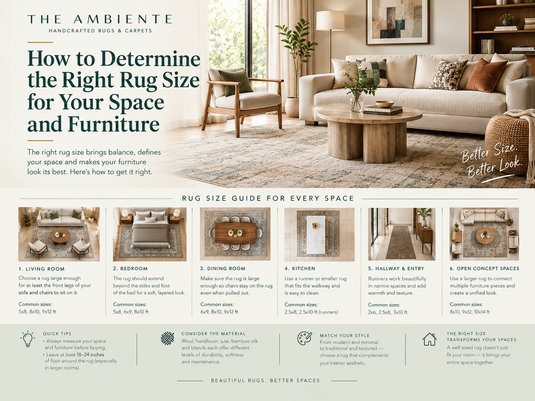
Measuring for a custom rug is not difficult, but it needs more thought than simply measuring the room from wall to wall. A custom rug should relate to the furniture, walking paths, door swings and architecture. If the measurement is wrong, even a beautifully made rug can feel awkward in the space.
At The Ambiente, we recommend measuring around the way the room is actually used. That means checking furniture placement, circulation, fixed joinery and the amount of visible flooring you want around the rug.
This guide explains how to measure a space for a custom rug in living rooms, bedrooms, dining areas, open-plan homes and unusual architectural layouts. It also covers irregular shapes, built-in furniture, oversized rugs and final site checks before production.
Start With the Furniture Plan
Do not begin with empty-floor dimensions alone.
A rug is usually there to anchor furniture, define a zone or connect different elements in the room. The most useful measurement therefore starts with the sofa, chairs, bed, dining table or other main pieces.
If the furniture plan is still changing, avoid approving the final rug size too early.
Measure the Room First
Record the overall room length and width.
Then note:
- Door positions
- Door swing direction
- Built-in wardrobes
- TV units
- Columns
- Fireplaces
- Floor outlets
- Balcony doors
- Fixed benches
- Changes in flooring material
These architectural features help define the usable rug area.
Use a Tape Measure, Not Guesswork
Product photos can make rugs look much larger or smaller than they really are.
Always measure the actual room with a tape measure or laser measurer.
For final production dimensions, do not rely on visual estimation.
Mark the Rug Outline on the Floor
One of the most useful methods is to mark the intended rug size with painter’s tape.
This lets you see the footprint at full scale before the rug is made.
Walk around the room, move chairs and open doors while the outline is in place.
You may discover that a rug that looked correct on paper is too narrow or too close to a cabinet.
Living Room: Front Legs or All Legs?
The first living-room decision is whether only the front furniture legs or all legs will sit on the rug.
For many Indian homes, the front-legs-on arrangement works well because it connects the seating without requiring an oversized rug.
In larger rooms, putting all furniture legs on the rug can create a more luxurious, unified look.
See our complete rug size guide for Indian homes for common room layouts.
How Far Should a Rug Extend Beyond a Sofa?
A rug should usually be at least as wide as the sofa and ideally extend beyond it on both sides.
The exact extension depends on the room, but a few extra inches often make the composition feel more deliberate.
A custom rug gives you the freedom to match the actual sofa rather than forcing the room into a standard size.
Measure the Entire Seating Group
If the living room includes a sofa, lounge chairs and side tables, measure the whole group rather than the sofa alone.
The rug should connect the seating visually.
If one chair sits completely outside the rug while the others sit on it, the room can feel unbalanced.
Sectional Sofas Need Wider Rugs
Sectionals often require wider rugs than standard three-seater sofas.
Measure the full width of the sectional and consider where the return section ends.
For custom rugs, you can create a dimension that extends evenly beyond both sections rather than settling for a size that is too narrow.
Dining Rooms: Measure Chairs Pulled Out
This is the most important dining-room rule.
Do not measure only the table.
Pull the chairs back as they would be when someone sits down or stands up. The rug should extend far enough that the chair legs remain on the rug.
Our guide to round vs rectangular dining rugs explains shape selection as well.
How Much Clearance Should Dining Chairs Have?
A common starting point is around 24 to 30 inches beyond the table edge, but your actual chair depth should decide the final number.
Larger upholstered chairs may need more clearance.
Measure the real furniture rather than relying only on generic rules.
Round Dining Tables
For round tables, calculate the table diameter plus enough clearance for chairs.
A round rug can follow the shape of the table, but a large square or rectangular rug can also work depending on the room.
The key issue is still chair movement.
Bedroom Rugs: Measure the Bed and Walk Zones
For bedrooms, decide whether the rug will sit under the entire bed, under the lower two-thirds or as runners beside the bed.
Measure the bed frame, bedside tables and the amount of rug you want visible at the sides and foot.
Our king vs queen bed rug guide gives detailed placement examples.
Do Bedside Tables Need to Sit on the Rug?
Not always.
If the rug begins below the bedside tables, you can reduce the required length while still getting softness beside the bed.
If you want a fully unified look, measure so the bedside tables and bed sit on the rug together.
Measure for Runners Beside the Bed
Runners are useful in narrow bedrooms.
Measure the clear floor between the bed and wall or wardrobe.
Leave enough visible floor around the runner so it does not look squeezed into the gap.
Open-Plan Rooms Need Zone Measurements
In open-plan homes, the rug defines a functional zone.
Measure the seating area separately from the dining area even if both occupy one large room.
The rug should make each zone feel intentional without blocking circulation between them.
Measure Traffic Paths
Walk through the room as you normally would.
Note the main paths between doors, seating, kitchen and balcony.
A custom rug should not create awkward narrow strips of exposed floor in those paths or place a raised edge where people repeatedly step.
Door Clearance Matters
Check every nearby door.
Measure the gap under the door and consider both the rug thickness and the rug pad or underlay.
A thick rug that blocks a door becomes frustrating immediately.
Built-In Joinery Changes the Measurement
Wardrobes, media units, window seats and fixed cabinets should be included in the plan.
Decide whether the rug stops before the joinery or extends underneath it.
For most removable area rugs, stopping before heavy fixed joinery is more practical.
Measure Around Columns
If a column sits inside the desired rug area, decide whether the rug will be cut around it or stop before it.
An irregular cut-out can be produced in certain custom constructions, but the shape needs exact dimensions.
Custom Rugs for Curved Rooms
Curved walls and bay windows need more detailed measurements.
Use several reference points rather than one width and one length.
For complex curves, provide a scaled drawing or template so the manufacturer can reproduce the outline accurately.
Freeform and Irregular Shapes
For an irregular rug, create a dimensioned drawing with the overall width and length plus key curve points.
Do not send only a decorative outline without measurements.
Hand-tufted construction is especially flexible for shaped rugs because the backing can be cut to custom outlines.
How to Measure a Round Rug
Measure the required diameter across the centre.
Use tape on the floor to create the approximate circle and check how furniture relates to it.
If the rug is going under a table, measure the chair clearance as well.
How to Measure an Oval Rug
Record the maximum length and maximum width.
Also confirm the exact curve shape because two ovals with the same outer dimensions can look different.
How to Measure a Hallway Runner
Measure the clear hallway width and leave visible floor on both sides.
Then measure the length between doorways or transitions.
A runner should not stop awkwardly halfway across a doorway.
Consider the Rug Pad in Final Dimensions
The pad is normally cut slightly smaller than the rug, so it does not change the rug’s finished size.
However, pad thickness affects door clearance and furniture height.
Include it in the installation plan.
Do Handmade Rugs Have Size Tolerance?
Yes. Handmade rugs can have minor dimensional variation after weaving, washing and stretching.
If the rug has to fit precisely between fixed elements, tell the manufacturer how much tolerance is acceptable.
Do not assume a handmade rug will finish to the exact millimetre unless that requirement has been discussed.
When Should Final Site Measurement Happen?
Final measurement should happen after major fixed elements are installed or confirmed.
If furniture sizes are still changing, wait before signing off production dimensions.
For custom architectural projects, one final check before production can prevent expensive rework.
Measure Twice Before Approving
Use two measurements taken at different times or by two people.
For large rugs, small mistakes become expensive because the total area is significant.
Confirm dimensions in both feet/inches and centimetres if multiple teams are involved.
Keep Units Consistent
A common project error is mixing feet, inches, centimetres and millimetres.
Choose one primary unit in the approved specification and show conversions clearly.
Do not write ambiguous dimensions such as “8.5” without stating whether it means feet or metres.
Custom Rug Area Calculation
For rectangles:
Length × Width = Area
An 8' x 10' rug is 80 square feet.
For circles:
π × radius² = Area
Area is useful for preliminary budgeting because custom rug cost is strongly influenced by size.
See our custom rug cost in India guide for pricing factors.
Measure Before Developing Detailed Artwork
Pattern scale depends on final rug size.
A motif designed for a 5' x 8' rug may look too small or repetitive when stretched across a 10' x 14' rug.
Confirm dimensions early so the artwork can be developed at the correct scale.
Furniture Placement Should Be Included in Artwork Review
Some parts of the rug will be hidden.
A central motif may sit under a table. A border may disappear beneath the sofa.
Review the design together with the furniture plan so important details remain visible.
What Should You Send to the Rug Manufacturer?
- Room plan
- Final rug dimensions
- Shape drawing
- Furniture layout
- Door and joinery notes
- Reference artwork
- Preferred construction
- Material preference
- Delivery location
How Architects Should Document Measurements
Use a dimensioned plan with room and rug codes.
If multiple rugs are being produced, each should have a unique reference such as LR-01, BR-02 or LOBBY-03.
This prevents confusion during production and installation.
Measure for Installation Access Too
A rug can fit the room but still be difficult to deliver.
Check lift dimensions, staircases, door widths and corridor turns.
Large hand-knotted rugs may be heavy and require several people to position.
Oversized Rugs Need Special Planning
Very large rugs may require custom looms, special packaging and coordinated installation.
Measure not only the room but also how the rug will physically reach that room.
Custom Rug Size and Lead Time
Larger rugs generally take longer to produce.
For hand-knotted work, the impact can be significant because more area means more knots.
See our custom rug lead-time guide when planning the project schedule.
Common Measuring Mistakes
- Measuring only the room, not furniture.
- Forgetting dining-chair clearance.
- Ignoring door swings.
- Not checking built-in furniture.
- Mixing measurement units.
- Approving dimensions before the furniture plan is stable.
- Ignoring handmade size tolerance.
- Not checking delivery access.
- Using a standard rug size when the room clearly needs something different.
How The Ambiente Approaches Custom Measurement
We begin with the purpose of the rug.
Is it anchoring a sofa, framing a bed, supporting a dining table or defining an open-plan zone?
Once that is clear, we measure the furniture and circulation, then confirm the final outline against the room.
This produces a rug that belongs to the space rather than simply filling empty floor.
The Bottom Line
The best custom rug measurement comes from the furniture plan, not just the wall-to-wall dimensions.
Measure the room, mark the rug outline, check doors and joinery, test circulation and confirm how much furniture will sit on the rug.
For unusual shapes, provide a dimensioned drawing and final site check before production.
If you are developing a bespoke piece, explore The Ambiente’s custom rugs, living room rugs and bedroom rugs for scale and placement references.