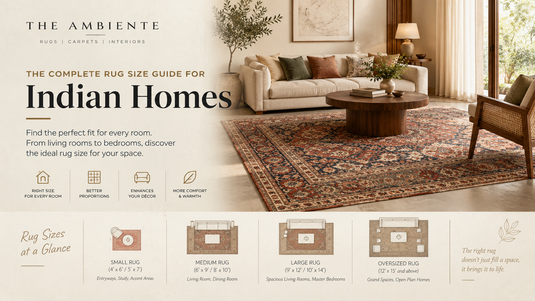
Choosing the right rug size sounds simple until you actually start measuring an Indian living room, bedroom or dining area. A rug that looks large in a product photo can feel surprisingly small once it sits under a sofa. A size that works in a compact apartment may look lost in a larger drawing room. Beds, dining chairs, TV units, doors and circulation space all change what “right size” means.
At The Ambiente, we prefer to size rugs around furniture and movement rather than around empty floor area. The rug should make the room feel connected. It should not look like a small island floating between furniture, and it should not be so large that it crowds the walls or blocks doors.
This guide explains practical rug sizing for Indian homes, including living rooms, bedrooms, dining rooms, foyers, corridors and open-plan spaces. It also covers common standard sizes and how to choose between medium rugs, large rugs and oversized rugs.
Why Rug Size Matters More Than Most People Expect
Colour and design attract attention first, but size determines whether a rug actually works in the room. A properly sized rug can visually connect furniture, define a zone and make a room feel more deliberate. An undersized rug can have the opposite effect.
In many Indian homes, furniture is placed close to walls to create walking space. That makes rug sizing especially important because the rug needs to bridge the space between seating pieces without making circulation awkward.
There is no one-size-fits-all formula, but there are reliable starting points.
Common Rug Sizes You Will See in India
Rug dimensions may be listed in feet, inches or centimetres. Common rectangular sizes include roughly 4' x 6', 5' x 8', 6' x 9', 8' x 10', 9' x 12' and larger custom formats.
A 5' x 8' rug is often useful for compact living rooms, bedrooms and study spaces. A 6' x 9' rug offers more furniture coverage. An 8' x 10' rug can anchor a standard living room comfortably, while 9' x 12' and larger rugs suit generous rooms, open-plan spaces and larger dining settings.
The numbers are only a guide. Handmade rugs may vary slightly, and custom sizing is common for projects that need precise dimensions.
How to Measure a Room Before Buying a Rug
Measure the usable room dimensions first, then measure the furniture arrangement. Do not rely only on wall-to-wall dimensions.
Mark the likely rug outline on the floor with painter’s tape or newspaper. This simple step helps you see whether the size looks balanced before you buy.
Check door swings, balcony doors, floor vents, cabinets and walking paths. In Indian apartments, a rug placed too close to a frequently opened balcony or main door can quickly become inconvenient.
It is usually better to leave some visible flooring around the rug rather than running it tightly against every wall.
Living Room Rug Size: The Most Important Room to Get Right
The living room is where rug sizing mistakes are easiest to notice because multiple furniture pieces need to relate to the rug.
For a detailed room-specific breakdown, you can also read our living room rug size guide.
Option 1: Front Legs on the Rug
This is one of the most practical arrangements for Indian homes. The front legs of the sofa and chairs sit on the rug while the back legs remain on the floor.
The rug should extend under the front of the seating enough to look intentional. A rug that barely touches the sofa legs can look too small.
This layout works well with living room rugs in 6' x 9' or 8' x 10' formats, depending on the room and sofa length.
Option 2: All Furniture Legs on the Rug
In larger rooms, placing the entire seating arrangement on the rug creates a luxurious and cohesive look. This usually requires an 8' x 10', 9' x 12' or oversized rug.
This approach is especially effective in open-plan living spaces because the rug clearly defines the seating zone.
Option 3: Small Rug Under the Coffee Table
This can work in a very compact room, but it is also the easiest layout to make look accidental.
If you choose a smaller rug, make sure there is a clear relationship between the rug, coffee table and surrounding seating. In many cases, moving up one size creates a more finished look.
How Wide Should a Living Room Rug Be?
A useful rule is that the rug should be at least as wide as the main sofa and ideally extend beyond it on both sides. The exact extension depends on the room, but a little extra width helps the rug frame the seating rather than sit inside it.
If your sofa is very long, a 5' x 8' rug may look too narrow even if the room itself is small. In that case, a 6' x 9' or 8' x 10' rug can often look more balanced.
Bedroom Rug Size for King and Queen Beds
Bedroom sizing depends on how much rug you want visible around the bed and whether the bedside tables sit on the rug.
We have a dedicated guide on rug sizing for king and queen beds, but the basic principles are simple.
Rug Under the Entire Bed
A large rug can sit under the bed and bedside tables, extending comfortably beyond the sides and foot. This creates the most unified look but needs the most floor area.
Rug Under the Lower Two-Thirds of the Bed
This is a popular and efficient layout. The rug starts below the bedside tables and extends beyond the foot of the bed. You still get softness where your feet land without covering as much floor.
Runner Rugs Beside the Bed
Two runners can be practical in narrow bedrooms or rooms where a large rug would interfere with storage or doors. They also work well when you want to expose beautiful flooring.
Browse bedroom rugs with the bed dimensions in hand rather than shopping by eye.
Dining Room Rug Size: Allow Space for Chairs
Dining rugs need to be sized around chair movement, not just the tabletop.
The rug should extend far enough beyond the table that chairs remain on the rug when they are pulled out for normal seating. If the back legs repeatedly catch the rug edge, the rug is too small.
A common starting point is roughly 24 to 30 inches of rug beyond the table edge on each side, but your actual chairs may need more or less.
For shape as well as size, see our guide to round vs rectangular dining rugs.
You can also explore dining room rugs once you have measured the fully used table footprint.
What Size Rug Works Under a Four-Seater Dining Table?
For many four-seater rectangular tables, a 5' x 8' or 6' x 9' rug can work, depending on table dimensions and chair depth.
For a round four-seater table, a round rug can be attractive, but make sure the diameter is large enough for the chairs. Matching the shape is less important than providing functional clearance.
What Size Rug Works Under a Six-Seater Dining Table?
Six-seater tables usually need more space. A 6' x 9' rug may work with a compact table, but 8' x 10' is often more comfortable.
Measure with the chairs pulled out. Do not assume a standard seating number automatically determines the rug size.
What Size Rug Works Under an Eight-Seater Table?
Large dining tables often need 8' x 10', 9' x 12' or custom dimensions. A too-small rug under an eight-seater table becomes frustrating quickly because multiple chairs cross the rug edge every day.
Rug Size for Small Indian Living Rooms
Small rooms do not always need small rugs.
This is one of the most useful design lessons. A slightly larger rug can make a compact room feel more coherent because it connects the furniture. Several small exposed gaps between the rug and sofa can visually break up the room.
In a compact apartment, measure carefully and aim for the front sofa legs to sit on the rug. A medium-size rug is often a better starting point than a tiny accent rug.
Rug Size for Large Living Rooms
Large rooms need enough rug to hold their visual scale. An 8' x 10' rug may be the minimum for many larger seating groups, while 9' x 12' and custom rugs can suit generous drawing rooms.
If the room has two separate seating areas, you do not necessarily need one enormous rug. Two coordinated rugs can define separate zones if they share colour, material or design language.
Open-Plan Homes Need Rugs to Define Zones
In an open-plan layout, the rug acts almost like an invisible wall. It tells the eye where one function ends and another begins.
A living room rug can anchor the sofa area, while a second rug defines dining. The rugs do not need to match exactly, but they should relate to each other.
Large rugs are especially useful because very small rugs can make an open-plan space feel fragmented.
Rug Size for Foyers and Entrances
Entrance rugs should leave doors free to open and close. Measure the door clearance before choosing pile height.
A runner works well in a narrow foyer, while a small rectangular or round rug can suit a broader entrance.
For high-traffic entrances, material and construction matter as much as dimensions. Avoid delicate high-pile rugs where shoes, dust and repeated traffic will be concentrated.
Rug Size for Corridors
Runner rugs should generally leave visible flooring along both sides. A runner that nearly touches the walls can make a corridor feel cramped.
Length matters too. It should relate to the corridor rather than stopping awkwardly in the middle of a doorway or transition.
Rug Size for a Home Office
If a desk chair has wheels, make sure the rug is large enough for the chair to move without repeatedly rolling off the edge.
A low-pile rug is often easier under office furniture. In compact study rooms, 5' x 8' can work well if it contains the desk and chair area.
Rug Size for Kids’ Rooms
Children need usable floor area. A rug should provide enough soft space for sitting and play rather than serving only as decoration.
A larger low-pile rug can make cleaning easier than multiple small rugs that shift around.
See The Ambiente’s kids room rugs for options designed around playful and practical interiors.
How Much Floor Should Show Around a Rug?
There is no fixed amount, but the visible border should feel deliberate. In many rooms, leaving several inches to more than a foot of exposed flooring around the rug works well.
Very small gaps can look like the rug was cut slightly too short, while very large gaps may make the rug feel disconnected from the furniture.
Furniture placement should guide the decision more than a rigid wall measurement.
Should a Rug Go Under a TV Unit?
Usually, no. A living room rug generally needs to connect the seating, not extend all the way to the TV console.
If the room is small and the rug naturally reaches the unit, that is fine. But do not buy a larger rug solely to place the TV unit on it.
What If the Standard Size Is Almost Right?
“Almost” can be enough in some rooms. Furniture can often compensate for a few inches of difference.
But if the rug repeatedly looks too narrow, prevents dining chairs from moving properly or leaves an awkward sofa arrangement, consider a custom size.
Custom rugs are especially useful in unusual rooms, long living areas, non-standard dining tables and designer projects.
Round Rugs: How to Choose the Diameter
Round rugs work best when their diameter has a clear relationship with the furniture.
For a round dining table, calculate enough diameter for the table plus pulled-out chairs. For an accent area, make sure the rug is large enough to feel intentional rather than like a small mat.
Round rugs can also break up rooms dominated by rectangular furniture.
Do Larger Rugs Make Rooms Look Bigger?
Often, yes. A larger rug can create visual continuity and make furniture feel like one composition. A tiny rug surrounded by disconnected furniture can emphasize the gaps in a room.
This does not mean the biggest possible rug is always best. Scale still matters. The rug should support the room rather than swallow it.
Common Rug Sizing Mistakes
- Buying based on the room dimensions without measuring the furniture.
- Choosing a living room rug narrower than the sofa.
- Buying a dining rug that fits the table but not the pulled-out chairs.
- Using a tiny rug in a large open-plan space.
- Ignoring door clearance and storage shutters.
- Forgetting to measure the bed plus visible rug extension.
- Assuming standard sizes will fit every Indian apartment layout.
A Simple Room-by-Room Starting Guide
| Room | Useful Starting Size | Main Check |
|---|---|---|
| Compact living room | 5' x 8' or 6' x 9' | Front sofa legs should connect with rug |
| Standard living room | 6' x 9' or 8' x 10' | Rug should frame seating |
| Large living room | 8' x 10', 9' x 12' or larger | Keep seating group visually unified |
| Bedroom | 5' x 8' to 9' x 12' | Allow visible rug at sides and foot |
| Four-seat dining | 5' x 8' or 6' x 9' | Chairs stay on rug when pulled out |
| Six-seat dining | 6' x 9' or 8' x 10' | Measure actual chair clearance |
| Eight-seat dining | 8' x 10', 9' x 12' or custom | Do not undersize |
How The Ambiente Recommends Choosing the Final Size
Start with function. Measure the furniture. Mark the rug outline on the floor. Walk around it for a day if possible.
Then look at proportion. Does the rug connect the furniture? Does the amount of exposed flooring feel balanced? Are doors and walkways clear?
Only after that should you focus on colour and pattern.
If you are deciding between two close sizes, the larger one often creates a more finished look, provided the room can comfortably accommodate it.
The Bottom Line
The right rug size is not determined by a single chart. It depends on how your furniture sits, how people move through the room and how much of the floor you want to visually connect.
For Indian homes, this usually means measuring the actual furniture footprint before buying. In living rooms, let the rug connect the seating. In bedrooms, make sure enough rug shows where your feet land. In dining rooms, leave enough space for chairs to move. In open-plan homes, use rugs to define zones clearly.
Once you have your measurements, compare The Ambiente’s medium, large and oversized rug collections to see which scale fits your room best.