A runner rug looks simple until you try to choose the right size for a hallway. Too narrow and it feels like a strip floating in the middle of the floor. Too wide and it crowds the walls. Too short and the hallway looks unfinished. Too long and the rug runs awkwardly into doorways or furniture.
In Indian homes, hallways and corridors vary a lot. Some are narrow passages between bedrooms, some connect living and dining areas, and some act almost like small galleries. A good runner should make movement feel natural while protecting the main walking path.
At The Ambiente, we recommend choosing runner size from the actual corridor dimensions, door positions and traffic pattern rather than from a standard chart alone. This guide explains how to measure, how much floor to leave visible, which materials work best and how to place runners in different hallway layouts.
What Is a Runner Rug?
A runner rug is a long, narrow rug designed for corridors, hallways, entrances, kitchens, bedside areas and other linear spaces.
Unlike a standard rectangular area rug, the proportions are much longer relative to the width.
That shape lets a runner protect the central walking path without covering the entire floor.
Why Runner Size Matters
In a hallway, the rug is one of the main visual elements because there is often less furniture.
The correct size can make the space feel longer, more finished and more comfortable underfoot.
The wrong size can make even a beautiful rug look disconnected.
Measure the Hallway First
Start with the clear width and length of the hallway.
Do not measure only wall to wall if built-in cabinets, consoles or doors reduce the usable area.
Record:
- Hallway width
- Hallway length
- Door positions
- Door swing direction
- Console tables
- Floor transitions
- Stair openings
- Any built-in storage
How Much Floor Should Show on the Sides?
A runner usually looks best when some flooring remains visible along both sides.
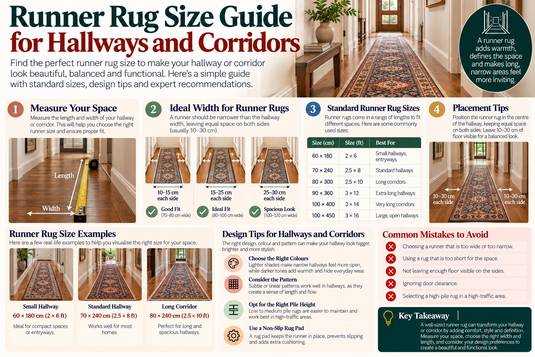
For many hallways, leaving roughly 3 to 6 inches on each side creates a balanced border, but the exact amount depends on corridor width.
In a very narrow passage, a 2 to 3 inch border may be enough. In a wide corridor, you may leave more.
The goal is symmetry. A runner squeezed tightly against one wall usually looks accidental.
How Wide Should a Runner Be?
Measure the clear corridor width, then subtract the amount of visible flooring you want on both sides.
For example, if the hallway is 42 inches wide and you want 4 inches of exposed floor on each side, a runner around 34 inches wide would fit comfortably.
Standard runners may not match that exact width, which is where custom sizing can be useful.
How Long Should a Runner Be?
The runner should relate to the full usable corridor rather than stopping randomly.
Leave enough exposed floor at both ends so the rug feels framed by the architecture.
A useful starting point is several inches to a foot of visible floor at each end, depending on the hallway length.
Do not force the runner under doors or across unrelated floor transitions simply to use the maximum available length.
Common Runner Rug Sizes
Common runner proportions include approximately 2' x 6', 2.5' x 8', 2.5' x 10', 3' x 10' and longer custom sizes.
These dimensions vary by brand and handmade production, so always check the actual finished size rather than relying only on the category name.
For a compact corridor, 2' x 6' or 2.5' x 8' may work. Long hallways can require 10', 12' or custom lengths.
Runner Size for Narrow Hallways
In a narrow hallway, avoid a runner that nearly touches both walls.
A small visible border helps the floor breathe and makes the runner look intentional.
Low-pile or flat-weave rugs are especially practical because they add less bulk.
Runner Size for Wide Corridors
Wide hallways can support broader runners, often around 3 feet wide or more.
If the corridor is very broad, a standard narrow runner may look undersized. In that case, a custom-width rug can look more architectural.
Runner Size for Long Corridors
Long corridors need enough length to create continuity.
Using a very short runner in the middle of a long hallway can break the visual line.
If one long runner is impractical, two coordinated runners can work, but leave a clear architectural reason for the break, such as a doorway or floor transition.
Should a Runner Enter Doorways?
Usually, no.
A hallway runner should remain in the hallway unless the layout intentionally connects two spaces.
Stopping just before bedroom or bathroom thresholds keeps the placement clean and prevents door interference.
Check Door Clearance
Measure the clearance under every nearby door.
A thick pile plus a rug pad may stop a door from opening properly.
This is one reason lower-pile runners work well in corridors.
Runner Rugs in Entry Hallways
Entry runners deal with more dirt, dust and moisture than most rugs.
Choose a durable material, lower pile and a pattern or mid-tone colour that does not show every mark.
A separate doormat should handle wet shoes before they reach the runner.
Runner Rugs in Bedroom Corridors
Bedroom hallways are usually drier and receive cleaner foot traffic.
This allows more freedom with wool, softer pile and lighter colours.
Comfort can matter more here than extreme stain resistance.
Runner Rugs Beside Beds
Runners are not only for hallways.
Two narrow runners beside a bed can provide softness where your feet land without requiring a large rug under the entire bed.
Measure the clear length from the bedside table toward the foot of the bed.
See our bedroom rug size guide for more placement options.
Runner Rugs in Kitchens
Long galley kitchens can use runners, but material and cleaning become more important.
Choose low pile and avoid delicate silk-like fibres near sinks and cooking areas.
A washable or easily maintained flat weave may be more practical.
Runner Rugs Near Stairs
Do not let a loose hallway runner extend onto the first stair.
If you want a stair runner, it should be separately measured and professionally installed.
Loose rug edges near stairs create a safety risk.
Best Materials for Hallway Runners
Wool
Wool is one of the best premium choices for hallways because it combines comfort and resilience.
A dense low- to medium-pile wool runner can handle regular residential traffic well.
Flat Weave
Flatweaves are practical because they sit low, vacuum easily and do not create a bulky transition.
Jute
Jute gives natural texture but should be used in dry hallways away from wet entrances.
Synthetic Fibres
Polypropylene and polyester can be practical in busy family areas where easy maintenance and budget matter.
Best Construction for a Runner
Hand-knotted runners can be beautiful long-term pieces, especially in wool.
Handloom and flat-weave runners offer a cleaner, lighter profile.
Hand-tufted runners can create custom patterns and shapes but may be thicker depending on construction.
See our rug construction guide for the differences.
Should a Runner Have Fringe?
Fringe can look beautiful in traditional hallways, but it adds visual length and may catch in doors or vacuums.
Include fringe in your measurement if it extends beyond the stated rug size.
For busy corridors, a clean finished edge may be easier to maintain.
Runner Rugs on Marble Floors
Polished marble can be slippery.
Use a quality non-slip pad under the runner and make sure the pad is safe for natural stone.
The pad should be slightly smaller than the rug so it does not show.
Runner Rugs on Wooden Floors
Choose a floor-safe pad that does not react with the finish.
Lift and clean underneath periodically because dust trapped under a moving runner can scratch the surface.
Runner Rugs on Tile
Tile is generally easy to work with, but polished tile can still be slippery.
A low-profile rubber or felt-and-rubber pad helps keep the runner stable.
How Pattern Changes the Hallway
Long linear patterns can make a corridor feel longer.
Large medallions or repeated motifs can add rhythm.
Geometric designs work well in modern hallways, while traditional motifs create a richer, collected look.
Explore The Ambiente’s geometric rugs and traditional rugs for design direction.
Light or Dark Runner?
Light colours can brighten a narrow hallway, especially where natural light is limited.
Mid-tone and patterned runners hide everyday dust better.
Very dark solid runners may show lint and light dust more visibly than expected.
Should the Runner Match Nearby Rugs?
It does not need to match exactly.
If the hallway opens into a living room, coordinate through colour temperature, material or design style.
Two identical rugs can sometimes feel too literal. Related rather than matching usually looks more natural.
How to Measure for a Custom Runner
Measure the clear hallway width and length, then decide the visible border you want on all sides.
Check doors, thresholds and furniture.
Mark the proposed outline with painter’s tape.
For unusual corridors, see our guide on how to measure for a custom rug.
What if the Hallway Is L-Shaped?
Use separate runners for each section rather than forcing one rug around a corner.
Coordinate the designs and leave a small break at the turn.
This keeps the placement clean and makes cleaning easier.
What if the Corridor Has a Console Table?
Decide whether the front legs of the console will sit on the runner.
Usually, it is cleaner for the runner to sit in the walking path and stop short of heavy furniture.
If the hallway is wide, a broader rug can intentionally connect the console and corridor.
How to Prevent a Runner From Sliding
Use an appropriate pad, keep the floor clean and make sure the rug lies flat.
Do not rely on random household tape or adhesives under a valuable handmade rug.
Replace worn pads when they lose grip.
Runner Rugs in High-Traffic Areas
Hallways concentrate traffic into a narrow path.
Choose durable fibre, controlled pile height and enough density to resist flattening.
Our high-traffic rug guide covers material choices in more detail.
Common Runner Sizing Mistakes
- Buying a runner that nearly touches both walls.
- Stopping randomly in the middle of a corridor.
- Ignoring door clearance.
- Forgetting fringe length.
- Using deep pile in a busy narrow hallway.
- Skipping a non-slip pad on marble or polished tile.
- Choosing a runner by standard size without measuring the actual corridor.
How The Ambiente Recommends Choosing Runner Size
Start with the hallway width. Leave a balanced border on both sides.
Then choose a length that relates to the full corridor while leaving visible flooring at the ends.
After that, check door clearance, material and traffic level.
The result should feel like the runner belongs to the architecture rather than simply filling empty floor.
How to Use Two Runners in One Long Hallway
In very long corridors, one continuous runner may be difficult to source, clean or install. Two runners can work well if the break aligns with architecture, such as a doorway, niche or change in wall treatment.
Avoid leaving an arbitrary gap in the middle of an otherwise continuous passage. The two rugs should also relate in colour, material or pattern so the hallway still reads as one composition.
Runner Width for Apartment Corridors
Apartment hallways are often narrower than villa corridors, which makes width especially important. A runner that is too wide can make the passage feel cramped, while one that is too narrow can look insignificant.
Measure from skirting to skirting, then account for any shoe cabinets, wall projections or furniture before choosing the final width.
Runner Rugs and Visual Direction
Pattern direction affects how a hallway feels. Long stripes can emphasise length, repeated medallions can create rhythm, and border designs can make a corridor feel more formal.
Choose the design according to whether you want the hallway to feel longer, quieter or more decorative.
The Bottom Line
The best runner size depends on the clear hallway dimensions, not only on standard rug labels.
Leave visible floor along both sides, avoid blocking doors and choose enough length to create continuity.
For busy hallways, low-pile wool, flat weave and practical synthetics work especially well.
Explore The Ambiente’s flat-weave rugs, wool rugs, geometric rugs and traditional rugs when planning a runner-style placement.