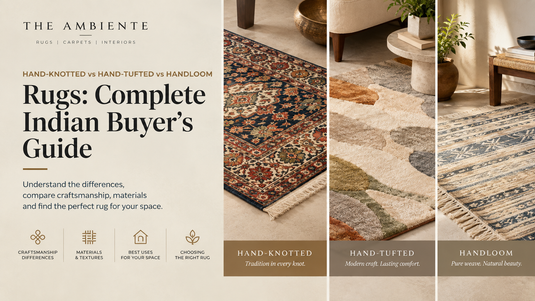
When you start shopping for a handmade rug in India, three construction terms appear again and again: hand-knotted, hand-tufted and handloom. They may all sit under the broad label of “handmade”, but they are not made the same way, they do not age the same way, and they are not priced for the same reasons.
That difference matters. A rug can look beautiful in a photograph and still be the wrong choice for your room, budget or expectations. The construction method affects how long the rug may last, how it feels underfoot, how much detail a design can carry, how easy it is to maintain and how much labour goes into making it.
At The Ambiente, we work closely with handmade rug construction and often see buyers comparing rugs mainly by colour, pattern and price. Those things are important, but construction is the part that explains what you are actually paying for.
This guide compares hand-knotted rugs, hand-tufted rugs and handloom rugs from an Indian buyer’s point of view. The goal is not to declare one method universally better. It is to help you understand where each one makes sense.
First, What Does “Handmade Rug” Actually Mean?
“Handmade” is a broad description. It tells you that human skill is involved, but it does not tell you exactly how the rug was constructed.
A hand-knotted rug is built knot by knot on a loom. A hand-tufted rug is made by pushing yarn through a backing fabric with a tufting tool. A handloom rug is woven on a loom, where warp and weft yarns are interlaced to create the surface.
Those are three very different processes. They require different amounts of time, labour and finishing. They also create different structures.
This is why two rugs with similar colours and the same dimensions can have very different prices. The visible design may be only one part of the story.
What Is a Hand-Knotted Rug?
A hand-knotted rug is one of the most labour-intensive forms of rug making. The weaver works on a loom and ties individual knots around the warp threads. Row by row, the pile and pattern are formed.
The knotting process can take weeks or months depending on the size, knot density, design complexity and number of weavers working on the loom. Large, intricate rugs can take considerably longer.
Because the pile is physically tied into the foundation, the structure is integrated rather than glued onto a backing. This is one reason quality hand-knotted rugs are associated with long service life when they are properly used and cared for.
If you want a deeper technical comparison between knotting and tufting, read our guide to hand-knotted vs hand-tufted rug construction.
How Can You Recognise Hand-Knotted Construction?
Turn the rug over. In many hand-knotted rugs, you can see the pattern on the reverse because the design is part of the structure itself. The back usually reveals rows of knots rather than a separate cloth backing pasted over the rug.
The edges and fringes can also provide clues. On traditional hand-knotted construction, the fringe is often an extension of the rug’s foundation rather than a decorative piece stitched on later.
Handmade does not mean mechanically perfect. Slight variations can appear because real people are knotting the rug. Those variations should not be confused with poor workmanship. The useful question is whether the structure is sound and the pattern is intentionally executed.
Why Are Hand-Knotted Rugs More Expensive?
Labour is the biggest reason. A dense hand-knotted rug may contain a very large number of individual knots. More complex patterns also require closer attention and slower work.
Material matters too. A wool rug will behave differently from one using silk-like fibres, and premium yarns increase the cost. Design development, dyeing, washing, clipping and finishing also add to the process.
A higher price should therefore reflect more than a luxury label. It should connect to material, construction quality, labour, design and finishing.
Where Do Hand-Knotted Rugs Work Best?
They are particularly well suited to living rooms, formal sitting areas, bedrooms, dining rooms and spaces where you want a long-term textile piece rather than a short-term decorative layer.
A quality hand-knotted rug can also make sense if you like the way natural materials age. Wool, for example, can develop character over time rather than simply looking “new” forever.
For a heavily used room, choose the material and pile thoughtfully. A dense wool hand-knotted rug is often more practical than a delicate high-sheen rug in the same location.
What Is a Hand-Tufted Rug?
A hand-tufted rug is also made by people, but the yarn is not individually knotted around the foundation threads.
Instead, a design is drawn onto a backing cloth stretched on a frame. A craftsperson uses a hand-held tufting tool to push loops of yarn through that backing. Depending on the technique, the loops may be left intact or cut to form pile.
Once the surface is complete, an adhesive is generally applied to the back to secure the tufts. A secondary backing may then be attached. The front is trimmed, carved or finished to create the final surface.
This method is much faster than hand-knotting, which is why tufted rugs can deliver detailed designs and plush texture at a lower price than comparable hand-knotted rugs.
What Are the Advantages of Hand-Tufted Rugs?
Design flexibility is a major advantage. Curves, bold shapes, colour blocks and detailed contemporary patterns can be produced efficiently.
Hand-tufted rugs can also feel thick and comfortable underfoot. If you want a plush rug for a bedroom or a lower-traffic sitting area, tufting can offer strong visual impact without the investment of a hand-knotted piece.
They are useful for projects where designers need a particular colour palette or graphic composition within a controlled budget. This is one reason modern rugs are often produced with tufted techniques.
What Are the Limitations of Hand-Tufted Rugs?
The backing system is important. Because adhesive is commonly used to secure the tufts, the rug does not have the same integrated knot structure as a hand-knotted rug.
Over time, depending on quality, climate, storage and use, backing materials can age. A poorly made tufted rug can also shed more than expected or show problems if the adhesive and finishing were not handled properly.
This does not mean every hand-tufted rug is disposable. A well-made tufted rug can give many years of useful service. It simply belongs to a different construction category and should be priced and evaluated accordingly.
What Is a Handloom Rug?
Handloom rugs are woven on a manually operated loom. Instead of tying individual pile knots, the maker interlaces yarns through a warp and weft system.
This approach can create flatweaves, low-pile textures, ribbed surfaces, loops and other woven effects depending on the loom and technique.
Handloom rugs are often cleaner and more linear in structure than hand-knotted rugs. They work especially well with contemporary interiors where texture, colour and simplicity matter more than very intricate pictorial detailing.
If you like lightweight or lower-pile surfaces, you may also want to explore flat-weave rugs.
What Are the Advantages of Handloom Rugs?
They can offer an excellent balance between handmade character, practical construction and price. Because weaving is faster than knotting, the labour requirement is generally lower than for a comparably sized hand-knotted rug.
Handloom construction can also produce crisp textures and subtle tonal variation. Wool, cotton, viscose-type fibres and blends may all be used depending on the desired effect.
For apartments, modern homes and rooms where you want a rug that feels refined without being visually heavy, handloom can be a very sensible choice.
What Are the Limitations of Handloom Rugs?
Handloom weaving usually cannot reproduce the same level of fine, knot-by-knot detail as a high-density hand-knotted rug. If your design depends on tiny motifs, complex borders or very detailed curves, another construction may suit it better.
The durability also depends heavily on material, density, weave and finishing. “Handloom” alone is not a quality guarantee.
Hand-Knotted vs Hand-Tufted vs Handloom: The Simple Comparison
| Feature | Hand-Knotted | Hand-Tufted | Handloom |
|---|---|---|---|
| How it is made | Individual knots tied by hand | Yarn pushed through backing with tufting tool | Yarns woven on a hand-operated loom |
| Typical production time | Longest | Faster | Moderate |
| Design detail | Excellent for intricate designs | Excellent for bold and shaped designs | Best for woven texture and cleaner patterns |
| Backing | Pattern often visible on reverse | Usually secondary backing with adhesive | Woven structure |
| Typical price | Highest | Lower than hand-knotted | Usually mid-range |
| Best for | Long-term investment and craftsmanship | Design impact and value | Modern texture and everyday versatility |
Which Construction Lasts the Longest?
All else being equal, a well-made hand-knotted rug generally has the strongest reputation for longevity because the pile is tied directly into the foundation.
But “all else being equal” is doing a lot of work in that sentence.
A poorly made hand-knotted rug is not automatically better than a carefully made handloom rug. Material quality, density, finishing, foot traffic, cleaning habits, pets, moisture and sunlight all influence lifespan.
A rug that is ideal for a quiet bedroom may perform poorly in a busy entrance. Construction needs to match the room.
Which One Is Best for an Indian Living Room?
Start with how the room is used.
If your living room is formal and you want a piece that may stay with you for many years, a wool hand-knotted rug is a strong option.
If the room is contemporary and you want a sculptural pattern or thick surface without moving into the highest price range, hand-tufted can work very well.
If the room has modern furniture, warmer neutrals and a preference for lower pile, handloom can create texture without overwhelming the space.
For busy family rooms, think about cleaning and traffic before choosing a delicate fibre simply because it looks luxurious in a showroom.
Which One Is Best for Bedrooms?
Bedrooms give you more flexibility because foot traffic is usually lower.
A hand-tufted rug can provide softness at an approachable price. A handloom rug can sit neatly under a bed without creating too much bulk. A hand-knotted rug can be a beautiful long-term choice if you want the bedroom to feel more collected and refined.
Size is often more important than construction here. A premium rug that is too small can make the room feel disconnected. Our bedroom rug size guide explains how placement changes around king and queen beds.
Which One Is Best for Dining Rooms?
Dining rooms need a rug that handles chair movement and inevitable spills.
Low to medium pile is usually easier to live with than a deep pile. Wool can be a practical material because of its resilience, but spills still need prompt attention.
Hand-knotted and handloom constructions can both work well depending on the design. Hand-tufted rugs can work too, but pay attention to shedding, pile height and backing quality.
Whatever construction you choose, the rug must extend far enough beyond the table for chairs to move comfortably. See our guide on round vs rectangular dining rugs for shape and clearance advice.
How Material Changes the Comparison
Construction tells you how a rug is built. Material tells you what it is built from.
Wool is widely used because it is resilient, warm and naturally suited to floor textiles. Bamboo-silk-style fibres can add sheen and softness but generally need more careful treatment. Cotton can make rugs lighter and more casual. Jute brings a dry natural texture but does not like persistent moisture.
A hand-knotted rug made from a delicate lustrous fibre may need more care than a dense wool handloom rug, even though the knotting method is structurally more labour-intensive.
That is why we recommend comparing both construction and fibre. Our material guide on wool vs bamboo silk vs silk rugs goes deeper into that decision.
How to Compare Quality Within Each Construction
Do not stop at the construction label. Ask better questions.
- For hand-knotted rugs: look at knot consistency, material, foundation, finishing and design clarity.
- For hand-tufted rugs: inspect pile density, backing quality, carving, edge finishing and shedding.
- For handloom rugs: look at weave consistency, yarn quality, edge stability and whether the rug lies flat.
Also examine the reverse. A seller who is comfortable showing the back of the rug is giving you useful information about how it was made.
How Much Should You Spend?
There is no sensible universal price because rug pricing depends on dimensions, material, construction, design, finishing and brand.
Instead of asking, “What is the cheapest rug of this size?”, ask, “What construction and material am I getting at this price?”
A lower-cost tufted rug can be the right purchase if you want a fashionable piece for a room you may redecorate in a few years. A more expensive hand-knotted rug can make sense if you want a long-term piece and value the labour behind it.
The wrong purchase is not necessarily the cheaper one. It is the rug that does not match your expectations.
Is Hand-Knotted Always Better?
No. It is more labour-intensive, but that does not make it the right answer for every room.
If you need a custom graphic rug for a design project with a specific budget, hand-tufting may be the practical choice. If you want a thin, modern rug for an apartment, handloom may suit the room better. If you want an intricate rug to keep for many years, hand-knotted may justify the investment.
“Better” depends on what you need the rug to do.
How The Ambiente Approaches the Choice
At The Ambiente, we prefer to start with the room rather than the construction label.
We ask how much traffic the rug will receive, whether children or pets use the space, what furniture will sit on it, whether the client wants a subtle texture or a detailed pattern, and how much maintenance feels realistic.
Only then does it make sense to talk about construction.
This approach also helps prevent a common mistake: paying for craftsmanship that the room does not need, or saving money on construction and then expecting it to behave like a completely different product.
Questions to Ask Before Buying a Handmade Rug
- What exactly is the construction method?
- What fibres are used, and in what percentages?
- Is the rug suitable for the traffic level in my room?
- Does the rug use adhesive or a secondary backing?
- What kind of shedding should I expect?
- How should spills be cleaned?
- Can the seller show me the back of the rug?
- Is the fringe structural or decorative?
- Can this rug be professionally cleaned?
- What size will work with my furniture rather than just my floor dimensions?
The Bottom Line
Hand-knotted, hand-tufted and handloom rugs can all be excellent choices. They simply solve different problems.
Choose hand-knotted when craftsmanship, intricate design and long-term value are priorities. Choose hand-tufted when you want strong design flexibility, plushness and a more accessible price. Choose handloom when you want woven texture, cleaner lines and a practical handmade option for modern interiors.
Then look beyond the label. Material, density, finishing, room use and maintenance matter just as much.
If you are shopping online, explore The Ambiente’s hand-knotted, hand-tufted and handloom rug collections side by side. Comparing real examples makes the construction differences much easier to understand.