If you are comparing handmade floor coverings, the terms hand-knotted, hand-woven, handloom and hand-tufted can become confusing very quickly. Sellers often use “handmade” as a broad label, but the construction underneath can be completely different.
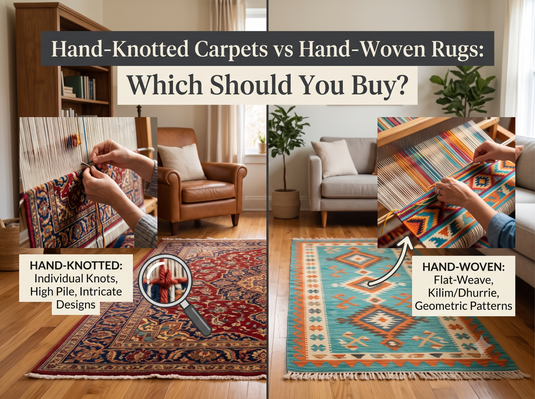
The biggest difference is structural. A hand-knotted rug is built by tying individual knots onto a foundation. A hand-woven rug usually refers to a rug made on a loom without individually tied pile knots, often in flat-weave or handloom construction.
Neither is automatically better. The right choice depends on your budget, room, traffic level, design preference and how long you expect to keep the rug.
At The Ambiente, we work across hand-knotted, handloom, hand-tufted and flat-weave constructions. This guide explains the difference in practical terms and helps you decide which one fits your home.
What Is a Hand-Knotted Carpet?
A hand-knotted carpet is made by tying pile yarn manually around warp threads stretched on a loom. After each row of knots, weft threads are inserted to lock the structure in place.
This process creates a pile rug in which the design is physically integrated into the structure.
Because every knot is tied by hand, production can take weeks or months depending on size, knot density and complexity.
What Is a Hand-Woven Rug?
“Hand-woven” is a broader term. It can describe rugs made manually on a loom without individual pile knots.
Common examples include handloom rugs and flat-weave rugs such as dhurries.
These constructions are often lower in pile, lighter in weight and faster to produce than hand-knotted rugs.
Hand-Knotted vs Hand-Woven: The Structural Difference
The easiest way to think about it is this:
- Hand-knotted: individual knots create the pile.
- Hand-woven: yarns are woven through the structure without individually tied pile knots.
This difference affects texture, durability, design detail, weight, price and production time.
Which One Takes Longer to Make?
Hand-knotted rugs generally take much longer.
The weaver has to tie thousands or millions of knots across the surface. Higher knot density increases production time further.
If you want to understand how knot density works, read our KPSI and knot density guide.
Which One Costs More?
Hand-knotted rugs usually cost more because of the labour involved.
However, material matters too. A hand-woven rug in premium wool or silk can still be expensive.
Do not compare only by construction name. Compare size, fibre, design and finishing as well.
Which One Is More Durable?
Both can be durable when well made.
Hand-knotted wool rugs are especially known for long-term use because the pile is tied into the foundation.
Hand-woven wool rugs can also perform very well, especially in lower-pile formats where there is less fibre to crush.
Which One Is Better for High Traffic?
For busy living rooms, hallways and family spaces, both can work if the material is right.
Dense wool hand-knotted rugs offer excellent resilience.
Low-pile handloom and flat-weave rugs can also be very practical because they are easy to vacuum and less likely to trap debris.
See our high-traffic rug guide for more detail.
Which One Is Better for Bedrooms?
Bedrooms allow more freedom because traffic is lower.
A plush hand-knotted rug can add warmth and luxury.
A handloom rug works well in modern bedrooms that need a cleaner, lighter look.
Use our bedroom rug collection to compare different constructions in room context.
Which One Is Better for Dining Rooms?
Low to medium pile is usually easier under dining chairs.
A flat-woven or handloom rug can be practical because chair legs move more easily.
A dense low-pile hand-knotted wool rug can also work beautifully if the dining room is more formal.
Which One Shows More Design Detail?
Hand-knotted rugs usually offer greater potential for detailed curves, borders and intricate motifs because knot density can be increased.
Hand-woven rugs are especially strong for stripes, blocks, texture, simple geometry and tonal patterns.
Which One Looks More Modern?
Either can look modern.
Construction does not determine style.
A hand-knotted rug can have a minimal abstract design, while a hand-woven rug can carry traditional stripes or motifs.
Browse The Ambiente’s modern rugs to see how different constructions can share a contemporary look.
Which One Feels Softer?
Hand-knotted rugs often have a more substantial pile, so they may feel softer underfoot.
Hand-woven flatweaves are typically thinner.
However, fibre makes a huge difference. Soft wool handloom can still feel excellent underfoot.
Which One Is Easier to Clean?
Low-pile hand-woven rugs are often easier to vacuum because dust has less depth to settle into.
Hand-knotted rugs are also straightforward to maintain when vacuumed gently and professionally cleaned as needed.
For material care, see our rug care guide.
Which One Is Better for Pets?
For pets, avoid loose loops that claws can catch.
Dense low-pile wool is often one of the strongest options.
A flat weave can also be practical, but some pets may catch nails in coarse woven structures.
Which One Is Better for Children?
For play areas, comfort and stability matter.
A wool hand-knotted rug with a proper pad provides softness and weight.
A lighter hand-woven rug may move more easily, so use a non-slip pad on hard floors.
Which One Is Better on Marble?
Both can work on marble, but lighter woven rugs usually need more grip.
Use a quality underlay and keep the stone completely dry after mopping.
Our marble floor rug guide covers this in detail.
Which One Is Better on Wooden Floors?
Again, both can work.
Choose a floor-safe pad and vacuum underneath periodically.
A heavy hand-knotted rug may move less, while a flatweave may need more anti-slip support.
How the Back Looks Different
The back of a hand-knotted rug usually shows the pattern clearly through the knot structure.
A hand-woven rug shows interlaced yarns and typically does not have the same tied-knot appearance.
Looking at the reverse is one of the easiest ways to understand how a rug was made.
What About Fringe?
In many hand-knotted rugs, fringe is an extension of the warp foundation.
In some hand-woven rugs, fringe may also come from warp ends, but construction details vary.
Do not use fringe alone as an authenticity test.
What About Weight?
Hand-knotted rugs are often heavier because of pile and dense structure.
Flat-woven rugs are usually lighter and easier to move.
This can matter if you rearrange furniture often or live in a rental.
What About Rug Pads?
Both constructions can benefit from a rug pad.
Hand-woven rugs usually need more grip because they are lighter.
Hand-knotted rugs may benefit more from cushioning and floor protection.
See our rug pad guide.
Which One Works Better for Custom Rugs?
Hand-knotted custom rugs are ideal when detail, craftsmanship and longevity matter.
Handloom custom rugs work well for modern texture, stripes and tonal designs.
If you need highly sculpted forms or quick custom production, hand-tufting may be better than either.
Which One Has Better Long-Term Value?
Hand-knotted rugs generally have stronger long-term value because of labour, craftsmanship and repairability.
That does not mean every hand-knotted rug becomes collectible or appreciates in price.
It simply means the construction is designed for long service when well made.
Which One Is Easier to Repair?
Hand-knotted rugs can often be re-knotted locally if pile or foundation is damaged.
Hand-woven rugs can also be rewoven, but repair methods depend on the weave.
See our handmade rug repair guide.
Which One Is Better for a Limited Budget?
Hand-woven and handloom rugs usually provide a more accessible handmade entry point.
You can still get natural fibres, craft and contemporary design without paying for months of knotting labour.
Which One Is Better for a Luxury Interior?
For formal living rooms, master bedrooms and premium residences, hand-knotted rugs often provide more visual depth and craft value.
That said, a beautifully designed handloom rug can look just as sophisticated in a minimal interior.
How to Choose Based on Your Room
Choose hand-knotted if you want:
- Long-term craftsmanship
- Detailed pattern
- Premium wool or silk blends
- A more substantial pile
- Greater repairability
Choose hand-woven or handloom if you want:
- Lower pile
- Modern texture
- Easier movement and handling
- A more accessible handmade price
- Simple geometry or tonal design
How to Compare Two Rugs Fairly
Do not compare only the construction label.
Match size, fibre, pile and intended use first.
A premium wool handloom rug can be a better purchase than a poorly made hand-knotted rug.
Common Buying Mistakes
- Assuming hand-knotted always means better for every room.
- Assuming hand-woven means cheap.
- Ignoring material quality.
- Choosing by design before size.
- Skipping the rug pad.
- Comparing prices across different sizes.
How The Ambiente Recommends Choosing
Start with room use, then choose material, then construction.
If the rug needs to handle heavy use, dense wool matters more than a luxury label.
If the room is formal and long-term, hand-knotting becomes more attractive.
If the space is modern and you want low pile with good value, handloom can be the smarter choice.
How Hand-Knotted and Hand-Woven Rugs Age Differently
Hand-knotted rugs often become more visually interesting with age because the pile settles, colours soften and the surface develops a natural patina. A well-made wool hand-knotted rug can remain usable for decades if it is rotated, cleaned correctly and repaired when needed.
Hand-woven rugs can also age beautifully, especially when made from wool or strong natural fibres, but the wear pattern is different because the surface is usually flatter. High-traffic areas may become smoother over time rather than showing pile compression.
Which One Works Better With Modern Furniture?
Modern furniture can work with either construction. Handloom and flat-weave rugs often suit clean-lined furniture because they keep the floor visually light. Hand-knotted rugs add more texture and can create a stronger contrast against simple sofas and tables.
If your furniture is very minimal, a hand-knotted rug can become the statement piece. If the furniture already has strong forms and materials, a quieter hand-woven rug may support the room better.
Which One Works Better With Traditional Furniture?
Hand-knotted rugs naturally complement carved wood, classic upholstery and heritage-inspired interiors because they can reproduce detailed borders and motifs.
That said, a hand-woven dhurrie or flat weave can create a lighter, more relaxed traditional look, especially in homes that mix old furniture with contemporary architecture.
What About Colour and Dyeing?
Both constructions can use natural or synthetic dyes. The difference is not the dye source but how the yarn is structured in the rug.
If colour variation, abrash or dye provenance matters to you, read our natural vs synthetic dyes guide.
How to Spot a Misleading Product Description
Some listings use “handmade” and “hand-woven” very loosely. If a product is described as hand-knotted, the seller should be able to show the back and explain the knot structure. If the rug is actually tufted, it should not be marketed as hand-knotted.
Ask direct questions when the terminology is vague. A trustworthy specialist should explain exactly how the rug was made.
Which One Is Better for Someone Buying Their First Handmade Rug?
If your budget is limited and you want an easier entry point, handloom or flat-weave construction can be a very good first handmade purchase.
If you already know you want a long-term premium piece and are comfortable spending more, a wool hand-knotted rug is often worth considering.
Final Buying Check
Before buying, ask for the exact fibre, construction, finished size and care method. If the seller cannot explain those four points clearly, keep looking. A rug should be easy to understand before it becomes a long-term part of your home.
The Bottom Line
Hand-knotted carpets and hand-woven rugs are both handmade, but they are constructed differently.
Hand-knotted rugs use individual knots and generally offer more detail, labour and long-term craft value. Hand-woven rugs are woven on a loom without individual pile knots and are often lighter, lower in pile and more affordable.
Choose based on the room, material, traffic level and budget rather than assuming one construction is universally better.
Compare The Ambiente’s hand-knotted rugs, handloom rugs and flat-weave rugs to see the differences in real products.