If you have ever compared premium hand-knotted rugs, you may have seen terms such as KPSI, knot count or knot density. These numbers can sound technical, and sellers sometimes use them as if a higher number automatically means a better rug. That is not always true.
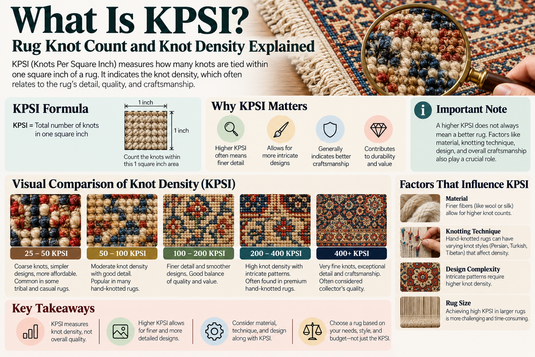
KPSI stands for knots per square inch. It describes how densely the knots are packed in a hand-knotted rug. A higher knot density can allow finer pattern detail, smoother curves and more complex motifs, but it is only one part of quality. Material, design, weaving skill, foundation, finishing and intended use matter just as much.
At The Ambiente, we think buyers should understand KPSI because it helps explain why two hand-knotted rugs of the same size can differ significantly in price and appearance. This guide explains how knot density works, how to count it and when a higher KPSI is actually useful.
What Does KPSI Mean?
KPSI means knots per square inch. It estimates how many individual pile knots appear within one square inch of the rug.
For example, if the back of a rug contains 10 knots horizontally and 10 knots vertically within a one-inch square, the density is approximately 100 KPSI.
If there are 12 knots across and 15 knots vertically, the approximate density is 180 KPSI.
The number gives you an idea of the rug’s weaving resolution. More knots within the same area allow a designer to create smaller curves, thinner lines and greater visual detail.
Why Knot Density Matters
Imagine an image made from pixels. A low-resolution image can still be beautiful, but it cannot show the same fine detail as a high-resolution image.
Knot density works in a similar way. A rug with relatively low knot density can produce bold geometric motifs, tribal forms and large-scale patterns beautifully. A very detailed floral or pictorial rug may need a much denser knot structure to reproduce tiny leaves, borders and curves cleanly.
This is why KPSI should always be considered in relation to the design.
Does a Higher KPSI Mean Better Quality?
No. It can indicate finer weaving, but it does not automatically mean better quality.
A dense rug made with poor material and weak finishing is not necessarily better than a lower-density rug made from excellent wool by skilled weavers.
Similarly, a simple tribal rug may not need fine knotting. Its beauty may come from bold motifs, handspun yarn and texture rather than tiny detail.
Quality is a combination of design suitability, material, structural integrity, workmanship and finishing.
How to Count KPSI at Home
Turn the rug over so you can see the knot structure on the back.
Use a ruler and mark a one-inch section horizontally and vertically. Count the number of knots across one inch, then count the number down one inch.
Multiply the two numbers.
If you count 9 knots across and 12 knots down, the approximate KPSI is 108.
Because handmade weaving is not mechanically perfect, the number may vary slightly from one area to another. Count in more than one place if you want a better estimate.
What Does the Back of a Hand-Knotted Rug Show?
The reverse of a genuine hand-knotted rug usually reveals the pattern because the design is part of the structure itself.
You can often see rows of knots, colour changes and the underlying foundation.
If the back is covered with a secondary fabric, you may be looking at a hand-tufted rug rather than a traditional hand-knotted one.
For more authenticity checks, see our guide on how to identify a genuine handmade rug.
Typical Knot Density Ranges
There is no universal global standard because knot systems, knot types and production traditions differ. Still, broad ranges can help buyers understand what they are seeing.
| Approximate Density | General Character |
|---|---|
| Below 60 KPSI | Coarser structure, bold motifs, strong texture |
| 60 to 100 KPSI | Good for many decorative and traditional designs |
| 100 to 200 KPSI | Allows more detail and smoother curves |
| 200 to 400 KPSI | Fine weaving for intricate designs |
| Above 400 KPSI | Very fine weaving, often used for highly detailed premium rugs |
These ranges are only a guide. They should not be treated as a grading system by themselves.
Why Knot Type Matters
Different rug-making traditions use different knots, including symmetrical and asymmetrical knots.
Because knot structure differs, comparing two KPSI numbers from different weaving traditions is not always a perfect apples-to-apples comparison.
The material and yarn thickness also matter. A fine silk yarn can support much denser knotting than a thick wool yarn.
Wool Rugs and Knot Density
Wool is one of the most common materials used in hand-knotted rugs because it is resilient, warm and easy to dye.
A dense wool rug can support detailed pattern while still feeling substantial underfoot.
However, wool yarn has physical thickness. Extremely high knot counts usually require finer yarn and greater weaving time.
That is why a 100 KPSI wool rug can still be a beautiful, premium piece if the design is appropriate.
Silk and Bamboo Silk Rugs
Silk and bamboo-silk-style fibres are finer and more lustrous than many wool yarns.
They can support detailed pattern and smooth curves, especially when used in fine hand-knotting.
But the material also changes maintenance. High-density silk or bamboo silk is not automatically the best choice for a busy family room.
Our wool vs bamboo silk vs silk guide explains how these materials behave in actual homes.
Why Higher KPSI Usually Costs More
Higher knot density generally means more knots need to be tied within the same rug area.
That increases labour time. A weaver has to make more individual actions before completing each row.
Fine weaving also demands greater control over tension, colour changes and pattern reading.
However, price is also influenced by material, rug size, design, dyeing, finishing and brand. KPSI is one input, not the complete price formula.
Does Higher KPSI Make a Rug More Durable?
Not automatically.
A dense structure can support a stable surface, but durability depends on fibre quality, foundation, knot strength, pile height, use and maintenance.
A lower-density wool rug can perform exceptionally well in a busy room because wool is resilient and the structure is strong.
A very fine silk rug may have a higher knot density but still require more careful use.
KPSI and Pattern Detail
This is where knot density matters most clearly.
Fine floral borders, medallions, curved vines and pictorial imagery need greater resolution than bold stripes or geometric blocks.
If you compare a detailed traditional rug with a minimal modern design, the traditional pattern may benefit from higher density even if both rugs are equally well made.
KPSI and Modern Rugs
Modern design does not always need a high knot count.
A large abstract composition can look stronger with thicker yarn and visible texture.
High-low pile, handspun wool and material contrast can be more important than knot density in some modern rugs.
Why KPSI Should Match the Design
A good rug specification uses only as much detail as the design requires.
Paying for 400 KPSI on a simple two-colour block pattern may not add meaningful visual value.
On the other hand, trying to reproduce a highly detailed floral design at a very coarse density can make curves look jagged and small motifs disappear.
Construction should serve design, not marketing.
How Knot Density Affects Production Time
Higher knot density usually extends production time because more knots are required for every square inch.
A large rug at high density can take months to weave.
That is one reason hand-knotted rugs are fundamentally different from hand-tufted or machine-made carpets.
For a broader construction comparison, read our hand-knotted vs hand-tufted vs handloom guide.
Knot Density and Rug Thickness
A higher KPSI does not automatically mean a thicker rug.
Thickness depends more directly on pile height and yarn size.
Some fine hand-knotted rugs have low, tight piles. Some coarser rugs use thick yarn and feel much heavier underfoot.
Do not confuse density with pile height.
Knot Density and Rug Weight
Weight can increase with density, but material and pile thickness play a larger role.
Two rugs with similar KPSI can have different weights if one uses thick wool and the other uses fine silk.
Weight alone is therefore not a reliable authenticity or quality test.
Can You Estimate Knot Density From the Front?
Not accurately.
You may notice that fine patterns look sharper, but pile height and finishing can hide the underlying knot structure.
The reverse side is the best place to inspect knot density.
Why Sellers Sometimes Use “Knots Per Square Metre”
Some producers describe density using knots per square metre instead of KPSI.
This is simply another measurement system.
When comparing two rugs, make sure the seller is using the same unit before assuming one has a higher density.
KPSI vs Knot Count
People often use “knot count” loosely to mean density.
Technically, total knots in the entire rug would depend on the rug size. KPSI is more useful because it measures knots within a fixed area.
A large rug can contain millions of knots even at moderate density simply because it covers more area.
How KPSI Relates to Custom Rugs
For custom projects, the designer and manufacturer should choose a density that matches the artwork.
A detailed custom medallion may need finer knotting. A large contemporary abstract may work beautifully with a lower density and thicker yarn.
If you are specifying custom rugs, see our guide on how custom rugs are made for architects and interior designers.
What Other Quality Factors Matter Besides KPSI?
- Quality of wool, silk or other fibre
- Strength and consistency of the foundation
- Weaver skill
- Dye quality
- Design clarity
- Edge finishing
- Washing and clipping
- Whether the rug lies flat
- Whether the pile is even
- Suitability for the intended room
Does Uneven Knot Density Mean Poor Quality?
Handmade rugs can show slight variation because the work is done manually.
Small differences are normal. Large inconsistent sections, severe distortion or weak structure deserve closer inspection.
The rug should still look balanced and feel structurally sound.
Can Machine-Made Rugs Have a “Knot Count”?
Machine-made carpets may use density measurements, but they are not hand-knotted in the traditional sense.
Machine production uses mechanical weaving, tufting or other industrial systems.
See our machine-made carpet manufacturing guide to understand the difference.
Should You Buy the Highest KPSI You Can Afford?
No.
Buy the rug whose construction suits its design and your room.
If you need a durable living-room rug, material and traffic suitability may matter more than extremely fine knotting.
If you are buying a detailed collector-style rug, higher density may be valuable because it supports the artistry.
KPSI for Living Rooms
A hand-knotted living-room rug does not need an extreme knot count to perform well.
Dense wool at a moderate knot density can be an excellent long-term choice.
Browse The Ambiente’s living room rugs to compare how construction, material and design work together.
KPSI for Bedrooms
Bedrooms receive less traffic, so buyers have more freedom to choose fine materials and intricate detail.
High-density wool, bamboo silk or silk blends can work beautifully when maintenance expectations are realistic.
KPSI for Dining Rooms
For dining rooms, choose a practical pile height and material first.
A high knot count does not help if the rug is too delicate for chair movement and food spills.
Dense wool is often a sensible choice.
Questions to Ask a Seller
- What is the construction method?
- What is the approximate KPSI or knot density?
- What material is used?
- What knot type is used?
- Is the rug hand-knotted throughout?
- How long did production take?
- What room is the rug recommended for?
- How should it be cleaned?
How The Ambiente Looks at Knot Density
We do not treat KPSI as a simple score.
We look at whether the density is appropriate for the design, material and intended use.
A great handmade rug should feel coherent. The yarn, knotting, pattern and finishing should work together.
That is more important than chasing the highest number.
The Bottom Line
KPSI is a useful technical measurement, but it is not a complete quality grade.
Higher knot density allows finer pattern detail and usually requires more labour, which can increase price. But material, design, foundation, finishing and weaving skill remain equally important.
Choose knot density according to the rug you want, not according to a number alone.
To see how knotting looks in real products, explore The Ambiente’s hand-knotted rugs, wool rugs and traditional rugs.