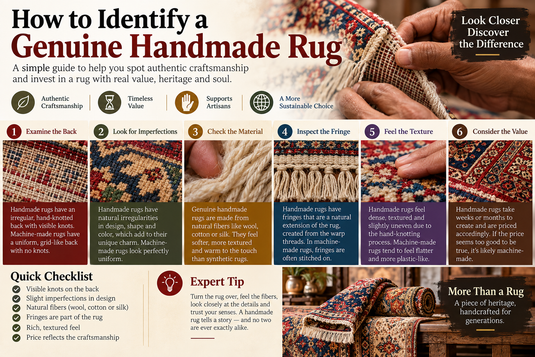
Buying a handmade rug can be confusing because the words used in the market are not always precise. A rug may be described as handmade, handwoven, hand-knotted, hand-tufted, handloom, artisanal or handcrafted, and those terms do not all mean the same thing.
If you are spending more for a handmade rug, you should be able to understand what you are paying for. You do not need to become a textile expert, but a few practical checks can help you separate genuine handmade construction from vague marketing.
At The Ambiente, we believe the best way to buy confidently is to look beyond the front surface. The back of the rug, the way the fringe is attached, the consistency of the weave, the material information and the seller’s willingness to explain the construction can tell you a lot.
This guide explains how to identify a genuine handmade rug, what signs to look for, which “imperfections” are normal, and which red flags deserve more questions.
First, Understand What “Handmade” Can Mean
Handmade is a broad category. It does not automatically mean hand-knotted.
A hand-knotted rug is made by tying individual knots around foundation threads. A hand-tufted rug is made with a manual tufting tool that pushes yarn through a backing cloth. A handloom rug is woven on a manually operated loom.
All three can involve significant human skill, but the structures are different. This distinction matters because it affects durability, price and how the rug should be evaluated.
If you are not sure which construction you want, start with our complete comparison of hand-knotted, hand-tufted and handloom rugs.
1. Turn the Rug Over
The reverse side is one of the most useful places to inspect.
On many hand-knotted rugs, the design is visible on the back because the pattern is built into the structure. You can often see the rows of knots and changes in colour.
A machine-made rug may have a very uniform backing and extremely regular structure. A hand-tufted rug may have a cloth backing applied over the reverse, often because adhesive is used to secure the tufts.
The goal is not to find “messiness”. It is to understand whether the back matches the construction the seller is claiming.
2. Look at the Fringe
In a traditional hand-knotted rug, the fringe is often formed by the warp threads that run through the rug. In other words, it is structurally connected to the foundation.
On some machine-made rugs, fringe may be sewn on as a decorative feature after production.
This is not a complete authenticity test because different handmade constructions use different edge treatments, but it can provide useful evidence when combined with other signs.
3. Expect Small Human Variations
Handmade does not mean careless, but it also does not mean mechanically identical.
A rug woven by people can contain slight variations in spacing, knot size, colour or alignment. These differences are often subtle.
Perfectly repeated edges, completely uniform stitch spacing and factory-level symmetry can suggest machine production, although a highly skilled handmade rug can also be remarkably precise.
So do not use imperfection alone as proof. Use it as one clue.
4. Check Whether the Pattern Is Visible on the Back
For hand-knotted rugs, the pattern usually appears on the reverse. It may be less vivid than the front, but the colour layout should correspond.
If the back is hidden by a secondary cloth, you may be looking at a hand-tufted rug rather than a hand-knotted one.
Again, that does not make the rug “fake”. It simply means the construction should be described honestly.
5. Understand Knot Density
Hand-knotted rugs are often discussed in terms of knot density. A higher knot count can allow finer detail, but it is not the only measure of quality.
Material, design, finishing, foundation and the skill of the weaver all matter.
A bold tribal design does not need extremely fine knotting to be beautiful or durable. A detailed floral rug may benefit from higher density because tiny curves and motifs require more resolution.
Do not let a knot number become the only sales argument.
6. Examine the Edges
Look at the sides of the rug. Handmade rugs usually have edges that are finished by hand or woven into the structure.
Check for loose yarn, poor binding or areas where the side cord is separating.
Small differences in edge tension can happen in handmade work, but the rug should still feel structurally secure.
7. Ask What Material Is Used
A genuine handmade rug can still be made from many different fibres.
Common materials include wool, cotton, jute, bamboo silk, viscose-type fibres, natural silk and blends.
Do not assume handmade automatically means natural fibre. Hand-tufted and handloom rugs can use synthetic or regenerated fibres as well.
If material matters to you, ask for the fibre composition in writing.
Our guide to wool vs bamboo silk vs silk rugs explains how premium rug fibres behave differently.
8. Feel the Pile, but Do Not Use Softness as Proof
Softness tells you something about the material and finishing, but not necessarily whether the rug is handmade.
Machine-made synthetic rugs can be extremely soft. Hand-knotted wool rugs can feel firm and dense rather than silky.
A rug should be judged according to its intended material and construction, not according to whether it feels “luxurious” for five seconds in a showroom.
9. Look for Colour Variation
Hand-dyed yarn can sometimes show subtle variation in colour, especially in larger areas of one shade. This is often called abrash in traditional rug terminology.
Abrash can be caused by different dye batches, yarn characteristics or intentional design.
It can add depth and character, but not every handmade rug will show obvious colour variation. Modern production can control colours very closely.
10. Check the Shape
A handmade rug may not be geometrically perfect to the millimetre. Slight differences in width or length can happen during weaving, washing and stretching.
However, major distortion is not something you should automatically accept simply because the rug is handmade.
The rug should still lie reasonably flat and work within normal dimensional tolerance.
11. Ask How Long It Took to Make
A seller should be able to explain the production method and approximate lead time.
Hand-knotted rugs take far longer than hand-tufted rugs because the pile is built knot by knot. Large, fine pieces may take months.
Hand-tufted rugs are faster, while handloom production sits in a different category altogether.
If someone claims a large, intricate hand-knotted rug was produced in an extremely short time, ask more questions.
12. Ask Where It Was Made
Origin is useful context, though it is not proof of quality by itself.
Indian handmade rug production is strongly associated with regions such as Bhadohi. Our guide to Bhadohi’s carpet-making tradition explains why the region has such a strong place in India’s rug industry.
A transparent seller should be able to tell you where the rug was made and how it was constructed.
13. Compare the Price With the Claimed Construction
Handmade rugs can be available across a wide price range, but production time still matters.
A large fine hand-knotted wool rug requires substantial labour. A genuine natural silk hand-knotted rug requires even more investment.
If a price seems dramatically lower than comparable products, investigate the material and construction rather than assuming you found an impossible bargain.
Sometimes the explanation is simple: the rug is hand-tufted, power-loomed or made with a silk-like regenerated fibre rather than natural silk.
14. Ask for Close-Up Photos
When buying online, request clear images of the front, back, fringe, edges and pile.
A detailed reverse-side photo is especially helpful for hand-knotted rugs.
Video can also show pile direction and sheen more accurately than a single photograph.
15. Read the Product Description Carefully
Good product pages should state construction and material clearly.
Look for specific language such as “hand-knotted wool”, “hand-tufted wool and bamboo silk” or “handloom wool blend”.
Vague terms such as “artisan style”, “hand-finished” or “crafted look” do not necessarily describe the main construction.
If the description avoids explaining how the rug is made, ask.
16. Understand the Difference Between Hand-Tufted and Hand-Knotted
This is one of the most common points of confusion.
Both can legitimately be called handmade because people are involved in production. But they are not structurally the same.
Hand-knotted rugs tie pile yarn into the foundation. Hand-tufted rugs insert yarn through a backing and usually rely on adhesive to secure the pile.
That difference affects production time and expected lifespan.
Our more technical article on hand-knotted vs hand-tufted rugs explains the structure in detail.
17. Do Not Confuse Handloom With Hand-Knotted
Handloom rugs are woven manually but generally do not contain the individually tied pile knots of a hand-knotted rug.
They can be excellent rugs and may offer strong value, but they should be described accurately.
This distinction is especially important when comparing prices online.
18. Beware of “Silk” Without a Fibre Explanation
Silk terminology can be confusing.
Natural silk, bamboo silk, viscose and other regenerated fibres can all create a shiny surface, but they are not the same material.
If a rug is advertised simply as “silk”, ask exactly what fibre is used.
This affects care, durability and price.
19. Understand What a Certificate Can and Cannot Prove
A certificate may provide useful information about material, construction, origin or quality checks, depending on who issued it.
But a certificate is only as reliable as the organisation behind it.
Do not let a decorative piece of paper replace physical inspection and clear product information.
20. Check Whether the Seller Can Explain Care
A seller who understands the rug should be able to tell you how to vacuum it, what to do with spills and when professional cleaning is recommended.
Different materials need different care. Wool is not cleaned the same way as bamboo silk or natural silk.
If the answer is simply “wash normally”, be cautious.
What Does a Genuine Hand-Knotted Rug Look Like From the Back?
You will typically see the pattern repeated on the reverse, along with rows of knots. The back will not usually be covered by a secondary fabric.
The exact appearance depends on knot type, foundation and density.
A finer rug may show a very clear, tight reverse pattern, while a coarser rug may look more open.
Does an Imperfect Rug Mean It Is Handmade?
No.
Intentional or minor human variation can support the handmade story, but poor workmanship is still poor workmanship.
Uneven edges, serious distortion, loose knots and obvious structural problems should not be celebrated as “artisan charm”.
Authenticity and quality are related but separate questions.
Can Machine-Made Rugs Look Handmade?
Yes. Modern manufacturing can imitate traditional patterns, distressed surfaces and irregular textures very effectively.
That is why surface appearance alone is not enough.
The backing and construction reveal much more.
If you want to understand industrial production, see our guide to the machine-made carpet manufacturing process.
How to Check a Rug When Buying Online
- Read the construction field.
- Read the full fibre composition.
- Zoom in on front and back images.
- Ask for a reverse-side photograph if none is shown.
- Check dimensions and expected variation.
- Ask whether fringe is structural or applied.
- Review care instructions.
- Check return and exchange terms.
- Ask about origin if it matters to you.
- Compare the price with similar construction and material.
Red Flags to Watch For
Be cautious when a listing uses luxury language but avoids specific construction details.
Other warning signs include:
- “100% silk” with no explanation of whether it is natural silk.
- Hand-knotted claims with a fully fabric-covered back.
- Very large fine rugs at prices inconsistent with the claimed labour.
- No material percentages.
- No clear photos of texture or backing.
- A seller who cannot explain basic care.
- Identical “handmade” rugs available in huge quantities with no variation and immediate replenishment.
What About Vintage and Antique Rugs?
Age adds another layer of complexity. A genuine old rug may show repairs, fading, wear, replaced fringe or uneven colour.
Those signs do not automatically reduce authenticity, but condition should be disclosed honestly.
If a rug is sold as antique or collectible, provenance and expert assessment become more important.
How The Ambiente Approaches Authenticity
We believe the construction should be stated clearly. Hand-knotted should mean hand-knotted. Hand-tufted should be described as hand-tufted. Handloom should be described as handloom.
Material should also be clear because the fibre changes both value and care.
The goal is not to convince every buyer that one method is superior. It is to make sure the buyer knows what they are choosing.
The Bottom Line
The easiest way to identify a genuine handmade rug is to combine several clues rather than relying on one trick.
Look at the back, examine the fringe and edges, ask about construction, confirm the fibre, compare the price with the claimed labour and make sure the seller can explain how the rug was produced and cared for.
Remember that handmade includes several legitimate methods. A hand-tufted rug is not a fake hand-knotted rug if it is honestly described. A handloom rug is not inferior simply because it does not contain individual knots.
The real issue is transparency.
If you want to compare genuine handmade construction in practice, explore The Ambiente’s hand-knotted rugs, hand-tufted rugs and handloom rugs.