Most of us interact with carpet in a very finished state.
You walk into a showroom, look through samples, compare colors, press your hand into the pile, and perhaps check the fiber content and price. By that point, the material already looks simple and complete. It can be easy to forget how many separate manufacturing steps are needed to turn raw fiber into a floor covering capable of handling years of foot traffic.
A typical machine-made residential carpet is not simply woven from yarn in one continuous operation.
In fact, most modern broadloom carpet is tufted rather than woven. Hundreds or thousands of needles insert yarn into a primary backing at high speed. The tufts then need to be secured, secondary backing may be added, the surface is finished, and the completed carpet goes through inspection before being rolled, packaged, and shipped.
That is the short version.
The actual process starts before yarn reaches a tufting machine. Fiber selection, spinning, twisting, heat-setting, dyeing, backing construction, coating, shearing, testing, and finishing all influence how the final carpet looks and performs.
At The Ambiente, we think knowing how carpet is made makes shopping for it more useful. Terms such as face weight, twist, backing, solution-dyed fiber, cut pile, and loop pile stop sounding like disconnected specifications once you know which part of production they describe.
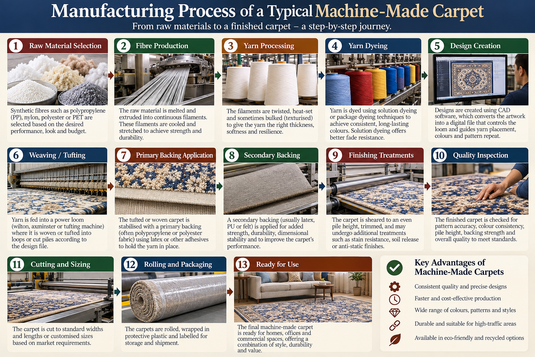
Here is a step-by-step look at how a typical machine-made carpet goes from raw material to finished flooring.
First, What Do We Mean by "Machine-Made Carpet"?
Machine-made carpet is a broad category.
It can include tufted carpet, woven carpet, needle-punched carpet, bonded carpet, carpet tiles, and other constructions produced with mechanized equipment.
For residential wall-to-wall flooring, however, tufted carpet is by far one of the most common manufacturing methods.
That is the process we will focus on here.
A tufted carpet is produced by inserting pile yarn through a premanufactured primary backing using a row of rapidly moving needles. The loops created by those needles can remain intact or be cut to produce different carpet styles.
Adhesive or another backing compound then helps lock the tufts into place, often while attaching a secondary backing for stability.
That basic construction differs substantially from traditional woven carpet, where pile and backing are created as part of an integrated weaving process.
Machine-made does not mean one universal construction method.
Step 1: The Manufacturer Defines the Carpet Specification
Long before production begins, someone has to decide what carpet is actually going to be made.
This includes obvious decisions such as color and pattern, but also technical ones.
The specification may establish:
- Fiber type
- Yarn size
- Yarn twist
- Pile height
- Tuft density
- Gauge
- Stitch rate
- Cut or loop construction
- Face weight
- Dyeing method
- Primary backing
- Secondary backing
- Coating or adhesive system
- Target width
- Intended traffic level
- Stain or soil treatments
- Performance standards
These decisions are connected.
A carpet designed for a quiet bedroom does not necessarily need the same construction as one intended for a busy family room. A plush residential carpet will use different pile characteristics from a dense low-loop product.
Manufacturing therefore begins with engineering as much as appearance.
The goal is to produce a surface that meets a particular combination of feel, cost, appearance, and performance.
Step 2: Choosing the Fiber
The visible portion of most carpet begins as fiber.
Modern residential carpets are commonly made from nylon, polyester, triexta, polypropylene, wool, or blends.
Synthetic fibers dominate much of machine-made residential production.
Each has different characteristics.
Nylon is known for resilience and abrasion resistance. Polyester offers softness and strong resistance to many water-based stains. Triexta is valued for softness and inherent stain resistance. Polypropylene absorbs very little moisture and works well in particular applications.
Wool remains an important natural carpet fiber, although its raw-material cost and processing requirements generally place it in a different segment of the market.
The manufacturer chooses fiber according to the carpet's intended performance and price.
Fiber is not simply a decorative choice. Its physical and chemical properties affect almost every later manufacturing step.
Step 3: Synthetic Polymer Becomes Filament
If the carpet uses a synthetic fiber, production begins at the polymer level.
The exact process depends on the material, but synthetic polymers are generally melted and forced through devices called spinnerets.
A spinneret contains very small openings.
As molten polymer passes through these openings, it forms continuous filaments.
The process is a little like pushing material through an extremely precise showerhead, although the industrial chemistry and temperature control are obviously far more sophisticated.
The shape of the spinneret openings can influence the cross-sectional shape of the finished fiber.
Why would that matter?
Fiber geometry can affect luster, soil visibility, texture, and light reflection.
A carpet fiber that looks like a simple thread to the naked eye can therefore have considerable engineering built into its microscopic structure.
Step 4: The Filaments Are Cooled and Drawn
Freshly extruded synthetic filaments need to be cooled and stabilized.
They may also undergo drawing, which stretches the filaments in a controlled way.
Drawing helps orient the polymer molecules and can influence strength and other mechanical properties.
At this point, the fiber begins acquiring the characteristics necessary for textile use.
Manufacturers can control numerous variables, including filament thickness, geometry, and the number of filaments that will ultimately form a yarn bundle.
These specifications are largely invisible once carpet is installed, but they contribute to how the finished pile responds to wear.
Step 5: Fiber May Be Textured or Crimped
Perfectly straight synthetic filament does not always have the bulk or tactile qualities desired for carpet.
Manufacturers can therefore add texture or crimp.
Texturing introduces bends, curls, or irregularity that create bulk and help the yarn behave more like a useful carpet pile.
Bulk is important because it allows the yarn to occupy more physical volume without simply adding a proportional amount of raw material.
You may encounter the term BCF, meaning bulked continuous filament.
BCF yarn is widely used in carpet manufacturing. Instead of being made from short fibers spun together, the yarn is composed of continuous synthetic filaments that have been processed to create bulk.
The distinction between continuous filament and staple fiber affects later manufacturing and can influence characteristics such as shedding.
Step 6: Staple Fiber Takes a Different Route
Not all carpet yarn begins as continuous filament.
Some fibers are cut into relatively short lengths known as staple fibers.
These short fibers need to be aligned, blended, and spun together into yarn.
Wool naturally exists as staple fiber and follows spinning processes suited to the characteristics of the fleece.
Synthetic materials can also be made into staple yarn.
Staple yarn can create particular textures and appearances, but loose fiber shedding may be more noticeable in some new carpets made from staple yarn.
Again, this does not automatically indicate poor quality.
It is simply a different yarn structure.
Step 7: The Yarn Is Spun, Plied, and Twisted
Once the fiber has been prepared, it needs to become carpet yarn with the correct size and structure.
Yarns may be twisted to bring fibers or filament bundles together.
Multiple individual yarns can also be plied together.
Twist is particularly important in many cut-pile carpets.
Think about the end of a loose rope.
If the strands have very little twist, they separate easily. Increase the twist and the structure becomes tighter.
Carpet behaves in a comparable way.
Higher yarn twist can help a cut pile maintain a defined texture and resist untwisting or blooming under use.
This is why twist specifications sometimes appear when comparing carpets.
But as with almost every carpet number, more is not automatically better in every context. The appropriate twist depends on the desired construction.
A loop-pile carpet, for example, has different requirements from a textured cut pile.
Step 8: Heat-Setting Can Stabilize the Twist
Synthetic yarn often goes through heat-setting after twisting.
Heat-setting uses controlled heat to help stabilize the yarn's shape and twist.
This can improve appearance retention and reduce the tendency of the yarn to untwist.
The temperature and method depend on the fiber and product.
This is a good example of an invisible manufacturing step that has an obvious effect later.
When you see a textured carpet maintaining relatively distinct yarn bundles rather than turning into a fuzzy surface quickly, yarn construction and heat-setting may be part of the reason.
Fiber selection alone cannot explain performance.
Step 9: The Carpet Gets Its Color
There are several points in production at which carpet can be colored.
This is one of the more interesting aspects of modern carpet manufacturing because "dyeing" is not a single process.
Solution Dyeing
In solution-dyed synthetic fiber, pigment is incorporated into the material before or during fiber formation.
The color is therefore integral to the fiber.
This can provide excellent colorfastness and resistance to certain types of staining.
Solution-dyed fibers are widely used where stain resistance or resistance to fading is important.
The trade-off is that color decisions have to be made earlier in manufacturing.
Yarn Dyeing
Yarn can also be dyed after it has been formed but before it is made into carpet.
This gives manufacturers another route for producing particular colors or multicolored constructions.
Piece Dyeing
Some carpet is tufted in an undyed state and colored afterward.
The completed carpet may pass through a dyeing system that applies color across the material.
Printing
Carpet can also be printed.
Modern carpet printing technology can create detailed patterns and complex color placement that would be difficult to achieve through basic yarn changes alone.
Each method has advantages.
There is no universal rule that one dyeing technique makes every carpet better.
The appropriate choice depends on the desired appearance, fiber, performance, production scale, and cost.
Step 10: Primary Backing Is Manufactured
Before tufting can happen, the carpet needs a surface through which the yarn can be inserted.
This is called primary backing.
Primary backing is typically a woven or nonwoven synthetic material designed to provide a stable base during tufting.
You normally do not see much of it once the carpet is installed because pile covers the front and additional backing components cover the reverse.
Still, primary backing is fundamental to carpet construction.
It has to hold the tuft arrangement accurately while moving through high-speed production equipment.
Think of it as the canvas into which the pile yarn will be inserted.
Step 11: Yarn Is Fed Into the Tufting Machine
Now we reach the part of carpet manufacturing that most directly creates the floor surface.
Large numbers of yarn packages feed the tufting machine simultaneously.
Each yarn needs to arrive at the correct location with controlled tension.
The tufting machine contains a row of needles extending across the carpet's width.
As the backing moves through the machine, the needles repeatedly push yarn through it at high speed.
Underneath, loopers catch the yarn to form loops.
The process happens incredibly quickly compared with traditional hand carpet construction.
This is why machine tufting can produce large quantities of broadloom carpet at a price accessible to residential customers.
Step 12: Gauge Determines Needle Spacing
One specification associated with tufting is gauge.
Gauge refers to the spacing between tufting needles.
Closer needle spacing can contribute to a denser arrangement of yarn across the width of the carpet, although stitch rate and yarn size also matter.
Gauge by itself does not define quality.
A particular gauge may be exactly right for one carpet style and unnecessary for another.
Still, understanding gauge helps explain why two carpets made from the same fiber and having similar pile height can feel very different.
One may contain tufts packed much more closely together.
Step 13: Stitch Rate Controls Tufts in the Other Direction
Needle spacing determines one part of tuft density.
Stitch rate helps determine another.
As the backing moves through the tufting machine, needles repeatedly penetrate it. The number of tufting cycles over a given length contributes to how closely tufts are spaced along the direction of production.
Combine gauge with stitch rate, yarn size, and pile height, and manufacturers can create widely different surfaces using the same general equipment.
This is one reason simply knowing that a carpet is "machine tufted" tells you very little about its actual performance.
Machine settings can produce everything from economical basic carpeting to dense, sophisticated products.
Step 14: Loop Pile Is Created
If the yarn loops remain intact after being inserted into the backing, the result is loop-pile carpet.
Loop size can vary.
Low, tight loops create a very different appearance from larger, more textured loops.
Manufacturers can also vary loop heights within the same carpet to create patterns and surface texture.
Level-loop carpet keeps loops at a relatively consistent height.
Multi-level loop uses varying heights.
Loop construction can be particularly effective in areas where a firm, textured surface is desired.
There are practical considerations, especially with pets. Claws can potentially catch in some looped constructions.
The scale and tightness of loops therefore matter in addition to the fiber.
Step 15: Cut Pile Is Created
For cut-pile carpet, loops are cut during the tufting process.
Special cutting mechanisms work with the loopers beneath the backing, cutting the yarn so two pile ends emerge from each former loop.
The cut fibers can then be finished into different textures.
Plush, Saxony, frieze, and textured cut pile all involve variations in yarn, twist, pile height, density, and finishing.
The words describe the appearance of the surface, but that appearance begins with how yarn is controlled during tufting.
A highly twisted yarn behaves differently when cut from a relatively straight, lightly twisted one.
Step 16: Cut-and-Loop Construction Adds Pattern
Modern tufting equipment can combine cut and loop areas.
This produces what is appropriately called cut-and-loop carpet.
By controlling which yarns remain looped and which are cut, manufacturers can create patterns through texture alone.
This can be subtle, such as a tonal geometric design, or highly visible.
Computer-controlled tufting has greatly expanded the complexity manufacturers can achieve.
Needles, yarn feeds, pile heights, and cutting actions can be individually controlled or organized in sophisticated patterns.
A machine-made carpet can therefore involve much more than repeating identical tufts across a roll.
Step 17: Patterned Tufting Uses Precise Yarn Control
Patterned carpet is where modern machine manufacturing becomes especially interesting.
Some systems can vary the amount of yarn fed to individual needles.
That allows the machine to alter pile height or effectively hide certain yarn colors below the visible surface while bringing others forward.
The result can resemble a woven or printed pattern even though the carpet is tufted.
This requires careful coordination between digital design and mechanical production.
A pattern begins as data.
The manufacturing equipment translates that information into precise yarn placement across thousands of repeated movements.
So while machine-made carpet is produced quickly, sophisticated versions still involve substantial design and engineering work.
Step 18: The Freshly Tufted Carpet Is Not Finished Yet
When carpet leaves the tufting machine, the pile exists, but the product is not yet ready for your floor.
The yarn loops have been inserted through the primary backing, but they need to be secured.
Without an appropriate backing or coating process, tufts could pull out too easily.
This is where the next stage becomes critical.
The carpet moves to backing operations, where adhesives or coating compounds stabilize the construction.
Step 19: A Precoat or Adhesive Is Applied
The backside of tufted carpet is typically coated with a compound designed to help lock tufts into the primary backing.
Latex-based systems have traditionally been common, although backing technologies vary by manufacturer and product.
The coating needs to adhere well to the backing and yarn while remaining suitable for the carpet's expected use.
Tuft bind, which measures the force required to pull a tuft from the carpet, is influenced by this stage.
Too little binding strength can lead to yarn pulling loose under traffic or cleaning.
The chemistry behind the carpet therefore plays a structural role even though homeowners rarely see it.
Step 20: Secondary Backing May Be Added
Many residential broadloom carpets receive a secondary backing.
This is laminated to the carpet after tufting.
The secondary backing improves dimensional stability, helps protect the carpet's structure, and provides a surface suitable for handling and installation.
If you have ever turned over a conventional carpet sample, this is probably the layer you noticed.
Different manufacturers use different secondary backing systems.
Some are relatively traditional woven synthetic fabrics. Others are engineered backing systems designed to provide particular performance characteristics.
The backing may influence flexibility, installation behavior, moisture performance, and dimensional stability.
This is why two carpets with nearly identical pile can behave differently during installation.
Step 21: The Backing Is Cured
After coating and backing are applied, the carpet generally passes through curing equipment.
Heat helps set or cure the adhesive system.
Temperature, speed, and dwell time must be controlled.
The goal is to establish a stable bond without damaging the fiber or creating unwanted distortion.
This manufacturing stage can also affect dimensional stability.
Large sheets of textile material contain internal stresses. Heat and coating processes need to be managed carefully so the finished broadloom remains within required specifications.
Step 22: The Carpet Surface Is Sheared
Cut-pile carpet rarely emerges from tufting with every yarn end at a perfectly uniform height.
The surface therefore needs finishing.
Shearing machines use precise cutting blades to trim the pile.
This creates a more even face.
The level and type of shearing depend on the carpet style.
Some products are designed to have a very smooth appearance. Others retain deliberate texture.
Patterned carpet may receive additional shearing or finishing to make the design more visible.
The quality of this step affects the first thing customers see when they look at the finished carpet.
Step 23: Loose Fiber Is Removed
Manufacturing inevitably leaves some loose fibers and debris.
Carpet may go through cleaning, brushing, vacuuming, or related finishing operations to remove this material.
This helps provide a cleaner finished surface before inspection and packaging.
Some carpets, particularly those made from staple fiber, may still shed loose fibers after installation.
Initial shedding is not necessarily a sign of manufacturing failure.
The amount and persistence depend on fiber type, yarn construction, carpet structure, and vacuuming.
Step 24: Additional Treatments May Be Applied
Depending on the carpet, additional treatments can be added during manufacturing.
These may be intended to improve resistance to stains, soil, static electricity, or other conditions.
Not every carpet needs the same treatments.
For example, some fibers have inherent stain-resistant characteristics. Solution-dyed products may achieve certain performance goals without relying on the same topical dye-blocking processes as other carpets.
Consumers concerned about chemical composition or indoor emissions should look for specific information from the manufacturer rather than assuming all carpeting is treated identically.
Relevant third-party certifications can also provide information about tested emissions or other characteristics.
Step 25: Carpet Undergoes Quality Control
Manufacturing a large continuous roll means small defects can become large problems if they are not caught.
Quality control may occur throughout production rather than only at the end.
Manufacturers can examine characteristics such as:
- Color consistency
- Pattern alignment
- Carpet width
- Pile height
- Face weight
- Tuft density
- Tuft bind
- Backing adhesion
- Dimensional stability
- Surface defects
- Streaking
- Missing tufts
- Dye variation
- Roll length
Some checks are automated. Others involve trained inspectors.
Lighting is particularly important for visual inspection because subtle differences in pile or color can become more visible under directional illumination.
Step 26: Performance Testing Takes Place
Depending on the carpet and market, products may be tested for various aspects of performance and safety.
Tests can evaluate wear, appearance retention, flammability, colorfastness, static generation, tuft bind, delamination, stain resistance, and other properties.
The exact standards depend on the intended product category and jurisdiction.
Manufacturers may also conduct internal testing that goes beyond minimum requirements.
Performance ratings can be useful when comparing carpets, but make sure you understand what a test measures.
A stain-resistance result does not tell you how well a carpet resists crushing.
A flammability classification does not tell you how comfortable the carpet feels.
No single test represents overall quality.
Step 27: The Carpet Is Rolled and Packaged
Finished broadloom carpet is usually produced in long lengths.
After inspection, it is rolled around a core and prepared for storage and shipping.
Labels identify relevant product information such as style, color, roll number, production lot, and dimensions.
Lot information can be particularly important.
Textile products can show slight variation between production runs. When multiple pieces of carpet are needed for one installation, using material from compatible dye lots helps reduce visible differences.
Professional flooring retailers and installers pay attention to this when ordering material for large spaces.
Step 28: Broadloom Width Affects Installation Planning
Carpet does not come in unlimited widths.
Residential broadloom is manufactured in standard or manufacturer-specific widths, often around 12 feet in the U.S. market, though other widths exist.
Room dimensions therefore affect how much material is needed and where seams must be placed.
A room that is slightly wider than the available roll may require a seam even if the total square footage seems modest.
Patterned carpet can require additional material because the pattern needs to align across seams.
This is one reason carpet estimating involves more than multiplying room length by width.
The manufacturing dimensions directly affect installation planning and waste.
Step 29: Carpet Arrives at the Installer
Manufacturing may be complete, but performance still depends heavily on what happens next.
The floor needs to be prepared.
Appropriate cushion must be selected for stretch-in installations. Tack strips, seams, transitions, and stretching all need to be handled properly.
Some carpets use glue-down or other installation systems.
A high-quality carpet can perform poorly if installed incorrectly.
Likewise, a properly installed moderate-cost carpet may provide years of satisfactory service.
At The Ambiente, we consider installation part of the flooring system rather than something separate from the product.
The manufacturer creates a carpet capable of performing to certain standards. The installer has to give it the conditions it needs to do so.
How Machine-Tufted Carpet Differs From Machine-Woven Carpet
Tufting is common, but it is not the only machine manufacturing process.
Machine-woven carpet is structurally different.
In woven constructions, pile yarn and foundation yarns are interlaced during the weaving process rather than tufting pile through a previously manufactured primary backing and securing it afterward.
Traditional woven carpet types include Axminster and Wilton constructions.
These processes can produce durable, sophisticated carpeting and are often used in demanding commercial, hospitality, and high-end residential applications.
They also tend to be slower and more expensive to manufacture than conventional tufted carpet.
If you turn over a woven carpet, the structural difference from standard tufted broadloom may be visible.
Again, "machine-made" does not necessarily mean "tufted."
What About Machine-Made Area Rugs?
Machine-made rugs can be produced differently from wall-to-wall carpet.
Power-loomed rugs, for example, may be mechanically woven using equipment capable of creating complex patterns at high speed.
Other area rugs may use tufted constructions.
Some are printed.
This matters because people sometimes use "machine-made carpet" and "machine-made rug" as though they describe an identical production method.
They do not.
Always look at the specific construction.
A machine-woven polypropylene area rug and a tufted nylon broadloom carpet may both be machine-made synthetic floor coverings, but they have substantially different structures.
Why Can Two Nylon Carpets Perform So Differently?
Once you understand manufacturing, this question becomes much easier to answer.
Imagine two carpets labeled "100% nylon."
One has a dense pile, strong yarn twist, carefully heat-set fibers, appropriate pile height, good tuft bind, quality backing, and a construction designed for heavy residential traffic.
The other has a loose, tall pile with less fiber and a lighter construction intended for low-traffic use.
They share a fiber name.
They are not equivalent carpets.
The same is true for polyester, wool, triexta, and other fibers.
When shopping, fiber content should start the conversation rather than end it.
Which Manufacturing Specifications Matter Most to a Homeowner?
You do not need to become a textile engineer to choose carpet.
But understanding a few specifications can prevent bad comparisons.
Pay attention to fiber type because it influences resilience, staining behavior, softness, and cost.
Look at pile construction. Is it cut, loop, or cut-and-loop?
Consider pile height and density. A dense lower pile often behaves very differently from a tall loose one.
For cut-pile carpet, yarn twist can be relevant to appearance retention.
Look at dye method if fading or staining is a particular concern.
Check the backing system and recommended cushion.
Finally, look at the manufacturer's intended traffic rating and warranty.
A carpet's construction should suit the room rather than simply have the highest number in every specification.
Is Heavier Carpet Always Better?
No.
This is one of the most persistent carpet-shopping misconceptions.
A heavier face weight means there is more pile fiber per unit area, but that does not tell you how the fiber is arranged.
A tall, loose pile can use a substantial amount of yarn while being less suitable for a busy hallway than a shorter, denser construction.
Fiber type also matters.
Comparing face weight across completely different fibers and carpet styles can be particularly misleading.
Use face weight to compare genuinely similar products, then look at density, pile height, twist, construction, and performance rating.
The goal is not to buy the most fiber by weight.
It is to buy the carpet whose structure suits the space.
Does Machine-Made Mean Low Quality?
Not at all.
Machine production is a manufacturing method, not a quality category.
Modern tufting and weaving equipment can produce carpets with very precise construction and strong performance.
Machines also make consistent residential carpet affordable on a scale that hand production could never match.
The meaningful questions are what material was used, how the carpet was engineered, what backing supports it, how it was finished, and what level of traffic it is designed to handle.
A low-cost carpet and a premium carpet can both emerge from sophisticated machinery.
Their specifications may be very different.
From Polymer to Floor
The next time you pick up a carpet sample, turn it over.
Look at the pile, then look at the backing.
What appears to be a simple piece of soft flooring is actually the result of a long production sequence.
Synthetic polymer may have been melted, extruded into microscopic filaments, cooled, drawn, textured, twisted, and heat-set. The yarn may have been solution-dyed or colored later. It was then fed into a tufting machine alongside hundreds of other yarn ends.
Needles inserted that yarn into primary backing thousands of times.
Loops were formed, some perhaps cut. Pile heights and colors may have been controlled to create texture or pattern.
The carpet then received backing compounds, a secondary backing, curing, shearing, finishing, inspection, testing, rolling, and labeling before ever reaching a flooring retailer.
At The Ambiente, we think understanding this process helps make carpet specifications less abstract.
Density tells you something about how much pile has been packed into the surface. Twist tells you something about how the yarn was built. Solution dyeing tells you when color became part of the fiber. Backing specifications tell you how the tufted face was stabilized.
None of those details exists in isolation.
They are all parts of the manufacturing process.
The Bottom Line
A typical machine-made residential carpet is produced through a carefully controlled sequence rather than one simple manufacturing operation.
The basic process begins with selecting and preparing the fiber. Synthetic materials are commonly extruded into filaments, while staple fibers may be spun into yarn. Yarn is twisted, sometimes plied and heat-set, and then colored either before or after carpet formation depending on the dyeing method.
During tufting, hundreds or thousands of needles insert yarn into a primary backing. The resulting pile may remain looped or be cut.
Backing compounds secure the tufts, secondary backing adds stability, and curing fixes the structure in place. The surface is then sheared, cleaned, finished, inspected, tested, rolled, and sent onward for installation.
Every step changes something about the final floor.
That is why The Ambiente recommends looking beyond color and softness when comparing carpet.
Ask what fiber you are getting. Look at how the yarn is constructed. Consider pile density and height. Understand whether the carpet is cut or looped. Check how it was dyed, what backing it uses, and what traffic level it is designed to handle.
A carpet may look simple once it is installed.
The manufacturing behind it is anything but.