outdoor carpet has a harder job than most indoor flooring.
An indoor carpet might deal with foot traffic, pet hair, crumbs, and an occasional spill. Put carpeting outside, and the list gets longer very quickly. There is rain, humidity, direct sun, temperature changes, dirt, pollen, leaves, muddy shoes, pool water, and sometimes snow or freezing conditions.
That means buying outdoor carpet based mainly on color or softness is usually a mistake.
A carpet can look perfectly suited to a patio in a product photo while being wrong for an uncovered deck or pool area. The fiber might tolerate water, for example, while the backing holds moisture against the surface below. Another product might have excellent UV resistance but lack the dimensional stability needed for a demanding installation.
At The Ambiente, we think outdoor flooring decisions make more sense when you understand the specifications behind the appearance.
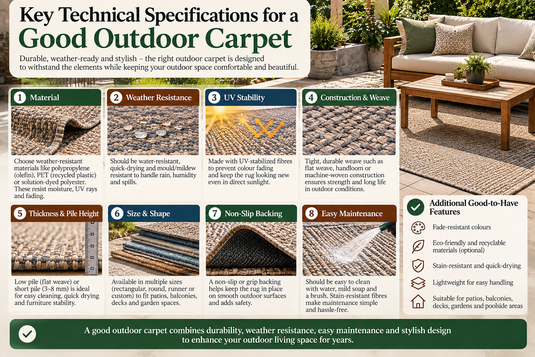
For most outdoor applications, you want a carpet specifically approved by its manufacturer for outdoor use, with low moisture absorption, strong UV and colorfastness performance, suitable backing, good dimensional stability, practical drainage and drying characteristics, and an installation system designed for the actual substrate and exposure.
The phrase "outdoor carpet" is only the beginning.
Here are the technical details worth examining before you buy.
1. Outdoor-Use Rating Comes First
The most basic specification is also the easiest to overlook.
Is the carpet actually rated for outdoor use?
A carpet being synthetic, stain resistant, or described as durable does not automatically make it suitable for an exposed exterior installation.
Look at the manufacturer's technical documentation. It should clearly identify approved applications.
Some products may be suitable for covered porches or sunrooms but not fully exposed patios. Others are designed for indoor-outdoor use and can handle direct weather exposure when installed correctly.
This distinction matters because the whole carpet assembly has to tolerate outdoor conditions.
The face fiber may be water resistant while the backing, adhesive, or other components are not.
If a manufacturer does not approve a product for your intended outdoor application, consider another carpet.
2. Fiber Type Has a Major Effect on Performance
Most practical outdoor carpeting uses synthetic fibers.
polypropylene, also called olefin, is especially common. Solution-dyed polyester and certain nylon products may also be used depending on the application.
Each fiber behaves differently.
Polypropylene or Olefin
Polypropylene is widely used outdoors because it absorbs very little moisture.
That characteristic helps it dry relatively quickly and makes it resistant to many water-based stains. It is also commonly solution-dyed, which can provide good resistance to fading.
Polypropylene is generally affordable too.
Its limitations include lower resilience compared with nylon and a tendency to attract oily soils. It can also be damaged by high heat.
For patios, porches, pool-adjacent spaces, and casual outdoor living areas, however, polypropylene is often one of the first fibers worth considering.
Polyester
Polyester also has relatively low moisture absorption and can provide good stain resistance.
Solution-dyed polyester can offer good colorfastness, which is especially relevant outside.
Performance varies significantly by construction, so do not choose purely because the product says "polyester." Check whether the specific carpet is approved for outdoor exposure.
Nylon
Nylon is valued for resilience and abrasion resistance.
In high-traffic applications, these qualities can make it attractive.
Nylon absorbs more moisture than polypropylene, however, and its UV performance depends on how the fiber is manufactured and dyed.
Outdoor-rated solution-dyed nylon can perform well in certain applications, but ordinary indoor nylon carpet should not simply be moved outside because nylon is known for durability.
The product's outdoor rating matters more than the fiber name alone.
3. Solution-Dyed Fiber Is Worth Looking For
Outdoor carpeting spends its life exposed to light, so the way it is colored matters.
Solution dyeing incorporates pigment into the synthetic material as the fiber is manufactured. The color is part of the fiber rather than being applied only after fiber production.
That can provide excellent colorfastness.
For an outdoor carpet sitting in strong sunlight, this is valuable.
It can also improve resistance to certain stains and cleaning agents, depending on the fiber and manufacturer.
You may hear the analogy that a solution-dyed fiber is like a carrot, with color running through it, while some conventionally dyed fibers are compared with a radish, which has color concentrated at the exterior.
The analogy oversimplifies textile chemistry, but it captures the basic idea.
Still, do not stop at the words "solution-dyed."
You should also look for the manufacturer's actual lightfastness, UV, and warranty information.
4. UV Resistance Is Critical
Water gets much of the attention outdoors, but sunlight can be equally hard on flooring.
Ultraviolet radiation can cause fading and material degradation.
Outdoor carpet therefore needs to be designed for sustained light exposure.
Look for claims supported by actual product specifications and testing rather than vague language such as "fade resistant."
No carpet should be assumed to remain completely unchanged forever under intense direct sun.
Geography matters too.
A covered porch in a northern climate experiences very different solar exposure from an uncovered patio in Arizona.
Orientation matters as well. A west-facing patio may receive hours of intense afternoon sun.
If fading would be particularly noticeable, medium or variegated colors may age more gracefully than certain saturated solid colors, even with good UV performance.
5. Moisture Absorption Should Be Low
A sensible outdoor carpet should not behave like a sponge.
Low moisture absorption allows the face fiber to release water more readily after rain, washing, splashing, or humidity.
This is one reason polypropylene is so common outdoors.
But there is an important distinction between a fiber absorbing very little water and an entire carpet installation staying dry.
Water can still move between fibers, through backing, underneath carpet, and into seams or edges.
In other words, a hydrophobic face fiber does not mean water cannot become trapped in the flooring assembly.
That is why drainage, backing, substrate slope, and installation details matter just as much as fiber.
6. Examine the Backing
Flip over a carpet sample.
The backing deserves almost as much attention as the surface.
Backing stabilizes the carpet and helps maintain its structure. Outdoors, it also affects how water moves through or beneath the product.
Different outdoor carpets use different backing systems.
Some are designed to allow water to pass through. Others have more substantial moisture-resistant backings. Carpet tiles may have specialized modular backings.
The correct choice depends on the installation.
A carpet installed on a covered porch may have different requirements from one placed on an uncovered concrete patio.
Ask specifically:
- What is the backing made from?
- Is it rated for continuous outdoor exposure?
- Is the backing permeable?
- How does water escape from the installation?
- Is it compatible with the intended adhesive or installation system?
- Can it be installed over concrete, wood decking, or another planned substrate?
The answer should come from the manufacturer's technical information, not guesswork.
7. Drainage Is a System, Not a Carpet Feature
Good outdoor drainage involves more than choosing a carpet with holes in the backing.
Water needs somewhere to go.
Suppose an outdoor carpet allows rain to pass through quickly but is installed over concrete that slopes toward the house and collects water in a low spot.
You still have a drainage problem.
The carpet cannot correct the underlying geometry of the patio.
The substrate should have appropriate drainage and slope for its location and construction.
Deck installations require separate consideration because wood and composite deck manufacturers may have rules about coverings, ventilation, trapped moisture, and surface compatibility.
Before covering a deck, make sure the flooring system will not interfere with drying or affect the deck warranty.
Outdoor carpet should work with the drainage design, not fight it.
8. Drying Speed Matters
A carpet that can get wet should also be able to dry effectively.
Slow drying can contribute to odors, staining, biological growth on accumulated organic matter, and deterioration of adjacent materials.
Several factors affect drying:
fiber absorption, pile height, pile density, backing, airflow, shade, humidity, substrate design, and installation method.
A thin, low-pile polypropylene carpet on a properly draining surface will generally dry differently from a thick textile sitting in a shaded, humid location.
Think about your actual climate.
If a patio receives little sun and remains humid for days after rain, rapid drying should be a high priority.
If the area is fully covered and rarely gets wet, you may have somewhat more flexibility.
9. Pile Height Should Usually Be Low
For most outdoor environments, low pile is the practical choice.
It is easier to clean, traps less loose debris, and generally dries faster than a deep plush pile.
Outdoor spaces collect things indoor rooms do not.
Leaves break into small particles. Pollen settles. Grass clippings blow in. Insects, soil, dust, and plant debris all find their way onto the floor.
A thick pile provides plenty of space for this material to lodge.
Low-pile or flatwoven outdoor carpeting is much easier to sweep, vacuum, rinse when appropriate, or otherwise maintain according to the manufacturer's instructions.
It also tends to be more stable under outdoor furniture.
Deep-pile outdoor carpet exists, but make sure the extra softness is worth the maintenance commitment.
10. Pile Density Affects Durability
Pile height tells you how tall the fiber is. Density tells you how closely fibers are packed.
These are not the same thing.
A dense low-pile carpet can be extremely durable because there is substantial material supporting the surface without long fibers bending and crushing.
For outdoor areas with regular foot traffic, density can be valuable.
Unfortunately, consumers are not always given a simple density specification that allows direct comparison between products.
You can still examine samples.
Bend the carpet and see how readily you can see the backing through the pile. Compare the amount of fiber in similar products. Review face weight and construction information where available.
Do not use density or face weight as the sole quality measure, though.
The fiber, backing, tuft bind, construction, and intended use all contribute to performance.
11. Face Weight Is Useful, but Easy to Misinterpret
Carpet specifications sometimes list face weight, usually expressed as the weight of pile fiber per unit of area.
A higher face weight means more pile material, but it does not automatically mean better outdoor carpet.
One product may have a higher face weight because it has a taller, looser pile. Another may use a lower but denser and more appropriate construction for outdoor traffic.
Compare face weight only among reasonably similar carpets.
It is one piece of technical information, not a quality score.
If a retailer tries to reduce the entire comparison to "this one has more ounces," ask about the rest of the construction.
12. Tuft Bind Matters
For tufted carpet, tuft bind describes how strongly the tufts are held in the backing.
This matters outdoors because carpets may experience heavy foot traffic, furniture movement, cleaning, and environmental stress.
Poor tuft retention can result in fibers pulling loose.
The exact testing and specification may not appear prominently on a retail tag, but manufacturers and commercial-grade product documentation may provide relevant performance information.
If you are carpeting a demanding outdoor area, particularly a hospitality-like residential space or frequently used covered terrace, ask about tuft retention and suitability for the traffic level.
13. Dimensional Stability Is Important
Outdoor flooring experiences temperature and moisture changes.
Materials expand, contract, soften, stiffen, and otherwise respond to environmental conditions.
A carpet with poor dimensional stability may develop ripples, curling, buckling, seam movement, or edge issues.
Backing construction contributes significantly to stability.
Carpet tiles deserve particular attention because each tile needs to remain flat and aligned.
Outdoor-rated modular carpet systems should be designed to tolerate their intended temperature and moisture range when installed according to specifications.
Never assume an indoor carpet tile is suitable outside simply because replacing individual tiles would be convenient.
14. Check the Temperature Range
Outdoor surfaces can become much hotter or colder than the surrounding air.
A dark patio surface in direct summer sun may reach very high temperatures. In colder climates, flooring can experience freezing conditions.
The carpet, backing, adhesive, and seam treatment all need to tolerate the expected temperature range.
This is especially important for adhesives.
An adhesive formulated for interior climate-controlled environments may behave poorly under outdoor heat, cold, or moisture exposure.
Always use the installation products specified or approved by the carpet manufacturer for the application.
The compatibility of the system matters more than buying individual components that each sound "weather resistant."
15. Abrasion and Traffic Ratings Matter
How will the space actually be used?
A decorative balcony for two people has different performance needs from an outdoor dining area used by a large family every weekend.
High foot traffic means more abrasion.
Shoes may also carry abrasive grit onto outdoor carpet, increasing wear.
Look for the manufacturer's recommended traffic level and application category.
If the carpet is intended only for light residential use, putting it along a heavily used pool entrance may produce disappointing results.
Traffic ratings are particularly important for stairs.
If you intend to carpet exterior steps, verify that the specific product and installation system are approved for that purpose.
Stairs increase both wear and safety demands.
16. Stain Resistance Is More Than a Nice Extra
Outdoor carpet will get dirty.
That is not a possibility. It is part of the job.
Food from outdoor dining, muddy shoes, drinks, sunscreen, grease from a grill area, leaves, bird activity, and pets can all create stains.
Look for fibers with good resistance to the kinds of stains you realistically expect.
Polypropylene performs well against many water-based stains but can attract oily soils.
Solution-dyed fibers may offer additional cleaning advantages depending on the product.
The manufacturer's cleaning instructions are worth reading before purchase.
A carpet that requires delicate care is rarely a sensible choice for an exposed patio.
17. Mold and Mildew Resistance Needs Context
Many outdoor carpets are advertised as mold or mildew resistant.
Read that claim carefully.
Synthetic carpet fibers such as polypropylene do not provide much food for mold themselves. But outdoor carpet inevitably collects organic material.
Dust, pollen, food particles, soil, pet debris, and leaves can all support biological growth when they remain wet.
The substrate underneath may also be vulnerable.
So "mildew-resistant carpet" does not mean you can install it in a permanently damp area and never think about moisture again.
Good drainage, quick drying, cleaning, airflow, and proper installation remain essential.
If the carpet stays wet for long periods, find out why.
18. Slip Resistance Deserves Attention
Outdoor carpet is often chosen partly because it provides more traction than some hard surfaces.
But do not assume every carpeted outdoor surface is automatically slip resistant.
The whole installation matters.
A loose piece of carpet on a smooth patio can move underfoot. Wet algae or debris can develop underneath or around poorly maintained flooring. Edges can curl and create trip hazards.
If slip resistance is particularly important, look for relevant manufacturer data and installation requirements.
Pool decks, exterior stairs, ramps, and entry routes warrant extra caution.
Local building codes may impose requirements for certain applications.
Outdoor carpet should never be used as an improvised way to conceal a dangerously slippery or structurally defective surface.
19. Water Around Pools Adds Another Layer
Poolside carpeting has specific demands.
There is frequent water exposure, bare feet, cleaning chemicals, sunscreen, and intense sunlight.
The carpet needs to dry quickly and remain secure.
Resistance to pool chemicals may also be relevant, but the exact performance depends on fiber, backing, and exposure.
Check whether the manufacturer specifically approves the carpet for pool environments.
A general "indoor-outdoor" label may not tell you enough.
Also think about hygiene and maintenance.
A textured surface that is comfortable under bare feet still needs to be easy to clean and drain.
20. Installation Method Is a Technical Specification Too
Outdoor carpet can be installed in several ways, depending on the product and substrate.
Some carpet is fully adhered. Other products may use perimeter attachment, specialized tapes, loose-lay methods, or modular systems.
Follow the manufacturer's installation instructions.
Fully adhering an outdoor carpet with the wrong adhesive can lead to bubbling, release, trapped moisture, and premature failure.
Surface preparation matters too.
Concrete may need to be clean, structurally sound, and within specified moisture conditions. Existing coatings can affect adhesive bond. Cracks or uneven areas may need attention.
Wood decking introduces a separate set of questions around drainage, fastening, ventilation, and compatibility.
The best carpet will perform poorly if installed incorrectly.
21. Concrete Moisture Still Matters Outdoors
It can seem strange to worry about concrete moisture when the carpet is already outside and expected to get wet.
But the issue is not simply whether water touches the carpet.
Moisture moving through concrete can affect adhesives and backing systems. Standing water can also interfere with bonding and drying.
Installation specifications may contain limits or requirements for substrate conditions.
If the carpet is being installed on a covered slab where adhesive performance is critical, proper assessment is important.
Do not assume outdoor exposure makes every moisture-related installation rule irrelevant.
22. Outdoor Carpet on a Wood Deck Requires Caution
Putting carpet over a wood deck can make the surface more comfortable, but trapped moisture can be a concern.
Wood needs to dry.
A carpet and backing system that retains water against the deck may slow that process.
Before installation, check the deck manufacturer's recommendations if applicable. Understand whether covering the surface affects warranty terms.
The carpet itself should also be suitable for the deck material.
Composite decking manufacturers may have their own cautions regarding rubber, latex, vinyl, dyes, or other materials that can interact with or discolor the surface.
A breathable, removable outdoor rug may make more sense than permanently installed carpet in some deck situations.
23. Look at Edge Stability
Carpet edges can become vulnerable outdoors.
An exposed edge may experience foot traffic, cleaning, water, wind, and temperature change.
Fraying or curling creates both an appearance problem and a trip hazard.
Check how the product's edges are supposed to be finished.
Some installations require binding, transition strips, nosings, or specific edge treatments.
Outdoor stairs deserve especially careful edge detailing.
A DIY cut edge that looks acceptable on installation day may not remain stable after a season of use.
24. Carpet Tiles Offer Useful Advantages Outdoors
Outdoor-rated carpet tiles can be extremely practical.
If one section becomes badly stained or damaged, you may be able to replace individual tiles rather than the entire floor.
Tiles are also easier to transport and handle than large rolls.
But modular flooring brings additional technical requirements.
The tiles need sufficient dimensional stability to avoid curling or opening gaps. The backing and installation system must be designed for exterior conditions. Drainage needs to work across the whole assembly.
And it is worth buying spare tiles during the original installation.
Manufacturing batches can vary slightly in color, and a particular product may be discontinued years later.
Keeping a small number of matching replacements can make future repairs far easier.
25. Outdoor Carpet and Rugs Are Not Exactly the Same Thing
The terms sometimes get used interchangeably, but the installation changes the decision.
An outdoor area rug is removable.
You can lift it to clean the surface underneath, move it during severe weather, or reposition it seasonally.
Installed outdoor carpeting is meant to cover the floor more continuously and therefore requires more consideration of seams, adhesives, edges, drainage, and long-term substrate contact.
For a rental home or a deck where you want the surface to remain accessible, an outdoor rug might make more sense.
For a covered porch, screened room, or large concrete recreation area, installed outdoor carpet may provide better full-floor coverage.
Decide whether you actually need carpet before comparing specifications.
26. Consider Cleaning Before Buying
Imagine the carpet covered in pollen and muddy paw prints rather than looking pristine in a showroom.
How will you clean it?
Can it be vacuumed?
Can it be swept?
Can it be rinsed with water?
What cleaning products does the manufacturer allow?
Can it be pressure washed? Do not assume the answer is yes.
How quickly will it dry afterward?
Can stains be spot treated?
Does grease require a particular cleaning process?
Read the maintenance instructions before purchase.
If the required routine is unrealistic for your household or climate, pick a different product.
27. Check Warranties Carefully
Outdoor carpet warranties can contain important limitations.
The warranty may distinguish between covered and uncovered outdoor areas. Pool installations, stairs, commercial traffic, pet damage, flooding, or improper installation may be treated differently.
Fading warranties may have defined thresholds rather than promising that color will never change.
Installation products may need to be manufacturer approved.
Keep receipts, product labels, lot information, and installation documentation.
If a problem develops, having that information makes a warranty claim much easier to evaluate.
28. What Specifications Should You Compare Side by Side?
Once you have narrowed down several outdoor carpets you like, compare them systematically rather than relying on feel alone.
At The Ambiente, we would look for the following:
- Explicit approval for your indoor-outdoor or fully outdoor application
- Face fiber type, such as polypropylene, polyester, or nylon
- Dye method, particularly whether the fiber is solution-dyed
- UV and lightfastness performance
- Water absorption characteristics
- Pile height
- Pile or tuft density where available
- Face weight, interpreted alongside construction
- Backing type
- Drainage characteristics
- Dimensional stability
- Suitable temperature range
- Traffic rating
- Stain resistance
- Mold and mildew resistance claims and what they actually cover
- Slip-related performance where relevant
- Approved installation methods
- Adhesive requirements
- Substrate compatibility
- Cleaning instructions
- Warranty terms
- Approval for special locations such as pools or stairs
You may not find every specification on a retail product label.
For serious installations, ask for the manufacturer's technical data sheet.
29. What Is a Good Specification for a Covered Porch?
A covered porch usually gives you more options because the carpet may receive less direct rain and UV exposure.
You still want a product rated for outdoor or appropriate indoor-outdoor use.
Low pile, good dimensional stability, easy cleaning, and resistance to humidity remain important.
If wind-driven rain can enter the porch, drainage and drying become more significant.
The substrate matters too.
A concrete porch and a wood porch may require completely different installation approaches even if you choose the same surface appearance.
30. What Is a Good Specification for an Uncovered Patio?
Fully exposed patios are more demanding.
Prioritize excellent UV resistance, low moisture absorption, fast drying, outdoor-rated backing, and a drainage-compatible installation system.
Low-pile solution-dyed polypropylene is often a practical category to explore for this type of environment, though other outdoor-rated fibers can work.
The patio itself needs appropriate drainage.
If water regularly pools on the surface, solve that issue rather than covering it with carpet.
In climates with snow and freezing conditions, confirm that both carpet and installation materials are designed for the seasonal temperature range.
31. What Is Best for a Balcony?
Balconies involve an additional concern: drainage systems and building rules.
You do not want carpet obstructing drains or causing water to remain where it should flow away.
In apartments and condominiums, building management or an owners' association may also restrict flooring or attachment methods.
A removable outdoor rug or approved modular system may be preferable to permanent full-floor installation.
Wind exposure should also be considered.
Loose flooring on an elevated balcony needs to be appropriately secured according to product and building requirements.
32. Don't Buy Outdoor Carpet Based on One Specification
This is probably the most important buying lesson.
Polypropylene does not automatically equal good outdoor carpet.
Solution-dyed does not automatically equal permanent color.
Mold resistant does not mean safe to leave wet.
Water resistant does not mean waterproof.
Heavy face weight does not automatically mean durable.
A product can perform exceptionally in one category and poorly in another.
Outdoor carpet works as a system.
The face fiber, backing, substrate, adhesive, seams, edges, drainage, environment, and maintenance all interact.
What Would The Ambiente Choose?
For a typical exposed residential patio, we would begin by looking for a low-pile carpet explicitly rated for full outdoor use.
Solution-dyed polypropylene is often a strong candidate because of its low moisture absorption, stain resistance, color performance, and practical price point.
But we would not choose it until checking the backing, drainage requirements, UV performance, installation method, and substrate compatibility.
For a high-traffic covered outdoor room, an outdoor-rated solution-dyed nylon product might deserve consideration when resilience is especially important.
For decks and balconies, we would first decide whether permanently installed carpet is appropriate at all. A removable outdoor rug can sometimes provide the comfort and visual effect you want while making cleaning and inspection easier.
The location comes first. The material follows.
Good Outdoor Carpet Starts Under the Carpet
It is tempting to think the difficult part is finding a carpet that survives rain.
Modern synthetic fibers make that relatively easy.
The harder question is what happens to the water after it reaches the flooring.
Can it pass through?
Can it drain away?
Can the carpet dry?
Can the surface underneath dry?
Will the adhesive remain stable?
Will the backing keep its dimensions through summer heat and winter cold?
Those are the questions that determine whether an outdoor carpet installation continues to work after the first season.
At The Ambiente, we recommend asking for technical information rather than relying solely on an "indoor-outdoor" label.
Start with an approved outdoor-use rating. Look at the fiber and dye method. Check UV resistance, moisture absorption, backing, drainage, drying, pile height, traffic performance, and dimensional stability. Then make sure the carpet can be installed correctly over the actual surface you have.
Only after that should you choose the color.
A good outdoor carpet is not simply an indoor carpet made tougher. It is a flooring material designed as part of an exterior environment, where water, sunlight, dirt, temperature, and the substrate all matter.
Choose for those conditions, and the carpet has a much better chance of doing what you wanted it to do in the first place: make an outdoor area more comfortable without creating a maintenance problem underneath your feet.