The colour of a handmade rug can come from many different dye systems, but buyers often reduce the conversation to one question: are natural dyes better than synthetic dyes?
The answer is more nuanced.
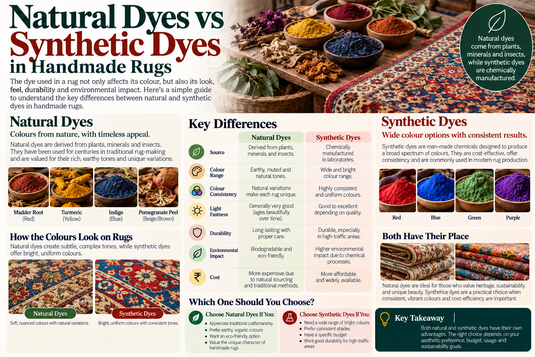
Natural dyes have deep historical importance and can create beautiful variation. Modern synthetic dyes offer excellent consistency, colour range and repeatability. Both can produce high-quality rugs when the dyeing process is handled well.
At The Ambiente, we think the useful question is not which category sounds more traditional. It is how the dye behaves with the fibre, design, intended use and production method.
This guide explains the difference between natural and synthetic dyes in handmade rugs, including colour variation, fading, reproducibility, environmental considerations, cost and what buyers should ask before purchasing.
What Are Natural Dyes?
Natural dyes are colourants derived from plant, insect, mineral or other naturally occurring sources.
Historically, rug-making regions used locally available materials such as madder root, indigo, walnut husks, pomegranate rind and other botanical sources.
The exact colours depended on geography, water, fibre and the dyeing knowledge of the workshop.
What Are Synthetic Dyes?
Synthetic dyes are manufactured chemical colourants designed to produce controlled and repeatable shades.
They became widely used in textiles because they offer large colour ranges, reliable availability and easier batch consistency.
Modern rug production can use high-quality synthetic dyes that perform very well when applied correctly.
Why Natural Dyes Are Associated With Traditional Rugs
Before modern synthetic dyes were available, natural dyeing was the standard method.
That is why antique and traditional rugs are often discussed in relation to indigo, madder and other historic dye sources.
Natural dye variation also contributes to the visual depth found in many older rugs.
Explore The Ambiente’s traditional rugs for designs inspired by heritage rug language.
Natural Dyes Can Produce Beautiful Variation
One of the most attractive features of natural dyeing is subtle variation within a colour family.
Two dye batches may not be perfectly identical.
When these yarns appear in a rug, the result can create tonal movement known as abrash.
Abrash is not necessarily a defect. In many handmade rugs, it adds character and depth.
Synthetic Dyes Offer Better Repeatability
For a custom interior project, consistency can be extremely important.
If a designer needs several rugs to match or wants to reproduce a colour later, synthetic dyes can offer more controlled repeatability.
That does not mean every synthetic dye batch is perfectly identical, but the system is generally easier to standardise.
Which Has a Wider Colour Range?
Synthetic dyes generally offer the broader and more predictable colour range.
Bright contemporary shades, precise neutrals and highly specific custom colours are easier to achieve consistently.
Natural dyes can create a wide range as well, but the result may be more dependent on material, process and batch.
How Wool Responds to Dyes
Wool takes dye beautifully because its protein structure bonds well with many dye classes.
This is one reason wool rugs can display rich colour in both traditional and modern designs.
Wool can work with both natural and synthetic dye systems.
How Silk and Bamboo Silk Respond
Silk and regenerated cellulose fibres reflect light differently from wool.
The same nominal colour may appear brighter or more lustrous on silk-like fibres.
Dye selection must therefore be coordinated with fibre type.
See our material comparison guide for how these fibres behave.
Do Natural Dyes Fade?
All dyes can change with enough light exposure.
Natural dyes are not automatically fade-proof, and synthetic dyes are not automatically permanent.
Lightfastness depends on the dye, mordant, fibre, process and amount of UV exposure.
Protect all premium rugs from intense direct sunlight where possible.
Do Synthetic Dyes Fade?
High-quality synthetic dyes can offer strong lightfastness, but performance varies by dye class and process.
A poorly dyed rug can fade regardless of whether the dye began as a natural or synthetic source.
What Is Colourfastness?
Colourfastness describes how well a dye resists change or transfer under conditions such as washing, rubbing and light exposure.
This is more useful than simply asking whether a dye is natural.
A high-quality rug manufacturer should understand how the colour behaves during finishing and cleaning.
Can Natural Dyes Bleed?
They can, especially if dyeing or washing was not handled correctly.
Synthetic dyes can also bleed if the process is poor.
Proper dye fixation and washing are essential in either system.
Why Mordants Matter in Natural Dyeing
Many natural dyes require a mordant to help the colour bond to the fibre.
Different mordants can change both the final shade and performance.
That means natural dyeing is still a chemical process in the broad scientific sense, even when the colour source is botanical.
Are Natural Dyes More Sustainable?
Not automatically.
A dye being natural does not guarantee low environmental impact.
Large amounts of plant material, water, land or mordants may be needed depending on the process.
Sustainability should consider the full system: sourcing, water use, chemicals, wastewater treatment, energy and product lifespan.
Are Synthetic Dyes Bad for the Environment?
They can create environmental problems if wastewater and chemicals are poorly managed.
However, controlled modern dyeing with proper treatment can reduce those impacts substantially.
The responsible question is how the dye house manages water and chemistry, not simply whether the dye is synthetic.
What Are Azo Dyes?
Azo dyes are a large class of synthetic dyes widely used in textiles.
Some specific azo compounds can break down into restricted aromatic amines, which is why regulated textile supply chains pay attention to banned substances.
Buyers should avoid assuming that all azo dyes are unsafe. The relevant issue is whether restricted substances are present and whether the product meets applicable standards.
Natural Dyeing and Handmade Character
Natural dyeing can support a handmade aesthetic because subtle batch differences are visible in the finished rug.
This works especially well in vintage-inspired, tribal and traditional designs.
Explore The Ambiente’s vintage rugs and tribal rugs for styles where tonal variation can feel especially appropriate.
Synthetic Dyes and Modern Design
Modern rugs often require precise colour relationships.
Neutral gradients, clean geometric shapes and carefully matched interior palettes can benefit from repeatable synthetic dye systems.
This is especially useful in modern rugs and custom project work.
Which Is Better for Custom Rugs?
It depends on the brief.
If the project needs exact colour matching across several rugs, synthetic dyes may be more practical.
If the design intentionally wants natural tonal variation and a heritage character, natural dyeing may be attractive.
The construction and material should be considered at the same time.
Colour Matching for Architects and Interior Designers
Design professionals often work with Pantone references, fabric samples, paint chips and stone samples.
For exact project matching, physical yarn approval is essential regardless of dye type.
Our commercial rug specification guide explains how colour should be documented.
Does Natural Dyeing Cost More?
It can.
Natural dye sources, longer processes, smaller batches and specialist knowledge can increase production cost.
However, pricing depends on the specific dye method and scale.
Do Synthetic Dyes Make Rugs Cheaper?
Not necessarily.
A premium hand-knotted rug can use synthetic dyes and still be expensive because labour, wool quality, knot density and finishing dominate the cost.
Dye type is only one part of the price.
How Dye Choice Affects Reorders
For hospitality or multi-phase projects, repeatability matters.
If a rug may need to be reordered later, keep approved yarn references and dye information.
Synthetic systems generally make repeat colour matching easier, though no textile batch should be assumed perfectly identical without checking.
What Is Abrash?
Abrash refers to visible tonal variation within areas that appear to be one colour.
It can result from different dye batches, yarn differences or intentional design.
In traditional rugs, abrash can be desirable because it gives the surface movement and history.
Is Abrash a Defect?
Not necessarily.
If the variation is intentional or consistent with handmade production, it can be part of the rug’s character.
Unexpected harsh colour breaks may be less desirable in a modern minimal design where uniformity is the goal.
How Washing Changes Colour
Rugs are often washed after weaving.
Washing can soften colours, remove surface residue and change the overall appearance.
That means the final rug should be judged after finishing, not only by raw yarn colours.
Natural Dyes and Ageing
Well-made natural-dyed rugs can develop beautiful patina over time.
Colour may soften rather than remain exactly as it looked on day one.
This ageing character is one reason collectors often value older naturally dyed rugs.
Synthetic Dyes and Ageing
High-quality synthetic dyes can remain stable for many years when protected from excessive light and cleaned correctly.
Again, the quality of the dyeing process matters more than the label alone.
How to Ask a Seller About Dyes
- Are the yarns naturally dyed, synthetically dyed or mixed?
- What fibre is being dyed?
- Is colourfastness tested?
- Should strong direct sunlight be avoided?
- Can the colour be reproduced for a future custom order?
- Are restricted substances controlled in the dyeing process?
Can You Identify Natural Dyes by Looking?
Not reliably.
Some natural-dyed rugs show soft tonal variation, but skilled synthetic dyeing can create similar effects.
A visual impression is not proof of the dye source.
If provenance matters, ask the manufacturer directly.
Natural Dyes and Hand-Knotted Rugs
Natural dyeing is especially associated with hand-knotted traditions because both processes have deep craft histories.
A naturally dyed hand-knotted rug can have rich tonal depth, but the quality still depends on wool, knotting and finishing.
Synthetic Dyes and Hand-Tufted Rugs
Hand-tufted custom rugs often use synthetic dyes because designers need predictable colour matching and quicker production.
This can be an advantage rather than a compromise when the project requires precise brand colours or coordinated interior palettes.
Which Is Better for Minimal Rugs?
Minimal designs usually depend on subtle differences in neutral tones.
Either dye system can work, but repeatability may be especially important in large uniform fields.
Explore The Ambiente’s minimal rugs for examples of colour-led simplicity.
Which Is Better for Traditional Rugs?
Natural dyes can reinforce the heritage character of a traditional rug, especially when combined with handspun wool and hand-knotting.
Synthetic dyes can also produce beautiful traditional patterns with greater repeatability.
The design language does not determine the dye system by itself.
How Dye Choice Relates to Rug Care
All rugs should be cleaned according to fibre and dye stability.
Do not assume natural dyes require one universal cleaning method.
Professional cleaners should test colourfastness before washing valuable handmade rugs.
See our rug care guide for material-specific maintenance.
How The Ambiente Thinks About Dye Choice
We look at the design requirement first.
If the project benefits from tonal variation and craft character, natural dyeing can be meaningful. If the project requires exact colour coordination and repeatability, synthetic dyes can be the more practical tool.
The important thing is good dyeing, responsible process control and honest product information.
How to Compare Dye Quality in a Finished Rug
When looking at a finished rug, pay attention to whether the colour feels balanced across the surface, whether the shades support the design and whether any variation looks intentional. In a traditional or vintage-inspired rug, tonal variation may add richness. In a clean minimal rug, uneven colour may be distracting if uniformity was the goal.
The back of a hand-knotted rug can also be useful because it shows the yarn colours more directly, without as much influence from pile direction and surface finishing. This does not tell you whether the dye is natural or synthetic, but it can help you understand the consistency of the colour application.
Why Dye House Skill Matters More Than the Label
A natural dye in inexperienced hands can produce weak, inconsistent or poorly fixed colour. A synthetic dye used by an experienced dye house can produce excellent colourfastness and repeatability.
The skill lies in preparing the fibre, controlling temperature, managing pH, using the correct mordant or dye chemistry, washing away unfixed colour and drying the yarn correctly. That process has a direct effect on how the rug looks years later.
Should Buyers Pay Extra for Natural Dyes?
Only if the natural-dye process is meaningful to the rug you are buying. For a heritage-style hand-knotted piece with handspun wool, natural dyes may add character and support the story of the rug. For a contemporary custom project that needs exact repeatable colours, paying extra for natural dyes may not improve the final result.
The better question is whether the dye choice supports the design, craftsmanship and way you plan to use the rug.
The Bottom Line
Natural dyes and synthetic dyes can both create excellent handmade rugs.
Natural dyes offer heritage, tonal variation and a distinctive craft character. Synthetic dyes offer consistency, wide colour choice and easier repeatability.
Neither category automatically guarantees better quality or sustainability.
Look at the full rug: fibre, construction, colourfastness, design, finishing and intended use.
To compare how colour works across different rug styles, explore The Ambiente’s traditional rugs, modern rugs, vintage rugs and hand-knotted rugs.