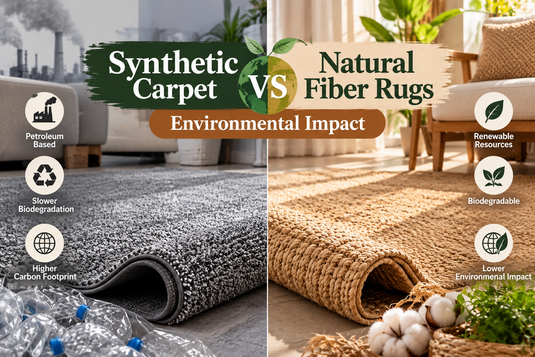
Choosing a carpet or rug for your home usually starts with practical questions. Will it look good with the sofa? Is it comfortable underfoot? Will it work in a high-traffic room? Is it easy to clean? How much will it cost? But there is another question that is becoming increasingly relevant:
What environmental impact am I accepting when I choose a synthetic carpet instead of a natural fiber rug?
It is a reasonable question, especially if you are furnishing a home with sustainability in mind. The answer, however, is not as simple as saying that natural fibres are always environmentally friendly and synthetic fibres are always harmful.
Both choices have trade-offs. Synthetic carpets can be durable, affordable, stain resistant, and practical for busy households. Some synthetic materials can also contain recycled content or be recycled after use. Natural fibres such as wool, jute, and cotton come from renewable or plant-based sources, but their production, processing, transportation, and maintenance still have environmental impacts.
The most useful way to think about the decision is to look at the whole life of the rug.
- Where did the material come from?
- How much processing did it require?
- How long will the rug last?
- How often will it need cleaning?
- Can it be repaired?
- What happens when you no longer want it?
- Life cycle assessment, commonly called LCA, is designed to consider these stages rather than judging a product based on one material characteristic. The International Wool Textile Organisation describes LCA as a method that can examine raw material production, manufacturing, use, and end of life. The U.S. Environmental Protection Agency similarly notes that carpet can have environmental impacts throughout its life cycle, including manufacturing, transportation, recycling, and disposal.
So if you are deciding between a synthetic carpet and a natural fiber rug, here is how to think about the decision without reducing it to a simple "good" or "bad" choice.
First, What Counts as a Synthetic Carpet?
Synthetic carpet is generally made using manufactured fibres rather than fibres that occur naturally.
Common synthetic carpet fibres include:
-
Nylon
-
Polypropylene
-
Polyester
-
PET
-
Acrylic and other synthetic blends
Many of these materials are polymer-based and are commonly derived from petrochemical feedstocks.
The exact environmental impact depends on the material, manufacturing process, recycled content, construction, transportation, useful life, and end-of-life pathway.
The EPA's carpet materials research identifies nylon, PET, polypropylene, and related polymers among the major materials used in residential carpet, and notes that carpet systems can also contain backing and adhesive materials. That last point is important. When you buy a synthetic carpet, you are not necessarily buying one material.
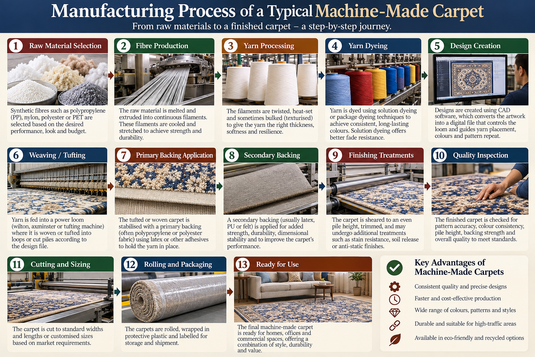
A carpet can contain the face fibre, primary backing, secondary backing, adhesives, coatings, and other components. The same is true for many natural-fibre rugs. This is why simply looking at the label on the front of the product is not enough to understand its environmental footprint.
What Makes Natural Fiber Rugs Different?
Natural-fibre rugs are made using fibres sourced from plants or animals. Some of the most familiar examples include:
-
Wool
-
Jute
-
Cotton
-
Sisal
-
Hemp
-
Linen
-
Silk
Wool is particularly common in premium rugs because it combines natural fibre characteristics with durability, softness, resilience, and a long history of use in floor coverings.
Jute and sisal are popular when homeowners want a more textured, organic appearance. Cotton is lightweight and versatile.
Silk is generally associated with decorative and luxury rugs where softness, fine detail, and sheen are priorities. Natural does not automatically mean low impact, though.
Growing crops requires land, water, and other resources. Raising sheep has environmental impacts as well. Fibres then have to be cleaned, spun, dyed, transported, and turned into a finished rug. So the more useful question is not:
"Is this fibre natural?"
It is:
"How was this fibre produced, how long will the rug last, and what happens to it afterward?"
The First Big Difference: Where the Raw Material Comes From
One of the clearest differences between many synthetic and natural fibres is the source of the raw material.
Synthetic fibres are manufactured from chemical feedstocks, many of which are fossil-fuel based.
Natural fibres originate from biological sources.
Wool comes from sheep.
Jute comes from a plant.
Cotton comes from a plant.
Sisal comes from agave.
This distinction matters because renewable biological resources can be replenished, while fossil resources are finite.
Wool is particularly interesting in this respect. The IWTO describes wool as naturally renewable, biodegradable, and recyclable. It also emphasizes that environmental assessment should consider the complete life cycle rather than focusing on one stage.
However, renewable sourcing does not mean zero environmental impact.
Sheep farming involves land, feed, water, methane emissions, and other considerations.
Plant fibres have their own agricultural impacts.
The point is not that natural fibres have no footprint.
The point is that their footprint comes from a different set of processes.
Synthetic Carpets and Fossil-Based Materials
One concern with conventional synthetic carpet is its dependence on manufactured polymers.
Producing virgin synthetic fibres requires raw materials, energy, and industrial processing.
The EPA's carpet life-cycle model includes raw-material acquisition, manufacturing energy, transportation, recycling, landfilling, and combustion among the factors that can affect the environmental performance of carpet.
This does not mean every synthetic carpet has the same environmental footprint.
A carpet made with recycled PET is different from one made entirely from virgin polymer.
A very durable synthetic carpet that stays in use for 15 years is different from a low-cost product replaced after three years.
A carpet that can be recovered and recycled is different from one that ends up in landfill.
That is why comparing "synthetic" and "natural" as two single categories can be misleading.
What Happens When a Synthetic Carpet Is Thrown Away?
End of life is one of the biggest issues to consider.
Carpet is bulky and often contains multiple materials. That can make collection, separation, and recycling difficult.
The EPA notes that carpet's complex material composition and bulky nature create challenges for recycling and waste management.
Synthetic fibres also do not biodegrade in the same way as natural fibres.
That means the environmental question continues after the carpet has stopped being useful in your home.
Can it be reused?
Can it be recycled?
Can the individual materials be separated?
Is there a collection program available in your area?
These questions are worth asking before you buy.
But Synthetic Carpets Can Have Some Practical Advantages
This is where the conversation becomes more interesting.
For homes with pets or allergy concerns, compare the practical trade-offs in our guide to the best rugs for allergies and pets.
Synthetic carpets are not without benefits.
They are often:
-
Affordable
-
Available in many colours and patterns
-
Easy to manufacture at scale
-
Resistant to certain types of staining
-
Suitable for heavy everyday use
-
Easy to replace
-
Available in recycled versions
For some homes, those practical characteristics matter.
Imagine a busy household with children, pets, frequent visitors, and a high probability of spills.
A synthetic carpet that can handle that environment for many years may be a reasonable choice.
The environmental calculation changes if the alternative is a delicate rug that has to be replaced frequently because it cannot cope with the way the room is used.
This is why durability and suitability belong in a sustainability conversation.
Longevity May Matter More Than the Fibre Label
Think about two rugs.
Rug A is made from a natural fibre but is replaced after four years because it was unsuitable for the room.
Rug B is made from a synthetic fibre and remains in use for fifteen years.
Which one has the lower overall environmental impact?
You cannot answer that question from the fibre name alone.
You would need to know the materials, production methods, transport, maintenance, replacement cycle, and end-of-life treatment for both products.
Life-cycle thinking is useful precisely because it forces us to look beyond the point of purchase. The IWTO's discussion of textile LCA includes production, manufacturing, distribution, consumer use, reuse, recycling, and disposal as relevant stages.
A rug that lasts longer can spread the environmental cost of its original production over more years of use.
That does not automatically make a durable synthetic rug more sustainable than every natural rug.
It simply means durability deserves a place in the comparison.
Wool: One of the Most Interesting Natural Rug Fibres
If sustainability is one of your priorities, wool deserves serious consideration.
If you choose wool, proper care matters. See our wool rug cleaning guide for safe at-home maintenance.
Wool is renewable, biodegradable, recyclable, durable, and naturally suited to carpet applications.
The IWTO reports that wool products can have long lifespans and that wool is biodegradable and recyclable. It also notes that wool's environmental performance needs to be considered across its full life cycle.
There is another practical benefit.
Wool is naturally resilient.
Its fibre structure helps it recover from compression, which is useful in carpets and rugs that experience regular foot traffic.
Wool also has natural properties that can help with soil and stain resistance. The IWTO's carpet-care guidance describes a protective membrane associated with wool that helps repel dirt and stains and emphasizes proper care to extend the useful life of wool carpets.
That means a wool rug is not simply a sustainability choice.
It can also be a practical long-term floor covering.
Does Wool Have an Environmental Cost?
Yes.
It is important to say that clearly.
Sheep farming requires land and resources and produces greenhouse gas emissions, including methane.
Wool processing also requires energy and water.
Dyeing, spinning, washing, finishing, transportation, and rug manufacturing all contribute to the overall environmental footprint.
This is why it is not scientifically useful to say that wool is "impact-free."
Even the wool industry's own LCA discussions acknowledge the importance of measuring environmental impacts across the entire supply chain.
There is also debate around how conventional LCA methods account for some characteristics of biological materials such as wool. The IWTO has argued that certain existing assessment approaches do not capture all of wool's characteristics, including renewability, biodegradability, and recyclability.
The takeaway for a homeowner is simple:
Wool has environmental advantages, but it is not impact-free.
That is a much more useful conclusion than either extreme.
What About Jute and Other Plant Fibres?
Jute, sisal, hemp, cotton, and similar plant fibres can be attractive alternatives to synthetic carpet.
They bring a natural texture and often work particularly well with interiors built around wood, stone, linen, rattan, and other organic materials.
They can also be useful when you want a rug with a more relaxed visual character.
But again, agriculture matters.
Different crops have different water, land, fertilizer, pesticide, and processing requirements.
The country and farming system matter.
The manufacturing process matters.
The backing material matters.
The dyeing process matters.
So if a rug is advertised as "natural," ask what the complete composition is.
A natural fibre rug with synthetic backing and adhesive is still a mixed-material product.
What About Recycled Synthetic Carpets?
This is an important middle ground.
A recycled synthetic carpet can use material that already exists rather than relying entirely on virgin raw materials.
Recycled PET is one example.
The EPA has documented the use of recycled materials in carpet and notes that recycling can change the material and energy requirements associated with carpet production.
But recycled content does not automatically make a carpet environmentally superior in every situation.
You still need to consider:
-
How much recycled content is actually present?
-
What was the original material?
-
Can the finished carpet be recycled again?
-
How durable is it?
-
What backing does it use?
-
How long will it last?
-
What happens at the end of its life?
A recycled product that is quickly discarded may have a different environmental profile from a durable product that remains useful for many years.
One Often-Ignored Issue: Mixed Materials
One of the biggest challenges in carpet recycling is not necessarily the fibre itself.
It is the combination of materials.
Imagine a carpet made from one type of fibre, attached to a synthetic backing using adhesives.
At the end of its life, recycling the entire product requires separating or processing those different components.
The EPA's carpet research identifies face fibres, primary and secondary backing, and latex as components that can be involved in carpet construction.
This is relevant when comparing natural and synthetic rugs.
A 100% natural fibre rug is not automatically simple to recycle, but a product made from several different materials can present additional challenges.
If sustainability matters to you, ask about the whole construction.
The Environmental Impact of Cleaning
The rug's environmental impact does not stop when it leaves the factory.
You will use the rug for years.
During that time, you will vacuum it, spot clean it, wash it, and possibly have it professionally cleaned.
Those activities consume energy, water, cleaning products, and transportation resources.
A rug that needs frequent intensive cleaning may have a different use-phase impact from one that can be maintained with regular vacuuming and occasional professional care.
The IWTO notes that use-phase impacts, including cleaning and maintenance, are an important part of textile life-cycle assessment.
This is another reason to choose a rug that fits your lifestyle.
If you have a low-traffic bedroom, you may not need the same performance characteristics as a busy family living room.
Durability and Maintenance Should Be Considered Together
A rug that is extremely durable but difficult to maintain may not be ideal for every household.
Likewise, a rug that is easy to clean but needs replacing frequently may not be the most responsible long-term choice.
The best choice is often the material and construction that can handle your actual environment.
For example:
Living room
A durable wool rug can be a strong option for a room that gets regular foot traffic.
Bedroom
A softer natural-fibre rug may make sense because the space usually experiences less traffic.
Dining room
Choose based on how frequently you eat there and how comfortable you are managing spills.
Kids' room
Practical maintenance may take priority over choosing the most delicate natural fibre.
Formal sitting room
You may have more freedom to choose a luxurious material or intricate handmade construction.
There is no single correct material for every room.
Handmade Construction Changes the Conversation
When you buy a handmade rug, you are buying more than fibre.
When craftsmanship and sourcing matter, it is also worth reviewing the ethical considerations when buying handmade rugs.
You are also buying craftsmanship.
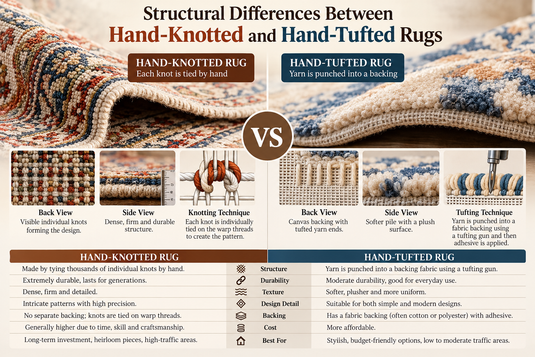
Hand-knotted, handloom, and hand-tufted rugs have different construction methods, production times, textures, and performance characteristics.
At The Ambiente, the collection includes handmade rugs across materials such as wool, bamboo silk, jute, wool and bamboo silk, and wool and silk. The brand's collections also include hand-knotted and handloom constructions.
For an environmentally conscious buyer, handmade construction can be considered alongside the material.
The key question is not simply whether something is handmade.
Ask:
How long will I keep it?
If a handmade rug becomes a long-term part of your home for many years, that longevity can be an important part of its overall value.
What About Wool and Bamboo Silk Rugs?
A blend such as wool and bamboo silk brings another layer to the discussion.
Wool is a natural animal fibre.
Bamboo-derived fibres can be plant-based, but the environmental profile depends on how the bamboo is processed into textile fibre.
So it is not enough to say:
"Bamboo grows quickly, therefore bamboo silk is automatically sustainable."
The processing route matters.
This is a good example of why responsible buying requires more than reading one material name.
If you are considering a blended rug, look at the composition and ask the seller about the manufacturing process.
What About the Carbon Footprint?
Greenhouse gas emissions are only one part of environmental impact.
They matter, but they are not the entire story.
An LCA can also consider:
-
Water use
-
Land use
-
Fossil energy
-
Eutrophication
-
Ecotoxicity
-
Resource depletion
-
Transportation
-
Waste
-
End-of-life treatment
The IWTO identifies many of these categories as relevant to textile environmental assessment.
That is why you should be careful with claims such as:
"This rug has a lower carbon footprint, so it is more sustainable."
Maybe.
But the answer depends on the boundaries and assumptions used in the assessment.
A product can perform well in one environmental category and less well in another.
What If I Just Want the More Responsible Choice?
If you do not want to become an expert in life-cycle assessment before buying a rug, that is completely understandable.
You can still make a thoughtful decision.
Start with these questions.
1. Will I keep it for a long time?
If the answer is no, rethink the purchase.
2. Is the material appropriate for the room?
A rug that cannot handle the room's traffic may have a short useful life.
3. Can I maintain it easily?
Understand the cleaning requirements before buying.
4. What is the rug actually made from?
Look beyond marketing descriptions.
5. Does the rug contain recycled material?
If yes, ask how much.
6. Can it be repaired?
Repair can extend useful life.
7. What happens when I no longer need it?
Ask whether the rug can be reused, resold, donated, or recycled.
8. Is the brand transparent?
Look for clear information about materials and construction.
9. Is the design timeless enough to keep?
A rug you still love ten years from now is less likely to be replaced for purely aesthetic reasons.
10. Does the rug need to be perfect?
Sometimes the most sustainable choice is simply buying less often.
Should You Always Choose Natural Fibre?
Not necessarily.
There are situations where a synthetic carpet can be a sensible choice.
If you need:
-
High stain resistance
-
Easy maintenance
-
A lower upfront price
-
A particular colour range
-
A carpet for temporary use
-
A highly demanding environment
a synthetic product may make practical sense.
The environmental question is what happens over its entire useful life.
If the synthetic carpet lasts many years, contains recycled material, and has a responsible end-of-life route, the comparison becomes more nuanced.
Likewise, if a natural-fibre rug is poorly made, frequently replaced, or discarded after a short period, its environmental benefits may be reduced.
When Does a Natural Fiber Rug Make More Sense?
A natural fibre rug may be particularly attractive if you:
-
Want renewable materials
-
Prefer wool or plant-based fibres
-
Value long-term craftsmanship
-
Want a rug that can become part of your home for many years
-
Prefer natural textures
-
Care about biodegradability
-
Want a material with established recycling potential
-
Are comfortable following appropriate care instructions
Wool is particularly compelling when you want a combination of durability, natural fibre characteristics, and long-term use.
The IWTO describes wool as renewable, biodegradable, recyclable, and durable, while also emphasizing that responsible care helps maximize its useful life.
How The Ambiente Fits Into the Conversation
At The Ambiente, rugs are designed around materials, craftsmanship, colour, texture, and the needs of the space.
The collection includes natural and blended materials such as wool, jute, bamboo silk, wool and bamboo silk, and wool and silk, along with handmade constructions including hand-knotted and handloom rugs.
That gives homeowners the opportunity to think about their rug as a long-term interior piece rather than simply another decorative purchase.
For someone interested in environmental impact, this approach can be useful because it encourages you to consider several things at once:
Material.
Construction.
Durability.
Maintenance.
Design longevity.
End of life.
The Ambiente's handmade rug collections can be explored through its range of styles and materials, but the right choice should ultimately depend on how the rug will be used in your home.
A Simple Comparison
| Factor | Synthetic Carpet | Natural Fiber Rug |
|---|---|---|
| Raw material | Often manufactured polymers | Plant or animal-based fibres |
| Renewable source | Usually no for virgin petrochemical fibres | Often yes, depending on fibre |
| Durability | Can be very durable | Can be highly durable, especially wool |
| Stain resistance | Often strong | Depends on fibre and treatment |
| Maintenance | Often practical | Depends on material |
| Recycled options | Available for some fibres | Recycling also possible for some natural fibres |
| Biodegradability | Generally limited | Many natural fibres are biodegradable |
| End-of-life | Recycling can be difficult depending on construction | Some natural fibres offer biodegradability or recycling options |
| Design life | Depends on style and quality | Can be long with timeless designs |
| Environmental impact | Depends heavily on material and life cycle | Depends heavily on farming, processing, construction and lifespan |
This table is intentionally broad.
The environmental performance of an actual product can differ significantly from the general characteristics of its fibre category.
The Most Important Question May Be: How Long Will You Keep It?
This is probably the question I would ask before any other.
Imagine buying a rug today and still having it in your home ten or fifteen years from now.
You have cleaned it, maintained it, perhaps moved it from one room to another, and eventually passed it on or had it repaired.
That is a very different story from buying a rug every two or three years.
Longevity changes the equation.
It is one reason high-quality rugs can make sense even when their initial price is higher.
You are not only paying for the material.
You are paying for the expected useful life.
The IWTO emphasizes that long product lifespans are relevant to wool's sustainability profile and that reuse and recycling can extend a product's overall life cycle.
Buy Less, Choose Better, Keep Longer
There is a simple principle behind all of this.
Buy less. Choose carefully. Keep what you buy for longer.
You do not need to replace a perfectly good rug every time your interior style changes.
A neutral or thoughtfully designed rug can adapt as furniture and colours change around it.
That can be particularly valuable with handmade rugs.
A well-made rug can move from one home to another, one room to another, or one generation to another.
That is a different way of thinking about sustainability.
Instead of asking only:
"Which material is greener?"
you start asking:
"Which rug am I most likely to keep?"
That is a much more practical question.
Questions to Ask a Rug Brand Before Buying
If environmental impact is important to you, ask the brand:
-
What is the rug made from?
-
Is the fibre virgin or recycled?
-
Where is the material sourced?
-
Where is the rug manufactured?
-
How is it constructed?
-
What kind of backing does it use?
-
Are adhesives involved?
-
What care does it require?
-
How long is the rug expected to last?
-
Can it be repaired?
-
Can it be recycled?
-
Can it be reused or repurposed?
-
Are sustainability certifications available?
-
Can you provide information about the supply chain?
A good brand should be able to answer reasonable questions about its products.
And if a sustainability claim sounds too absolute, ask for more detail.
"Eco-friendly" is a broad phrase.
Specific information is much more useful.
Frequently Asked Questions
Is a natural fiber rug always better for the environment than synthetic carpet?
No. Natural fibres have advantages such as renewable sourcing and, for many fibres, biodegradability. But agriculture, processing, dyeing, transportation, construction, and maintenance all have environmental impacts. Synthetic carpets also vary widely depending on recycled content, durability, manufacturing, and end of life.
Are synthetic carpets bad for the environment?
Synthetic carpets can have environmental impacts because many conventional synthetic fibres are manufactured from fossil-based materials. However, recycled content, durability, manufacturing efficiency, and responsible end-of-life management can change the overall picture.
Is wool a sustainable material for rugs?
Wool has several characteristics that can support a more sustainable product, including renewability, durability, recyclability, and biodegradability. However, wool production and processing also have environmental impacts, so the complete life cycle should be considered.
Are jute rugs environmentally friendly?
Jute is a plant-based natural fibre and is often considered for eco-conscious interiors. However, the environmental impact of a finished jute rug also depends on farming, processing, dyeing, backing, transportation, and construction.
Are recycled synthetic rugs a good option?
They can be. Recycled synthetic materials can reduce reliance on virgin materials, but you should also consider durability, the percentage of recycled content, construction, and what happens when the rug reaches the end of its useful life.
Does buying a handmade rug make it more sustainable?
Handmade construction can support longevity and craftsmanship, but being handmade alone does not determine environmental impact. Material sourcing, production, durability, transportation, maintenance, and end of life all matter.
Which is better for a high-traffic room, wool or synthetic?
Both can work. The right choice depends on the specific construction, fibre quality, maintenance requirements, and expected lifespan. Wool can be highly durable and resilient, while some synthetic fibres offer strong stain resistance and practical maintenance.
What is the most important environmental factor when buying a rug?
There is no single factor. Material sourcing, manufacturing, durability, maintenance, transportation, and end of life all matter. Choosing a rug that suits the room and remains useful for a long time is an important part of the decision.
Should I choose a natural rug if sustainability is my priority?
Natural fibres are worth considering, particularly wool and certain plant-based fibres. But do not stop at the fibre label. Ask about construction, sourcing, durability, care, and end-of-life options.
Final Thoughts
If you are deciding between a synthetic carpet and a natural fiber rug, you do not have to reduce the decision to a simple argument about which material is "better."
There are legitimate reasons to choose either.
Synthetic carpets can offer affordability, durability, stain resistance, recycled-content options, and practical performance.
Natural fibre rugs can offer renewable materials, biodegradability, recyclability, natural textures, and long-term durability. Wool is especially notable for combining many of these characteristics.
The more responsible choice depends on the specific rug and how you use it.
Think about the entire journey:
Where does the material come from?
How is it manufactured?
How long will the rug last?
How much care does it require?
Can it be repaired or reused?
What happens when you no longer need it?
At The Ambiente, we believe a rug should be considered as part of the long-term character of a home, not simply as something to replace when trends change. Handmade rugs in materials such as wool, jute, bamboo silk, wool and bamboo silk, and wool and silk offer different combinations of texture, appearance, performance, and care requirements.
Ultimately, choosing a rug with a lower environmental impact is less about finding a perfect material and more about making an informed purchase.
Choose a material that fits your lifestyle.
Choose a construction that can handle your space.
Choose a design you will want to live with for years.
And when possible, choose quality over unnecessary replacement.
That is a much more useful way to think about sustainability when buying a rug.