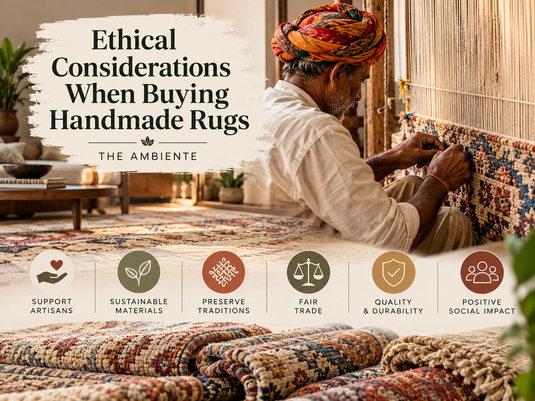
A handmade rug can be one of the most personal objects you bring into a home. Someone selected or prepared the fibers, created the design, worked at a loom, tied knots or built up the weave, and finished the piece by hand. Depending on the technique and size, the process may take weeks, months, or even longer.
That human element is part of what makes handmade rugs so compelling. It is also why buying one deserves a little more thought than simply choosing the right size and color.
Many handmade rugs are produced in countries where weaving has been practiced for generations, including India, Nepal, Pakistan, Afghanistan, Morocco, Turkey, and other important textile-producing regions. These traditions can provide skilled employment, sustain regional crafts, and support households and communities. At the same time, global supply chains can involve serious concerns around wages, working conditions, child labor, environmental impact, and the distribution of profits.
So, how do you buy a handmade rug responsibly without making assumptions about an entire country or industry?
At The Ambiente, we think the most useful approach is to ask specific questions. Who made the rug? Where was it made? How was the maker paid? What materials were used? What working conditions existed? Can the seller explain how the rug reached you?
Ethical sourcing is rarely captured by a single label. Here are the considerations worth understanding before you buy.
Start With an Important Point: "Made in a Developing Country" Does Not Mean "Unethical"
It is easy for discussions about ethical shopping to slip into an unhelpful assumption that goods made in lower-income countries are inherently exploitative.
That is not the case.
Handmade rug production can provide valuable skilled work and preserve textile traditions that have existed for centuries. In some communities, weaving is an important source of income and an area of specialized knowledge passed from one generation to another.
It is also important not to romanticize that picture.
Traditional craftsmanship and poor labor practices can exist in the same supply chain. The fact that a rug is handmade does not automatically mean the artisan received fair compensation. Likewise, a higher retail price does not necessarily mean a larger share reached the person who made it.
Country of origin alone tells you very little.
What matters is the structure of the supply chain, the employment arrangement, the conditions under which people work, and the practices of the businesses involved.
Fair Pay Is One of the Central Questions
Handmade rugs are labor-intensive. That should be reflected in how the people making them are compensated.
To understand the craft behind that labour, read our guide to the history of handmade rug weaving.
The difficulty for shoppers is that "fair wage" can be hard to evaluate from thousands of miles away.
A wage that sounds low when converted into US dollars may not tell you much without understanding local living costs, working hours, employment protections, benefits, consistency of work, and how much control a worker has over their schedule.
At the same time, low local wages should not become an excuse for paying skilled craftspeople as little as possible.
When assessing a rug seller, look for information beyond broad claims such as "supporting artisans." A business that takes sourcing seriously should ideally know who its production partners are and be able to explain how artisans are compensated.
Useful questions include whether makers are paid by the day, hour, or piece; whether rates are agreed upon in advance; whether intermediaries take large commissions; and whether workers have any means of raising concerns about pay or conditions.
The answers may vary considerably between regions and production models. Transparency is often more meaningful than a vague promise that everything is "ethical."
Child Labor Requires Particular Attention
Child labor is one of the most serious concerns associated with parts of the handmade rug industry.
It also needs to be discussed carefully.
Children learning a traditional craft from family members is not automatically the same thing as exploitative child labor. The ethical line is crossed when work interferes with education, harms a child's health or development, involves coercion, or exposes children to unsafe conditions.
Buyers should expect businesses to have clear policies against illegal and exploitative child labor. More importantly, there should be some system for checking that these standards are followed.
Simply asking a supplier whether they use child labor is not a particularly robust safeguard.
Independent certification, inspections, long-term supplier relationships, traceability, and documented labor standards can provide stronger forms of accountability. None is perfect on its own, but together they can make abuses harder to hide.
Organizations and certification systems addressing labor conditions in rug and textile supply chains may provide additional reassurance. When you encounter a certification, however, find out what it actually covers. Some standards focus primarily on environmental characteristics, while others focus more directly on working conditions or supply-chain practices.
A logo means very little if neither the retailer nor the customer understands the standard behind it.
Working Conditions Matter Just as Much as Wages
Pay is only one part of fair work.
Rug making can involve weaving, knotting, washing, dyeing, trimming, stretching, drying, and finishing. Each stage creates different workplace considerations.
Artisans working at looms may spend long periods in repetitive positions. Poor lighting, inadequate ventilation, excessive working hours, and unsuitable workstations can affect health. Dyeing and washing can introduce chemical or environmental risks if materials are handled without appropriate safeguards.
Ethical production should therefore consider questions such as reasonable working hours, breaks, ventilation, access to clean facilities, workplace safety, and the handling of dyes or other substances.
This is another reason why a beautiful photograph of someone sitting at a loom does not prove that a supply chain is responsible.
Images can show craftsmanship. They cannot tell you whether that worker is paid properly, has reasonable hours, can leave the job freely, or works in safe conditions.
Good sourcing practices have to go deeper.
Traceability Makes Better Decisions Possible
Imagine two rugs.
One comes with information about the country and region where it was made, the materials, weaving technique, production partner, and relevant labor or environmental standards.
The other simply says "handmade imported rug."
Even if the two rugs look equally beautiful, the first gives you more information with which to make a responsible purchasing decision.
Traceability means being able to follow a product through meaningful parts of its journey from raw materials and production to the retailer.
Perfect end-to-end traceability is difficult, especially in industries involving small workshops, independent artisans, subcontractors, farmers, wool suppliers, dye houses, and finishing facilities. But difficulty is not a reason for businesses to know nothing about their supply chains.
A retailer should at least be able to tell you where the rug was produced and have a reasonable understanding of the suppliers involved.
At The Ambiente, we believe good rug buying begins with curiosity. If the origin of a handmade product is completely unclear, asking why is reasonable.
Be Careful With Romantic Stories About Artisans
The rug industry has a habit of describing makers in highly romantic terms.
You have probably seen phrases about "ancient traditions," "remote villages," and "timeless artisan techniques." Sometimes those descriptions are relevant and accurate. Sometimes they turn real working people into part of a marketing story.
There is nothing wrong with celebrating cultural knowledge. In fact, understanding where a weaving method originated can make a rug more meaningful.
The problem comes when a seller tells you a detailed emotional story about an artisan but provides almost no information about their pay, working conditions, or relationship with the business.
Respecting craftspeople means treating them as skilled professionals, not simply as picturesque characters in a product description.
Ask whether artisans are named with their consent. Consider whether their work is being credited appropriately. Look for businesses that describe craftsmanship accurately rather than exaggerating or inventing cultural narratives to make products seem more exotic.
Understand the Role of Middlemen
A handmade rug may change hands several times before reaching your floor.
There may be a weaver, workshop owner, local collector, exporter, importer, wholesaler, designer, and retailer involved. Each participant may perform a legitimate role and add costs through logistics, quality control, warehousing, marketing, customs, or customer service.
So intermediaries are not automatically a bad thing.
The ethical question is whether the value generated by the final sale is distributed reasonably and whether layers of intermediaries make the supply chain difficult to inspect.
A rug selling for several thousand dollars at retail does not necessarily mean the person who tied the knots received anything close to that amount.
You cannot determine fairness simply by comparing the maker's wage with the retail price because the final price includes many other costs. But a business should understand its purchasing chain well enough to evaluate whether producers are being treated fairly.
Shorter supply chains can sometimes make that easier, though they are not inherently ethical either.
Again, transparency matters more than a simple slogan.
Materials Have Ethical Implications Too
Labor is only half of the story. A rug's materials also deserve attention.
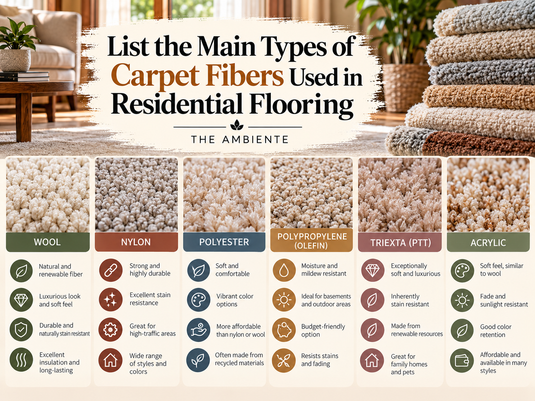
Material choice also affects the broader footprint of a rug. Compare synthetic carpet vs. natural fiber rugs when weighing durability, sourcing and environmental impact.
Wool, cotton, silk, jute, viscose, synthetic fibers, and blended materials all have different environmental and social implications.
For wool rugs, questions can include where the wool comes from, how sheep are raised, and how the fiber is processed. Cotton production can involve substantial water use and agricultural inputs depending on farming methods and location. Silk raises animal-welfare questions that some buyers may wish to consider.
Synthetic fibers bring a different set of concerns, including fossil-fuel use and shedding of microplastic fibers.
There is no material that is automatically perfect in every context.
A durable, high-quality wool rug that remains in use for decades may make more sense than a poorly made rug replaced every few years. Likewise, recycled or alternative materials can have advantages, but the words "recycled" and "natural" should not be treated as complete environmental assessments.
Look at materials alongside durability, processing, transport, repairability, and expected lifespan.
Dyes and Water Use Deserve More Attention
Color is central to rug making, but dyeing can be resource-intensive.
If dye sourcing matters to you, see our guide to custom rugs made with natural dyes in India.
Depending on the production method, dyeing may require significant amounts of water. Improper handling or disposal of wastewater can affect local waterways and communities.
Natural dyes are sometimes presented as the obvious ethical choice. The reality is more complicated.
"Natural" does not automatically mean harmless or sustainable. Natural dyes require raw materials, land, water, and processing. Some may require mordants or other substances to bind color to fiber.
Modern synthetic dyes can produce consistent color efficiently, but they also need to be managed responsibly. The key issue is not simply whether a dye came from a plant or a laboratory. It is how the dyeing process is controlled and what happens to water and chemicals afterward.
When environmental impact matters to you, look for suppliers that can discuss their dyeing processes, wastewater management, and relevant standards rather than relying on the word "natural."
Handmade Does Not Automatically Mean Sustainable
This is an important distinction.
A product can be handmade and still be produced using environmentally harmful materials. It can be made from natural fibers while workers are poorly paid. It can carry an environmental certification without answering every question about labor.
Terms like "handmade," "artisan," "natural," and "sustainable" refer to different things.
A handmade rug simply means hand labor played a significant role in its production. The term alone does not answer questions about environmental performance or social responsibility.
This doesn't diminish the value of handmade craftsmanship. It simply means shoppers should avoid treating one positive characteristic as proof of everything else.
Cultural Heritage and Design Appropriation Can Be Complicated
Many rug designs carry cultural meaning.
Patterns can identify a region, community, weaving tradition, or family practice. Some motifs have histories that extend far beyond contemporary interior design.
That creates another ethical question: who benefits when traditional patterns are commercialized?
There is a meaningful difference between purchasing work made within a living craft tradition and buying a mass-produced imitation that copies the visual language of a community while returning no economic value or recognition to it.
The boundaries are not always easy to define. Textile designs have traveled between cultures for centuries, and motifs evolve through trade, migration, imitation, and reinterpretation.
Still, buyers can ask useful questions.
Is a product accurately described? Is a particular cultural origin claimed when there is no real relationship to that tradition? Is the maker or community acknowledged? Is the seller using cultural identity merely as a marketing device?
Respect begins with accuracy.
Certification Can Help, but Don't Outsource Your Judgment to a Label
Certifications can be useful because consumers cannot personally visit every workshop involved in producing a rug.
Depending on the rug and region, you may encounter organizations or standards addressing child labor, fair working conditions, organic fibers, chemical use, or environmental practices.
For example, GoodWeave is known for work aimed at addressing child, forced, and bonded labor in supply chains including rugs and home textiles. Other certifications may address textiles, chemical inputs, organic materials, or broader environmental criteria.
The important thing is to investigate what a certification actually means.
Ask:
- What does the certification cover?
- Does it address labor, environment, materials, or all three?
- Is verification performed independently?
- Does it apply to the rug itself, a particular material, or the factory?
- Is the certification current?
- Can its claims be verified through the certifying organization?
A genuine, relevant certification can be useful evidence. It should complement supply-chain transparency rather than replace it.
Price Can Be a Clue, but It Is Not Proof
It takes time to make a rug by hand.
Price should be considered alongside construction and craftsmanship. Our guide on whether handmade rugs are worth the higher price explores that trade-off in more detail.
A large hand-knotted rug may contain hundreds of thousands or even millions of individual knots. Skilled production can take many months.
That labor has value.
An unusually inexpensive "handmade" rug should prompt questions about how the price was achieved. The explanation could be completely legitimate. Production techniques vary, labor costs differ by country, and hand-tufted rugs are much faster to produce than hand-knotted rugs.
But extremely low prices can also be associated with pressure somewhere in the supply chain.
The opposite assumption is equally dangerous. Expensive does not automatically mean ethical.
Luxury pricing can result from branding, retail overhead, scarcity, design positioning, or high margins. Unless the brand provides information about sourcing and production, a high price tells you very little about how much the maker was paid.
Use price as a reason to ask questions, not as an ethical certification.
Handmade, Hand-Knotted, and Hand-Tufted Are Not the Same
Knowing how a rug is constructed helps you understand both its price and the labor involved.
For a closer look at terminology and construction, read what handmade rugs are called, or explore our hand-knotted rugs collection.
Hand-knotted rugs are made by tying individual knots onto a foundation. They are highly labor-intensive and can take months to complete.
Handwoven or flatweave rugs, such as many kilims and dhurries, are produced without a knotted pile. They still require considerable skill but use a different construction technique.
Hand-tufted rugs are made by inserting yarn into a backing using a tufting tool. The process involves handwork but is generally much faster than traditional hand-knotting.
These differences matter when evaluating claims.
A retailer should not imply that every rug labeled "handmade" required the same amount of labor. Clear product descriptions help customers understand what they are actually paying for and help prevent genuine handcraftsmanship from becoming an empty marketing term.
Longevity Is Part of Ethical Consumption
One of the simplest ways to reduce the impact of home furnishings is to buy fewer things and keep them longer.
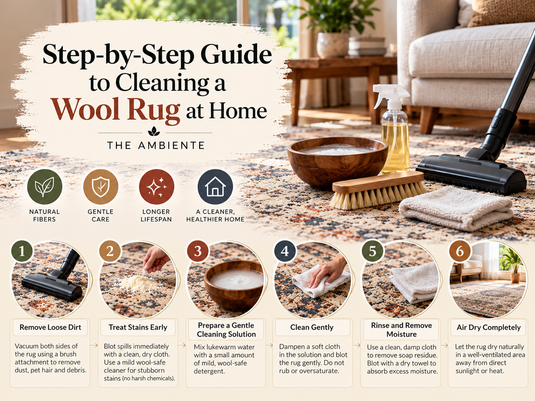
Longevity also depends on care. If you own wool, see our wool rug maintenance tips for practical ways to extend its usable life.
A well-made rug can last for many years. Some handmade rugs remain useful for generations, particularly when properly maintained and repaired.
This does not erase questions about how the rug was produced, but durability matters.
Consider whether the rug suits your actual household. A delicate piece that cannot tolerate your pets, children, or level of foot traffic may be a poor choice even if it was responsibly made.
Buy for real life.
Learn how the rug should be vacuumed, rotated, spot-cleaned, and professionally cleaned. Use an appropriate rug pad. Address damage before it becomes severe. If possible, repair a quality rug rather than replacing it because of relatively minor wear.
Caring for craftsmanship is part of respecting the resources and labor that created it.
Vintage and Secondhand Rugs Are Worth Considering
Ethical shopping doesn't always require buying something newly made.
Choosing existing pieces can also extend a rug's lifecycle. Browse vintage rugs or read how vintage rugs add timeless character to living rooms.
Vintage and secondhand rugs can be excellent choices, especially if you value unique designs and the character that comes with age.
Buying an existing rug extends its useful life and does not require new production for that particular purchase. High-quality handmade rugs can often be cleaned and repaired when necessary.
There are still questions to ask about condition, repairs, fiber content, authenticity, and provenance. Older rugs may also have limited documentation about their original production conditions.
So secondhand is not a way to answer every ethical question. It is simply another route worth considering.
What Should You Ask a Rug Seller?
You do not need to conduct an international labor audit before buying a rug. But you can ask enough questions to tell whether the seller understands its own products.
Good questions include:
- Where was this rug made, and can you identify the region or production partner?
- Is it hand-knotted, handwoven, hand-tufted, or made using another technique?
- What fibers and dyes were used?
- What policies are in place concerning child, forced, or bonded labor?
- How are working conditions monitored?
- How are artisans compensated?
- Is any independent certification applicable to this product or supplier?
- How long does this type of rug typically take to make?
- Can the rug be repaired, and what care does it need?
- What evidence supports environmental or social claims made about the rug?
A retailer may not have a perfect answer to every question. Complex supply chains make complete information difficult.
What matters is the quality of the response.
Specific answers are more useful than polished phrases about "empowerment," "conscious living," or "timeless craft."
Ethical Shopping Does Not Require Perfection
There is a risk of making responsible shopping seem so complicated that people give up entirely.
You are unlikely to find a rug for which every environmental and social variable is perfectly documented. Even responsible businesses operate within complex global systems involving agriculture, shipping, energy, manufacturing, and international trade.
The objective is not to find a product with zero impact.
It is to make a better-informed choice.
Prioritize the issues that matter most while looking for credible evidence of responsible practices. For many buyers, that means starting with the prevention of child and forced labor, fair treatment of adult workers, safe working conditions, traceable production, and durable materials.
Then consider environmental factors such as fiber sourcing, dyes, wastewater, transport, and longevity.
A company that can explain both what it knows and what it is still working to understand is often more credible than one making sweeping claims of perfect sustainability.
Respect the Craft, but Also Respect the Craftsperson
A handmade rug represents more than a decorating decision.
It is the result of raw materials, design knowledge, technical skill, physical work, cultural exchange, transport, and commerce. When rugs travel from workshops in one country to homes in another, buyers become part of that chain.
That does not mean you should feel guilty about purchasing a handmade rug from a developing country. Responsible international trade can support livelihoods and help traditional skills remain economically viable. Avoiding products simply because they come from lower-income countries can remove opportunities rather than improve working conditions.
The better response is thoughtful purchasing.
At The Ambiente, we believe appreciation for a handmade rug should extend beyond its pattern, color, and texture. It should include curiosity about where it came from and respect for the people whose skills made it possible.
Look for meaningful transparency. Understand the construction. Ask about labor practices. Examine environmental claims instead of accepting them at face value. Consider whether you will use the rug for many years.
Most importantly, remember that "handmade" describes a process involving actual people.
A beautiful rug should not need an exploitative story hidden behind it in order to reach your home.
When the supply chain respects the people doing the work, protects children, pays attention to environmental consequences, and treats traditional knowledge as something more than a marketing device, buying a handmade rug can do more than furnish a room. It can help sustain skilled work and give you a piece whose value comes not only from how it looks, but from knowing more about how it was made.