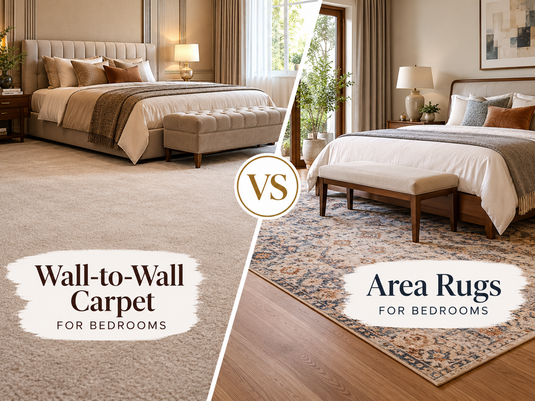
Choosing between wall-to-wall carpet and an area rug can seem like a fairly simple bedroom decision. Then you start thinking about what you actually want from the room.
You want the floor to feel warm when you get out of bed. You want something comfortable underfoot, but you also need to think about cleaning, dust, furniture placement, durability, cost, and how easily you can change the room later. If you rent, have pets, deal with allergies, or expect to redesign the bedroom in a few years, the choice becomes even more specific to your situation.
At The Ambiente, we believe flooring and rugs should make sense for the way you live, not just look good in a photograph. Both wall-to-wall carpet and area rugs can work beautifully in a bedroom. Neither is automatically the better option.
The difference is mostly about what you value and which compromises you are comfortable making.
Here is what to consider before you decide.
First, What Is the Main Difference?
Wall-to-wall carpet is installed across essentially the entire floor of a room. It is typically fitted over underlay and secured around the perimeter, creating a continuous textile surface from one wall to another.
If you prefer the flexibility of a removable floor covering, browse bedroom rugs designed for layered, adaptable interiors.
An area rug, on the other hand, covers only part of the floor. Hardwood, tile, laminate, vinyl, or another flooring material remains visible around it. Area rugs can be placed beneath the bed, beside it, in a sitting area, or anywhere else that needs extra softness or visual definition.
That difference affects almost everything else, from comfort and acoustics to maintenance and design flexibility.
Comfort: Wall-to-Wall Carpet Has the Edge in Total Softness
If your number-one priority is creating the softest possible bedroom, wall-to-wall carpet is hard to beat.
Every step you take in the room lands on a softer surface. That can be especially pleasant first thing in the morning when the alternative is stepping onto a cold hard floor. A good carpet paired with quality underlay also provides cushioning that can make the entire bedroom feel cozier.
This full-floor softness can make particular sense in children's bedrooms, where a lot of time may be spent sitting or playing on the floor. It can also be appealing if you simply dislike walking on hard flooring barefoot.
Area rugs provide softness more selectively.
A properly sized rug beneath a bed can give you a comfortable surface where it matters most, particularly along both sides and at the foot of the bed. But parts of the room will still have exposed hard flooring.
For many bedrooms, that is perfectly sufficient. You get the tactile comfort of a rug without committing the entire room to carpet.
So ask yourself a simple question: Do you want softness everywhere, or primarily around the bed?
Area Rugs Offer More Design Flexibility
This is one of the biggest advantages of choosing an area rug.
A rug can function as an important design element in a bedroom. It can introduce color, pattern, texture, or contrast without requiring permanent changes to the room.
If your bedroom is fairly neutral, for example, a patterned rug can add character. If the room already contains strong colors or artwork, a quieter rug can help ground the overall scheme.
More importantly, you can change it.
Your taste may be different five years from now. Your bed may change from a queen to a king. You might repaint the walls, replace the curtains, move to another home, or decide that the bedroom needs an entirely different mood.
An area rug can move with those changes.
Wall-to-wall carpet is more permanent. Although there are many carpet colors, textures, and constructions available, replacing carpet is considerably more involved than rolling up an area rug and introducing another one.
If you enjoy changing your interiors periodically, an area rug gives you much greater freedom.
Wall-to-Wall Carpet Creates a More Uniform Look
Design flexibility is not always the goal.
Sometimes you want a bedroom to feel quiet, consistent, and visually calm. In that case, wall-to-wall carpeting can be very effective.
Because the flooring runs continuously across the room, there are fewer visual transitions. There is no border between the rug and the exposed floor and no question about whether the rug is large enough for the bed.
This can be particularly useful in bedrooms with unusual layouts. A standard rectangular area rug does not always work naturally in rooms with angled walls, alcoves, columns, or other architectural complications. Fitted carpet follows the shape of the room.
It is also worth thinking beyond the bedroom itself. If adjacent bedrooms, hallways, or dressing areas already have carpet, continuing the same material can create visual consistency.
On the other hand, if your home has beautiful hardwood floors, covering them completely might feel like a missed opportunity. A rug lets you soften the bedroom while still allowing the flooring to play a visible role in the design.
Think Carefully About Cleaning
Both options need regular cleaning, but the process is different.
If you are considering wool, our step-by-step wool rug cleaning guide explains what safe home care involves.
Wall-to-wall carpet accumulates dust, hair, crumbs, fibers, and other particles over time. Regular vacuuming is essential, including along edges and in less accessible areas.
Occasional deep cleaning may also be needed, depending on the carpet, household, and amount of traffic.
The challenge is that you cannot simply remove fitted carpet for cleaning.
If something spills, you treat it where it is. If a stain proves difficult to remove or part of the carpet becomes damaged, repair or replacement can be more complicated than dealing with a rug.
Area rugs also need vacuuming and appropriate spot cleaning, of course. The difference is that they are removable.
Depending on the rug's construction, size, and care instructions, it may be possible to move it for cleaning or have it professionally cleaned away from the room. If it eventually becomes excessively stained or worn, you can replace the rug without replacing the entire floor.
That does not necessarily make rugs low maintenance. Some handmade, natural-fiber, high-pile, or delicate rugs require specialized care. Always consider the specific material rather than assuming all rugs can be treated the same way.
Still, from the standpoint of accessibility and replaceability, area rugs generally provide more options.
What About Allergies?
You may have heard that anyone with allergies should avoid carpet completely. The issue is more nuanced than that.
For a deeper comparison of construction, pile and fibre choices, read our guide to the best rugs for allergies and pets.
Textile floor coverings can collect dust, pollen, pet dander, and other particles. The practical question is how effectively those particles are removed through routine cleaning.
For someone with significant allergies or asthma, hard flooring is often easier to clean thoroughly because dust and debris remain accessible at the surface. Pairing hard flooring with a removable, regularly cleaned area rug can therefore be appealing.
With wall-to-wall carpet, allergens can accumulate within the pile and in areas that are harder to reach.
The material, carpet construction, cleaning routine, indoor humidity, ventilation, pets, and individual sensitivity all matter. If allergies are a serious health concern, it makes sense to follow guidance from your healthcare professional rather than choosing flooring based solely on general design advice.
Bedroom Acoustics Are Easy to Overlook
Bedrooms are supposed to feel restful, and sound plays a role in that.
Soft surfaces absorb sound. Wall-to-wall carpet can reduce footfall noise and help limit some of the reverberation you hear in rooms dominated by hard surfaces.
This may matter particularly in upstairs bedrooms. Footsteps on hard flooring can be noticeable in the room below, depending on the building's construction. Carpet and underlay can help reduce impact noise, although the amount of improvement varies substantially by product and floor assembly.
Area rugs can help too.
A large rug with a quality rug pad can absorb sound and soften footsteps across a significant part of the bedroom. It will not offer the same complete coverage as fitted carpet, but it may be enough if acoustic control is only a secondary concern.
Curtains, upholstered furniture, bedding, and other soft furnishings also affect how a bedroom sounds, so the flooring does not have to do all the work.
Pets Change the Calculation
Have a dog or cat that sleeps in your bedroom? Add that to the decision.
Wall-to-wall carpet can give pets a comfortable, less slippery surface. But fur, dander, dirt, and occasional accidents can make maintenance harder.
There is also the possibility of claw damage, depending on the animal and carpet construction. Looped carpet, for example, can sometimes be vulnerable to snagging.
Area rugs make localized problems easier to manage. If a rug is badly damaged after years of life with a pet, replacing one rug is generally simpler than replacing fitted carpet across the bedroom.
But an area rug can slide or bunch if it is not properly secured. A suitable rug pad is important for keeping the rug stable and reducing movement.
If you share the bedroom with animals, prioritize durability and cleanability over appearance alone.
Consider What Is Already Under the Rug
Area rugs make the most sense when you are happy to leave at least some of the existing floor visible.
If you have hardwood, polished concrete, attractive tile, or good-quality engineered flooring, this can be a major advantage. A rug introduces softness without hiding one of the room's architectural features.
If the existing flooring is damaged, unattractive, or simply not something you want to see, an area rug may feel more like an attempt to conceal it.
You can buy a very large rug, but at some point the question becomes whether fitted carpet would be a cleaner solution.
This is also important when budgeting. If you are starting from a bare subfloor, comparing the price of wall-to-wall carpet with the price of an area rug is not an equal comparison. The area rug still needs a finished floor beneath it.
If you already have suitable hard flooring, however, adding a rug can be a much simpler project.
Cost Depends on More Than Square Footage
There is no universal answer to which option is cheaper.
Wall-to-wall carpet involves the carpet itself, underlay, installation, floor preparation, and potentially removal and disposal of existing flooring. Material prices vary dramatically depending on fiber, construction, quality, and brand.
Area rugs have an equally wide price range. An inexpensive machine-made rug might cost far less than carpeting an entire room, while a large handmade rug in a high-quality natural fiber can easily cost considerably more.
Rug pads should also be included in the budget.
Think about cost over time as well. Wall-to-wall carpet is a larger installation commitment. If one area experiences excessive wear or staining, replacing just that portion may not be straightforward.
A rug is an individual furnishing. You can replace it without changing the rest of the flooring, and a high-quality rug may even move with you to another room or home.
At The Ambiente, we recommend thinking in terms of value for your particular space rather than simply comparing the initial price tags.
Room Size Matters
The size of your bedroom can influence which option feels more natural.
In a small bedroom, wall-to-wall carpet provides softness without creating another visual boundary on the floor. It can make the room feel cohesive, especially when relatively little flooring is visible around the bed anyway.
An area rug can work just as well, but proportion matters.
A common mistake is choosing a bedroom rug that is too small. A little rug floating beneath the center of a large bed can make both the bed and the room feel disconnected.
Generally, a bedroom rug should extend far enough beyond the bed that you can comfortably step onto it when getting up. Depending on the room, the rug might sit beneath the entire bed and nightstands, or it might begin in front of the nightstands and extend beyond the foot.
There is no single configuration that works in every bedroom. Bed size, room dimensions, furniture placement, and rug size should be considered together.
Furniture Placement Is Easier to Change With a Rug, Up to a Point
Bedrooms evolve.
You might move the bed to another wall or add a bench, desk, reading chair, dresser, or larger bedside tables.
With wall-to-wall carpet, the flooring doesn't dictate the furniture layout. The same material exists wherever you move the bed.
An area rug requires more thought. If the rug was selected specifically for one bed position, rearranging the room can mean repositioning the rug too. In some cases, it may no longer suit the new arrangement.
That said, rugs also provide an excellent way to create zones.
A large rug can visually anchor the bed, while a smaller separate rug might define a reading area. This is particularly effective in large primary bedrooms where furniture can otherwise feel as if it is floating independently around the room.
Installation Is Very Different
Wall-to-wall carpeting is an installation project.
The room normally needs to be measured accurately, prepared appropriately, and fitted with the carpet and underlay. Furniture may need to be removed temporarily. Professional installation is often worthwhile, particularly if you want neat joins and edges.
An area rug is far less permanent.
Once you have the correct size, you can position a rug and pad without changing the underlying floor. This makes rugs particularly attractive for renters or anyone who does not want to undertake a flooring renovation.
A large rug can still be cumbersome to position beneath a heavy bed, but that is a furniture-moving problem rather than a construction project.
Renters Usually Have an Easier Decision
If you rent your home, an area rug is generally the practical choice unless the property owner is replacing or installing carpet.
You can transform how a bedroom looks and feels without permanently changing the flooring. When you leave, the rug comes with you.
A large rug can also help protect the landlord's flooring from everyday wear, although you should make sure the rug backing or rug pad is suitable for the floor underneath. Certain materials can discolor or react with some flooring finishes.
Wall-to-wall carpeting makes more sense when you own the property or have explicit permission to make permanent flooring changes.
Think About Longevity, Not Just Today's Style
Bedrooms tend to change gradually. Bedding is replaced. Paint colors change. Furniture gets updated. Artwork moves around.
Your flooring needs to work through those changes.
A neutral wall-to-wall carpet can provide a long-lasting foundation precisely because it does not demand much visual attention. If you know you enjoy the warmth and comfort of carpet, choosing a versatile color and durable construction may serve you for years.
A rug offers another version of longevity. A well-chosen rug does not have to remain in the same bedroom forever. It may eventually move into a guest room, office, living area, or another home.
This is especially relevant if you are investing in a rug you genuinely love. Unlike fitted carpet, it is not tied permanently to the dimensions of one room.
Don't Forget the Rug Pad
If you choose an area rug, what goes underneath it matters.
A quality rug pad can add cushioning, reduce movement, help protect the flooring beneath the rug, and reduce wear. It can also make a relatively thin rug feel more substantial underfoot.
Choose a pad designed for both your rug and the flooring underneath it. Pads are available in different materials and thicknesses, and the correct choice depends partly on whether the rug is sitting on hardwood, tile, carpet, or another surface.
The rug pad is easy to treat as an optional extra when budgeting. In many bedrooms, it should really be considered part of the rug setup.
Can You Put an Area Rug Over Wall-to-Wall Carpet?
Yes, and sometimes it works very well.
You do not necessarily have to choose exclusively between carpet and a rug. An area rug over fitted carpet can introduce pattern, texture, or color while retaining the overall softness of a carpeted bedroom.
There are a few practical considerations.
Rugs are more likely to shift or ripple when placed over carpet, particularly if the carpet underneath has a thick pile. Furniture can help anchor a large bedroom rug, and products designed specifically for rug-on-carpet use may improve stability.
From a design perspective, layering tends to work best when there is enough contrast between the carpet and rug. For example, a patterned or textural rug over a relatively simple carpet creates a clearer sense of intention than two very similar surfaces competing with each other.
So, Which Is Better for a Bedroom?
Wall-to-wall carpet is likely to suit you better if you want maximum softness, full-room warmth, consistent flooring, and good sound absorption. It can also be useful when the floor underneath is not something you want exposed.
For material trade-offs beyond format, compare synthetic carpet vs. natural fiber rugs.
An area rug may be a better fit if you value flexibility, already have attractive hard flooring, like changing your decor, rent your home, or want an easier way to remove and replace the textile element of your flooring.
For many people, the decision comes down to a few practical priorities:
- Choose wall-to-wall carpet if all-over comfort and a cohesive appearance matter most.
- Choose an area rug if flexibility, removability, and showing some of the existing floor matter more.
- Consider allergies, pets, children, and cleaning habits before focusing on color or pattern.
- Compare the total cost, including underlay and installation for carpet or an appropriate rug pad for an area rug.
- Think several years ahead. Consider whether you are likely to change the room, move home, or rearrange the furniture.
Finding the Right Balance for Your Bedroom
There is no rule saying a bedroom is more comfortable with wall-to-wall carpet or more stylish with an area rug. Both assumptions are too simplistic.
The better choice is the one that supports how you actually use the room.
If you love the experience of walking across a soft floor and want that feeling from doorway to bedside, fitted carpet makes a strong case. If you love your hardwood floor but want warmth around the bed, covering the entire room probably does not make sense. A thoughtfully sized rug gives you both.
And if visual flexibility is important, rugs have an obvious advantage. You can use them to change the balance of color, pattern, and texture without redesigning the whole bedroom.
At The Ambiente, we see rugs as more than something used to fill an empty section of floor. The right rug should relate to the proportions of the room, work naturally with the furniture, and feel appropriate for everyday life.
Before making your choice, look at your bedroom as it really is. Consider where your feet land in the morning, how often you vacuum, whether pets sleep beside the bed, how much of the existing floor you want to see, and whether you are likely to change the room in a few years.
Those practical questions will usually tell you more than any design rule.
Wall-to-wall carpet gives you complete coverage and consistent comfort. Area rugs give you flexibility and the opportunity to combine the character of a textile with the beauty and practicality of hard flooring. Neither needs to be treated as a compromise.
The goal is simply to choose the surface that makes your bedroom more comfortable, useful, and enjoyable to live in.