Comparing carpet prices can be confusing because two products that look similar in photographs may have completely different construction, material and expected life. A low price is not always a deal, and a high price is not automatically proof of quality.
If you are searching for “carpet prices near me” or “rug deals near me”, the smartest approach is to compare the specification first and the discount second.
At The Ambiente, we recommend beginning with size, material and construction. Once those three are comparable, price becomes much easier to judge.
First Decide Whether You Mean Carpet or Area Rug
People often use the words carpet and rug interchangeably, but pricing can differ substantially.
Wall-to-wall carpet is generally priced by area plus installation. Area rugs are finished pieces with their own construction, edge finishing and design.
Our rug vs carpet guide explains the distinction.
Compare the Same Size
A 5' x 8' rug covers 40 square feet. An 8' x 10' rug covers 80 square feet.
The larger rug has twice the area, so comparing only total price can be misleading.
Always record the actual dimensions before deciding which seller offers the better deal.
Calculate Price Per Square Foot
For area rugs, divide the selling price by the rug area.
This gives you a useful comparison number.
For example, a ₹40,000 rug measuring 8' x 10' costs ₹500 per square foot.
However, price per square foot is only meaningful when the products have similar materials and construction.
Compare Construction
Machine-Made
Machine-made carpets can usually be produced at the lowest cost because manufacturing is automated.
Hand-Tufted
Hand-tufted rugs involve manual production but are faster to make than hand-knotted rugs.
Handloom
Handloom rugs can offer strong handmade value, especially for modern textures and low-pile designs.
Hand-Knotted
Hand-knotted rugs usually cost more because every knot is tied by hand.
Our construction guide explains why the prices differ.
Compare Material
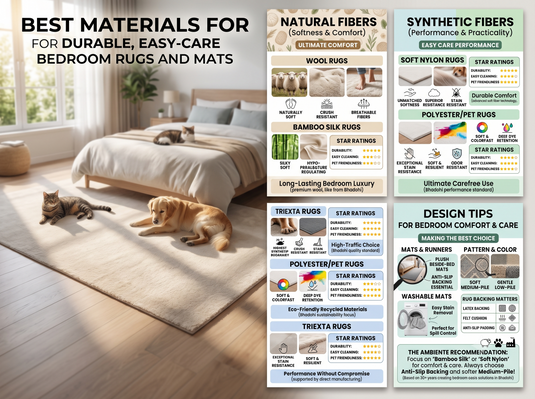
Wool, bamboo silk, natural silk, jute, cotton, polyester and polypropylene are not equivalent.
Wool rugs usually cost more than low-cost synthetic rugs but also offer a different feel and long-term performance.
Silk and fine bamboo-silk constructions can push prices higher again.
Compare Pile Height and Density
A thick dense rug generally uses more material than a thin low-density product.
For hand-knotted rugs, knot density also affects labour.
See our KPSI guide if you are comparing fine handmade carpets.
Compare the Final Selling Price
Ignore the size of the discount for a moment.
A rug marked “60% off” can still be more expensive than an equivalent rug marked “25% off”.
Compare the final price, not the marketing percentage.
Check Whether Shipping Is Included
Large rugs can be expensive to ship.
A lower product price may not be a better deal if shipping is added later.
Check the delivered price to your location.
Check Installation Cost for Carpet Flooring
If you are buying wall-to-wall carpet, include underlay, adhesives, edge finishing, labour, transport and waste allowance.
A quoted carpet rate per square foot may not include installation.
How to Find Good Deals Near You
Search for specialist rug stores and carpet showrooms in your city, but compare them with direct online pricing before visiting.
Call ahead and ask whether the store carries the material and construction you want.
This prevents a wasted trip to a showroom that only sells machine-made flooring when you are looking for handmade area rugs.
Use Google Maps Carefully
Local reviews can help identify nearby stores, but read recent reviews rather than relying only on the star rating.
Look for comments about product quality, delivery, after-sales service and whether the showroom actually carries the styles shown online.
Visit a Specialist Rug Showroom When Possible
Seeing rugs in person helps you understand pile, sheen, weight and true colour.
It is especially useful for bamboo silk, silk blends and high-low texture.
If you are comparing a large purchase, an in-person visit can reduce uncertainty.
Compare Online and Offline Prices
Some brands have different online promotions, showroom offers or clearance stock.
Ask whether the online price is valid in store and whether showroom samples have separate discounts.
Ask About Display Pieces
Showrooms sometimes discount display rugs, discontinued colours or last pieces.
These can be good deals if the rug is still in excellent condition.
Inspect edges, fringe, stains and pile wear before buying.
Ask About End-of-Season Sales
Festive and seasonal sales can reduce prices on ready-made inventory.
This is useful if you are flexible on exact design and size.
Custom rugs usually have less discount flexibility because they are produced specifically for the project.
Compare The Ambiente With Local Options
If you are shopping for handmade rugs, compare local showroom quotes with The Ambiente’s online collections first.
The Ambiente offers direct access to handmade rugs across hand-knotted, hand-tufted and handloom constructions, making it a useful benchmark for premium Indian rug pricing.
You can browse living room rugs, bedroom rugs and modern rugs before visiting nearby stores.
Do Not Compare Handmade With Machine-Made as Equals
A machine-made rug can be a perfectly good purchase, but it should not be used as the price benchmark for a hand-knotted piece.
The production time and labour are fundamentally different.
How to Compare Hand-Knotted Rug Prices
Compare size, material, knot density and origin.
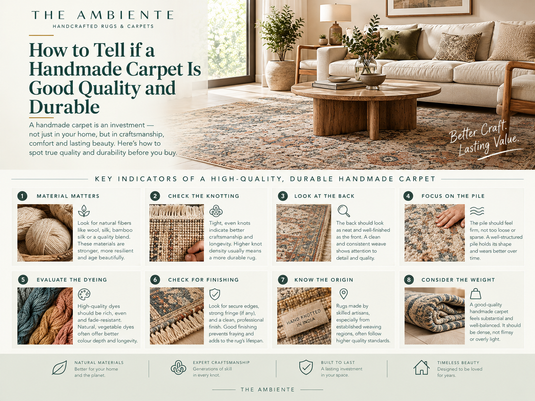
Two hand-knotted rugs can differ widely in price because one uses coarse wool while another uses fine wool and silk at a much higher knot density.
How to Compare Hand-Tufted Rug Prices
Compare pile weight, wool quality, number of colours, carving, backing and thickness.
Custom shapes and high-low designs can increase the cost.
How to Compare Handloom Rug Prices
Compare material, weave density, pile height and finish.
Handloom wool can offer very good value for modern homes.
How to Compare Jute Rug Prices
Check whether the rug is pure jute or blended with cotton, wool or synthetic fibre.
Also check whether the construction is hand-braided, handwoven or machine-assisted.
How to Compare Synthetic Rug Prices
Look at fibre type, density, backing and whether the rug is washable or stain-resistant.
Polypropylene and polyester products can vary widely in quality even when both are labelled synthetic.
Should You Negotiate at a Rug Showroom?
In some independent showrooms, there may be room to discuss the price, especially on older inventory or multiple purchases.
At fixed-price branded stores, published pricing may be less flexible.
Ask politely rather than assuming every rug has a hidden discount.
What Is a Good Deal?
A good deal is a rug that fits your room, suits the traffic level and is fairly priced for its construction.
A heavily discounted rug that is too small, too delicate or the wrong colour is not a good deal.
Check Return Terms Before Chasing the Lowest Price
The cheapest seller may have stricter return terms.
For online buying, the ability to return or exchange a rug can be worth paying slightly more.
Check Care Costs
A delicate rug may need professional cleaning more often.
Include long-term maintenance in your idea of value.
Our rug care guide explains material-specific maintenance.
Check Rug Pad Cost
On marble, wood and polished tile, a rug pad may be necessary.
Add that to the total project cost rather than treating it as an unexpected extra.
See our rug pad guide for details.
Check Whether Custom Sizing Saves Money
Sometimes a custom rug is more economical than buying an oversized standard rug just to get the right width.
If the room has unusual proportions, ask for a custom quote before assuming ready-made is cheaper.
Our custom rug cost guide explains the major pricing factors.
Use a Simple Comparison Sheet
For each rug, record:
- Seller
- Final price
- Size
- Price per square foot
- Material
- Construction
- Pile height
- Shipping
- Return terms
- Expected care
This makes the best value much easier to see.
Common Price Comparison Mistakes
- Comparing different sizes.
- Comparing handmade and machine-made products directly.
- Looking only at discount percentage.
- Ignoring shipping and installation.
- Not checking fibre composition.
- Buying the wrong size because it is cheaper.
- Assuming high price automatically means high quality.
How The Ambiente Recommends Shopping for Deals
Decide the correct rug specification first.
Then compare current prices from specialist sellers and local showrooms.
This keeps the search focused and prevents a discount from pushing you toward a rug that does not suit the room.
How to Compare Local Showroom Quotes
Ask each showroom to write down the exact specification next to the price. At minimum, the quote should include size, material, construction and whether the price includes GST, delivery and installation.
This prevents one shop from quoting a bare product rate while another gives you a complete delivered price.
How to Compare Online Rug Prices With Nearby Stores
Take screenshots or notes of comparable online products before visiting a local showroom. Use them as reference points, not as automatic bargaining tools.
A nearby store may provide immediate viewing, faster delivery or local after-sales support, while an online specialist may offer a larger handmade selection or direct-manufacturer pricing. Those service differences have value too.
What to Do When Prices Differ Dramatically
If two rugs look similar but one costs much more, ask why. The answer may be fibre quality, hand-knotting, knot density, origin, pile weight, finishing or simply brand positioning.
If the seller cannot explain the difference clearly, keep comparing. A premium price should be supported by a premium specification, not only by marketing language.
How to Compare Clearance and Outlet Deals
Clearance stock can offer excellent value, especially when a brand is discontinuing a colour, size or collection. Inspect the rug carefully and confirm whether the return policy changes for clearance items.
For handmade rugs, a discontinued design can still be an excellent long-term purchase if the construction, material and size are right for your room.
When a Higher Price Is Actually Better Value
If a better-made rug will stay in the room for many years, paying more upfront can be reasonable. This is especially true for dense wool, handloom and hand-knotted rugs that suit the space and can be professionally maintained.
The cheapest purchase price is not always the lowest long-term cost.
How to Compare Prices for the Same Rug Size
Once you decide on a target size, keep that size constant while comparing sellers. For example, compare only 8' x 10' rugs rather than mixing 6' x 9' and 9' x 12' options.
This sounds obvious, but online search results often mix dimensions, making one product look much cheaper only because it is smaller.
How to Compare Offers During Festive Sales
During festive periods, compare the sale price against the normal specification, not only the advertised percentage. If the rug already fits your room and the material is right, a seasonal sale can be worthwhile.
If the discounted rug is the wrong size or a lower-grade construction than you wanted, the sale does not improve the value.
How to Decide When to Buy
If you have found the correct size, construction and material at a price that fits your budget, waiting endlessly for a larger discount can create more risk than benefit. Handmade inventory is often limited by design and size.
Buy when the specification is right and the total delivered price makes sense, not only when the discount banner looks dramatic.
Keep a Shortlist Instead of Comparing Everything
Once you have identified three or four rugs that meet the same size, material and construction requirement, stop expanding the search and compare those properly. Too many loosely comparable options make it harder to see real value.
A focused shortlist also makes it easier to compare return terms, delivery time and service quality alongside price.
The Bottom Line
To compare carpet and rug prices properly, make sure you are comparing the same size, material and construction.
Use price per square foot as a starting point, then add shipping, installation, rug pad and long-term care.
For nearby deals, compare local showrooms with direct online specialist pricing rather than relying only on discount percentages.
If you are benchmarking handmade rug prices, start with The Ambiente’s hand-knotted rugs, hand-tufted rugs and handloom rugs so you can compare like for like.