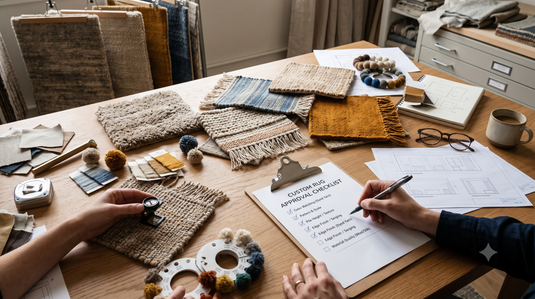
A custom rug sample should help a designer make decisions that a digital rendering cannot settle: how yarn feels, how colours relate under real light, whether the pile supports the intended detail, and how the edge will be finished. Sampling is most valuable when those questions are defined before the first prototype is produced. An attractive piece of textile without a clear relationship to the final specification can create false confidence.
This guide explains how to brief, review and approve custom rug samples, including colour references, strike-offs, construction details and client feedback. It also shows how to record changes so production follows the agreed design. For the wider project sequence, read how custom rugs are made for architects and interior designers. Here, the focus is the approval stage that connects a drawing to the finished rug.
What can a sample prove?
A sample can demonstrate agreed elements such as yarn selection, colour relationship, pile height, density and finishing. It cannot automatically prove the exact appearance of a much larger rug, confirm every production tolerance or replace a complete specification. Ask what the sample represents and which features will change when the design is scaled. The answer should be recorded rather than assumed from the way the sample looks.
Separate appearance approval from technical suitability. A sample may look excellent but be inappropriate for a dining area, rolling chair or intense housekeeping routine. Review the room's use alongside the design. If the supplier provides test information, check the product and construction covered. A beautiful sample does not establish an unverified commercial performance rating, fire classification or chemical-testing claim.
Distinguish yarn cards, colour swatches and strike-offs
A yarn card is useful for narrowing colour and fibre choices, but it does not show the finished structure. A woven or tufted swatch demonstrates how selected yarns behave together in a surface. A strike-off is typically a trial section of the design produced to assess agreed elements, although terminology varies between suppliers. Confirm what each term means in the project before paying for sampling.
A small representative sample should include the difficult parts of the rug, not only its easiest plain area. If the design has fine outlines, gradients, raised sections or mixed fibres, select a portion that allows those features to be reviewed. A plain corner may confirm the base colour while leaving the most important production question unanswered. A second sample may be justified when the border and central field use different techniques.
Write a room-specific brief
Define the room, user activity, furniture arrangement, floor finish and expected care method. Include whether the rug is for a family living room, formal bedroom or hospitality project. Note traffic routes, doors and any requirement for a pad. These details influence pile, edge finish and material suitability. A brief limited to a colour mood board leaves practical decisions to be made too late.
Record the final size, shape and orientation, including whether dimensions include fringe. Identify the main viewing direction and the parts hidden under furniture. Provide a scaled plan rather than an unmeasured room photograph. If the design has a central feature, show where it sits relative to the table or bed. The sample review should then test the visible elements that matter in the finished installation.
Establish a single specification record
Use one controlled document for the approved design. Include a project reference, version number, date, supplier, intended rug size, construction, fibre composition, pile height and edge details. Attach the artwork and identify the physical sample by the same reference. Without this connection, a signed sample and a revised drawing can accidentally describe different products.
Keep changes traceable. If the client changes an accent colour, update the specification and state whether a new sample is required. Do not let separate email threads contain conflicting instructions about colour, size and finishing. A clear decision record reduces ambiguity for both the designer and supplier. It also makes later discussions more useful because everyone can refer to the same approved version.
Review colour in the actual environment
View the sample beside the floor, upholstery, wall finish and curtains. Check it in daylight and under the room's planned artificial lighting. A colour that matches in one light may diverge in another, especially when different materials reflect light differently. Do not approve a colour match solely from a phone photograph or under lighting that will not be used in the final space.
If the rug has directional pile, turn the sample and record the preferred orientation. Some perceived colour difference comes from reflection rather than dye mismatch. Ask the supplier whether the full rug is expected to show the same effect. For projects where colour consistency is critical, discuss an appropriate assessment method and agreed tolerance with the supplier rather than inventing a universal acceptable difference after delivery.
Evaluate texture, pile and comfort
Touch the sample, compress it gently and inspect how the surface responds. A thick pile is not automatically better than a lower one. Assess the intended activity: a bedroom may favour softness, while a dining area requires easy chair movement and practical cleaning. Raised details may add visual depth but can also collect soil or complicate use if placed in the busiest route.
Compare the sample with the declared construction. Ask whether the pile height and density will be reproduced throughout the rug and how handmade variation is handled. Do not turn a tactile impression into a durability guarantee. Comfort, visual texture and long-term performance are related but different questions. Browse wool rugs and hand-knotted rugs for context when comparing material and construction options.
Check pattern scale and detail resolution
Review the strike-off against a full-size drawing or scaled layout. A motif may look precise in a small section but too dense across a large rug. Fine outlines can soften when translated into yarn, and tiny colour changes may merge from normal viewing distance. Decide whether that translation supports the design or whether the artwork needs simplification before production.
Examine the difficult joins, curves and transitions. For geometric drawings, compare line weight and repeat alignment. For florals or abstract work, assess whether changes in shape are acceptable within the selected technique. The objective is not to force every handmade rug to resemble a print. It is to agree on which variation is welcome and which would alter the design's intended character.
Inspect edges, backing and the underside
The sample should show relevant edge treatment, or a separate edge sample should be provided. Check binding, overlocking, fringe or a shaped edge according to the design. Ask how the finish will behave under furniture and foot traffic. A neatly presented surface can conceal an edge detail that has not been resolved, especially when a custom shape includes tight curves or narrow projections.
Review the underside and backing composition. Ask whether the construction uses adhesive and what cleaning restrictions apply. Confirm the recommended pad and compatibility with the floor finish. If the sample is made differently from the final rug for convenience, document that difference explicitly. Otherwise, the designer may approve a structure that production cannot reproduce or that does not meet the room's requirements.
Agree on tolerances before approval
Discuss dimensional variation, shape, squareness, pattern alignment and acceptable handmade differences with the supplier. There is no single tolerance appropriate for every technique and project. A shaped rug fitted near joinery needs a different conversation from a large rectangular piece with generous clearance. Record the agreed method of measurement and whether the item is measured before or after finishing.
Do not use a vague phrase such as normal handmade variation to cover every possible difference. Identify which characteristics may vary and how much flexibility the room allows. If exact alignment or colour is essential, explain that early and verify whether the construction can support it. It is better to adjust the design or technique before ordering than to argue about an unstated expectation after production.
Test care assumptions without damaging the sample
Obtain written care instructions and check whether they match the intended housekeeping routine. If the room needs a particular cleaning method, establish compatibility before approval. Do not soak, bleach, heat or aggressively scrub a sample without the supplier's agreement. A casual stain experiment may damage the sample while providing little reliable information about the full rug's long-term performance.
Ask what evidence supports claims about staining, abrasion or colourfastness when those properties are important. Record the test method and the product covered, rather than accepting an isolated number without context. The handmade rug care guide can help frame everyday questions, but the project's actual specification and supplier instructions should determine the approved care routine.
Present options to the client clearly
Show a small number of purposeful alternatives. Explain what changes between them, such as warmer base colour, lower pile or more open pattern, and what remains constant. Use the same room materials and lighting for comparison. A presentation with many unrelated samples can make the client choose from immediate visual preference while missing the implications for maintenance, cost or delivery.
Record the client's decision in plain language. If the choice is conditional, state the conditions: approve the base colour, revise the outline, or reduce the raised detail. Avoid treating a casual message saying looks good as approval of every technical characteristic. The final approval should connect the sample, drawing, dimensions and specification so the supplier has one unambiguous instruction to produce from.
Use a practical approval checklist
Confirm that the project reference and version match; the sample represents the agreed construction; fibre composition is documented; colours have been reviewed in relevant light; pile and texture suit the room; difficult motifs have been assessed; edge and backing are resolved; size and tolerances are agreed; care instructions are acceptable; and the final price and production sequence reflect the approved version. Mark unresolved items rather than hiding them in general approval.
Keep photographs of the sample beside the room materials, but retain the physical reference where practical. Photographs are useful for discussion, not exact colour control. Agree who keeps the approved sample and whether a matching reference is held by the supplier. If only one sample exists, establish how production will refer to it and how delivery will later be checked against it.
Plan sampling time and avoid preventable delays
Request an estimate for sample production, shipping, review and revisions. The lead time for the final rug should start from the milestone agreed with the supplier, often after specifications and approvals are settled. Do not assume that the clock started when the first enquiry was sent. A design with several unresolved colours can require more than one review cycle before production is ready.
Common delays include late furniture changes, conflicting approvals, unavailable yarns and a sample that omits the design's difficult section. Reduce them by completing the brief, assigning one decision owner and reviewing samples promptly. The custom rug delivery and installation guide explains the later stages. Sampling should be planned as part of that sequence, not treated as a decorative step outside the schedule.
Check the finished rug against the approval
At delivery, inspect the rug in a clean, dry space before positioning heavy furniture. Compare dimensions, drawing, colour relationship, pile, edges and backing with the approved specification. Photograph any concerns in ordinary light and identify the relevant version. Allow for the agreed handmade variation, but distinguish it from a different material, incorrect size or unresolved production error.
Inspect packaging and transport damage as well. A problem may arise during shipment rather than manufacture, so record the condition on arrival. Report issues within the supplier's stated period and retain the approved reference until the installation has been accepted. A well-run sampling process makes this discussion more objective because the expected result was defined before production rather than reconstructed from memory.
Frequently asked questions
Is a yarn card enough to approve a custom rug?
Usually not when texture, pattern translation or finishing are important. A yarn card helps choose colour and fibre, but it does not show the completed structure. Ask for a representative sample or strike-off when the project requires assessment of pile, joins, mixed materials or edge treatment.
Does sample approval guarantee an exact colour match?
It establishes an agreed reference, but lighting, pile direction and production variation still need discussion. Record the assessment method and acceptable variation before approval. A screen image is particularly unsuitable as the only colour reference. Ask what the supplier can realistically reproduce in the chosen construction.
Who should sign off the final version?
Assign one decision owner who consolidates the designer's, client's and supplier's instructions. The approval should identify the sample and specification version. Other stakeholders may contribute, but production should not receive conflicting final directions from several people or separate messages that refer to different revisions.
Should a revised border require a new sample?
It depends on what changes. A different fibre, technique, colour relationship or difficult drawing may justify a new representative sample. A minor documented adjustment may be resolved through updated artwork if all parties agree. Make that decision explicitly rather than assuming the original sample approves an untested change.
## Related room planning and care
If the brief uses a softened classic pattern, the transitional styling guide can help establish the palette and contrast before sampling. For a strong geometric interpretation, the tribal pattern guide helps separate decorative inspiration from origin claims that require their own evidence.