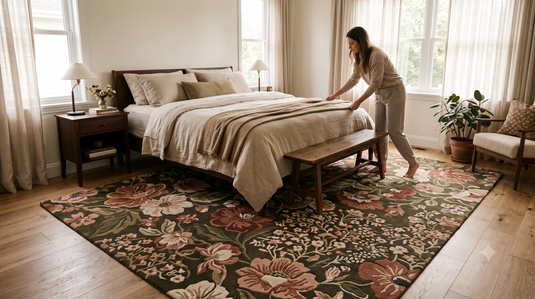
A floral rug can make a bedroom feel calm, expressive or richly layered, depending on the size of the motifs and the contrast between colours. Floral does not necessarily mean ornate, pink or traditional. A rug may use small botanical repeats, broad abstract leaves, a floral border or a simplified pattern that reads almost as texture. Choose the drawing according to the room rather than the label alone.
This guide explains how to coordinate floral rugs with bedding, furniture and curtains, then plan a size and layout that leaves the design visible. It also covers fibres, lighting and care so the bedroom remains practical. Browse floral rugs to compare visual approaches, and use the actual product dimensions and material details to narrow the shortlist before judging how a styled photograph looks.
Decide what role the rug should play
Start by identifying the strongest existing element in the bedroom. It may be a patterned headboard, dark timber bed, bright bedding or a large window wall. The rug can support that element or become the room's main pattern. If everything is asked to lead, the room may feel restless. If every surface is equally plain, a floral rug can provide the missing decorative layer.
Write a short brief such as quiet botanical pattern under an ivory bed, or large floral design visible beside a plain grey bed. This is more useful than searching for the prettiest floral rug in isolation. It helps you recognise when a lovely product does not fit the room. The best rug is the one whose scale, colour and placement support the bedroom's real arrangement.
Understand small, medium and large motifs
Small repeated flowers can merge into a textured field when viewed from the doorway. They can work well when bedding is plain and the room needs subtle detail. However, a tiny high-contrast repeat can still look visually active. Medium motifs remain legible without dominating every surface. Large blooms or leaves can create a clear design statement, especially when enough of the rug remains visible around the bed.
Motif size should be judged at full rug scale. A small sample may show a beautiful flower without revealing that the finished design repeats it frequently across a large area. Ask for a full image as well as a close detail. If only a narrow strip will be visible, consider whether the pattern will still make sense or whether a border and quieter field would be more effective.
Use contrast to create calm or emphasis
A floral design in closely related tones can feel restful even when the drawing is intricate. A design with strong dark outlines and bright accents attracts more attention. Neither is wrong for a bedroom, but the choice should match your preference and the rest of the room. Examine the rug from the doorway and from the bed rather than judging only a close-up image.
If the bedding already has a large pattern, use lower contrast or a different motif scale in the rug. If the headboard is plain and the bedding restrained, stronger florals can work beneath it. Avoid buying several equally bold floral patterns and hoping they will match because each contains pink or green. The amount and distribution of colour matter as much as its presence.
Build a palette from the fixed furniture
Look first at the bed, wardrobes, floor and curtains. These are usually harder to change than a cushion or duvet cover. Identify their undertones and choose a rug base that relates to them. Then select one or two floral accent colours that can be repeated lightly in bedding or artwork. This keeps the room connected without requiring an exact copy of the pattern on every textile.
A cream bed and warm timber can support ivory, muted rose and olive. A grey upholstered bed might work with dusty blue, soft taupe and restrained ivory. A dark wood bed can benefit from a lighter rug ground that separates the furniture from the floor. Test samples beside the actual materials, because a named colour such as ivory or sage can vary widely between products.
Coordinate patterned bedding and a floral rug
When both bedding and rug carry pattern, vary the scale and contrast. A large botanical rug can sit with a fine stripe or small woven texture in the bedding. A detailed floral duvet may work better with a quieter rug that uses a broad border or low-contrast repeat. Choose one shared colour family, then let the patterns differ so the room has depth rather than a matched-set appearance.
Plain bedding is the simplest way to let a floral rug lead. Use the rug's quieter base colour for the duvet and repeat a small accent in one cushion or throw. Avoid repeating every rug colour across the bed. If the room feels crowded after installation, remove an accessory before replacing the rug. Often the issue is the total amount of pattern rather than the floral design itself.
Select curtains as a large background surface
Curtains can occupy more visible area than the rug, so they deserve careful consideration. Plain ivory, oatmeal, stone or a quiet colour taken from the floral design can support the room. If you choose patterned curtains, test whether their motif scale and contrast differ enough from the rug. Two similar botanical patterns can compete even when the colour palette is close.
View curtain samples hanging vertically near the window. Daylight through the fabric changes its colour and makes a flat sample misleading. Check the room with curtains open and closed, especially if the rug contains reflective yarn. A calm window wall can give a floral floor pattern space to be appreciated. A strongly patterned window wall may call for a simpler rug or plainer bedding.
Three bedroom palette examples
For a warm relaxed bedroom, combine an ivory-ground floral rug with muted terracotta and olive, a cream bed and oak furniture. Keep curtains close to ivory and repeat olive in one cushion. Terracotta can appear in a small artwork detail rather than across the whole bed. This gives the room warmth while retaining a light base around the furniture.
For a cooler contemporary bedroom, try a soft grey and dusty-blue floral rug, plain grey headboard, walnut bedside tables and stone bedding. The timber adds warmth while the rug connects the cool surfaces. For a dramatic room, use a dark floral rug beneath a pale upholstered bed and keep the curtains restrained. Check that the exposed border and side areas receive enough light for the drawing to remain visible.
Measure for the bed and walking space
Measure the bed frame rather than relying only on the mattress size. Include the furniture footprint, the route to the wardrobe and the door swing. A rug under the bed should provide useful exposed surface where people step down, but the exact extension depends on the room. Mark the outline with tape and test how the furniture sits before ordering a standard size.
The pattern needs a placement plan too. If most of the rug lies beneath the bed, a dramatic central motif may be hidden. A floral border or all-over repeat can be more effective because the visible areas still carry the design. If you intend to place a rug at the foot of the bed, ensure that it supports a real seating or dressing area rather than appearing as a disconnected decorative rectangle.
One large rug or bedside rugs?
One larger rug can visually connect the bed and surrounding space. It may also be harder to move or clean, so consider access and routine care. Two bedside rugs can provide comfort without covering as much floor, but they need secure installation and a coherent relationship to the bed. They should not curl, slide or interfere with nearby drawers and doors.
Matching bedside rugs are one option, not a requirement. Related colours and compatible proportions can work when the room is deliberately asymmetrical. Avoid placing a delicate fringe directly in the busiest walking route. The rug size and shape guide helps compare layouts; use it alongside the floral drawing to decide how much visible pattern the room actually needs.
Choose material for comfort and maintenance
Wool can provide a comfortable, resilient surface for everyday bedroom use. Its appearance ranges from matte and textured to more refined, depending on yarn and construction. Cotton may offer a lighter option, with washability determined by the label. Silk and viscose-rich surfaces can create lustre and fine detail but need an appropriate spill and cleaning plan. Material choice should reflect use, not only softness in a showroom.
For a bedroom with pets, a low or moderate pile may be easier to inspect and maintain than deep shag. Consider snagging and the care requirements of any loops, raised motifs or fringed ends. Browse wool rugs to compare comfort-focused options, then ask for the exact composition and construction. A floral design does not by itself establish whether a rug is durable, washable or suitable for a particular cleaning method.
Check light and colour direction
Bedrooms often receive strong light at one time of day and warm artificial light at night. A floral rug may look quiet in evening light but sharper in morning sunlight. Test the sample at both times if colour is important. Warm lamps can emphasise yellow and red notes, while cooler light may make blue and grey details more prominent.
Pile direction can change the appearance of a rug when viewed from the door and from the bed. Ask for photographs from opposite ends or rotate a sample. Choose the orientation that works from the main viewpoint while checking that the border and motifs remain correctly arranged. Do not confuse ordinary directional reflection with damage, but investigate unexplained patches that do not change when the rug is turned.
Install the rug so it stays useful
Use a pad compatible with the rug, floor finish and required door clearance. A soft surface that shifts when you step out of bed is less useful than a slightly firmer one that stays stable. Keep the pad inside the rug edges and inspect corners after furniture is positioned. Avoid relying on the weight of the bed to secure exposed corners and bedside areas that can still move.
Check that bedside drawers, wardrobe doors and the bedroom door open freely. If the combined rug and pad thickness obstructs movement, choose a different product or layout rather than forcing the door over the pile. The rug pad and underlay guide explains what to ask about grip, cushioning and floor compatibility before you install the rug.
Care for floral detail and pale areas
A floral pattern can make some everyday marks less obvious, but pale backgrounds still need regular care. Vacuum with settings allowed by the manufacturer, especially around raised motifs and fringe. Clean the exposed edges as well as the area beside the bed, because dirt can accumulate where the furniture makes access awkward. Move small furniture carefully rather than dragging legs over the surface.
Blot spills promptly and use only approved cleaning methods. Do not scrub one flower or border intensely, since local pile distortion can become more visible than the original mark. Keep the foundation and floor dry, manage direct sunlight and rotate when the arrangement permits. Read the woven rug maintenance guide for advice on snagging and fading, then adapt it to the actual fibre and construction.
Shop with an accurate room brief
Before purchasing, record the desired rug outline, visible pattern area, base colour, accent colours and care requirements. Request full-rug and detail images, material composition, construction and exact dimensions. If the product is handmade, ask about expected variation. Confirm whether the image represents the exact item or a design example, and understand return conditions before relying on an online colour match.
Do not let an attractive close-up override the layout. A rug can have beautiful flowers yet be the wrong size, too reflective for your preference or impractical for the household. A clear brief helps you compare products fairly. The final choice should make the bedroom feel comfortable and connected while leaving enough of the design visible to justify the pattern you selected.
Frequently asked questions
Can floral rugs work in a minimalist bedroom?
Yes. Choose a restrained palette, open drawing or low-contrast botanical pattern, and keep the major furniture simple. Floral does not require ornate furnishings. The amount of contrast and visible detail matters more than the label, so assess the rug from a room-scale view rather than only a close-up.
Should the floral rug match the duvet exactly?
No. A shared colour and different pattern scale can create a more natural relationship. Plain bedding often gives the rug room to lead. If both textiles are patterned, vary their contrast and scale rather than choosing two similar florals that compete across the bed and floor.
Is a large floral pattern unsuitable for a small bedroom?
Not automatically. A large, low-contrast drawing can feel calmer than a tiny high-contrast repeat. Check how much of the motif will be visible around the bed and whether the rug footprint is proportionate. A full image and taped floor outline are more useful than a general rule about motif size.
What is the easiest way to avoid a colour mistake?
Compare a sample beside the bed, floor, bedding and curtains under the room's actual light. If samples are unavailable, request unfiltered photographs from different directions and confirm the return policy. Treat screen images as guidance, particularly when ivory, grey and muted colours need to relate closely.
## Related room planning and care
For a more restrained blend of modern and traditional furniture, read the transitional rug guide. When brown timber or earthy shades dominate the room, the brown rug palette guide helps with undertones and contrast. Keep the bedroom plan attached to the actual furniture and light.