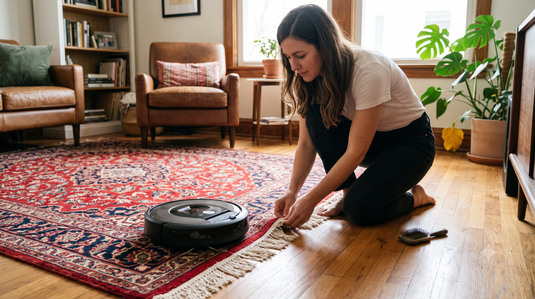
A robot vacuum can help remove everyday dry dirt, but a handmade rug needs a cleaning plan based on its fibres and structure rather than the robot's strongest setting. Fringe, loose threads, deep pile, delicate yarn and curled edges can create problems that a room map does not fully explain. The right question is whether the particular robot, rug and settings work together under supervision.
This guide explains how to assess that combination, test it carefully and know when to keep the robot away. It focuses on preserving the rug rather than ranking current vacuum models. For a wider comparison of manual equipment, see the soft-rug vacuum guide. Always check the rug's care instructions and the robot manufacturer's guidance before assuming that a carpet setting is suitable for every handmade surface.
Why fringe deserves special attention
Fringe may be part of a rug's structural foundation or a decorative attachment, depending on construction. It can be pulled into a rotating brush or roller even when the robot passes over the main pile without difficulty. A successful first run does not prove that repeated unattended cleaning will remain harmless. The fringe can change position, twist or become more exposed when furniture moves.
Inspect the ends before testing. Look for loose, long, fine or already damaged fringe and ask the rug supplier how it should be cleaned. Do not cut it short simply to accommodate a robot. On some hand-knotted rugs, fringe relates to the foundation, and careless cutting or pulling can affect more than appearance. If the fringe is vulnerable, excluding the rug and cleaning it manually is a practical decision.
Identify the rug before changing the machine
Record the pile fibre, construction, backing, pile height and edge treatment. A low wool pile, a looped handloom structure and a reflective viscose-rich surface can require different handling. Handmade does not prescribe one universal vacuum method. Nor does a robot described as suitable for carpets prove compatibility with every rug fibre, fringe or finishing technique.
Ask whether the care instructions allow a rotating brush, require suction-only cleaning or limit suction intensity. If the instructions are unclear, contact the supplier before a trial. Browse hand-knotted rugs and wool rugs for construction and material context, but use the specification of your actual rug. A broad category cannot establish the permitted cleaning settings for an individual piece.
Evaluate the robot's relevant features
Look at brush action, suction control, obstacle behaviour, mapping and the ability to exclude areas. Model names and app features change, so use the current manual for the exact machine. A robot may support a floor map without supporting the same exclusion controls as another model from the brand. Do not assume that a feature mentioned in a review exists on your device.
iRobot's mapping guidance illustrates that zone capabilities differ between models. That is why a purchase should be based on verified features rather than a general statement that smart robots can avoid rugs. Ask how exclusions are saved, whether they apply to each cleaning mode and what happens when a map is recreated. A practical safety margin matters as much as the presence of a button in the app.
Set exclusions around vulnerable areas
Where supported, create a keep-out area around the rug or the vulnerable end. Include enough space for the robot's approach, turning movement and side brush, then observe whether the boundary behaves as intended. A line drawn exactly along the fringe may not provide sufficient protection. Treat map boundaries as a control to test, not a guarantee that every thread will remain untouched.
If the machine cannot reliably exclude the area, use a manufacturer-approved physical barrier or close the room during automated cleaning. Avoid improvised barriers that create a trip hazard or damage the rug. You can still use a robot for the hard floor and other suitable surfaces while cleaning the handmade rug manually. Automation is useful when it supports the care plan, not when the rug has to be altered to accommodate it.
Prevent movement and curled edges
A robot can push a lightweight rug, climb a curled corner or catch a raised edge. Before testing, make sure the rug lies flat and the corners are sound. A compatible pad may improve support and stability, but the combined thickness changes how the robot approaches the edge. Confirm that the pad is appropriate for the floor finish as well as the rug.
Do not glue down a valuable rug or use unsuitable tape simply because the robot moves it. Adhesive residue and backing changes can create a separate care problem. The rug pad and underlay guide helps with floor compatibility and support. If the edge remains unstable after suitable installation, exclude the rug until the issue is resolved rather than repeating a damaging test.
Run the first test under supervision
Begin with the rug clean of loose objects and the robot's brushes free of hair and debris. Use the lowest appropriate setting allowed by both manufacturers and observe the approach, crossing and turning behaviour. Keep the trial brief. Watch the side brush as well as the main roller, because the machine can disturb an edge even when it seems to clean the centre successfully.
Stop if the robot stalls, repeatedly climbs the edge, pulls fringe, catches a loop or leaves a visible change in the pile. Do not let it struggle in the hope that its anti-tangle function will solve the problem. After the test, inspect the surface, ends and underside where accessible. A working motor and a completed cleaning map do not tell you whether the rug has been handled gently.
Check brush action and suction separately
Brush agitation can lift dirt but may be unsuitable for delicate fibres or vulnerable loops. Suction can also be too strong for a light rug or loose construction. These are different mechanisms, so reducing one does not automatically solve the other. If the robot cannot disable or adjust the action required by the rug's instructions, it may not be the appropriate tool for that surface.
Avoid interpreting a large amount of fibre in the dust bin as proof of an effective deep clean. Some loose fibre may be expected with certain wool rugs, but persistent heavy fibre removal or visible thinning needs investigation. Read the wool shedding guide to distinguish normal loose fibre from signs that the care routine or rug condition requires attention.
Protect delicate and reflective surfaces
Silk and viscose-rich surfaces can show changes in pile alignment and local abrasion, so a repeated automated route may be inappropriate without explicit care approval. A rug may look darker along a route because the pile has been disturbed, but unexplained persistent tracks deserve assessment. Do not increase brush pressure or suction to remove a mark before understanding whether it is soil or a surface change.
For a delicate rug, manual suction-only cleaning with an appropriate attachment may provide more control than a robot. The exact method should come from the product's instructions or a qualified cleaner. A convenient machine is not automatically gentle because it is small. Compare the cleaning action with the rug's needs, especially when the surface uses fine yarn, mixed fibres or raised design details.
Keep robot mopping away from rugs
A vacuum-and-mop robot introduces a separate moisture issue. Rug detection and mop lifting capabilities vary by model and may not prevent every contact with a thick rug, fringe or irregular edge. Configure the appropriate exclusions according to the current manual and test them. If protection is uncertain, remove the mop component or exclude the room in the manner permitted by the manufacturer.
Do not use robot mopping as a way to spot-clean a handmade rug. Water and cleaning solution can reach the foundation or floor and may affect dyes, backing and delicate fibres. A no-mop zone is not necessarily a no-vacuum zone, so understand which mode each control governs. If the rug becomes wet unexpectedly, stop the machine and seek fibre-appropriate advice before running further passes over the area.
Handle pet hair and accidents separately
A robot can help with routine dry hair and dust when the rug permits the cleaning action. It should not be sent through an untreated wet spill or pet accident. Lift solids, blot liquids and follow the rug's cleaning guidance first. Otherwise, the machine may spread residue across the rug and floor or contaminate its wheels and brushes, creating a larger cleaning task.
Check the brush and wheels regularly in a pet home. Hair wrapped around a roller can change its action and make a previously acceptable setup less gentle. Keep feeding bowls and wet pet areas outside the automated route where possible. The busy-home rug materials guide explains how fibre and construction interact with pets, but it does not replace the instructions for the cleaning machine.
Choose a realistic cleaning schedule
The appropriate frequency depends on use, soil and the product's care instructions. A hallway used with outdoor shoes has a different dirt load from a bedroom with limited traffic. More automated passes are not always better for a delicate rug. Monitor the surface and dust collection, and combine routine dry cleaning with appropriate manual attention to corners, fringe and areas beneath furniture.
Do not treat the robot as a substitute for inspection. It may miss soil near furniture, fail to clean the fringe safely or repeatedly follow the same path. Periodically check the rug's condition and rotate it when practical. For the wider maintenance routine, see how to clean and protect handmade rugs, adapting the advice to the actual fibre, construction and household use.
Maintain the machine before judging compatibility
Dirty sensors, worn brushes and hair around wheels can affect navigation and cleaning. Follow the manufacturer's maintenance schedule and use compatible replacement parts. A robot that previously crossed a rug reliably may behave differently after an edge curls, a pad is changed or the machine's components wear. Reassess the setup when something changes rather than relying on the original successful trial.
Empty the dust container and inspect the roller after early runs on a new rug. If fibre collection is unexpectedly high, reduce use and investigate. Do not wait until visible damage appears before questioning the routine. Maintenance helps the robot work as intended, while the rug's condition tells you whether the intended action remains suitable. Both checks are necessary for a useful automated cleaning arrangement.
What to do if fringe becomes tangled
Stop the robot and disconnect it according to the manufacturer's safety instructions before touching the brush. Do not pull the machine across the rug to release the fringe, because that can increase tension on the ends. Follow the machine's procedure for removing the roller or clearing an obstruction. If the fringe cannot be released without force, ask for assistance rather than cutting through it.
After release, photograph and inspect the affected area. Loose foundation threads, distorted ends or a changed edge need rug-specific assessment. Keep the robot away until the cause is resolved. A repair may be possible, but a repeated tangle should not be accepted as normal cleaning behaviour. The most useful response is to change the boundary or method, not to repeat the same route and hope for a better result.
A buying checklist for homes with handmade rugs
Before purchasing a robot, list the rugs in the home with fibre, pile, fringe and care restrictions. Identify which surfaces should be excluded completely. Check the exact model's brush controls, mapping, exclusions and mop behaviour against that list. Ask about local service, replacement parts and return conditions. Avoid choosing only by a suction number, because the relevant issue is controlled compatibility rather than maximum cleaning force.
If you are buying a rug for a home that already uses a robot, disclose the machine and settings to the rug supplier. A low, stable surface without vulnerable decorative ends may be easier to manage, but it still requires a trial and manufacturer approval. Choose the rug for the room's comfort and design needs, then establish a safe cleaning routine around it instead of sacrificing construction or cutting fringe for convenience.
Frequently asked questions
Is every robot vacuum safe for a hand-knotted rug?
No. Suitability depends on the machine's cleaning action and the rug's fibre, pile, fringe and condition. Check both manufacturers' instructions and supervise an initial test when use is allowed. If the necessary settings or exclusions are unavailable, clean the rug manually and use the robot on other suitable surfaces.
Can I hide fringe underneath the rug?
Only consider handling the ends in a way approved by the rug supplier. Repeated folding can affect appearance or create uneven edges, and it is not appropriate for every construction. Excluding the vulnerable area is often a more controlled approach. Do not tape, glue or cut the fringe without suitable advice.
Does anti-tangle technology eliminate the risk?
No feature should be treated as a guarantee for every rug. The machine may still pull a fine thread or disturb an edge before recovering. Inspect the setup and supervise testing. A feature that helps the robot continue moving does not necessarily establish that the textile experienced no damaging tension.
Should I replace manual vacuuming entirely?
No. Even a compatible robot may leave fringe, edges, corners and areas beneath furniture needing attention. Use a manual method suitable for the rug and inspect it regularly. Automated cleaning is one part of a routine, with spill response, moisture control and periodic condition checks remaining separate responsibilities.
## Related room planning and care
For rooms used by children, the child-safe rug materials guide connects backing, testing information, stability and cleaning. If a rug is being commissioned, include equipment and care restrictions in the custom rug sample checklist before approving the finished specification.