A brown rug can make a living room feel warm and grounded, but it works best when its undertone relates to the sofa, curtains and floor. Brown ranges from pale sandy taupe to caramel, walnut and deep chocolate. Those shades are not interchangeable. A rug that looks neutral on a website may reveal red, yellow, grey or olive notes once it is placed beside your furniture.
This guide helps you choose the right brown, plan contrast and connect the room without matching every object. It covers practical palettes, pattern scale, lighting, size and everyday care. Start with the brown rug collection as a browsing category, then evaluate the actual colour and material of the shortlisted product. The goal is a room that feels coherent in daylight and at night, not a collection of items all called brown.
Identify the rug's undertone
Compare brown with a plain white sheet and a sample of your sofa fabric. A golden or caramel brown usually reads warm, a grey-brown may feel quieter or cooler, and a reddish brown can intensify warm timber. These are visual observations rather than fixed scientific colour labels. The same rug can appear different against contrasting backgrounds, so assess it beside the surfaces that will surround it.
Ask for a physical sample when available, or photographs in ordinary light with a reference object. Screens and edited room photographs are poor tools for exact matching. If the furniture cannot change, let it guide the undertone. If you are furnishing from scratch, choose the rug and main upholstery together before buying smaller accessories that may restrict the palette unnecessarily.
Decide whether brown should blend or contrast
A brown rug close to the floor colour can create a quiet layered effect, but the edge may become difficult to distinguish. A lighter rug on a dark floor can define the seating area more clearly. A darker rug on pale flooring can provide visual weight. Neither approach is automatically better. Decide whether you want the rug to be a gentle foundation or a clear focal area.
Contrast can come from value, texture or pattern. A taupe rug on a medium wood floor may remain visible through a woven surface even when the colours are close. A dark border can define a light brown field, while a subtle pattern can connect multiple shades. Look at the room from the doorway to judge the effect, because the rug is usually experienced as part of the whole arrangement.
Pair a brown rug with a grey sofa
Grey upholstery can lean blue, green, beige or pink. A cool blue-grey sofa beside a golden brown rug creates a warm-cool relationship that needs a bridge. An ivory cushion, a muted blue detail in the rug or a warm timber table can help. A greige sofa may connect more easily with taupe or walnut because the colours already share some warmth.
Avoid adding many unrelated grey and brown shades in an attempt to solve the mismatch. Start with the sofa, rug and floor, then choose one supporting neutral and one restrained accent. If the room feels cold, use warmer lighting and textiles after checking the basic undertones. Lighting cannot fully correct a colour relationship that you dislike during daylight, so test the samples before making a large purchase.
Pair brown with a beige or ivory sofa
Beige and ivory sofas can work well with brown because they create a lighter surface above a grounded floor layer. The challenge is undertone. A yellow cream sofa with a pinkish taupe rug may look less harmonious than expected. A brown with a compatible warm note often provides a smoother transition. A cooler ivory sofa can support a grey-brown or a stronger dark chocolate contrast.
Repeat a lighter tone from the sofa in the rug's pattern or accessories if you want a connected look. You do not need an exact match. A patterned brown and ivory rug can link the two surfaces while allowing the coffee table to introduce another material. Keep curtains relatively calm when the rug carries strong detail, so the lower half of the room does not compete with the window wall.
Pair brown with green, blue or colourful furniture
A muted green sofa can sit comfortably with brown because the palette suggests earthy relationships, but the specific shades still need testing. Olive may work with warm walnut or caramel, while sage can suit softer taupe. Add ivory or stone to keep the arrangement from becoming too dark. A blue sofa can gain warmth from brown timber and a brown rug, with a small blue detail repeated elsewhere.
For terracotta, rust or burgundy upholstery, choose the rug's brown carefully so the room does not become uniformly heavy. A lighter ground, an open pattern or pale curtains can create relief. With a bright sofa, brown can behave as a neutral base. Let the sofa remain the main colour statement and choose a rug with a restrained palette rather than introducing several equally saturated accents.
Work with light and dark wood floors
On pale oak, deeper brown can define the seating group while the floor keeps the room light. On medium honey-toned timber, a cooler taupe may create balance or may feel disconnected, depending on the rest of the room. On dark walnut, a lighter brown or brown-and-ivory pattern can be easier to read. Compare the rug against a broad area of floor rather than a small isolated sample.
Wood floors often contain several tones and grain patterns. Choose one of those tones as a connection, but avoid reproducing every variation in the rug. If the floor is already visually active, a simpler pattern may be useful. If the floor is uniform, a textured or patterned rug can add depth. The relationship is about distribution of visual detail as much as colour.
Style brown rugs on marble and tile
Cool pale marble can make a warm brown rug look richer, while beige stone may produce a softer effect. Veining adds another colour to consider. If the stone has strong grey lines, a brown rug containing a little charcoal or grey can connect the surfaces. A highly patterned tile floor may benefit from an open rug design that gives the eye a place to rest.
Check the pad as carefully as the colour. Polished surfaces can require effective grip, but pad and backing materials must be compatible with the floor finish. A heavy rug is not automatically stable without support. Read the rug pad guide for marble, wood and tile before choosing an underlay, and follow the flooring manufacturer's instructions about suitable contact materials.
Choose curtains that support the palette
Curtains occupy a large vertical area, so their colour can change how a brown rug reads. Ivory, oatmeal, muted grey or a quiet version of an accent colour can work, depending on undertone and light. If the rug is detailed, a plain curtain can provide balance. If the rug is nearly solid, a subtle curtain weave or fine pattern can add interest without overwhelming the room.
Avoid selecting curtains from the rug's darkest colour unless you want a strong enclosing effect. A dark rug and dark window wall can be attractive in a large, well-lit room but heavy in a smaller space. Test the curtain sample vertically, since fabric hanging near a window looks different from fabric lying flat. View the combination with the curtains both open and closed before deciding.
Three complete palette examples
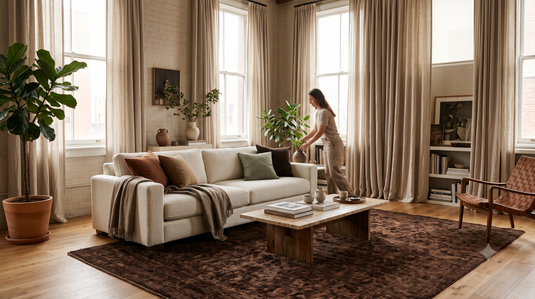
For a warm modern living room, try a caramel-and-ivory rug, cream sofa, oak coffee table and off-white curtains. Add a muted rust cushion and keep metal details restrained. The ivory connects the upholstery and rug, while the wood supports the caramel. Check that the off-white is not noticeably cooler than the sofa fabric; a small mismatch can become obvious across large surfaces.
For a cooler room, try a taupe rug, grey sofa, walnut table and soft stone curtains. Add dusty blue or sage in one artwork or cushion. The taupe bridges grey and timber without requiring the rug to copy either exactly. For a dramatic room, use a chocolate-brown rug with an ivory sofa, pale floor and simple dark furniture details. Keep enough light surfaces visible to prevent the floor area from feeling compressed.
Select pattern and texture for the furniture
A solid brown rug can look rich through weave and pile alone. An abstract pattern can introduce lighter or darker areas without a strongly traditional drawing. A floral or geometric design may connect more colours, but the scale should relate to the room. Detailed furniture often benefits from a quieter rug; plain furniture can carry a stronger pattern underneath it.
Texture is important when the palette is restrained. A mixed-height surface or varied yarn can create interest, although practical care needs should still be considered. Ask whether the construction is appropriate for pets, chair movement and cleaning. Browse living room rugs to compare shapes and visual approaches, then narrow the choice through fibre, pile and your actual household use.
Measure the rug around the seating group
Place the sofa, chairs and coffee table before finalising the rug size. Mark the proposed outline with tape and check the walking routes. A rug that joins the main furniture can make the palette feel deliberate, while a small floating rug may look disconnected even when the colours are excellent. Check whether the drawing will remain visible around the table and front legs of the furniture.
In a small living room, correct proportion often matters more than using a pale colour everywhere. A suitably sized brown rug can anchor the room without making it feel smaller, especially when the furniture and curtains leave visual space. Use the rug size and shape guide to compare layouts rather than ordering from a room photograph with unknown dimensions.
Check evening light and pile direction
Warm lamps can emphasise golden or reddish notes in brown. Cooler lighting can make taupe appear greyer and reveal differences between the sofa and rug. Test the sample under your usual lamps rather than under a special light chosen to make the combination flattering. If the room serves both daytime and evening use, aim for a relationship that feels comfortable in both settings.
Some piled rugs reflect light differently from opposite ends. Rotate a sample or view photographs in both directions before judging whether a shade is too dark. This directional effect is not necessarily a defect. Choose the orientation that works from the main entrance, then inspect the room from the sofa as well. An online image captured from one direction may not represent the view you will see most often.
Brown is practical, but it still needs care
Medium brown and patterned surfaces may make some dry dirt less conspicuous, but they do not prevent stains. Pale pet hair can be highly visible on dark brown, while oily marks can alter the pile's appearance. Choose colour with the household's real sources of dirt in mind, and avoid postponing cleaning simply because the rug still looks presentable from across the room.
Follow the manufacturer's vacuum and spill instructions. Blot liquids promptly, avoid aggressive rubbing and do not use an unapproved cleaner because the colour seems forgiving. Manage sunlight, rotate when possible and keep the underlying floor dry. The handmade rug care guide explains a routine that can be adapted to the fibre and construction of your chosen rug.
Shop with a clear specification
Write down the preferred undertone, size, pattern strength and care needs before browsing. Request the material composition, construction, actual dimensions and sample arrangements. Confirm whether the photograph shows the exact rug supplied or a representative design. For a colour-sensitive purchase, understand the return conditions before ordering, especially when a handmade or custom piece may have expected variation.
The brown living-room rug buying guide can support the shopping stage, while this article focuses on how the colours work together. Use both to separate room planning from seller comparison. A well-priced rug is only useful if its dimensions, undertone and maintenance requirements fit the home in which it will be used.
Frequently asked questions
Can a brown rug work with a black sofa?
Yes, particularly when the rug and sofa differ in lightness and the room includes lighter surfaces. A light taupe or brown-and-ivory rug can provide separation. Repeat black in a small detail and use curtains or walls to preserve balance. A very dark brown rug beside a black sofa needs more careful lighting and contrast.
Should the rug match the wood floor exactly?
No. An exact match may make the rug disappear visually. Choose whether you want a blended effect or a clearer seating zone, then use undertone, texture and lightness to achieve it. A related brown is often more useful than an identical one, especially when the floor already contains varied grain.
Does a brown rug make a small room look dark?
Not automatically. Size, contrast, lighting and the surrounding furniture all matter. A medium brown rug with pale upholstery and open curtains can feel balanced. If the room is poorly lit and most major surfaces are dark, a lighter ground or more open pattern may be a better choice.
What should I check first when shopping online?
Check the actual dimensions and colour information, then request a sample if possible. Look for photographs in different light and from both pile directions. Confirm the fibre and care instructions as well. A colour match that works on screen may change once the rug sits beside your floor and sofa.
## Related room planning and care
If you want a softened classic drawing rather than a plain surface, compare transitional rug styling. If you are planning the bedroom as well, the floral bedroom rug guide explains how bedding, curtains and the visible rug area affect colour choices.