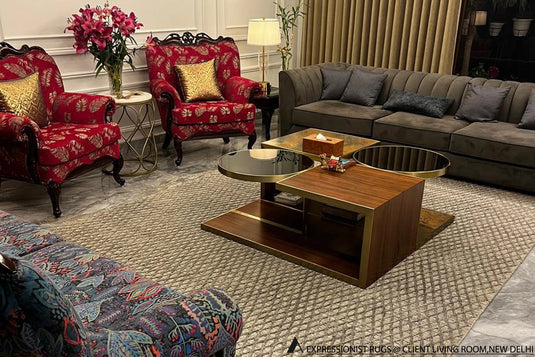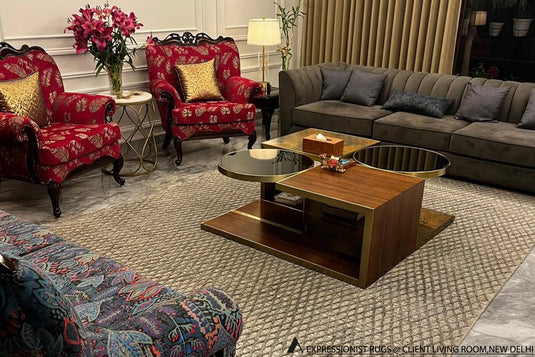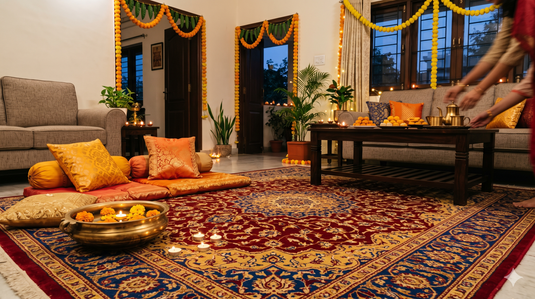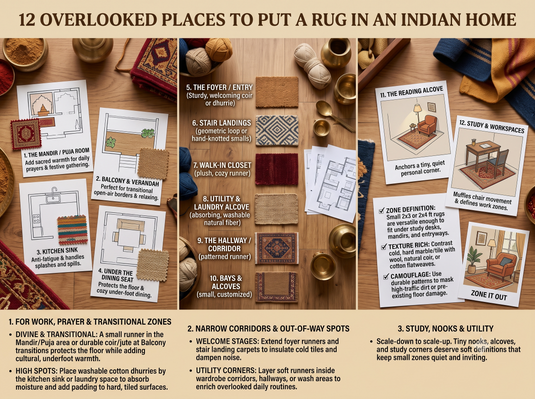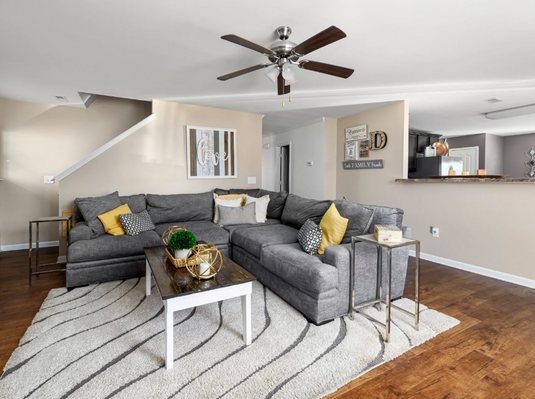
Choose a living-room rug by measuring the furniture group and walking routes, not only the room's length and width. The rug should connect the sofa, coffee table and relevant chairs while allowing doors, drawers and people to move comfortably. Front legs on the rug is a useful starting arrangement, but it is not a rule that overrides your floor plan.
A suitable size can make the seating group easier to read. It cannot change the room's physical dimensions. This guide explains how to compare rug sizes for a straight sofa, sectional, paired sofas or compact lounge, then extends the same measuring approach to other rooms and shapes.
Measure the furniture that will remain
Record the sofa's overall width and depth, including arms or a chaise. Measure the coffee table and any chairs that belong to the conversation group. Include side tables if their placement affects circulation or the rug outline.
Next, record fixed obstacles such as doors, cabinets, radiators or balcony access. Mark where people actually walk, especially the route through the room. A rug that looks centred in a plan can still sit awkwardly across that route.
Use one unit throughout the measurements. Convert product dimensions carefully if the retailer lists feet while your plan uses centimetres. Labels such as large or oversized are not standard dimensions across suppliers.
Decide what the rug should connect
Some rugs serve a small reading corner; others anchor a whole seating group. Define the role before comparing sizes. A rug intended only as a decorative accent can be smaller than one meant to unite a sofa and two chairs.
For a main seating area, consider which furniture legs will sit on the rug. All legs, front legs or no furniture legs are possible arrangements, but they create different effects. The chosen arrangement should be deliberate rather than the accidental result of a bargain size.
If the furniture is widely separated, a coffee-table-only rug may look disconnected. A larger rug or a tighter furniture arrangement can solve that problem. Test both before assuming the rug alone needs to cover more floor.
Straight sofa with a coffee table
Begin with a rug that extends beyond the sofa's visible seating footprint enough to feel connected. Check the side view and entrance view rather than relying on one fixed extension measurement. The sofa's arms, nearby chairs and room width influence the result.
Place the front legs on the proposed rug outline if that arrangement suits the room. Make sure the sofa is stable and the rug edge does not create an uncomfortable transition. The coffee table should sit in a coherent relationship to the seating.
For example, a sofa around 210 centimetres wide might lead you to test a rug around 240 centimetres wide and a larger alternative. These are illustrative dimensions, not a universal prescription. The useful decision comes from marking the outlines and checking the remaining floor.
Sectional or L-shaped sofa
Measure the complete sectional footprint, including the chaise. Do not choose a rug using only the main straight section. The rug should relate to the whole conversation area, including the inside of the L.
A rectangular rug can align with the main sofa and extend toward the chaise. A square or custom shape may suit another layout, but unusual shape is not automatically necessary. Compare standard options first.
Check the space between the coffee table and every seating position. The chaise can create a narrow route even when the overall room is generous. Our custom rug measuring guide helps record a more complex footprint.
Two facing sofas
Think of the space between the sofas as one group. A rug that reaches both sets of front legs can create a clear connection. If the arrangement requires all legs on the rug, check that the surrounding circulation remains comfortable.
The rug width should respond to the sofas and any chairs at the ends. A long narrow rug may fit between the sofas while failing to include the rest of the group. Mark the complete arrangement rather than only the empty centre.
If a standard size cannot work, consider changing the furniture spacing before commissioning a custom rug. Small placement changes can sometimes resolve the proportions without adding production time and cost.
Sofa and accent chairs
Include the chairs that belong to the seating group, even if they are occasionally moved. Decide whether the rug supports their normal position or a fixed display arrangement. A chair should not become unstable because its legs sit unevenly across an edge.
A round rug can work with a compact conversation group if its diameter connects the relevant furniture. A rectangle may provide more usable coverage around a longer sofa. The shape should respond to placement rather than simply repeat the coffee table's outline.
Our round rug size guide can help compare a circle with the furniture footprint. The right diameter is the one that works in the actual arrangement.
Make room for the coffee table
Check the table's footprint, legs and usable space around it. A rug should not force the table too close to the sofa or leave it inconveniently far away. The furniture arrangement and rug dimensions need to be considered together.
Different households need different clearance. Test sitting down, standing up and reaching the table rather than adopting one number without context. The rug edge should not become an obstacle in the route people use repeatedly.
A very deep or uneven pile can affect a lightweight table's stability. Include pile height and pad thickness in the decision. A correctly sized outline does not guarantee that every surface construction suits the furniture.
Use floor markings to compare sizes
Mark two plausible rug outlines with removable tape appropriate for the floor finish. Place the furniture in its intended position and use the room normally. Open doors and drawers, move chairs and walk between the entrance and balcony.
Photograph each option from the same viewpoints. This makes the difference easier to compare later. Ask which outline connects the furniture without dominating circulation.
Do not leave tape on a sensitive surface beyond the manufacturer's recommendations. A paper template or another suitable marking method may be better. The test should help the decision without damaging the floor.
Understand standard dimensions
Standard rug sizes are useful starting points, but they do not belong automatically to a particular room. A size that works for one sofa arrangement may be too small or too large for another.
Check the actual dimensions rather than assuming every nominal size is exact. Handmade products may have stated tolerances, which should be confirmed where a precise fit matters. Keep the supplier's specification with the order.
Browse medium-size rugs, large-size rugs and oversized rugs after defining the footprint. Collection names help browsing but cannot replace measurement.
A small living room may need more than a small rug
A tiny rug can fragment a compact seating group when all the furniture sits outside it. A larger, suitable rug may provide a clearer connection. However, a rug that obstructs a door or presses awkwardly against every boundary is not an improvement.
Consider furniture depth and circulation first. A narrower sofa arrangement or a smaller coffee table may make a suitable rug size possible. The rug cannot solve an overfilled floor plan by itself.
Our small living room guide explains the relationship between furniture and visible floor. Choose by the usable arrangement rather than the label small room.
Open-plan living needs a defined zone
In an open-plan room, the seating rug can help identify the lounge without covering the dining or kitchen circulation. Decide where the conversation group begins and ends. The rug should support that zone rather than expand automatically to every nearby wall.
Consider how the rug relates to other floor textiles. Two rugs do not need to be identical, but their palettes and scale should make sense together. Avoid an awkward overlap in a shared walking route.
If the dining area also needs a rug, measure it separately using chair movement. The living-room sofa rule is not a dining-room sizing rule. Different furniture creates a different footprint.
Dining rooms: test pulled-out chairs
Measure the tabletop, then pull the chairs back to the positions used for sitting and standing. Check where the rear legs land. The rug needs enough usable area for those movements without creating an awkward edge transition.
A planning allowance can be helpful, but chair design and room clearance decide the final dimensions. Test the actual furniture where possible. Do not assume a table's seating capacity alone establishes the rug size.
Compare dining room rugs by pile, cleaning and dimensions. A dense manageable surface may suit chair movement better than a deep, loose pile.
Bedrooms: measure the stepping areas
Decide whether the rug belongs partly beneath the bed, beneath the whole arrangement or alongside it. Measure the places where people step out and walk. Bedside tables and door movement can change the available space.
A larger rug can connect the bed and furniture, while separate bedside rugs may suit another layout. Neither is universally better. The important result is a stable, useful surface in the intended stepping areas.
Our bedroom rug size guide provides additional questions. Mattress labels alone do not describe the complete bed frame or room footprint.
Hallways and entryways: keep access clear
For a runner, check the width of the walking route and every door that opens across it. For a circular entry rug, test the perimeter from each approach. A shape that looks attractive can still be inconvenient near a threshold.
Consider moisture and shoe traffic as well as dimensions. A decorative rug should not be assumed to replace an entrance mat designed for wet footwear. The whole product needs suitability for the intended location.
Choose backing and a compatible pad for the actual floor. Our rug padding guide explains why stability requires its own specification.
When a custom size is worthwhile
Custom dimensions can help when standard products cannot connect the furniture without obstructing circulation. An unusual room or a precise design brief may justify the additional process. Confirm custom availability for the selected construction.
Provide the final dimensions, shape, furniture plan and intended use. Ask how the pattern will adapt and what dimensional tolerance applies. A design cannot always be enlarged or shortened without changing its composition.
Compare custom-size supplier quotes using the same brief. Include approvals, production and delivery rather than treating a manufacturing estimate as the arrival date.
Check installation and care before buying
Pile height, backing and a pad can affect furniture stability and door clearance. Confirm the complete installed thickness if a threshold is tight. Ask what the rug and pad manufacturers recommend for the floor finish.
Inspect the delivered rug's dimensions, label and condition before discarding packaging. Follow the supplier's flattening instructions and report a mismatch promptly. Do not cut or alter the rug simply to make an incorrect size fit.
Keep the care sheet with the order details. A correct layout still needs a material and maintenance routine that suit the household. Our high-traffic material guide can help connect sizing with daily use.
Frequently asked questions
Should all sofa legs sit on the rug?
Not always. All legs or front legs can both work, depending on the arrangement. Test the furniture and walking routes. The chosen placement should feel connected and stable rather than follow a rule that does not fit the room.
Can the coffee table sit on a small rug by itself?
Yes, as an intentional accent arrangement. For a main seating group, it can look isolated if the sofa and chairs are far outside it. Compare a larger outline or closer furniture placement before deciding.
Is there one best rug size for a three-seat sofa?
No. Sofa width, room layout, chairs and circulation vary. Measure the actual furniture and test plausible outlines. A nominal seating capacity does not establish the dimensions of the complete group.
How do I make the final choice?
Choose the outline that connects the intended furniture and leaves normal movement comfortable. Then confirm material, installed thickness, backing, care and delivered terms. Size is a design decision supported by measurements, not a label chosen from a generic room chart.
For related decisions, compare Round Rugs: Furniture Matching, Entryway Materials and Care, Custom Rugs: From Design Approval to Delivery and Installation, How to Choose a Modern Living Room Rug: Styles and Layout. These guides connect the material, layout and care choices behind this topic.
Need help choosing a rug or carpet?
Ask The Ambiente about rug sizes, materials, colours or the right choice for your room.