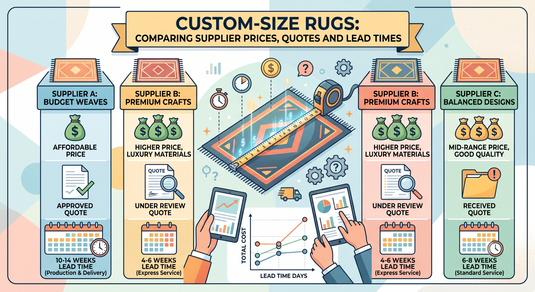
Custom-size rug prices and lead times can be compared, but only when the brief is consistent. A hand-tufted wool rug, a detailed hand-knotted carpet and a felt-ball design are not equivalent purchases. Size, fibre, construction, sampling and design changes all affect the quotation.
For Indian buyers, start by requesting the same specification from The Ambiente, Jaipur Rugs, Obeetee, Hands and Carpet Cellar. Public custom prices are usually quote based, so the table below separates verified published timing from information that needs a supplier quote. We have not obtained private quotations and do not present invented per-square-foot rates as current prices.
A current comparison of public information
Official information was checked on 3 October 2026. The estimates below are the suppliers' published descriptions, not a promise that a new order will arrive within those periods.
| Supplier | Public custom-price basis | Published timing or limitation | What you still need |
|---|---|---|---|
| The Ambiente | Request a quote for the exact brief | No universal verified production period used here | Written price, construction and project timeline |
| Jaipur Rugs | Request a product-specific custom quote | No current universal India lead time confirmed here | India-specific production and delivery estimate |
| Obeetee | Non-standard pricing varies with specification | FAQ states about 40–45 days for hand-tufted and 80–120 days for hand-knotted production | Approved quote and separate delivery estimate |
| Hands | Custom size, colour and design enquiry | No universal production period confirmed here | Sampling, production and delivery milestones |
| Carpet Cellar | Commission-specific quote | FAQ describes custom work taking six months to a year after commissioning | Scope, stage schedule and arrival estimate |
Sources for the numerical timing are Obeetee's FAQ and Carpet Cellar's FAQ. Obeetee's shipping page separately notes that custom delivery depends on production complexity. Production time should therefore not be read as a complete door-to-door promise.
Why a single price comparison can be misleading
Two suppliers may quote for the same room while proposing different products. One might use hand tufting and another hand knotting. One might offer wool and another a blend. A lower total is not automatically better value if the scope has changed.
Ask each supplier to identify the construction and fibre clearly. If you request a match to an existing design, clarify whether only the size changes or whether the pattern, colours and material can change too.
Our construction comparison explains the basic differences. Use it to understand the quotations, rather than reducing the decision to one rate per square foot.
Define custom size and bespoke design separately
Custom size may mean adapting an existing design to a new dimension. A fully bespoke rug may involve new artwork, colours, sampling and a different construction plan. Those projects can require different time and effort.
A central medallion design may need more than simple scaling when the proportions change. Borders, corners and motif spacing may have to be redrawn. A plain textured rug might require a different type of design adjustment.
State which changes you need. If the only issue is fit, ask for size adaptation first. If you want original artwork, explain that explicitly so the supplier can quote the correct process and approval stages.
Create one brief for every supplier
Include the finished width and length, shape, intended room, floor type, fibre preference, construction preference and a design reference. State the budget and the date by which the rug needs to arrive.
Attach a room plan and photographs if they help explain the layout. Identify doors, furniture feet and circulation routes. The supplier should understand whether the rug is decorative, used daily or part of a larger professional project.
For colour, use a clear reference and ask whether a physical sample is available. A screenshot may be enough for an initial conversation, but it is a weak basis for exact matching in a valuable custom order.
Measure before requesting the quotation
Measure the furniture arrangement, not just the walls. Decide where the sofa or bed legs will sit and how the rug will relate to nearby chairs. Mark the proposed outline with removable tape.
Check access, door swing and the combined thickness of rug and pad. A custom rectangle that fits the floor plan may still create a clearance issue. Include these constraints in the brief before the supplier prepares a design.
Read how to measure a space for a custom rug. Once the dimensions are approved, ask what tolerance is expected in the finished handmade product and how that will be assessed.
Understand the area calculation
A rectangular rug's area is width multiplied by length. For example, a 2.4 by 3 metre rug covers 7.2 square metres. If a quotation is given per square foot, convert the measurements consistently before comparing totals.
Use the same unit for every supplier. Confusion between centimetres, metres, feet and inches can create a large difference. Write the final dimensions in one unit and, if useful, provide a clearly labelled conversion.
For shaped rugs, ask which area is used for pricing. The surrounding bounding rectangle may be larger than the usable shape, and the supplier's pricing method may include additional labour or waste. Do not impose a rectangular calculation on an irregular design without confirmation.
An illustrative cost comparison
Imagine two hypothetical quotes for the same 80-square-foot brief. Quote A lists a base rate of ₹900 per square foot, giving ₹72,000. Quote B lists ₹1,100 per square foot, giving ₹88,000. These numbers are examples for explaining the calculation, not actual prices from any named supplier.
Now suppose Quote A excludes sampling and delivery, while Quote B includes them. The base-rate difference no longer describes the whole transaction. If the constructions also differ, the comparison needs another layer of explanation.
Create a delivered-total column that includes all stated charges. Keep tax treatment, sampling, underlay and delivery visible. If a charge is unknown, mark it as unknown rather than assuming it is zero.
Costs to ask about explicitly
- Design development or adaptation.
- Physical sample or strike-off.
- Yarn, construction and finishing.
- Binding, fringe or shaped-edge treatment.
- Delivery, installation or access requirements.
- Taxes and any international charges.
- An appropriate underlay if required.
- Changes after the design is approved.
Ask whether the quote is fixed for a stated validity period and which changes would cause a revision. A detailed quotation helps you evaluate value even when the supplier does not publish a public custom-price calculator.
Read lead time as a sequence of stages
A custom project can include briefing, artwork, sampling, approval, production, washing or finishing, quality checks, packing and transit. Not every supplier organises the stages in the same way, so ask for the actual sequence.
The production estimate may begin only after artwork and colour approval. A delay in approving the sample can therefore move the final date. Clarify the starting point before treating a quoted number of days as a deadline.
Our guide to custom rug lead times explains this distinction. Ask the supplier to name the milestones and identify which dates are estimates and which commitments are documented.
How to use Obeetee's published estimates
The official FAQ gives different production periods for hand-tufted and hand-knotted rugs and says the result depends on size and complexity. That is useful evidence of why construction changes the schedule.
It is not a quotation for your specific design. Ask whether sampling, approval, finishing and transport are included in the estimate you receive. The same FAQ also explains that non-standard pricing can vary with specification.
Use the published numbers to frame an enquiry, then rely on the project-specific written estimate. Do not schedule an installation using a generic FAQ when the actual design has not been approved.
How to use Carpet Cellar's commissioning guidance
Carpet Cellar describes customisation as a process involving design, a carpet map, yarn preparation and weaving. Its stated six-month-to-one-year period is a useful reminder that some commissions are substantial projects.
Do not compare that period directly with a simpler size adaptation and conclude that one supplier is slow. The scope and method may differ. Ask what the proposed commission includes and how the design will be approved.
If the deadline is short, discuss a stocked alternative or a less complex brief. A ready-made rug in an appropriate size may be a better project decision than a fully bespoke design that cannot meet the schedule.
What to ask The Ambiente, Jaipur Rugs and Hands
For The Ambiente, provide the room plan, desired construction and dimensions, then request a written project quote. The brand's hand-knotted and hand-tufted collections can serve as style references. A collection price is not a custom quotation.
For Jaipur Rugs, use the India-specific enquiry route and identify the exact design or original brief. We did not verify a single current India custom lead time that applies to all orders, so obtain the timeline directly.
For Hands' custom-rug collection, ask how the selected dimensions, colour and design will be translated into a manufacturing brief. Request the sample process and milestones alongside the price.
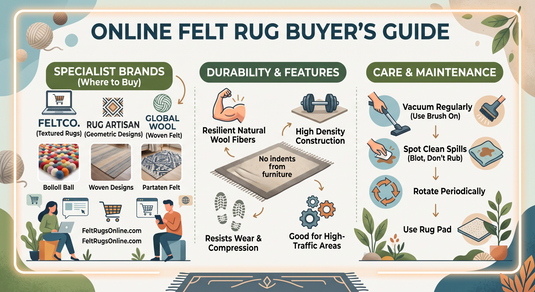
Consider a felt custom rug as a separate category
If your design calls for a felt-ball surface, specialists such as myfelt offer a different construction route. The Ink page displays a custom-size estimate alongside other delivery information, so confirm the applicable destination and order timeline directly.
A felt-ball rug should not be placed in the same price table as a hand-knotted wool carpet without identifying the structural difference. Compare it as an alternative way to fulfil a design brief, not as an identical product from a faster supplier.
For more sourcing detail, see our felt-rug guide in the related reading below. Consider cleaning, texture and furniture use before allowing an apparently shorter period to determine the choice.
Approve colour and design with care
Request a scaled drawing or artwork showing the finished proportions. Check border width, motif placement and any areas expected to sit under furniture. A beautiful pattern at one size may need adaptation at another.
For colour, agree on the reference method and acceptable variation. If a physical sample is used, retain it and its approval record. Natural and handmade materials may vary, but the supplier should explain the expected range before production.
Avoid approving from a heavily filtered room image. It can conceal both colour and pattern scale. Use clear artwork and material references, then treat the render as a communication aid rather than the sole specification.
Check payment, changes and cancellation
Ask about deposit stages, the balance, sample approval and changes after approval. Confirm what happens if the brief changes or the project is delayed. Custom products often have different conditions from stock items, but the exact rules belong to the supplier's quotation.
Read cancellation and return terms before paying. Do not assume that dissatisfaction with a chosen colour will be treated the same way as a manufacturing defect. Clear approval records make those distinctions easier to understand.
Keep all versions of the final brief and identify the approved one. In a professional project, assign one person to authorise design changes so the supplier does not receive conflicting instructions from several participants.
A decision method for a real project
First, remove quotes that do not meet the essential size, construction or deadline. Next, compare the remaining scope and delivered totals. Finally, assess the supplier's clarity about samples, approval and after-sales support.
Do not choose solely on the shortest quoted production period. A vague fast estimate can be less useful than a longer timeline with clear milestones. Similarly, a low base rate can be poor value if major charges remain unspecified.
If every suitable custom option exceeds the deadline, reconsider the brief. Explore a stocked size or a different construction before committing to a schedule that cannot realistically be met.
Frequently asked questions
Which supplier is cheapest for custom-size rugs?
We cannot identify a current cheapest supplier without matched quotations. Public starting prices do not establish the cost of an identical custom brief.
Does production time include shipping?
Not necessarily. Ask for separate approval, production, dispatch and arrival estimates.
Can I compare a hand-tufted quote with hand knotting?
Yes, as alternative purchases, but keep the construction difference visible. They are not like-for-like prices.
Is a custom order worth the wait?
It can be when fit or original design matters. For a short deadline, a suitable stocked rug may be the more practical choice.
Request a comparison you can act on
Send one consistent brief, ask for an itemised delivered quote and request a staged timeline. Then choose the supplier whose proposed rug, approval process and schedule match the project. That is a meaningful comparison even when no universal public price exists.