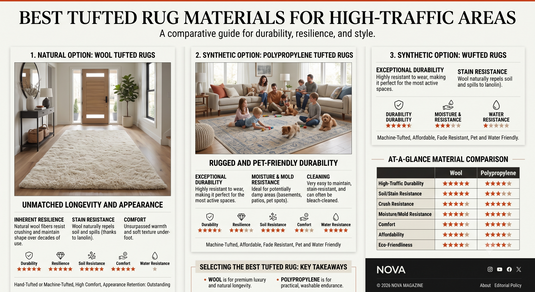
For a busy living room, corridor or family seating area, a dense wool tufted rug is usually the strongest starting point. A well-specified nylon rug can also be practical where cleaning and heavy daily use matter more than a handmade surface. Polyester and polypropylene can suit some budgets and routines, but neither the fibre name nor the word tufted guarantees that a rug will keep its appearance under constant footfall.
The best choice combines suitable yarn, a compact pile, sound backing, secure edges and a maintenance routine you can actually follow. A thick, wonderfully soft showroom sample can still be a poor match for a narrow route between a sofa and balcony door. This guide focuses on that real-life decision rather than treating every soft rug as equally durable.
What high traffic means in an Indian home
Traffic is not just the number of people who live with you. Think about where they walk, whether they wear shoes, how often the balcony is opened and whether chairs move across the rug. Four people repeatedly using one narrow passage can create more visible wear than a larger family using a wide seating area. Grit carried in from outside also changes how the surface ages.
A living room used mainly in the evening has a different brief from a home office with a wheeled chair. A rug beneath a dining table faces spills and chair movement as well as footfall. If your route is dusty, damp or close to an entrance, address those conditions first. Entry mats, dry floors and sufficient walking space make a substantial difference before any fibre comparison begins.
Understand what tufted construction tells you
Tufting inserts yarn into a primary backing. In many hand-tufted rugs, an adhesive and a secondary backing help secure the yarn. Machine-tufted floor coverings have their own backing systems and performance specifications. You should therefore ask whether you are buying a handmade area rug, a machine-made rug or fitted carpet. The same construction word covers products intended for quite different jobs.
Hand-tufted does not mean hand-knotted. Individual knots and adhesive-backed tufts behave differently during use and cleaning. A hand-tufted wool rug can work well in a family room, but soaking it or repeatedly exposing its backing to moisture can create problems. Our guide to hand-knotted versus hand-tufted rugs explains the construction distinction before you compare quotations.
Wool: a balanced choice for busy residential spaces
Wool is worth considering when you want comfort, a natural appearance and good recovery from ordinary compression. A dense wool surface can feel comfortable without needing an excessively long pile. Mid-tone wool designs also make it easier to live with the minor visual changes of daily use. Look at yarn quality and the finished surface, rather than assuming every wool label describes the same product.
There are trade-offs. Some shedding can occur, especially in a new cut-pile rug, and wool still needs prompt spill care. It is not waterproof or immune to stains. A pale wool rug in a dining area may demand more attention than a patterned one in a lounge. If maintaining a natural fibre is realistic for your household, wool rugs provide a useful place to compare textures and designs.
Nylon: useful when performance specifications come first
Nylon is commonly considered for resilient commercial and residential carpet applications. For an area rug, its suitability still depends on the product's pile, backing, finish and intended use. Ask for the manufacturer's traffic classification or warranty language if you need a heavy-use product. A nylon fibre claim on a marketplace listing is not a substitute for those details.
Think carefully about the look you want. A synthetic rug can deliver practical everyday service while feeling different from hand-tufted wool. If the brief is a study zone, a dense low pile may be more useful than a plush finish. If the brief is a formal handmade living room, wool may fit your visual expectations better. Compare samples rather than comparing fibre names as though they describe identical interiors.
Polyester: comfortable, but inspect recovery and density
Polyester rugs can offer soft touch and appealing colour at accessible prices. Their performance varies widely. A sparse, long-pile polyester rug may show flattened walking routes sooner than you expect, particularly in a narrow circulation path. A shorter, denser construction may behave quite differently. Look for photographs after use and ask how the pile recovers when compressed.
Also establish the cleaning method. Some polyester products are washable, while others are not because of their backing or size. Washable should describe the complete finished rug and a stated process. It should not be inferred from the face fibre. If a listing gives no backing information, no care label and no useful return policy, its low price is not enough to make it a dependable high-traffic purchase.
Polypropylene: consider stains and compression separately
Polypropylene can be a practical option for some households, particularly where price and resistance to certain spills influence the decision. However, a rug that handles a spill well can still flatten under repeated pressure. Stain resistance and appearance retention are different questions. Oils and greasy residues can also present cleaning challenges, so the term easy-care needs a specific explanation.
Do not transfer an outdoor claim from the fibre to the whole rug. The backing, dyes and construction must also be suitable for the stated location. For an indoor living area, choose a compact surface with a believable care label and avoid treating every polypropylene rug as an all-purpose solution. Our discussion of rug materials for high traffic and pets helps separate these priorities.
Viscose and silk blends need a more selective location
Viscose, often marketed under names such as art silk or bamboo silk, can produce a beautiful lustre. That visual effect should not be confused with the everyday resilience of wool. A high proportion of delicate lustrous fibre may be a poor choice for a main walking route, a spill-prone dining area or a household that expects aggressive home washing.
Blends need precise information. Ask for the actual composition and whether the decorative yarn occupies the whole surface or only small details. A wool-rich rug with a limited accent is different from a predominantly viscose rug. If shine is essential, consider placing it in a quieter seating zone and confirm a suitable professional cleaning plan. Match the material to the room instead of making the room accommodate an unsuitable material.
Pile height and density can change the decision
A shorter pile generally makes routine cleaning, door clearance and movement easier. Density helps the surface feel supported, but it cannot be judged from weight alone. A rug may be heavy because of its backing. Examine a sample, part the pile gently and ask whether face-yarn weight is stated separately. Large bare gaps between tufts are worth questioning for a busy location.
Cut pile and loop pile also create different experiences. Cut pile can show tracking and compression; loops can catch on claws or snagging objects. Very pronounced high-low carving looks striking but may put raised details directly under recurring footsteps. None of these structures is automatically unsuitable. The useful question is whether the specific design puts its most vulnerable features where your household will repeatedly use them.
Backing and edges deserve their own inspection
Turn the sample over. Ask what the primary and secondary backings are, what adhesive system is used and which cleaning methods are permitted. Check whether the backing lies flat and whether the edges look securely finished. If a retailer cannot explain the construction, request written information before buying a large rug that will be difficult to return.
A compatible underlay can help reduce movement and friction, but it cannot repair weak construction. Choose a pad approved for your floor finish and the rug type. Some pads add cushioning while others provide grip. Excessive thickness can make the edges less stable or interfere with doors. Keep the pad hidden inside the rug's perimeter and follow its maker's instructions rather than assuming every rubber-like mesh is suitable for every floor.
Choose colour and pattern for the way the room lives
Cream, black and saturated solid colours all reveal different things. Cream makes coloured marks easy to notice; black can highlight pale lint and dust; a lustrous surface may show directional footprints. A softly patterned mid-tone rug often offers a more forgiving daily appearance. This is about visibility, not permission to leave dirt in the pile.
Try a muted geometric pattern, a small-scale tonal design or a gently varied natural shade. Keep the pattern scale appropriate to the seating area. A rug can be practical without looking busy. The Ambiente's hand-tufted rugs can be considered by construction and room needs, with the specific material confirmed on the product or project brief before selection.
Three room examples to make the choice concrete
For a family lounge with a sofa and television, begin with a dense wool rug, a manageable pile and a mid-tone pattern. Place the front furniture legs consistently on the rug and leave a clear route to the balcony. Ask about initial shedding and approved vacuum settings. This approach balances everyday comfort with the visual importance of the seating area.
For a dining area with moving chairs, prioritise low pile, flat edges and a size that contains chair movement. Compare wool and a performance-oriented synthetic product using the actual care instructions. For a home office, consider whether a rug belongs beneath a rolling chair at all. A commercial carpet solution or suitable chair mat may be more sensible than a decorative tufted rug that was never specified for wheels.
Maintain the rug without damaging its construction
Remove dry grit regularly with the vacuum setting recommended for the rug. A rotating brush may be inappropriate for a handmade or delicate surface, so ask before using one. Rotate the rug when the layout allows, distribute furniture pressure with suitable supports and keep entry areas clean. These small habits are more useful than repeatedly trying to restore a heavily soiled walking lane.
Blot fresh spills with a clean absorbent cloth and consult the care label before applying a cleaner. Avoid rubbing, flooding or applying a general household mixture to an unfamiliar fibre. The Carpet and Rug Institute's maintenance guidance supports regular dry-soil removal, prompt spot attention and a suitable cleaning routine. A hand-tufted area rug may require more specialised care than fitted synthetic carpet.
Questions to ask before paying
Request the face-fibre composition, pile height, construction, backing details, finished dimensions and approved cleaning method. Ask which kind of traffic the product is intended for and what its warranty actually covers. If it is custom made, clarify the size tolerance and whether the sample matches the final yarn and finish. Photograph the sample beside your flooring and upholstery in natural light.
Also consider the cost of care and eventual replacement. The cheapest rug may be reasonable for a short-term rental, while a better-specified wool piece may suit a long-term family home. Choose based on your intended period of use. Do not pay a premium for a material description that the seller cannot substantiate, and do not expect a decorative rug to perform like tested commercial flooring.
Related rug planning guides
For related room decisions, compare our cream rug care guide, plush rug planning guide and shared children’s room ideas. They apply the same material-first approach to different colours, textures and daily activities.
Frequently asked questions
Is wool always better than synthetic fibre for high traffic?
No. Wool is a strong residential starting point, but a well-specified synthetic product may suit a particular budget, cleaning routine or commercial requirement better. Construction and use matter as much as fibre. Compare the actual products rather than treating natural and synthetic as fixed quality grades.
Can a hand-tufted rug be machine washed?
Only if the finished product's care label explicitly permits it. Many adhesive-backed hand-tufted rugs should not be machine washed or soaked. The fact that the yarn can tolerate water does not mean the backing can. Confirm the complete cleaning process with the maker before experimenting.
What is the safest general starting point?
For a busy dry residential seating area, start with dense wool, a low or moderate pile, a forgiving pattern and a compatible underlay. Then check the exact product against your walking routes, pets, furniture and cleaning expectations. Good selection is a combination of choices, not a single material promise.