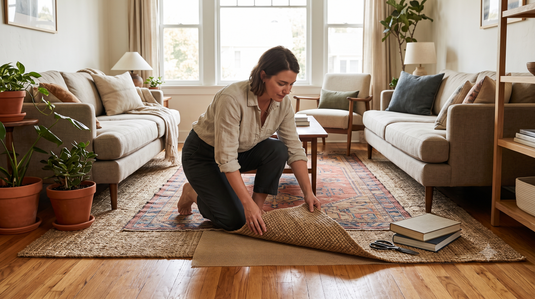
Layering rugs can add colour, texture and a more personal feel to a living room, but it also creates a floor assembly with more edges and more movement to manage. The most successful arrangement starts with a reason: perhaps an existing rug needs a broader visual frame, a patterned piece needs a quieter background, or a small seating area needs a softer surface. Buying two rugs simply because their colours match can result in a bulky arrangement that is difficult to clean.
Think of the lower rug as the foundation and the upper rug as the accent. Each needs a clear job. The foundation establishes the area, while the accent introduces the detail you want to notice. This guide explains how to compare dimensions, choose compatible surfaces, place furniture and maintain both layers. It also explains when a single rug is the more practical choice. No decorative effect is worth an unstable chair or a loose edge in a busy walkway.
Decide what the second rug will improve
Before shopping, identify the weakness in your current arrangement. If the seating group feels disconnected because the rug is too small, a larger foundation can create a stronger boundary. If the room looks flat because every surface is beige, a smaller patterned rug can add a controlled focal point. If you need softness where you sit on the floor, a top layer might help, provided its placement does not introduce difficult changes in level around furniture.
The second layer should solve that specific issue rather than multiply patterns and textures everywhere. Photograph the room without cushions and decorative throws, then look at the large surfaces: flooring, sofa, curtains and existing rug. If these already create a strong composition, layering may add little. If the floor area feels visually empty, test a second outline with paper or removable tape. This also reveals whether the accent will be visible once the coffee table is in place.
Choose a stable foundation
A foundation rug generally benefits from a relatively even surface. A dense, low-profile weave can make it easier to place another rug and furniture above it, although product-specific construction still matters. A very deep, loose or irregular pile may let the top layer shift and create pressure points under furniture legs. Check whether the lower rug lies flat on its own before adding anything. Layering should not be used to conceal a curled edge or unstable backing.
Jute is a popular visual foundation because its earthy texture can contrast with a patterned upper rug. It is not automatically suitable for every room. Consider spills, moisture exposure, roughness and the manufacturer's care instructions. A household that eats frequently around the coffee table may prefer a different base. Explore jute rugs for texture and dimension options, but evaluate the actual product rather than assuming all natural-fibre rugs behave alike.
Wool can also work as a foundation when the surface and construction are appropriate. A restrained wool rug may create a softer visual base than a coarse natural-fibre weave. Compare total thickness, backing and furniture support, especially if the top layer is also wool. The wool rugs collection provides browsing options; the care requirements and pile profile of each piece remain the deciding details.
Give the accent enough breathing room
The top rug should have enough visible foundation around it to make the layering intentional. There is no universal border width because the effect changes with shape, pattern and furniture coverage. A narrow strip may look like a sizing mistake, while an excessively wide border can make the accent appear isolated. Test two outlines before ordering. Look from the doorway and from the sofa, since the border visible in everyday use may differ from the view in a product photograph.
For example, a 240 by 300 cm foundation with a 160 by 230 cm accent leaves an average difference of 40 cm along the narrower dimension and 35 cm along the longer one when centred. Those figures describe geometry, not a guaranteed good layout. Furniture may cover much of the border, and the top rug may need to sit off-centre. Calculate what remains visible after placing the table and sofa rather than relying only on the nominal size difference.
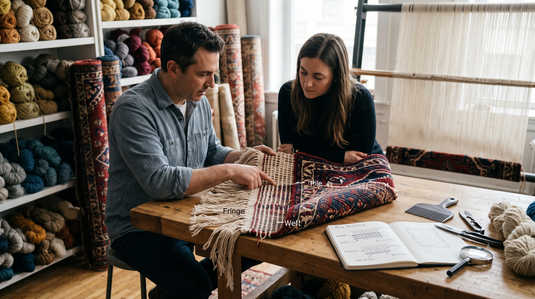
Be careful with fringe. Fringe can change the apparent boundary and create additional loose material between layers. Ask whether the listed dimensions include it. Avoid trapping long fringe under chair feet or laying another rug across it in a way that pulls the foundation unevenly. If the layered effect depends on a crisp edge, a bound or finished edge without long fringe may be simpler to maintain.
Match textures without building excessive height
Texture works best when the layers feel distinct but physically compatible. A relatively flat base and a moderate-pile accent can create contrast without excessive bulk. Two deep-pile rugs may feel plush at first but can make furniture support, vacuuming and edge transitions more difficult. Add the thickness of both rugs and any pads before judging clearance. A cabinet door that clears a single rug may scrape a layered arrangement.
Check the stiffness of each backing as well. A flexible upper rug may follow the unevenness of the foundation, while a rigid backing may bridge a raised area and leave a hollow or curled edge. Neither behaviour can be predicted from colour or fibre alone. Ask the retailer whether the proposed rug is suitable for layering and explain the lower surface. If possible, test a sample or a smaller piece before committing to a large arrangement.
Do not confuse visual texture with a need for high pile. An all-over weave, subtle colour variation or restrained geometric pattern can create interest on a comparatively flat surface. This is particularly useful around swivel chairs, coffee tables and spaces where children play. A layered room can look rich without creating a soft mound that is difficult to walk across or support furniture on.
Coordinate patterns and colours
Choose one dominant pattern. A quiet foundation can support a colourful accent, while a patterned foundation often pairs more easily with a simpler top rug. Two strong patterns may work if their scales differ and the colours connect, but they require more careful testing. Place flat product images side by side and consider the amount that will actually remain visible. A busy border hidden under furniture does not contribute much to the finished room.
Repeat a colour already present in the room to connect the layers with furniture. For example, a rust detail in the upper rug can relate to a cushion or warm timber, while a cream base can relate to curtains. Matching every shade is unnecessary. Instead, keep the undertones compatible and avoid introducing several unrelated accent colours at once. Check both rugs under the room's evening lighting as well as daylight.
If you want a quiet result, vary texture more than colour. Two neutral rugs can look deliberate when one is smooth and the other has a modest tactile weave. If you want a focal point, keep the lower rug understated and allow the accent to carry the colour. Our living room colour guide explains how to compare rug tones with flooring, upholstery and lighting.
Plan pads for two different interfaces
A layered arrangement has two interfaces: the hard floor beneath the foundation and the foundation beneath the accent. A pad designed for a hard floor does not automatically prevent movement between two textile surfaces. Ask the pad supplier for a product appropriate to each interface and confirm compatibility with the rug backings. Follow the supplier's sizing and installation guidance rather than improvising with shelf liners, adhesive sheets or several stacked pads.
The bottom pad must also suit the floor finish. Some materials may be unsuitable for particular wood coatings, polished stone or heated flooring. Ask before installation and keep the floor manufacturer's restrictions in mind. Cut pads inside the rug boundaries so they do not project. With irregular shapes, follow the actual outline rather than assuming a rectangular pad will remain hidden.
After installation, push gently against the top rug in the directions people normally walk. Check whether it creeps, bunches or pulls the foundation. Repeat the check after several days because movement may develop gradually. If a rug continues to shift, reconsider the materials or use a single rug. Placing a heavy coffee table on the centre does not necessarily control every exposed edge.
Keep chairs and tables level
Furniture should sit on a consistent support surface. A coffee table with two legs on the accent and two on the foundation can tilt if the thickness difference is significant. A chair positioned across an upper edge may rock when someone sits down. Test the furniture under normal load. If it is not stable, move the accent, resize it or choose a flatter arrangement rather than using improvised shims hidden beneath a rug.
For dining areas, layering can complicate chair movement because chairs repeatedly cross edges. A single appropriately sized rug is often easier to manage there. In a living room, an accent entirely beneath the coffee table can work if the table is stable and the exposed edge stays away from the main walking route. For a wider seating group, ensure that chairs pulled forward for conversation do not unexpectedly drop off a raised layer.
Low swivel bases and reclining furniture need particular attention. Check the full movement path, not only the resting position. A rotating chair can drag a top rug that appears secure when still. A recliner mechanism may need clear space near the floor. Follow the furniture manufacturer's requirements. The living room sizing guide can help establish the foundation size before you decide whether an accent is practical.
Straight, angled and offset arrangements
A centred, parallel arrangement is the simplest to evaluate. It gives a clear border and predictable furniture support. An offset arrangement can highlight one end of a seating group, such as a reading chair, but the foundation still needs to look purposeful on the other side. An angled accent introduces more exposed corners. Those corners can become obstacles if they point into a route between the sofa and a doorway.
If you want an angle, mark the entire outline and walk through the room several times. Check where a person carrying a tray would naturally step. Avoid using an angle solely to make a too-small accent appear larger. The visible diagonal may look expressive, but the physical area remains unchanged. A larger accent or a single suitably sized rug may provide a better solution.
Organic shapes can create attractive overlapping boundaries, but they require more precise pad trimming and edge checks. Make sure narrow projections lie flat and remain away from doorways. Keep the furniture layout simple enough that the shapes remain readable. For a sculptural seating arrangement, our curved sofa rug guide explains how to compare circles, rectangles and irregular outlines.
Clean both layers and the floor underneath
Layering creates hidden surfaces where dust and grit can accumulate. Vacuum according to each rug's care instructions and lift the accent periodically to inspect the foundation. The appropriate frequency depends on traffic, pets and how much grit enters the room. Do not assume that cleaning the visible top rug keeps the lower one clean. Check the pad and floor as well, using lifting help for heavy furniture or large rugs.
Spills deserve prompt attention because liquid can pass into the lower layer unnoticed. Blot the surface with a clean absorbent cloth, follow the rug's own care directions and inspect beneath it when safe to do so. Avoid soaking a layered assembly or allowing moisture to remain trapped between rugs and pads. If the rug contains delicate fibres or the spill reaches multiple layers, a specialist cleaner can advise on the appropriate treatment.
When to choose one rug instead
A single rug is often preferable where there are narrow walkways, frequent chair movement, very low doors or a household member who needs an even walking surface. It also simplifies cleaning and replacement. You can still create visual depth through texture, pattern, cushions and upholstery without adding another floor edge. Layering is a design option, not a requirement for a finished room.
Before buying, confirm that the two rugs improve the room enough to justify the extra maintenance. Keep dimensions, pad specifications and care instructions together. Photograph the finished arrangement and recheck it after normal use. The best layered layout remains flat, stable and easy to clean while delivering the visual contrast you wanted in the first place.