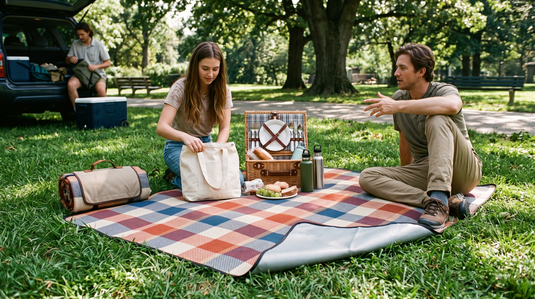
A picnic rug has a different job from a living room rug. It may sit on grass, sand or soil, carry food and shoes, then be folded into a bag before the journey home. Those conditions make portability, ground protection and drying as important as appearance. A textile that looks beautiful in a picnic photograph is not necessarily designed to cope with damp ground or repeated outdoor use.
Start by deciding whether you need a portable picnic blanket, an outdoor floor rug or a decorative layer for a protected setting. Those categories can overlap in appearance while differing substantially in construction and care. This guide explains how to compare them, measure for a group and plan maintenance without assuming that an ordinary indoor rug is weatherproof.
A picnic blanket and an outdoor rug solve different problems
A portable picnic blanket is usually designed to be carried, unfolded for temporary seating and packed again. Some products include a ground-facing barrier or an integrated carry strap. An outdoor area rug is more commonly intended to define a balcony, patio or other floor area. Its suitability for grass and repeated folding still needs to be confirmed.
A decorative indoor rug is another category. It may tolerate normal indoor traffic but have no stated resistance to damp soil, sunlight or outdoor cleaning. Fibre identity alone does not settle this question. A wool flatweave or a jute rug should not be assumed suitable for a wet lawn because it appears natural or lightweight.
Read the intended-use statement and care label. Ask whether the product can be used directly on grass, whether its underside is water-resistant or waterproof, and whether it is meant to remain outdoors. Our outdoor carpet specification guide explains why a verified product rating is more useful than broad material claims.
Match the product to the ground
Dry grass is not the same as wet grass, even on a day without rain. The ground can hold moisture after watering or overnight conditions. A textile that is comfortable for an afternoon on a dry surface may become damp underneath on another occasion. Check the location as well as the weather forecast before deciding what to take.
Sand creates a different challenge. A deeply textured surface can hold particles, and a strong wind can lift an unsecured lightweight blanket. Rocky or uneven ground may be uncomfortable even beneath a soft top layer. Choose a level area and inspect it for sharp objects before laying the textile down. Padding cannot make every unsuitable surface comfortable.
For a paved courtyard, the ground may be cleaner and more predictable, but heat and rough edges can still matter. Check that the product is intended for contact with that surface. Do not spread a valued indoor rug on abrasive paving just because there is no grass. The underside and edging deserve protection too.
Understand the underside claim
Water-resistant and waterproof are not interchangeable descriptions. Water resistance may be limited by the material, seams, wear or exposure conditions. A waterproof surface can also lose performance through damage or unsuitable treatment. Ask what the manufacturer actually promises rather than treating either word as permission to leave the product outdoors indefinitely.
An underside barrier can reduce moisture reaching the seating surface, but it does not protect against rain falling onto the top. It also does not necessarily make the textile suitable for standing water. Keep the distinction clear when planning a picnic. Ground protection and overhead weather protection are separate needs.
Inspect the underside after use. Small tears, delamination or an opening seam can change how the product behaves the next time it meets damp ground. Follow the manufacturer's repair and cleaning guidance. Household glue or a random waterproofing spray may damage the material, leave an uncomfortable finish or invalidate the stated care instructions.
Compare the top surface for comfort and cleaning
A soft fabric face can feel pleasant for sitting, but food, grass and grit will affect it. Consider how readily crumbs can be shaken away and whether the surface is washable. Long or highly textured fibres may take more effort to clean. A smoother surface may be easier to maintain, although it could provide less cushioning on a hard base.
Cotton, fleece-like fabrics and synthetic surfaces have different drying and handling characteristics, and blends vary. Read the complete specification rather than choosing from one fibre name. The material used underneath may need a different cleaning method from the top, which is why the care label should apply to the whole product.
If a decorative layer is important, separate its role from ground protection. A compatible picnic blanket can provide the functional base, while a removable throw can add comfort in a dry, protected setting. Confirm that both can be cleaned appropriately. Avoid making several unstable layers where people will step on and off the edge.
Measure for people, food and movement
Do not size the blanket only by counting people. Think about how they will sit, whether legs will extend, where food containers will go and whether bags need to stay on the textile. A small family with a large shared meal may need more usable area than a larger group making a brief stop with individual snacks.
Make an outline at home and test it with the actual group if possible. Sit down with the basket, plates and cushions in place. Leave enough room for someone to stand without stepping over food or another person's feet. A manufacturer can supply dimensions, but a phrase such as family size may not match your particular arrangement.
For comparison, Decathlon India's listing for a 210 by 170 cm picnic cover provides a concrete footprint to evaluate. Product availability and specifications can change, so check the live listing before purchase. Treat the dimensions as a measurable example, not a guarantee that the same size suits every group.
Shape and the usable seating area
A rectangle is straightforward to arrange around a food tray and predictable when folded. A square may work well for a compact group. A round textile can suit people sitting around a central point, but the curved edge provides less room near the outside than a rectangle occupying a similar bounding area.
Measure the useful body rather than including tassels or loose fringe in the seating area. Decorative extensions can become dirty quickly on the ground and should not be counted as practical room for a person. If the product has straps, buckles or a folding mechanism, place them so that they do not create an uncomfortable lump beneath the seating area.
For an indoor round rug that you also admire visually, keep its intended use clear. Browsing round rugs can help with a home's seating arrangement, but it does not establish outdoor suitability. Verify the individual product rather than transferring the appearance of a picnic setting into a material claim.
Portability is more than total weight
Check the packed dimensions as well as the unfolded size. A light product can still be bulky, while a neatly folding design may fit more comfortably into your transport. Consider whether you will walk from a car park, carry several other items or use public transport. The right product should fit the journey, not just the destination.
Carry handles and straps need to be comfortable and secure, but they are not a reason to pack the textile while it is wet or dirty. Think about how the clean seating surface is protected from the ground-facing side during folding. A separate washable storage bag can be useful if the original product packaging does not manage that separation well.
Test the folding process before the first outing. It is easier to learn the arrangement on a clean floor than while managing food containers and a tired group outdoors. If the product must be rolled rather than folded, confirm that your storage space can accommodate it without repeatedly forcing sharp creases.
Choose colour for use rather than photography alone
A pale blanket can look airy in a photograph but show grass marks, soil and food spills clearly. A darker pattern can make some marks less noticeable, although it does not make the textile cleaner or more stain-resistant. Choose colour together with the approved cleaning method. Camouflage is a visual effect, not a maintenance treatment.
Pattern scale also changes the picnic setup. A busy design may compete with patterned tableware and cushions, while a simple border can define the seating area clearly. If the blanket will serve several settings, choose a palette that works with your existing accessories instead of purchasing a complete new set around one seasonal photograph.
Sun exposure can affect textiles differently depending on fibres, dyes and product ratings. Do not assume a bright colour is outdoor stable or that a natural colour will never change. If the product will be used repeatedly in strong sunlight, look for relevant manufacturer guidance and store it away from direct light between outings.
Manage food and furniture carefully
Place drinks and food containers on a stable surface. A deeply padded or uneven blanket can make a cup easier to tip. Keep hot cookware, stoves and open flames away from textiles and follow the equipment manufacturer's clearances. A picnic rug is not a protective surface for a portable cooking appliance.
Small folding chairs or stools may work better beside the blanket than partly on it. If they are placed on the textile, check that the feet remain level and do not puncture or repeatedly abrade the underside. A product intended for sitting on the ground may not be designed to carry concentrated furniture loads.
Leave a clear route for entering and leaving the group. Avoid placing the edge across a path used by other visitors, and keep loose decorative layers from curling into the walking area. The comfortable setup is one that supports the meal and conversation without making every movement an obstacle course.
Cleaning should follow the complete product label
Shake away loose debris where doing so is appropriate, then inspect both sides. Remove surface soil according to the care instructions. If the product is machine washable, confirm the permitted cycle, temperature and machine capacity. A washable top fabric does not automatically mean that a bonded underside or complete blanket can be put in a washing machine.
Do not apply a household stain recipe to every material. Bleach, solvents, strong rubbing or high heat can affect dyes, coatings and bonded layers. For a valuable decorative textile, ask a qualified cleaner before treating an unfamiliar spill. Our material-specific care guide explains why treatment must match the actual rug rather than a generic cleaning trend.
Dry the product as instructed and check the underside as well as the face before storing. Folding a surface that feels dry on top can still trap moisture in a backing or seam. If it must be transported while damp, unpack it promptly at home and complete the recommended drying process before longer storage.
Plan a short trial before a longer outing
Try the complete setup in a nearby, permitted outdoor space before relying on it for a full day away. Notice how the group fits, whether the blanket is comfortable on that surface and how easy it is to clean and pack afterwards. Take the same food containers and seating accessories you expect to use later. A short trial can reveal that you need a different footprint or less equipment without turning the first long picnic into an improvised product test.
Store it ready for the next trip
Choose a dry, ventilated storage location and keep the product away from sharp objects. A tightly packed damp blanket can develop problems that are not visible until the next outing. Inspect the carry bag too; dirt left inside can transfer back onto a clean textile when it is packed again.
Before each use, check the surface, seams, underside and straps. Small changes can affect comfort and protection even if the overall pattern looks unchanged. Replace or repair a damaged item according to the manufacturer's guidance rather than assuming that an extra decorative layer will solve a compromised ground barrier.
A good picnic rug is the one whose intended use, footprint, packed size and care routine match the outing. Indoor rugs remain valuable for their own setting, and outdoor products still need careful specification checks. Once those practical decisions are made, colour, texture and accessories can create the atmosphere you want without asking the textile to do a job it was never designed for.