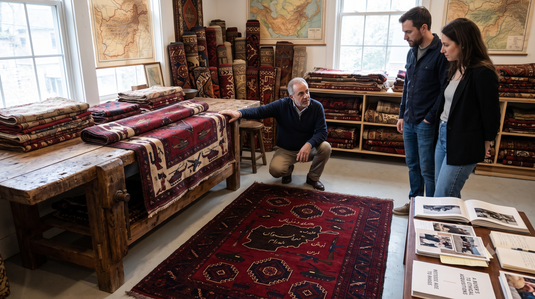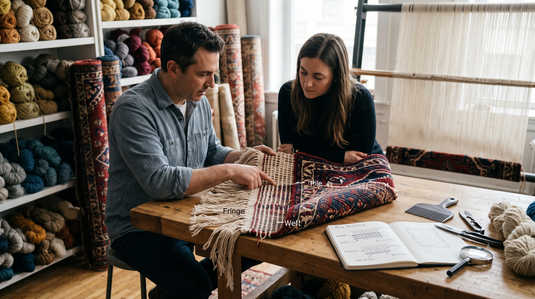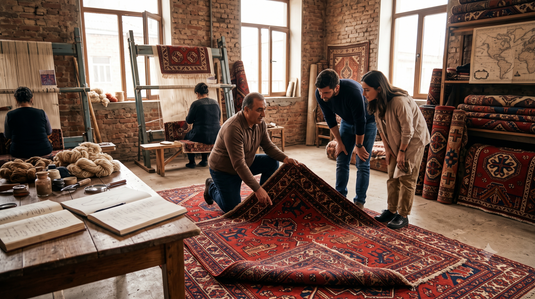
Rug history is a history of people as well as patterns. Makers, merchants, patrons and later collectors helped textiles move between households, cities and regions. Armenian weaving traditions form one part of that wider story, while the trading networks commonly called the Silk Road help explain why motifs and materials cannot always be confined neatly within a modern national label.
For a present-day buyer, this history is useful because it encourages better questions. What does a regional name mean on a listing? Is a rug documented as an older object, or is it newly made with a historical design reference? Which parts of its story are supported by records, and which are interpretations? Understanding those distinctions makes both collecting and everyday decorating more informed.
Armenian rugs are a tradition, not one fixed pattern
The phrase Armenian rug can refer to textiles associated with Armenian makers and communities across different places and periods. It should not be reduced to one colour combination, one knot count or one universally repeated symbol. Historical weaving developed through local materials, household practice, workshop production and contact with other traditions.
Museum collections are a useful starting point because individual objects can be studied alongside their inscriptions, materials and recorded histories. The Armenian Museum of America's textile collection presents examples that show this diversity. Looking at several documented pieces is more informative than treating a single online photograph as a template for every Armenian carpet.
A modern retail label still needs clarification. Ask whether Armenian describes the documented maker, production location, design inspiration or a dealer's attribution. Those meanings are related but different. A new rug inspired by a historic design can be worthwhile without being represented as a documented antique or an example woven by a specific historical community.
Dragon rugs and the problem of reading motifs too quickly
Vishapagorg is a term associated with dragon rugs in Armenian textile discussions. The Smithsonian Folklife Festival's Armenian carpet overview discusses this tradition. The name provides a useful introduction, but an individual rug still needs to be examined within its own date, place, construction and collection history.
Highly stylised forms do not always look like a literal animal to an unfamiliar viewer. Repetition, geometry and the constraints of weaving can transform how a motif appears. That makes context important. A seller's confident statement that every hooked shape has one universal meaning should be treated as a claim to investigate rather than an established fact.
Avoid assigning an ethnic origin solely from a motif. Designs travel, are adapted and are sometimes reproduced by later workshops. A pattern associated with one collection can appear in a newly made rug elsewhere. Look for supporting evidence and use careful language such as inspired by when the production history does not establish a stronger attribution.
Inscriptions can add evidence, but interpretation matters
Some rugs contain writing that records names, dates or other information. An inscription can be valuable evidence, but reading it accurately may require language expertise and knowledge of the object's context. A photograph that appears to show a date does not settle whether that date refers to manufacture, a dedication or another event.
Ask for a clear transcription and an explanation of who interpreted it. If the attribution is central to the price, request documentation rather than relying on a verbal translation. A dealer's description, an owner's family account and a scholarly catalogue are different kinds of evidence. Each can be useful, but their certainty and purpose should be stated clearly.
For decorative use, you may simply enjoy the arrangement of the inscription within the pattern. For collecting, more exact interpretation matters. Keep that distinction in mind so the level of investigation matches the purchase. A room rug and a historically important textile need not involve the same assessment process or the same expectations.
The Silk Road was a network of connections
The Silk Road is best understood here as a name for interconnected exchange routes and relationships rather than one continuous road used identically in every century. Goods, people and ideas moved through changing centres and routes. Rug histories intersect with those movements, but not every carpet can be linked to a particular trading journey.
Trade can help explain why a textile made in one place was collected in another or why a design vocabulary appears across a wide area. It does not justify claiming that every shared motif travelled along one documented route. Similarity is a starting point for research, not a complete reconstruction of an object's movement.
For a buyer, the practical lesson is to distinguish design resemblance from provenance. A rug can have patterns associated with exchange between traditions while its own production history remains uncertain. The broader handmade rug history guide offers context, while individual historical claims should be checked against object records and specialist research.
Makers and merchants played different roles
A carpet's place in history may involve the person who wove it, the workshop that organised production, the patron who commissioned it and the merchant who transported it. Those roles should not be collapsed into one story. A merchant's Armenian identity does not, by itself, establish that a carpet was woven in Armenia.
The Metropolitan Museum of Art gives a concrete example in its Carpets for Kings exhibition panels: around 1600, Polish king Sigismund III Vasa commissioned silk carpets from Iran through the Armenian agent Safer Muratowicz. The example shows the importance of intermediaries without confusing their identity with the manufacturing origin of the textiles.
That distinction remains useful in modern shopping. The country where a rug is sold, the nationality of the designer and the place where it was woven can all differ. Ask the seller to separate those facts. A well-explained international production story is more informative than a compressed description that leaves the buyer to assume they are the same.
Regional names require careful interpretation
Historical rug names can refer to a place, a trading centre, a style or a classification used by dealers and researchers. Their meaning may change between contexts. A buyer should ask how a name is being used on a particular listing rather than assuming that every label is a precise statement about where the loom stood.
Modern borders also do not map neatly onto every historical weaving community. Discussing the Caucasus, Armenian communities and wider trading networks requires care with dates and geography. A general design article should not turn a disputed attribution into a political claim. Use documented object descriptions and acknowledge uncertainty when the evidence remains incomplete.
When two sellers use different names for similar-looking rugs, compare the accompanying evidence. The more useful description explains construction, approximate period, condition and the basis of the attribution. It also distinguishes what is known from what is proposed. A short prestigious label with no supporting detail may tell you less than a cautious but well-documented catalogue entry.
Antique, vintage, reproduction and inspired design
An antique or vintage description is a claim about age, and age needs appropriate support. A reproduction refers to a newer object following an older design more directly. Inspired design allows greater reinterpretation. These categories should be described honestly so the buyer understands what is being purchased and why the price is being asked.
Do not use a distressed finish as evidence of age. New textiles can be deliberately washed or finished to look softened, while an older rug may retain strong colour. Condition and age are separate assessments. A faded appearance can result from several causes, and it does not independently establish a historical origin.
If your aim is a living room with historical references, a contemporary rug may serve the room more practically than a fragile older textile. Browse traditional rugs and verify each product's materials and manufacture. These are design shopping options; the collection link does not imply that The Ambiente stocks documented Armenian antiques.
Construction provides another layer of information
Look at the relationship between the surface, foundation and edges. A knotted pile rug and a flatwoven textile can both carry regional designs while having different tactile and maintenance characteristics. Ask how the product was made and which materials belong to the pile and foundation. A general wool description may not cover the whole structure.
Knot count is one technical detail, not a universal authentication test. A high density can support detailed drawing in a particular construction, but it cannot independently prove age, nationality or cultural attribution. Our KPSI guide explains how density should be interpreted within the complete specification.
For an unfamiliar or expensive historical piece, consult an appropriate specialist. Avoid destructive home tests, forceful pulling or chemical experiments. Photographs and written descriptions can guide initial questions, while a condition and attribution assessment may need close examination. The goal is to preserve the object as you investigate it.
Condition can matter more than an impressive label
An older rug may have worn pile, damaged ends, altered dimensions or previous repairs. None of those details should be hidden behind a historical story. Request photographs of the reverse, long sides, fringe and every repaired area. Ask whether the rug is suitable for normal floor use or needs a gentler display setting.
Foundation damage is different from surface wear, and an edge problem can continue to worsen if it is ignored. A seller should disclose known repairs and explain the condition plainly. If a rug is described as restored, ask what work was done and whether documentation exists. The appearance of the front alone cannot answer those questions.
Our repair versus replacement guide provides a practical framework for considering an existing rug. For a purchase, include the likely costs of cleaning, support and any specialist work in your decision. A historical attribution does not remove the need for a usable maintenance plan.
Bring historical references into a modern room
Choose which part of a historical design you want to emphasise: the repeated geometry, a border, a colour relationship or the scale of the drawing. That makes the room plan clearer than selecting a rug only because its title contains a region. A restrained sofa and simple tables can leave more of an intricate pattern visible.
Measure the furniture group before choosing the dimensions. A central motif may be hidden by a coffee table, while a repeated field remains visible around it. If the border is the part you most enjoy, make sure enough of it will remain exposed. The room should allow the rug's design to be experienced rather than covered almost completely.
Use the custom rug measurement guide and a taped floor outline to test the layout. Then examine a sample under the room's actual light. Historical interest can guide the aesthetic, but accurate placement and a material suited to everyday use determine whether the purchase works comfortably at home.
Keep a buyer's record of the claims
Before ordering, save the listing and ask for important attributions in writing. Record which details the seller confirms and which remain estimates. Include dimensions, materials, condition photographs and the return arrangements. If new research later changes an attribution, this record helps distinguish the original sales description from subsequent interpretation. It also prevents a memorable verbal story from becoming the only surviving account of the purchase. Clear documentation is useful whether the rug is a contemporary design, a family textile or an object bought for a collection.
Care should follow the object, not a regional stereotype
There is no single cleaning recipe for every rug described as Armenian or Silk Road-inspired. Fibres, dyes, construction, age and previous treatment can differ. Ask for product-specific guidance on a new rug and qualified conservation or cleaning advice for a valuable older textile. Regional terminology cannot replace a condition assessment.
Keep the rug away from persistent dampness and inspect its underside when moving it. Use support compatible with both the textile and floor. If you want to hang an older rug, arrange a method that distributes its weight appropriately rather than puncturing it with nails or stretching it from a few points. Our wall rug guide introduces the placement questions to discuss.
The strongest rug story is one that respects what is known and leaves room for what is uncertain. Armenian traditions and exchange networks offer rich historical context, but the individual textile still deserves careful attention. Ask about makers, construction, condition and evidence, then choose how the rug will fit your room and the care you can provide.