Knot names appear frequently in hand-knotted rug descriptions, but they are easy to misread. A Persian knot does not automatically mean that a rug was made in Iran. A Turkish knot does not establish a particular age or quality. Tibetan knotting describes a construction technique, and the name alone does not prove where a finished rug was woven. Understanding those distinctions helps you compare craftsmanship without turning a technical label into a claim it cannot support.
For most buyers, knot structure is one part of a larger decision. Fibre, yarn preparation, foundation, finishing, condition and room suitability also matter. This guide explains the three commonly discussed structures, what they can tell you and which questions to ask before buying. It does not treat one knot as a universal winner or assume that the finest-looking photograph represents the most practical rug for your home.
Start with the difference between pile and foundation
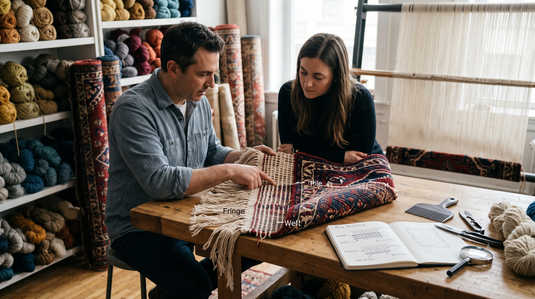
A hand-knotted pile rug contains surface yarn tied into a foundation formed by warp and weft threads. The warp runs lengthwise on the loom, while weft threads cross it and help secure rows of knots. The ends of the pile yarn create the surface after cutting and finishing. How those yarns are arranged is the basis of the knot terminology.
The foundation fibre may differ from the pile fibre. A wool pile rug can use cotton or another material in its structural threads. Ask the seller to distinguish those parts in the specification. A statement about soft wool on the face is not enough to explain how the complete rug should be cleaned, stored or inspected for damage.
Before comparing knot names, confirm that the product is actually hand-knotted. Hand-tufted rugs introduce yarn through a supporting cloth and commonly secure it with adhesive and backing; flatweaves are constructed without the same raised knotted pile. Our construction comparison helps separate those methods before you look at finer technical details.
The symmetrical knot, often called Turkish or Ghiordes
In a symmetrical knot, the pile yarn wraps around two adjacent warp threads so that the two ends emerge in a symmetrical arrangement. The Carpet Export Promotion Council illustrates this structure in its carpet production guide. Turkish and Ghiordes are commonly used names for it, but the structure is used beyond a single country.
The word symmetrical describes the knot itself. It does not mean that the whole design must be symmetrical, that the rug will be perfectly rectangular or that every knot is visually identical. A weaver can use this structure to make many kinds of patterns. Shape and pattern depend on the overall design and manufacturing process as well as the individual knot.
For a buyer, the useful question is how this rug is specified and finished. Ask about the yarn, foundation and expected use, then inspect the actual surface and reverse. Avoid choosing purely because a sales description calls the knot stronger than every alternative. A well-made rug is the result of the entire structure, and condition still matters when examining an older piece.
The asymmetrical knot, often called Persian or Senneh
An asymmetrical knot wraps the pile yarn around one warp thread and passes it beside the neighbouring thread in an open arrangement. The opening can face either direction. Persian and Senneh are names commonly associated with this technique. These names describe a structural convention; they should be separated from a documented statement about the rug's country of manufacture.
This knot appears in rugs from several weaving traditions. It can support detailed designs, but detail also depends on the fineness of yarn, spacing, drawing and skill. It is misleading to say that every rug with an asymmetrical knot will have finer decoration than every symmetrical example. Compare the finished products rather than treating a technical possibility as a guaranteed result.
If the design has small flowers, fine outlines or dense drawing, look at whether those elements are clear in the actual rug. View the reverse as well as the face and request a close photograph with a scale reference. What matters is the execution you are purchasing, not a general statement that a named knot makes all patterns superior.
Tibetan knotting uses a different arrangement
Tibetan knotting is commonly described through the use of a rod placed in front of the warp during weaving. Yarn is worked around the warp and rod, and the resulting loops are cut to form the pile. This differs from imagining every surface unit as the same two-warp knot used in the preceding descriptions.
The construction can produce a distinctive surface and is used for a range of modern and traditional-inspired designs. That does not make every Tibetan-knotted rug thick, minimalist or suitable for the same level of traffic. Pile height, yarn choice and finishing vary. You still need the exact specification and care instructions for the item you are considering.
The technique's name is also separate from provenance. A modern rug described as Tibetan-knotted may have been made in another documented weaving location. Ask where the rug was manufactured and what the seller means by the term. A clear answer should distinguish the technique, the design inspiration and the actual production history instead of combining them into one attractive label.
Knot structure, density and design are separate questions
Structure asks how the yarn is tied or worked. Density asks how many knots are present within a stated area. Design asks what the weaver is making. These properties are connected in production, but they are not interchangeable. A geometric design may intentionally use a different scale and construction from an intricately drawn floral one.
KPSI means knots per square inch. It can help compare similar hand-knotted products when the counting method is clear. It is not a complete durability score, and it should not be compared casually with pile weight or tuft density on a differently constructed rug. Those figures may measure different things even when they all appear in a product specification.
Read our KPSI and knot density guide before using a number to make a buying decision. A rug with fewer, larger knots can be a deliberate design choice. A high count cannot compensate for poor condition, an unsuitable fibre or a rug that does not fit your furniture layout.
Why the reverse is useful but not conclusive
A clear view of the reverse can show the woven pattern, rows and parts of the foundation. It is often more informative than a single styled room photograph. Ask for the full reverse, a close detail and an edge view. Together they provide a better starting point for discussing construction than one magnified patch without context.
Counting or identifying knots from a photograph can still be difficult. Depressed warp, finishing, camera angle and image resolution can complicate what you see. A buyer should not claim an exact technical attribution from an unclear image. If the seller advertises a density or knot type, request its documented measurement or explanation rather than guessing from pixels.
The reverse also cannot independently establish antique age or country of origin. A visible handmade structure may support one part of an assessment, but provenance needs other evidence. Our handmade rug identification guide explains how construction clues fit into a wider set of questions.
The yarn matters as much as the label
Two rugs using the same knot may feel very different because their pile yarn differs. Wool, silk and regenerated cellulose fibres have different handling and care considerations. A blend adds another layer of detail. Ask for the actual fibre percentages and whether those percentages describe the pile, the foundation or the complete rug.
Avoid using shine as a home test for silk. Lighting, finishing and several different fibres can produce a reflective surface. Likewise, softness does not prove a specific wool origin. A tactile sample is useful for comfort and colour decisions, while material identity should be supported by the product information and an accountable seller.
For a busy room, start with your expected traffic and maintenance routine. Browse hand-knotted rugs and verify each listing's materials and dimensions. Choosing a technically interesting construction still needs to lead to a product you can use comfortably and maintain according to its stated requirements.
Finishing changes how the rug looks and feels
After weaving, washing, shearing and other finishing processes influence the completed surface. The same knot structure can therefore appear smooth, textured or more sculpted in different products. A manufacturer's description of the finish is relevant when comparing a sample with a photograph or judging how a design will look in your room.
Do not confuse intentional texture with uneven wear. In a new rug, variations may be part of the design and should be explained in the specification. In an older rug, thinning or an exposed foundation needs a condition assessment. Ask what is intentional and what is damage, especially when a vintage piece is described through a romantic story rather than clear photographs.
Viewing direction is another factor. Pile can reflect light differently when seen from opposing ends. Turn a sample or move around it before choosing the final orientation. The knot name will not predict how a particular colour looks beside your sofa in morning light, so the room test remains important even after the construction questions are answered.
Repairability depends on more than the knot
A specialist may be able to repair parts of a hand-knotted rug by working with its foundation and pile. The practicality of that repair depends on the extent of damage, the availability of suitable yarn, the original construction and the condition of the surrounding area. No knot type guarantees that every damaged rug can be restored economically.
For an older purchase, request photographs of the ends, side edges and any previous repair. A neat face can hide an altered fringe or a weakened foundation. Ask whether repairs are disclosed in writing and whether the asking price reflects the condition. If the rug is valuable or its attribution is important, an independent assessment can clarify issues a general retail description cannot.
Use our rug repair guide to describe the area that needs attention. Avoid cutting fringe, pulling an exposed strand or applying household glue as a test. Those actions can change the evidence a repairer needs and make a manageable problem harder to address.
Compare two rugs through a room example
Imagine two wool rugs with similar colours for a living room. One uses symmetrical knots and a bold geometric pattern; the other uses asymmetrical knots and a finer floral drawing. The floral rug may show more detailed linework, while the geometric rug may suit the furniture and room scale better. The right choice is not settled by naming one knot superior.
Measure the sofa group and check where the main design will remain visible. A large coffee table might cover the floral centre but leave the geometric border exposed, changing how each rug works in the room. Then compare thickness, care, sample colour and total budget. Include a suitable pad and any delivery or professional cleaning requirements in that budget.
A Tibetan-knotted alternative could be equally appropriate if its dimensions, material and finish meet the same practical needs. The comparison becomes useful when you assess all three against one measured room. Otherwise, knot terminology can distract you from the most obvious reason a rug might disappoint: it is the wrong size or construction for how the space is used.
Questions worth asking before purchase
Ask the retailer to confirm the construction, knot terminology, pile composition, foundation materials and actual manufacturing location. If density is advertised, ask how it was measured and whether it applies across the design. Request the care instructions and clarify what is included in the stated dimensions, especially where the fringe changes the total length.
For a vintage or antique piece, add questions about attribution, age evidence, condition and repairs. For a new custom order, ask for drawings, tolerances and finishing details before approving production. Keep the answers with the invoice and photographs. That record is useful later when discussing cleaning, insurance, relocation or a repair enquiry.
Persian, Turkish and Tibetan knot names are helpful when they describe real construction accurately. They become misleading when they are used as shortcuts for guaranteed origin, prestige or durability. Learn the structure, verify the specification and judge the completed rug against your room. That is a more dependable buying approach than choosing on the strength of a knot name alone.