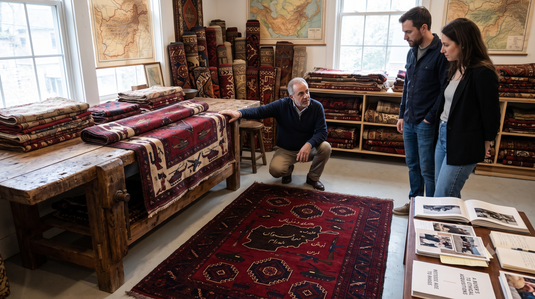
Afghan war rugs are textiles in which images associated with conflict appear alongside or within a woven design. They may include weapons, aircraft, vehicles, maps, writing or recognisable events. Their significance comes from the relationship between craft and modern history, but that relationship is not simple. A rug can involve displacement, commercial demand, borrowed imagery and individual decisions that are not fully recorded.
This is an educational guide to the category, not a recommendation to treat conflict imagery as a fashionable accessory. It also does not imply that The Ambiente sells Afghan war rugs. Understanding the genre can improve the way we discuss all handmade textiles: with attention to makers, evidence, condition and the limits of what a pattern alone can tell us.
The historical context needs careful language
The British Museum's War rugs: Afghanistan's knotted history places the genre within Afghanistan's recent conflicts, including the Soviet invasion in December 1979. The museum also discusses how conflict affected weavers through displacement, disrupted production and changing markets. That context is essential to understanding why these textiles should not be discussed only through colour and decoration.
It is tempting to describe every war rug as a direct personal account by its maker. That may be an interpretation, but it should not be assumed when the maker and circumstances are unknown. Workshops, dealers and buyers can influence designs too. A textile's imagery and its maker's intention are related questions, not automatically the same piece of evidence.
Use language that preserves those distinctions. Say that a rug depicts a particular motif when that motif is visible. Say that a museum or researcher interprets it in a certain way when the meaning is an attribution. Avoid giving an anonymous maker a precise political position or personal history that has not been documented.
War rugs are not the whole of Afghan weaving
Afghanistan has a much broader textile history than this one genre. Traditional patterns, varied constructions and different weaving communities should not disappear behind the attention given to military imagery. A war rug is one category within that wider field, and the term does not describe every Afghan carpet or every textile made by an Afghan weaver.
The same caution applies to terms used by dealers for groups or regions. A broad commercial label can conceal considerable variation. Ask what the seller means by an attribution and how it is supported. A name may refer to a stylistic classification, a production community or the location in which a textile was acquired.
For broader design context, our tribal rug pattern guide discusses why motifs should be interpreted carefully. Learning about war rugs should expand your understanding of craft and history rather than reduce a whole weaving culture to images of conflict.
Motifs can change without changing the entire structure
Some war rugs combine familiar repeated arrangements with military objects inserted into the pattern. Others use pictorial scenes or maps more prominently. Looking at the layout helps you see whether the imagery forms a border, fills the field or organises the whole composition. Those differences affect how the object communicates visually.
A repeated shape is not always immediately recognisable from a small online image. Ask for detailed photographs before describing it confidently as a particular weapon or vehicle. Stylisation, wear and the limitations of the drawing can make identification uncertain. If a museum catalogue uses cautious wording, preserve that caution rather than replacing it with a more dramatic story.
The design should be considered with the text, materials and documented history. One motif by itself rarely settles when or where the rug was made. A military object may remain in later designs, and older imagery can be reused. The date of a depicted event is therefore not automatically the manufacturing date of the textile.
Maps and inscriptions deserve separate attention
Maps can carry labels, borders, landmarks or symbols that require contextual reading. They are not necessarily accurate geographical documents. A woven map may reflect a supplied design, a commercial convention or a particular interpretation. Discuss what is actually visible before making claims about the maker's purpose.
Writing presents similar challenges. A date, place name or slogan needs an accurate transcription and translation. Ask who has read it and whether the explanation is documented. An unfamiliar script should not be treated as decorative proof of authenticity. If the inscription is central to a historical attribution, consult someone with relevant expertise.
Keep photographs and written explanations together. If two sources interpret an inscription differently, record the difference instead of silently choosing the more attractive account. That approach may seem less dramatic than a simple sales story, but it gives the buyer a more honest basis for understanding the object.
Provenance is more than a country name
Provenance concerns the recorded history of an object, including ownership and acquisition. A listing that says Afghan is not a complete provenance record. Ask where and when the rug was acquired, what is known about the maker or workshop, and whether any previous documentation accompanies it. The answer may remain incomplete, which should be stated plainly.
The British Museum's record for rug 2010,6013.25 illustrates the value of cautious attribution: its discussion considers Afghanistan and production in refugee settings in Pakistan rather than treating the visible imagery as conclusive proof of a single manufacturing location. An individual museum record is useful precisely because it distinguishes evidence from uncertainty.
Modern national labels, maker identity and actual production location can differ, especially where displacement is involved. A seller should explain which claim is being made. Avoid treating uncertainty as a reason to invent a more definite origin. It can be an important part of the textile's recorded history.
Construction and imagery are different classifications
War rug describes a subject category, not one mandatory construction. A buyer should separately ask whether the textile is hand-knotted, flatwoven or made through another method. The surface can look different depending on that construction, and the method affects handling, support and cleaning considerations.
The British Museum's record for rug 2010,6013.34 identifies a kilim example. That is a useful reminder not to assume that every war rug has the same knotted pile structure. The pattern category and the weaving method need separate descriptions.
Our construction comparison and kilim guide explain the broader differences. Those practical distinctions remain important even when the historical imagery is the main reason someone studies or collects a textile.
Materials cannot be established from a photograph alone
Ask for the pile, foundation and any backing materials. Wool may be common in many handmade textiles, but a broad genre name does not guarantee a specific fibre composition. Shine, softness and colour are not reliable substitutes for product information or an appropriate specialist assessment.
Dyes and previous treatments also matter. A historical textile may have been cleaned, repaired or exposed to conditions that affect its present behaviour. Do not assume that a material was dyed naturally because a seller describes the design as traditional. A claim about dye identity needs its own evidence.
Our natural and synthetic dye guide explains why dye categories should not be turned into simple promises about colourfastness or quality. For an older collectible textile, appropriate assessment should come before any unfamiliar cleaning treatment.
Condition should be documented plainly
Request photographs of the complete face and reverse, both ends, long sides and any damaged or repaired areas. A strongly coloured design can draw attention away from thinning pile or weakened edges. The historical story should never replace a clear condition report.
Ask whether the dimensions have changed through repair or trimming, whether the fringe is original or replaced, and what restoration is known. Wear may be compatible with the object's history, but it still affects how the textile can be used. A piece suitable for display may not be appropriate for daily foot traffic.
For a valuable purchase, seek independent expertise suited to the object. Our handmade rug repair guide introduces the kinds of structural problems that need attention. It should not be used as a home method for authenticating or restoring a historically significant textile.
Ethical buying questions should be specific
Ask what the seller can document about the supply chain, maker payment and production conditions. Broad statements such as supporting artisans should be backed by a clear explanation of the actual arrangement. A moving story or an attractive photograph does not establish how the purchase benefits the people who made the textile.
Be especially careful with claims that a design represents an individual survivor's experience. If the maker is unnamed and the account has no source, it may be a marketing interpretation. Respect for the maker includes avoiding invented biography as well as asking about responsible sourcing.
Our ethical handmade rug buying guide provides a broader set of questions. The appropriate level of confidence should follow the available documentation. If the answers remain vague, keep that uncertainty in the decision instead of treating the seller's intention as proof.
Display requires sensitivity as well as technique
Consider why you want to display the textile and how visitors may understand its imagery. Weapons and scenes of conflict can carry different associations for different people. A historical display may benefit from a short factual explanation, while a casual decorative setting may leave the meaning unexplained or appear to trivialise it.
Let the object be viewed without adding an invented interpretation. A label can state the documented materials, approximate date, attribution and source of the information. Where a detail is uncertain, say so. An honest description can make the display more informative without speaking on behalf of an unknown maker.
For physical installation, consult an appropriate textile specialist when the object is old or valuable. Avoid nails through the body, adhesive directly on the fibres and a few concentrated hanging points. The wall rug guide explains the general placement and support questions to raise before choosing a mounting method.
Care should protect both the textile and its information
Do not begin with a generic washing recipe. Age, construction, dyes, repairs and condition can change what treatment is suitable. A qualified cleaner or conservator can assess those factors and explain what results are realistic. Cleaning should not erase or disturb an inscription or a fragile structural area.
Keep documentation, photographs and treatment records with the object. Record any work done and retain the details of the specialist involved. This is useful for future care and prevents an alteration from becoming an unexplained part of the rug's history. Storage should also follow advice appropriate to its condition.
If you want a rug for normal household traffic, choose through practical room needs separately from collecting interests. You can explore hand-knotted rugs for contemporary shopping, checking individual specifications. That collection does not imply availability of war rugs or establish a connection with the historical objects discussed here.
Compare the object with the listing
On arrival, compare the textile with the saved listing before installing or cleaning it. Check its measured body, inscriptions, disclosed repairs and the condition of the reverse. Photograph any difference and raise it with the seller promptly through the agreed purchase process. Do not attempt a repair to make an unexpected problem disappear before discussing it. For a collectible object, the accuracy of the description matters alongside appearance, and a clear record gives both parties a more useful basis for resolving a discrepancy than an informal impression of the front.
A careful approach to value
Historical interest, scarcity, condition and documentation can affect a seller's price, but no general article can establish the value of an individual war rug. Avoid promises that a purchase will appreciate or that museum attention makes every example an investment. Personal interest and a collecting budget are different from a guaranteed financial return.
Compare documented examples and ask what supports the attribution and asking price. Include any required conservation, mounting and storage costs. If you are primarily seeking a comfortable floor rug, keep that practical requirement separate from the desire to own a collectible object. One textile does not necessarily satisfy both roles.
Afghan war rugs deserve attention because they bring difficult modern histories into a traditional textile medium. Studying them responsibly means looking beyond the dramatic motif to the construction, maker, market and evidence. Ask careful questions, preserve uncertainty where it exists and allow the documented object to tell a more complex story than a simple decorative or investment claim.