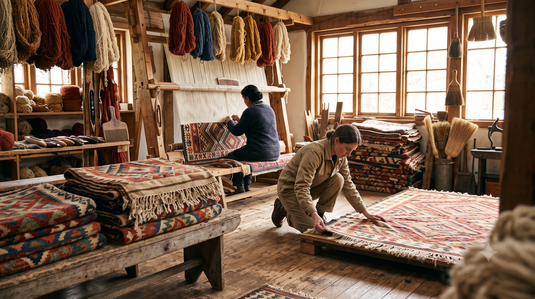
Kilim and handloom rugs are often grouped together when people shop for handmade textiles, but the terms answer different questions. Kilim identifies a flatwoven rug tradition and structure. Handloom describes production on a manually operated loom and can refer to several kinds of woven floor covering. Understanding that distinction helps you compare products without expecting every handmade rug to look or behave alike.
This guide explains how kilim weaving differs from pile carpets, how to assess a handmade claim and what handloom construction can offer. It also sets out a careful maintenance approach. A low-profile rug may look simple, but its dyes, yarns, edges and woven structure still need appropriate treatment.
What exactly is a kilim rug?
A kilim is a flatwoven textile associated with several weaving traditions, including those of regions in and around Anatolia, the Caucasus and Iran. The surface is created by interlacing yarns rather than building the cut pile found on many knotted carpets. It is generally relatively flat, although individual pieces can include supplementary decorative techniques.
The warp forms the lengthwise framework and the weft travels across it. In many kilims, coloured wefts make the visible design. The resulting textile can have a clear graphic appearance, with shapes that follow the possibilities of the weave. Not every kilim has the same fibre composition, age, origin or decorative vocabulary.
For a documented museum example, the Metropolitan Museum of Art's kilim record illustrates how a specific textile is described through origin, materials and technique. A museum example provides context; it does not authenticate a rug that merely resembles it online.
How does slit-tapestry weaving work?
In slit-tapestry construction, wefts of different colours turn back within their own design areas rather than continuing across every warp. Where adjoining colour areas do not interlock, a small slit can form between them. The placement and length of these joins are part of the structure and design.
That construction helps explain why many kilims have stepped or geometric outlines. The drawing is made through the woven colour areas, rather than printed onto an already completed surface. However, kilim is not a promise that every piece uses the same joining method, and other flatwoven techniques can create different effects.
A slit that belongs to the original weave should not automatically be treated as damage. An enlarging opening, broken yarn or stressed area is a different question. If you are unsure, ask a knowledgeable seller or textile specialist to distinguish intended construction from wear before attempting a repair.
Kilim versus a knotted pile carpet
A knotted pile carpet has knots attached to its foundation, creating a surface above the warp and weft. The pile can be clipped and finished to produce the intended texture. A kilim's flatter woven surface does not have that same layer of knotted pile.
The difference affects feel and appearance. A kilim can look crisp and graphic and may be easier to place where a low profile is desirable. A pile rug can provide a different level of softness and visual depth. Neither structure is automatically better; the room and the particular product determine suitability.
Knot density is not a useful quality measure for a kilim because it is not a knotted pile rug. Ask about fibre, weave, finishing, condition and intended use instead. Compare flatwoven rugs with pile options while keeping those construction differences clear.
Is every flatweave a kilim?
No. Flatweave is a broad construction category, and kilim belongs within a wider world of flatwoven textiles. Dhurries and other woven floor coverings have their own traditions and descriptions. A seller should use a specific term accurately rather than treating every low-profile rug as a kilim.
Some modern products use a kilim-inspired design while being produced by a different method. That can be a legitimate decorative choice when it is clearly described. The issue is whether the listing separates appearance from construction and origin, so you know what you are buying.
Ask for the method, complete material composition and place of manufacture. A photograph of a geometric pattern answers none of those questions by itself. A product with a printed kilim-style motif should not be compared as though it were an old handwoven textile.
How can you tell whether a kilim is handmade?
Start with disclosure. Ask the seller whether the rug is handwoven, machine woven or printed, and request clear photographs of both sides, edges and finishing. For a higher-value piece, seek written item-specific information about origin and condition.
Small variations in spacing, drawing or tension can be consistent with handwork. They are clues rather than proof. Machine-made rugs can imitate an irregular aesthetic, and accomplished handweaving can be very regular. Do not make the decision from one uneven line or a claim that all handmade rugs must be imperfect.
Look for a coherent woven structure and ask the seller to explain the photographs. Backing layers or attached fringes may need further discussion, but they are not a complete authentication test. If a handmade claim substantially influences the price, consider an independent assessment rather than relying on a few online images.
Handmade, authentic, vintage and antique are different claims
Handmade describes a method of production. Authentic might refer to construction, cultural origin or the accuracy of a seller's description, so ask what it means in the listing. Vintage and antique refer to age, which needs its own evidence. None of those terms should be used as a substitute for the others.
A newly made handwoven kilim can be a genuine craft product without being old. An old rug can have repairs, alterations or condition problems. A machine-made rug can be useful and attractive without being represented as handmade. Clear descriptions let you choose according to your priorities.
Do not assume that a named motif proves a specific origin or personal story. Designs circulate, and meanings can vary between communities and contexts. A responsible seller can distinguish documented information from interpretation. Be particularly cautious about elaborate provenance claims that cannot be connected to the actual textile.
What makes handloom carpets unique?
Handloom describes weaving on a manually operated loom. The process can produce tactile variation and a visible relationship between yarn and structure. Depending on the construction, the resulting rug may be flat or have a different surface texture. It should not be treated as a synonym for hand-knotted.
The appeal can include subtle changes in texture, tone and the way the surface catches light. Those effects can work especially well in a room where furniture and colour are restrained. The craft method is part of the rug's character, but it does not eliminate the need to assess durability and finishing.
Ask which technique is used and what the face and foundation contain. A wool handloom rug and a handloom rug with viscose may have different care requirements. Browse handloom rugs by actual specifications rather than choosing solely on the production label.
Handloom versus machine-made: compare fairly
Machine production can offer consistency and efficiency, while handloom production may provide a different tactile character and craft appeal. These are broad tendencies rather than a guarantee about quality. A poorly finished handloom rug is not automatically superior to a well-made machine-woven one.
Compare products in a similar size and intended-use category. Check composition, surface density, edge finishing, backing, maintenance and price. If one rug has a delicate decorative fibre and the other has a robust synthetic surface, the comparison involves more than manual versus machine production.
Choose the method that supports your priorities. If subtle texture and visible handwork matter, examine a handloom sample closely. If repeatable colour and a particular documented performance are more important, assess the relevant machine-made products. Our construction comparison guide explains how these methods differ.
Choosing a kilim for your room
A kilim can suit a casual seating area, a bedroom or another location where its particular construction is recommended. Measure the intended footprint and check how it will sit beneath furniture. A lower profile can be useful, but the rug still needs to lie securely without wrinkling or moving at the corners.
Consider pattern scale. Large geometric shapes can remain legible beneath a coffee table, while a detailed design may feel busier when only small sections are visible. Compare the colours with upholstery and the floor in daylight and evening light. A striking pattern should support the room's balance rather than depend entirely on a styled product photograph.
Use a suitable pad when recommended, checking compatibility with the floor and rug. A thin textile may feel more comfortable with support, but a thick pad can create an unnecessary edge. Choose the whole arrangement for the furniture and circulation pattern.
Routine cleaning without stressing the weave
Follow the maker's instructions and assess the rug's condition before choosing equipment. Remove dry soil gently with a suitable method, keeping suction and moving parts away from vulnerable fringes, loose yarns or weakened areas. Do not repeatedly pull at a section that is beginning to separate.
Check both sides when the rug can be lifted safely. Clean the floor and inspect the pad at the same time. A flat surface can still hold grit within its weave or underneath. Regular attention should remove accumulated debris without requiring forceful beating or dragging.
Old, fragile or valuable textiles need a more conservative approach than a sturdy modern rug. The Canadian Conservation Institute's surface-cleaning guidance explains why cleaning methods should reflect a textile's condition. Seek specialist advice when the structure is too weak for ordinary care.
What to do when a kilim gets wet or stained
Absorb a liquid spill promptly with a plain cloth and avoid pushing it across the weave. Do not flood the rug to rinse a small mark. Moisture can affect dyes, dimensions and the underlying floor even when the textile has little pile.
Use a compatible treatment only when the care instructions support it. Test as directed and stop if colour transfers or the weave changes. A kilim with several colours can have different dye behaviour in different areas. Do not assume a successful test on one corner proves that the entire textile is safe to wet-clean.
For an old or valuable piece, an unknown stain, or a spill that has penetrated deeply, contact an appropriate cleaner. Explain the construction and any treatment already attempted. A specialist can assess whether wet cleaning is suitable instead of applying a standard carpet process without checking.
What cleaning methods should you avoid?
Avoid machine washing unless the particular product is explicitly approved for it. A handmade description or wool composition does not make a rug machine washable. Size, dye stability, weave tension, shrinkage and finishing can all matter.
Do not use bleach, aggressive scrubbing, unapproved steam treatment or household chemical mixtures as universal remedies. Pulling on fringes or cutting loose yarns without understanding their function can also create damage. If a yarn looks displaced, ask for advice before trimming it.
Forceful beating can place stress on worn areas, and leaving a wet rug hanging by a weak edge can distort it. Cleaning should be a controlled process that considers the whole construction. A flatweave's low profile is not permission to treat it more roughly than a pile rug.
Drying, light and storage
After any approved cleaning, follow the specified drying method and ensure the textile and underlying surfaces are dry before returning the rug to use. Do not trap residual moisture between the rug, pad and floor. If the rug remains damp or develops an odour, investigate rather than masking it.
Manage prolonged direct light where practical, especially for a piece whose dyes or condition are uncertain. Rotation may distribute exposure and wear when the layout allows, but it cannot restore fading. Choose placement with both appearance and preservation in mind.
For longer storage, start with a clean, dry rug and a method appropriate to its condition. Avoid sharp folds that place concentrated stress on the weave. Check stored textiles periodically rather than assuming that wrapping them makes maintenance unnecessary. Valuable or fragile pieces may need a conservation-informed storage plan.
Repairs and wear: know when to ask for help
Loose edges, broken warps, expanding openings and damaged fringes should be examined before they worsen. A repair needs to respect the original construction. Household glue, an improvised backing or a decorative stitch can complicate later work and change the way the rug behaves.
Ask a specialist what can be stabilised and how visible the repair is likely to be. The goal may be preserving the textile for display rather than returning it to heavy floor use. A rug with meaningful age or family history can be worth retaining even when it no longer suits a busy walking route.
When buying a used kilim, request disclosure of existing repairs and wear. Look at the photographs in relation to the intended placement, and allow for any assessment or treatment in the budget. Condition should be a clear part of the purchase, not something discovered only after delivery.
A useful buying and care checklist
Confirm what the rug is: kilim, another flatweave, handloom pile or a design-inspired machine-made product. Then confirm the fibres, origin claims, dimensions, condition and care instructions. Ask for specific evidence when handmade production or age influences the price.
Finally, choose a stable placement and a routine you can follow. Kilim and handloom rugs offer different ways to bring texture and craft into a room. Understanding their structures helps you appreciate those differences while avoiding unreliable authenticity tests and cleaning shortcuts. A well-described rug in the right setting is easier to enjoy and maintain.