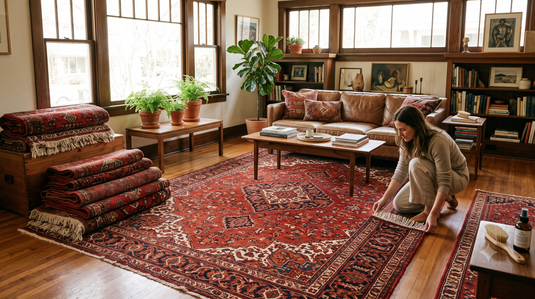
A red Persian rug can give a modern living room colour, warmth and a strong visual centre. Its pattern can soften straight furniture lines, connect timber with upholstery and introduce a sense of history. Buying one well, however, requires more than admiring the red field or counting knots.
Origin, construction, materials, condition and documentation all influence what you are purchasing. Care also needs to suit the actual piece, particularly if it is old, delicate or dye sensitive. This guide explains how to assess a Persian or Oriental rug, choose a red design for a modern room and maintain it without assuming that every traditional-looking rug has the same origin or quality.
Persian, Oriental and Persian-style: understand the description
Persian identifies a geographical and cultural origin associated with Iran. Persian-style describes a design influence and does not, by itself, establish where a rug was made. A rug woven elsewhere can use a Persian-inspired pattern while having its own legitimate origin and construction. The seller should distinguish those descriptions clearly.
Oriental is a broad historical retail term used for rugs associated with several Asian weaving traditions. It is not a precise statement of country, fibre, age or method of manufacture. When a listing uses the term, ask for the more specific information needed to understand the actual rug.
A named design is also different from a verified place of manufacture. A modern rug may use a city-style pattern without having been made in that city. Ask whether a place name describes documented origin or visual influence. This simple distinction helps prevent a decorative purchase from being represented as something it is not.
Which red Persian style suits a modern living room?
A large geometric composition can work well beside a simple sofa and clean-lined tables. Look for a balance between the pattern's scale and the size of the seating group. A strong central design can become the focal point, while a more evenly distributed pattern can support furniture without directing all attention to one area.
A medallion rug can also suit a modern room if the furniture arrangement allows the centre to remain visually meaningful. Check whether the coffee table will cover most of the medallion and whether that bothers you. An all-over design may be easier to reposition as furniture changes because it is less dependent on a particular centre.
Names such as Heriz, Tabriz or Kashan can help you explore different visual traditions, but do not treat them as a quality ranking. Actual rugs vary in palette, drawing, material and condition. Choose the particular piece whose red, supporting colours and proportions work with your room, then verify what the seller claims about its origin.
Pair red with a modern neutral palette
Red can be the room's main colour accent, especially when the sofa, walls and floor are relatively quiet. Look at the rug's secondary colours as well as the red ground. Ivory, blue, brown or green details can provide useful connections to cushions, art or furniture.
The red itself may lean towards rust, brick, burgundy or a brighter tone. Warm timber can amplify one effect, while cool grey upholstery can change another. Test the rug or a representative sample in the room's normal lighting. Screen images are a starting point, not a reliable final colour standard.
Keep the remaining patterns deliberate. A richly patterned rug does not require every cushion to be plain, but competing large motifs can make the room feel unsettled. Repeat a supporting colour rather than trying to match the entire design. Browse traditional rugs to explore the visual direction without assuming every item is Persian in origin.
Get the size right before judging the design
Measure the seating group and tape the proposed rug outline on the floor. A red rug can have a strong visual presence, so an undersized piece may look more isolated than a similarly small neutral one. Aim for a footprint that connects the sofa and chairs where the room allows.
Check practical clearances. Doors should open normally, and the rug should not create an awkward edge across the main walking route. If furniture is close to a wall, allow for the real placement rather than estimating from a photograph. Record both the usable floor area and the preferred furniture relationship.
Consider how the pattern will sit beneath the furniture. A border may be partly covered, and a central medallion may sit under a table. There is no universal requirement to display every motif. The important question is whether the visible portions produce a balanced arrangement that you will enjoy during ordinary use.
What features indicate a well-made rug?
Inspect the structure as well as the face. Look for secure edges, a sound foundation and finishing appropriate to the construction. A rug should not have unexplained weak sections or repairs hidden by a photograph. Ask for clear views of the back, edges, corners and fringes.
Consider the drawing of the design and the way the yarns form the surface. A finely detailed pattern may require a different structure from a bold geometric one. Quality should be judged in relation to what the maker intended, rather than assuming that the most intricate design is always the most durable or desirable.
Ask for complete fibre information. Wool pile, silk pile and mixed decorative sections can create different tactile effects and care needs. Foundation material matters too. A vague description such as premium natural fibre is not enough for an informed purchase. Compare hand-knotted rugs through their individual specifications.
What does knot count tell you?
Knot density can help describe the structure of a hand-knotted pile rug, particularly when considered alongside yarn thickness and design detail. It is only one characteristic. It does not automatically establish age, authenticity, durability or artistic value.
Confirm the unit used when comparing figures. Knots per square inch and knots per square centimetre are different measurements. Ask how a stated figure was assessed and whether it applies consistently across the piece. A number copied from a general collection description may not describe the specific rug.
A bold design made with thicker yarn can be well executed without an exceptionally high knot count. Conversely, a finely knotted rug can have condition problems. Inspect materials, finishing, structure and overall condition alongside density. Do not pay a premium solely for a number that you cannot connect to the actual product.
Understand what influences Persian carpet prices
Size is an obvious factor, but not the only one. Fibre quality, construction, labour, design, condition, age, documented origin and seller services can all influence the price. Two red rugs of similar dimensions may be very different products once those factors are examined.
For older rugs, repairs and wear can influence both appearance and practical use. A professional restoration may be acceptable when it is clearly disclosed, but its extent matters. Ask for a condition report where the purchase warrants one. Do not assume that an older rug is more valuable merely because it has survived.
Obtain current quotations for the exact pieces under consideration. There is no useful universal price for a Persian rug that ignores size, materials and condition. Include delivery, any specialist cleaning and a suitable pad in the budget. Personal enjoyment and decorative value should be separated from any claim about future resale.
Verify origin and provenance without overclaiming
Request an invoice that identifies what the seller is actually representing: origin, construction, fibre, dimensions and any claimed age. If there is supporting documentation, ask how it relates to the exact rug. A general certificate about the seller or collection is not necessarily evidence for a particular piece.
For an expensive or collectible rug, an independent specialist assessment may be worthwhile. This is especially helpful when origin, age or restoration materially influences the price. Online photographs and a brief chat cannot establish every detail. Be comfortable asking for more evidence before committing.
Respect the limits of motif identification. Many designs travel across regions and are adapted by different workshops. A familiar flower, medallion or border does not prove where a rug was made. For cultural background, our Persian rug history guide offers context, while the purchase decision still needs item-specific evidence.
Handmade characteristics are clues, not proof
Small variations in drawing or spacing can be consistent with handwork, but irregularity alone does not prove authenticity. A machine-made product can imitate a handmade appearance, and a skilled handmade rug can be remarkably regular. Use several observations together rather than looking for one supposedly decisive imperfection.
Back photographs can help distinguish construction, but they are not always sufficient. Attached fringes, backing layers and finishing need to be interpreted in context. A repaired edge may also look different from the original construction. Ask the seller to explain what you are seeing.
Avoid destructive home tests involving flame, harsh chemicals or pulling fibres. They can damage the rug and still produce an unreliable conclusion. If the question matters to the purchase value, obtain an appropriate assessment. Clear seller disclosure is often a more useful starting point than experimenting on the textile.
Daily care for a red Persian rug
Use a maintenance method appropriate to the piece's construction and condition. Remove dry soil with compatible equipment and avoid catching fringes or weakened areas. If the rug is delicate, old or visibly fragile, obtain advice before vacuuming it as though it were a robust modern carpet.
Inspect the places where furniture rests and where people walk repeatedly. Rotate the rug when practical to distribute use, but do not drag heavy furniture across it. Lift furniture properly and use suitable supports where needed. Monitor the edges and fringes so small damage can be addressed before it becomes more extensive.
Choose a floor-compatible pad that supports the rug without causing an awkward rise at its perimeter. Inspect the underside and floor periodically when access allows. The rug, pad and substrate should be considered as one arrangement, particularly after a spill or any professional wet cleaning.
Protect the colour from uneven exposure
Red is not a guarantee of colour permanence. Strong or uneven light can change the rug's appearance, and furniture can create a contrast between covered and exposed areas. Consider curtains, blinds or placement changes if part of the rug receives prolonged direct light.
The Canadian Conservation Institute's rug care guidance discusses protection from light and careful handling. Museum-oriented advice is particularly relevant to valuable or fragile pieces; everyday household routines should still reflect the maker's instructions and the rug's actual condition.
Rotation can distribute exposure but cannot reverse fading. Do not try to restore a pale area with a household dye or coloured cleaner. A change in colour may need specialist assessment to determine whether it is fading, staining, residue or another problem.
What to do after a spill
Remove loose solids carefully and absorb liquid promptly with a plain cloth. Work to contain the affected area rather than pushing the spill into the surrounding pattern. Do not scrub, flood the rug or apply a strong cleaner before checking compatibility.
Dye transfer is a reason to stop treatment. Some rugs have colours that react differently within the same design. An old or valuable red Persian rug may need professional help even when the spill appears small. Tell the cleaner what was spilled and what, if anything, has already been applied.
Do not assume vinegar, bleach, steam or carpet shampoo is suitable. The rug's face fibre is only part of the structure, and treatments can affect dyes, foundation and finishing. For routine wool care decisions, our wool rug cleaning guide provides a starting point; it does not replace an assessment of a sensitive piece.
When professional cleaning or repair makes sense
Seek help for persistent stains, dampness, musty odours, loose edges, damaged fringes or suspected dye instability. A specialist should be able to discuss the rug's construction, proposed treatment and drying process. Ask whether the rug needs inspection before a quotation can be finalised.
Cleaning and restoration are different services. Cleaning removes soil or addresses a spill where possible; restoration repairs structural or visual damage. Neither should be sold as a guarantee that the rug will become indistinguishable from new. Understand the expected result and limitations before approving work.
If the rug has sentimental or collectible significance, mention that when discussing treatment. The priority may be preserving original material rather than making every mark disappear. A careful decision can retain character and structural stability without pursuing aggressive cosmetic changes.
A confident buying decision
Choose the rug in a sequence: room size, visual fit, exact specification, condition, supporting evidence and practical care. Ask the seller to explain any claim that affects the price. A beautiful red design can be a worthwhile decorative purchase without an elaborate historical story being attached to it.
For a modern living room, the best red Persian or Persian-inspired rug is the particular piece that fits the seating group, complements the palette and suits the way the space is used. Precise descriptions and realistic care protect that enjoyment. They also make it easier to appreciate the rug's design without confusing appearance, origin and investment claims.
Persian rug styles for a contemporary room on a mid-range budget
A mid-range budget needs a number, a currency and a size before it becomes a useful buying brief. Decide your total spend, including a suitable pad and delivery, then shortlist rugs in the dimensions your seating group actually needs. A smaller rug with finer knotting is not necessarily better value if it leaves the sofa and chairs disconnected.
For a contemporary room, start with three visual directions: an all-over pattern with a restrained palette, a geometric medallion that works with simple furniture, or a softened traditional pattern whose supporting colours connect with upholstery. Heriz-style geometry can be a useful design reference, while more curving floral compositions may suit a room that needs softness. These are style directions, not promises of origin or price.
If an authenticated Iranian rug is beyond the budget, a clearly described Persian-inspired wool rug made elsewhere may be a practical alternative. It should be presented honestly as an inspired design, with its actual country and construction stated. You can enjoy the aesthetic without paying for an origin claim that is unsupported or irrelevant to your decorating goal.
Compare a sound, simpler wool piece with a more intricate silk-rich option. The latter can bring detail and sheen but may demand more careful placement and cleaning. For an everyday contemporary living room, construction, condition and appropriate size can matter more than elaborate drawing. Buying fewer decorative flourishes may be preferable to compromising the room layout.
For vintage rugs, include condition assessment and any necessary cleaning or repair in the budget. A low asking price is less attractive if worn edges or a weak foundation make the rug unsuitable for your traffic. Ask for a written condition description and clear back photographs before comparing an older piece with a new one.
The Ambiente offers traditional and transitional designs whose listed material, weave and price can be compared directly. Browse traditional rugs and transitional rugs with your dimensions and spending limit ready. Fair value means understanding the product you receive, rather than assuming that every Persian-style rug is imported or that the largest discount produces the best room.
A useful shortlist contains no more than three candidates: one within the preferred spend, one that offers a genuine construction upgrade, and one less expensive option in the correct size. Compare all three under the same criteria. Ask what explains each price difference, and select the rug whose appearance, evidence and care requirements justify the cost for your home.