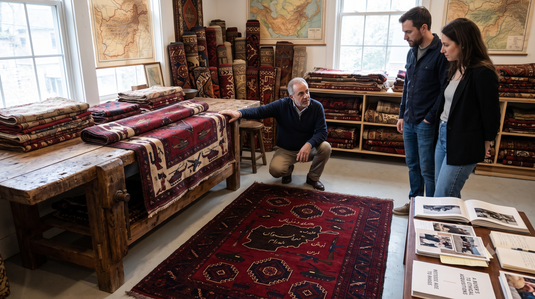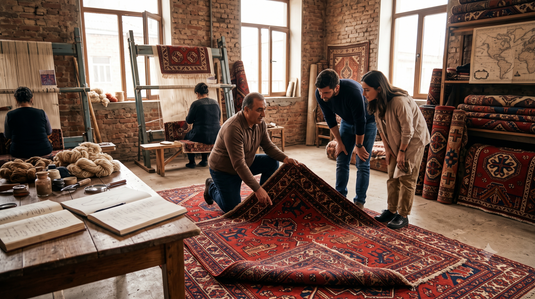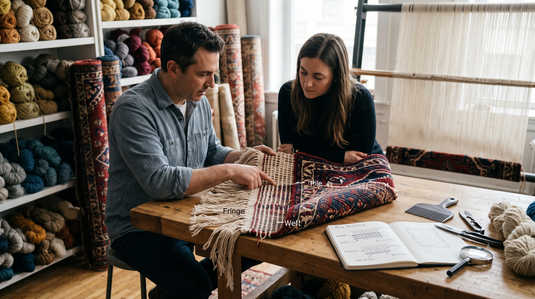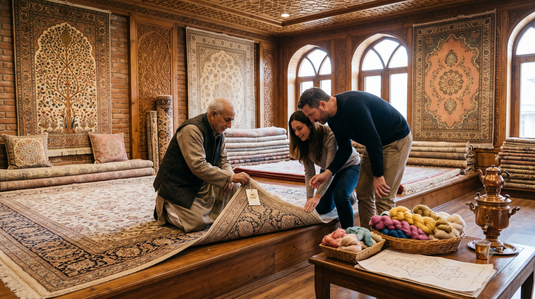
A Kashmiri carpet can be a beautiful centrepiece, but a floral design, glossy surface or expensive price tag does not establish where it was woven. Buying well means separating four questions: what the carpet is made from, how it was constructed, where it was produced, and whether its condition suits your room. Each answer should be supported by information about the individual piece rather than a general story about a region.
This guide helps you compare carpets online and in a showroom without relying on vague claims about luxury. It also explains how to judge price against material, workmanship, size and practical ownership costs. If you are comparing a Kashmir-origin carpet with other Indian handmade options, browse hand-knotted rugs for construction examples, while checking each product's origin separately. A hand-knotted carpet made elsewhere does not become Kashmiri because it uses a Persian-inspired pattern.
Start with origin, construction and style as separate facts
Kashmiri describes a connection to Kashmir; hand-knotted describes a method; Persian-inspired describes a design influence. Sellers sometimes place these words close together, which can make them sound interchangeable. They are not. A rug can reproduce an intricate floral composition through machine weaving, hand tufting or hand knotting. It can also be woven in another region while taking inspiration from historic Kashmir carpets.
Ask the seller to identify the production location in writing. Then request the construction, pile composition and foundation composition. Pile is the visible surface; the foundation is the underlying warp and weft. A silk pile and cotton foundation should not be described in the same way as an entirely silk structure. Clear descriptions make it easier to compare equivalent pieces and avoid paying for an assumption that the invoice never confirms.
How GI verification helps with authenticity
The Indian Institute of Carpet Technology, Srinagar describes a QR-based certification mechanism for hand-knotted carpets manufactured in Jammu and Kashmir. Its system allows buyers to check carpet details through the label, with an alphanumeric reference available when scanning fails. Treat this as a way to investigate the actual item being offered, rather than accepting a photograph of an unrelated certificate.
Ask for a clear label image, scan it yourself, and compare the returned details with the rug and invoice. Check the material, dimensions and identifying information that the verification record supplies. If a link opens a retailer's promotional page rather than the relevant verification service, ask for clarification. A seller saying that all its carpets are authentic is less useful than documentation that can be matched to your specific purchase.
GI verification addresses origin-related claims within its scope. It does not select the right size for your sofa, predict every maintenance cost, or guarantee that a used carpet has no repairs. Older pieces may require different evidence and specialist assessment. When documentation is incomplete, describe the uncertainty honestly and decide whether you are buying for decorative use or paying an additional premium for documented provenance.
Wool, silk and blends: choose for the room
Wool generally offers a resilient, comfortable surface suitable for everyday living, provided the construction and care instructions support that use. It has a different visual character from silk, with a softer lustre and less dramatic light reflection. A wool carpet can still carry precise motifs and sophisticated colour. Assess yarn quality, pile recovery and finishing rather than assuming that an understated surface indicates a lower-quality product.
Silk offers fine detail and reflective colour, but it needs a more considered placement and cleaning plan. A sunlit, busy dining area with regular spills creates a different ownership challenge from a quiet formal sitting room. Blends can balance appearance and cost, although the proportions and fibre identities must be disclosed. Terms such as silk touch, art silk or bamboo silk are not sufficient evidence of natural silk content.
For a busy family room, compare practical wool rugs alongside the Kashmir-origin pieces on your shortlist. Ask for sample care instructions before deciding. If the seller cannot explain how to respond to an ordinary spill without risking the fibre or dye, the attractive purchase price may conceal a difficult maintenance routine. Choose the material you can look after, rather than the one that looks most impressive under showroom lighting.
Read knot density without treating it as a score
Knot density describes how closely knots are arranged across a given area. It can help explain the precision of a drawing, but a larger number is not a complete quality rating. Yarn fineness, knotting consistency, foundation stability, finishing and the intended design also matter. Broad geometric motifs do not need the same resolution as tiny floral details, and a sturdy carpet can be valuable without winning a numerical comparison.
Request the measurement unit and method. Knots per square inch and knots per square centimetre are different scales. A statement such as very high density is not a measurement. If two sellers use different units, ask for a comparable calculation rather than attempting to judge from the size of the number. Do not compare density across fundamentally different constructions, because a tufted rug does not have the same individual knot structure.
Look at reverse-side photographs for the relationship between the pattern and structure, but avoid using one visual feature as conclusive proof. Some rugs are backed, photographed poorly or difficult to inspect remotely. The best assessment combines construction disclosure, close images, relevant documentation and an opportunity to inspect or return the item under the seller's actual policy.
Inspect condition before discussing value
New, vintage and antique carpets need different questions. For any piece, inspect the edges, ends, fringe, pile and reverse. Ask whether there are repairs, reweaving, colour restoration, stains, odours or signs of pest damage. Wear can be attractive in an older carpet, but the seller should distinguish intentional aesthetic character from structural deterioration that may continue during daily use.
Request photographs taken in ordinary light, including close views of corners and areas that look lighter or darker. Pile direction naturally changes the appearance of many rugs, so turn the rug or ask for images from opposite ends before interpreting every tonal change as fading. On the other hand, unexplained patches, brittle areas or uneven repairs deserve a closer assessment rather than a reassuring description of handmade variation.
Condition should influence placement. A fragile older rug may be suitable for controlled decorative use but poorly suited to the route between a balcony and sofa. If preservation is a major reason for buying, consult a textile or rug specialist about cleaning and display. Avoid trying to restore an unfamiliar valuable carpet with a household stain remover before its fibres and dyes have been assessed.
Understand why prices vary
Price can reflect size, fibre, labour, design complexity, condition, documented origin and the seller's services. Delivery, taxes, return costs, professional cleaning and a suitable pad also affect total ownership cost. Two carpets with similar photographs may differ substantially in foundation, yarn quality or repair history. Compare the specification and support offered, not just the visible pattern or advertised percentage discount.
Create a shortlist with the same approximate dimensions and intended use. Record the pile fibre, foundation, construction, origin evidence, condition and final payable price for each option. Ask whether the amount includes shipping and whether the exact piece shown will be supplied. If a handmade variation is expected, establish which differences are acceptable before you pay. An inexpensive substitute with undisclosed changes is not equivalent to the quoted rug.
There is no universal fair price per knot or guaranteed investment return. A carpet bought for your home should first satisfy your space, comfort and care requirements. Resale value is a separate question affected by demand, condition and provenance. For a broader comparison of design, origin and purchasing decisions, read the Persian and oriental rug buying guide.
Match the composition to a contemporary room
A central medallion can anchor a seating arrangement when the coffee table and furniture do not completely hide its structure. An all-over pattern is often easier to use when furniture covers the middle of the rug. A strong border provides a visual frame, but in a narrow room it may make an undersized rug look even more isolated. Consider the drawing in relation to the furniture footprint.
For a contemporary living room, repeat one or two quieter colours from the carpet in cushions or artwork. Let the rug carry the detailed pattern while major upholstered pieces remain relatively simple. A warm red or muted blue rug can work with modern furniture without making the room feel historical. The relationship depends on proportion, light and repetition, rather than a rule that traditional patterns require traditional sofas.
Use painter's tape to mark the proposed rug outline on the floor. Test walking routes, door clearance and how much of the design will remain visible. Browse living room rugs to compare formats, but verify the dimensions of the actual carpet rather than relying on styled photographs. A carefully chosen smaller design can still fail if it leaves every chair disconnected from the seating group.
Protect the purchase after delivery
Open the package in a clean, dry space and photograph the rug, label and packaging before discarding anything. Compare the delivered item with the invoice and verification record. Note any issues promptly within the seller's stated reporting period. This is particularly useful when buying online, where a problem can arise from transport or an incorrect item rather than intentional misdescription.
Use a floor-compatible rug pad, keep moisture away from the foundation and follow the fibre-specific vacuum guidance. Avoid aggressive rotating brushes on delicate surfaces and keep the fringe out of the vacuum head. Control strong direct sunlight where possible and rotate the rug when the room allows it. See the handmade rug care guide for a practical starting routine.
Compare two shortlisted carpets fairly
Imagine two carpets with similar floral drawings and the same approximate size. One is a new wool piece with clear construction details, documented origin and ordinary daily-care instructions. The other has a silk-rich surface, incomplete provenance and an undisclosed repair near the edge. The second may look more luminous in a photograph, but the information does not yet support a fair price comparison. Ask for the missing details before deciding that it represents better value.
Then return to your room brief. If the rug will sit under a frequently used dining table, the wool option may be easier to own even when the silk-rich piece is more visually intricate. If it is intended for a quiet formal room and the provenance questions are resolved, the second option may deserve further consideration. A good buying decision connects evidence about the carpet with the conditions in which you will actually use it.
Questions to ask before paying
Ask: Where was this exact carpet woven? What are the pile and foundation fibres? Is the construction hand-knotted? What origin documentation belongs to this piece? Are dimensions measured with or without fringe? Has it been repaired or restored? Which cleaning methods are permitted? What happens if the delivered item differs from the agreed specification? Keep the answers with the invoice rather than relying on a conversation you cannot retrieve later.
Ask about availability as well. A one-off rug cannot always be exchanged for an identical replacement, and an order made to a similar design may differ from a finished piece. Confirm whether you are purchasing available stock or commissioning production. This distinction changes the lead time, approval process and the relevance of a return policy written for standard stocked products.
Frequently asked questions
Is every floral silk carpet a Kashmiri carpet?
No. Fibre, pattern and origin are separate attributes. A floral silk carpet can be woven in more than one region. Ask for production details and evidence tied to the individual item. A decorative description may be accurate about its appearance while providing no meaningful proof of its geographical origin.
Does a higher knot count always mean a better buy?
No. Density can support intricate detail, but the best purchase also depends on fibre, construction consistency, condition, size and your room's use. A lower-density wool rug may suit daily family life better than a finer silk carpet that requires care you cannot realistically provide.
Can I identify silk by burning a loose thread?
Do not damage a carpet or perform a flame test in a shop or home. Fibre identification is better handled through reliable documentation and appropriate testing when needed. A casual test can damage the piece, produce misleading results with blends, and leave you responsible for the loss.
Does The Ambiente's hand-knotted collection prove Kashmir origin?
No. The collection identifies a construction category. Check the individual product's disclosed origin and supporting documentation separately. This guide explains how to evaluate Kashmir-origin claims wherever you shop; it does not claim that every hand-knotted rug sold by The Ambiente is a GI-certified Kashmiri carpet.
## Related room planning and care
For design comparisons, the tribal pattern guide explains why a motif does not establish origin. If you prefer a softer relationship between traditional drawing and modern furniture, explore transitional rug styling. Keep those appearance decisions separate from the documentation that supports a Kashmir-origin claim.