A transitional rug is useful when a room contains furniture from different design periods. It can connect a modern sofa with a traditional cabinet, or soften contemporary architecture without adding a strongly historical look. The term describes an approach to design rather than a fibre or construction. Most importantly, it should help you solve a real room problem, not become another vague label on a shopping list.
This guide explains how muted colours, simplified motifs and balanced contrast can work together. It covers pattern scale, furniture relationships, light, size and everyday maintenance, with practical examples for Indian homes. Browse transitional rugs to explore the category, but compare each product's drawing, materials and dimensions independently. Two rugs given the same style label can create very different results in the same room.
What is a transitional rug?
Transitional design generally sits between recognisably traditional and strongly modern approaches. A rug might retain a border or medallion while simplifying the drawing, use a classic motif in a restrained palette, or soften a geometric composition with texture and uneven colour. There is no single mandatory pattern. The useful characteristic is its ability to relate to both established decorative elements and contemporary furniture.
This makes transitional distinct from neutral. A brightly coloured rug can still combine traditional and modern elements, while a plain beige rug may be better described as solid or minimalist. Nor does transitional necessarily mean distressed. Faded effects are one possible design device, not a requirement. Look at the composition itself and ask which parts of your room it connects before relying on the category name.
Transitional, traditional and modern: a practical comparison
A traditional rug often uses a clearly defined decorative system, such as a medallion, floral field and multiple borders. A modern rug may favour abstraction, asymmetry, broad colour areas or a simplified geometric drawing. A transitional rug can borrow from either side, reducing contrast or modifying scale so the result feels comfortable alongside mixed furniture. These are design tendencies rather than rigid technical classifications.
When comparing options, identify the strongest visual feature. Is it the border, the central drawing, an abstract colour change or the surface texture? If your room already has ornate furniture, the rug may need to simplify the floor. If most furniture is plain and angular, a softened classic motif can add depth. The right decision depends on how much decoration the room already carries.
Why muted colours work in mixed interiors
Muted colours reduce the intensity of a hue without necessarily removing colour. Sage, dusty blue, warm grey, softened terracotta and faded rose can feel quieter than bright versions of the same family. They often help a rug sit between warm timber, painted furniture and different upholstery fabrics. However, muted is not a guarantee of compatibility. Undertone and contrast still matter.
A cool grey rug beside honey-toned wood can create a deliberate contrast, but may appear detached if no other element repeats the cool note. A warm greige can connect those surfaces more easily. An ivory rug with a pink undertone may clash with a yellow cream sofa. Compare samples side by side, rather than judging each item separately from an online photograph that has its own lighting and editing.
Identify the room's fixed colours first
Begin with elements you are unlikely to replace: floor, wall colour, large sofa, cabinetry and curtains. Write down their colour families and whether they read warm or cool. Then identify one dominant relationship you want the rug to support. You may want to connect a grey sofa and walnut floor, introduce colour to an ivory room, or make a traditional cabinet feel comfortable beside a contemporary chair.
Do not require the rug to match every object. A palette of two or three connected colours is usually easier to manage than one that attempts to represent the whole room. Select a base colour that relates to the largest surfaces, then an accent that can be repeated lightly. Smaller accessories can bridge the remaining difference after the rug is chosen, instead of dictating the entire purchase.
Three muted palettes to try
In a warm neutral living room, a rug combining ivory, taupe and dusty terracotta can work with oak or walnut and cream upholstery. Taupe connects the timber and fabric, while terracotta adds interest without requiring a bright red feature. Repeat the terracotta in one cushion or small artwork detail. Keep the curtains closer to the base neutral so the room does not become a collection of competing warm shades.
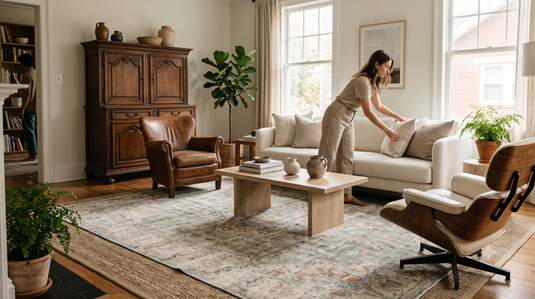
For a cool modern sofa with a traditional wood cabinet, consider greige, muted blue and a restrained warm accent. The greige connects the upholstery and timber; the blue can appear in artwork or a lamp. If the floor already has a strong reddish tone, test the warm accent carefully. A small sample can reveal whether the rug supports the floor or exaggerates a colour you hoped to quieten.
For a room with mixed cream, grey and black furniture, a soft sage and ivory rug can offer colour while retaining calm. Keep the black as a repeated outline in a frame or table leg rather than adding black to every accessory. If sage looks too cool under daylight, try an olive-leaning version. The point is to test a family of relationships rather than assume one named shade works universally.
Use pattern scale to control visual weight
Small detailed patterns can read as texture from a distance, while large motifs remain individual shapes. A softly drawn all-over pattern may sit well under a sofa arrangement because it continues around furniture. A central medallion needs enough visible space to contribute. If a large coffee table hides its main feature, consider a more distributed drawing or a different size rather than paying for detail you will not see.
Pattern contrast matters as much as scale. A large motif in similar tones can be quieter than a tiny black-and-white repeat. Examine the rug from the distance at which you normally enter the room. If the floor becomes the only thing you notice, decide whether that is your intention. Transitional styling often benefits from a balanced conversation between rug, furniture and artwork instead of a single dominant feature.
Connect modern sofas and traditional furniture
Start with shape and material. A plain contemporary sofa can sit beside a carved cabinet when the rug offers a shared colour or a softened decorative motif. You do not need to reproduce the cabinet's carving in the rug. A border, curved drawing or warm tone may be enough. Leave some space around the cabinet so that the rug does not make the arrangement look visually crowded.
If the sofa and cabinet both carry strong detail, choose a quieter rug and reduce accessory patterns. If both are plain, a transitional rug can provide the decorative layer. The geometric rug styling guide offers useful comparisons for rooms with angular furniture. Use it to assess whether a simplified geometric design would serve your room better than a softened floral one.
Measure the furniture group, not just the room
A rug should relate to the seating arrangement and circulation. Measure the sofa, chairs and coffee table in their actual positions. Mark the rug footprint with tape, then walk through the room and check door movement. One common approach is to bring the front legs of the main seating onto the rug, but the best arrangement depends on room size and furniture rather than a compulsory rule.
In an open-plan home, a rug can define one seating zone without covering the whole floor. Keep the design orientation aligned with that zone rather than with every wall in the larger space. A rug that connects the furniture can make a mixed interior look intentional even when the pieces differ. An undersized rug can make equally harmonious colours look disconnected because the layout has not been resolved.
Choose construction and fibre separately from style
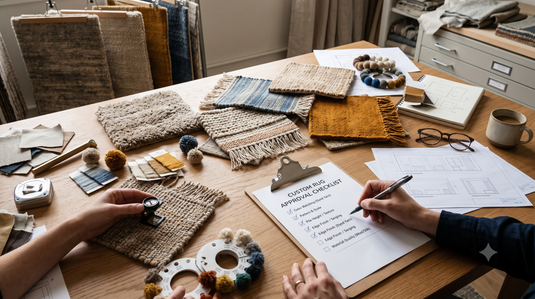
Transitional rugs can be hand-knotted, handloom, hand-tufted or machine-made. The style does not promise a particular lifespan or cleaning method. Ask for the pile fibre, foundation or backing, pile height and care instructions. Compare materials according to room use. A rug for a formal sitting area can be chosen differently from one exposed to pets, food and the main household walking route.
Wool can offer resilient comfort and a less reflective surface, while silk or viscose-rich effects may create more visible shifts under light. Blends need clear proportions and realistic cleaning advice. Browse wool rugs when comparing everyday options, and hand-knotted rugs when construction is a priority. Neither collection label replaces the specification of the exact product you order.
Check texture and pile direction in real light
A subtle palette can depend heavily on texture. Raised and lowered areas, mixed yarns or pile direction can give depth to colours that look flat on screen. Ask for a close detail and a full image from more than one direction. If possible, view the sample beside the floor and upholstery during daylight and under the lamps used at night. This is particularly useful with grey and ivory.
Pile direction may make the rug look darker from one side without indicating a fault. Decide which orientation works best from the main entrance and seating position, then check that the drawing still reads properly. Do not interpret every reflective change as fading. If a particular colour match is essential, establish the seller's sample, variation and return arrangements before purchasing a large handmade rug.
Layer accessories without creating a theme
Once the rug is in place, repeat its quieter colour in a cushion, curtain trim or artwork detail. Avoid buying a full set of matching patterned accessories. A room feels more natural when materials and shapes vary while a few colours connect them. You can mix linen, timber, metal and a textured rug without making every surface look alike.
If the room still feels unsettled, remove one item before adding another. A colourful throw or competing curtain may be the source of the problem, not the rug. Photograph the room from the entrance to see how the visual weight is distributed. Transitional design works well when each piece has a role and the palette connects them; it becomes less effective when every object is asked to attract equal attention.
Care for muted colour and surface detail
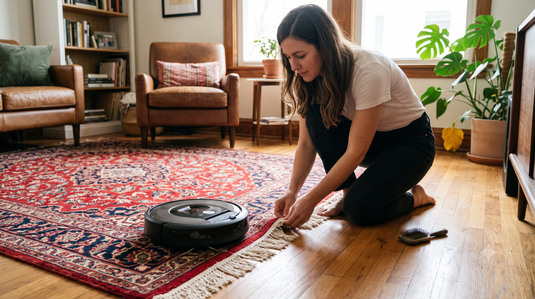
Muted patterns can disguise some everyday dust, but they do not prevent stains. Vacuum according to the product's instructions and address spills promptly with appropriate blotting. Avoid aggressive rubbing or unapproved chemicals, which can alter the pile and create a patch that remains visible even in a low-contrast pattern. Check the underside and pad after liquid reaches the rug.
Rotate the rug if the arrangement allows it and manage strong direct sunlight. A low-contrast rug may develop an obvious uneven area when only part of it is exposed. Furniture placement can also concentrate wear along one edge. The handmade rug care guide gives a starting routine, while the manufacturer's instructions should determine the exact cleaning method for your item.
Compare value through the complete specification
Ask for the final dimensions, fibre composition, construction and total payable price. Include a suitable pad and realistic cleaning costs in the budget. Check whether the rug pictured is the item supplied or an example of a made-to-order design. Handmade variations can be attractive, but the seller should explain what may change in colour, size or drawing before you place the order.
Avoid judging value only by a sale percentage or by how expensive the pattern looks. A simpler rug in a suitable construction may serve the home better than a highly decorative surface that needs specialist care after every spill. Choose a balanced combination of appearance, room fit and maintainability. The most successful transitional rug is one that connects the room and continues to work as the household uses it.
Frequently asked questions
Are transitional rugs always beige or grey?
No. They can use colour, including blue, green, rust and rose. What matters is the relationship between traditional and modern design elements. Muted colours are common because they can connect mixed furniture, but the category is not limited to neutral shades or a single palette.
Can I use a transitional rug with a traditional sofa?
Yes. Choose a rug that relates to the sofa's colours while balancing its decorative detail. If the sofa is patterned, a quieter rug may work best. Consider the cabinet, curtains and floor as part of the same arrangement rather than matching the rug to one item alone.
Is a distressed rug automatically transitional?
No. Distressing is an appearance or finishing effect, while transitional describes the overall design approach. A distressed traditional pattern may look transitional in one room, but another distressed rug may retain a strongly traditional or modern character. Evaluate the composition, colour and contrast rather than the label.
What is the best first step before shopping?
Measure the furniture group and identify the room's fixed colours. Those two decisions narrow the choices more effectively than searching broadly for a fashionable style name. Then compare samples, materials and care requirements so the rug supports both the room's appearance and its everyday activity.
## Related room planning and care
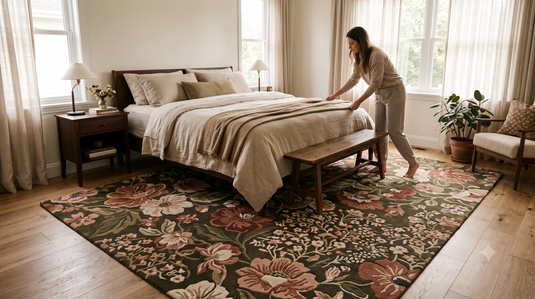
For a warm palette, read how to style brown rugs. For a bedroom with softened botanical detail, compare floral pattern scale and placement. Both guides help turn a broad style preference into a measured relationship between the rug and existing furnishings.